How Slot Games Get Certified Before Launch - A Step-by-Step Guide
Creating a visually stunning slot game with exciting features and balanced gameplay is only part of the journey toward a successful launch. Before a game can be deployed in many regulated markets, it must pass a structured certification process designed to verify that it operates fairly, securely, and consistently. Certification gives operators and regulators confidence that the game behaves according to its documented specifications and complies with the technical requirements of the target jurisdiction.
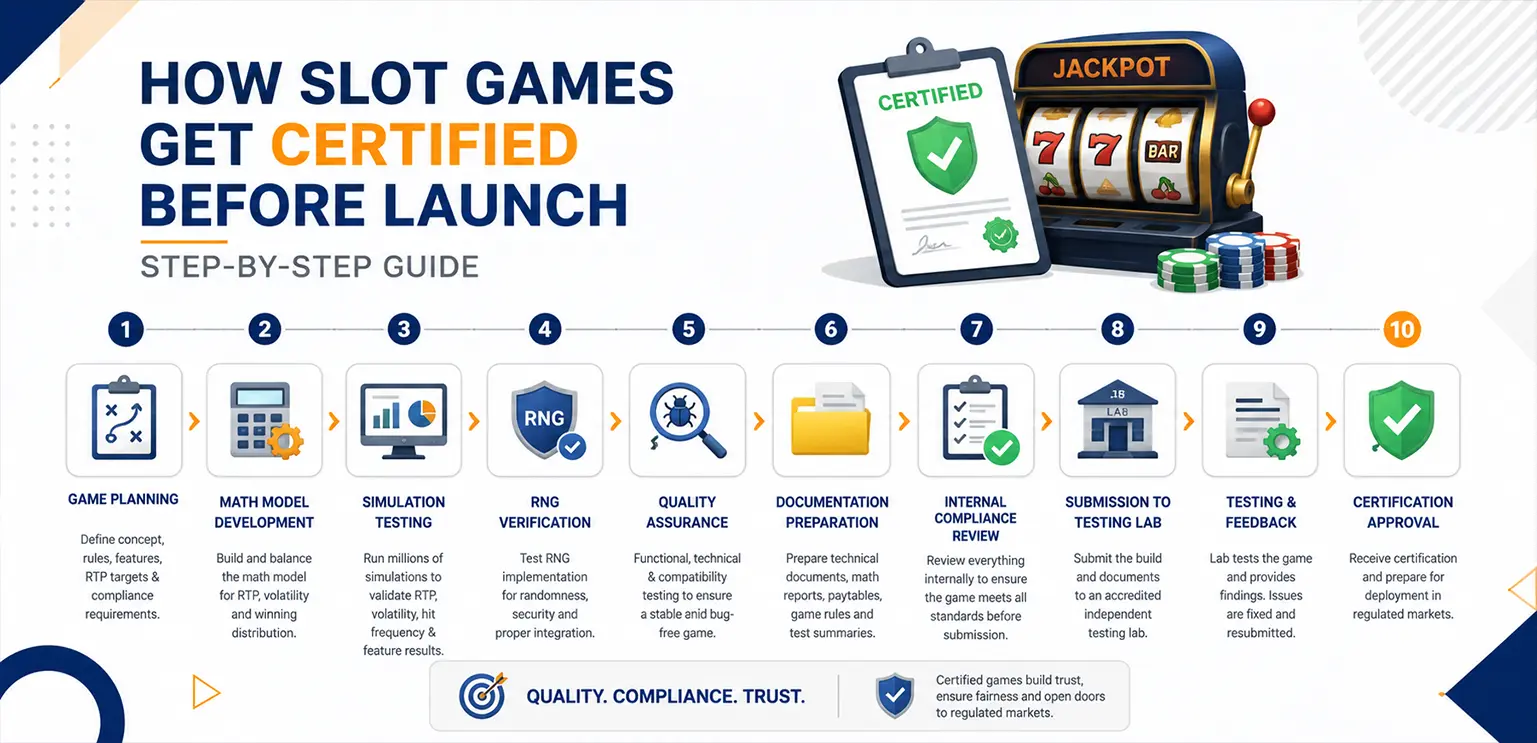
Many developers assume certification begins once development is complete. In reality, certification is the result of decisions made throughout the entire production lifecycle. Planning, mathematics, programming, simulation testing, quality assurance, documentation, security, and release management all contribute to how smoothly a game moves through external testing.
Successful slot game certification doesn't begin after development is complete—it starts on day one. Leading studios integrate certification-focused practices into every stage of production, including game planning, math model validation, simulation testing, quality assurance, security implementation, technical documentation, and compliance reviews. Although specific technical requirements differ between jurisdictions and certification laboratories, the overall development and preparation process follows a similar structured workflow across most regulated gaming markets.
Why Certification Is Required Before Launch
Regulated gaming markets require independent verification because slot games combine complex software, mathematical models, random number generation, financial calculations, and backend communication. Certification provides assurance that the software performs consistently under expected operating conditions. For operators and regulators, certification helps ensure:
- Game outcomes follow the documented rules. Every feature, payout, and gameplay mechanic should behave exactly as described in the official specifications.
- Random outcomes are generated correctly. Independent testing confirms that game outcomes cannot be predicted or manipulated through the implemented randomization process.
- Software performs reliably. Stability testing helps identify unexpected behavior, crashes, or technical issues before commercial deployment.
- Security controls are in place. Secure handling of game configurations, communication, and operational data helps reduce technical and compliance risks.
Although individual regulatory requirements differ, the overall objective is to establish confidence in the integrity of the game.
🔹 Step 1: Plan the Game for Regulated Markets
Certification begins much earlier than most people expect. During pre-production, studios define the technical direction of the project, identify the target jurisdictions, and establish the development standards that will be followed throughout production. Planning typically includes:
- Target market requirements
- Game mechanics
- Mathematical targets
- Technical architecture
- Compliance considerations
- Production milestones
- Documentation strategy
Making these decisions early reduces expensive redesign work later in development.
🔹 Step 2: Build and Validate the Mathematical Model
Before artists complete animations or developers polish user interfaces, mathematicians and game designers validate the game's mathematical behavior. The mathematical model determines how the game performs over millions of rounds rather than during a handful of manual play sessions. Developers evaluate several key metrics:
- Return to Player (RTP): The theoretical percentage returned to players over an extended period based on the game's design.
- Volatility: The balance between win frequency and win size, shaping the overall gameplay experience.
- Hit Frequency: How often winning combinations occur during long-term play.
- Bonus Contribution: Whether bonus features, jackpots, and special mechanics contribute correctly to the overall mathematical model.
Every regulated gaming market has its own certification standards, but the development and certification workflow is generally similar, ensuring slot games meet the required technical, mathematical, security, and compliance requirements before launch.
🔹 Step 3: Run Large-Scale Simulation Testing
Simulation testing is one of the most important stages before external certification. Instead of relying solely on manual gameplay, developers use automated simulation systems to execute millions—or in many projects, hundreds of millions—of virtual game rounds. These simulations help verify that long-term behavior matches the intended mathematical design. Simulation testing is commonly used to:
- Validate RTP accuracy. Long-running simulations help compare theoretical values with observed statistical outcomes.
- Analyze volatility. Developers review how wins are distributed over time and whether the player experience aligns with the intended risk profile.
- Confirm bonus performance. Automated testing verifies that bonus features behave consistently across countless gameplay scenarios.
- Identify rare edge cases. Simulations can uncover unusual combinations or logic paths that manual testing may never encounter.
While simulation testing does not replace formal certification, it significantly increases confidence before submission.
🔹 Step 4: Verify Random Number Generation
The Random Number Generator (RNG) is one of the core systems within a slot game. However, certification does not simply evaluate whether an RNG exists—it verifies that randomness is correctly implemented throughout gameplay. Internal validation focuses on:
- Proper integration with game logic
- Consistent random outcome generation
- Secure implementation
- Stable operation during extended gameplay
Reliable randomness is essential because every gameplay event ultimately depends on correctly generated outcomes.
🔹 Step 5: Perform Comprehensive Quality Assurance
Quality assurance extends far beyond identifying visual bugs. Professional QA teams examine the game from technical, functional, and production perspectives before external review. Internal QA commonly includes:
- Gameplay verification: Every feature, symbol interaction, bonus mechanic, and payout sequence is tested under normal and unusual gameplay conditions.
- Platform compatibility: The game is evaluated across supported browsers, operating systems, devices, and screen resolutions to ensure consistent behavior.
- Performance testing: Teams monitor loading times, frame rates, memory consumption, and stability during extended gameplay sessions.
- Regression testing: Previously resolved issues are re-tested after every significant update to confirm that new changes have not introduced additional problems.
Strong QA reduces certification delays while improving overall software quality.
🔹 Step 6: Prepare Technical Documentation
Documentation is often underestimated, yet it is one of the most important components of certification. Independent testing laboratories need clear technical information explaining how the software functions. Typical documentation includes:
- Game rules
- Paytable specifications
- Mathematical reports
- Software architecture
- Version history
- Configuration details
- Test summaries
Well-structured documentation speeds up technical reviews and reduces requests for clarification.
🔹 Step 7: Conduct an Internal Compliance Review
Before submitting the game for external testing, experienced studios perform their own compliance review. This internal assessment helps verify that the project is complete and that all supporting materials are ready. Teams typically review:
- Build stability
- Documentation completeness
- Configuration accuracy
- Version consistency
- Security implementation
- Outstanding issues
Finding problems internally is considerably less expensive than discovering them during formal certification.
🔹 Step 8: Submit the Game to an Independent Testing Laboratory
Once internal validation is complete, the game is submitted to an accredited independent testing laboratory. Depending on the target jurisdiction, developers may work with organizations such as Gaming Laboratories International (GLI), BMM Testlabs, eCOGRA, or other recognized testing bodies. The testing laboratory reviews the game to ensure it meets the technical standards and regulatory requirements of the target market. Although the evaluation process varies by jurisdiction, it generally includes a detailed assessment of game logic, mathematical models, software stability, security, technical documentation, and overall compliance.
🔹 Step 9: Resolve Findings and Complete Verification
It is common for testing laboratories to request clarifications or identify issues that require attention. This does not necessarily indicate poor development quality. Many projects receive observations that need to be addressed before final approval. Developers typically:
- Review laboratory findings
- Correct identified issues
- Update documentation where required
- Submit revised builds for verification
- Confirm that corrections have resolved the reported findings
Clear communication between development teams and testing laboratories helps streamline this stage.
🔹 Step 10: Receive Certification and Prepare for Launch
After completing the review process, the game receives certification according to the applicable standards and jurisdictional requirements. Certification allows operators and platform providers to proceed with deployment where the relevant approvals are accepted. Before launch, studios typically complete final activities such as:
- Deployment verification
- Operator integration
- Platform configuration
- Final production testing
- Release planning
At this stage, the focus shifts from certification to delivering a stable launch experience.
Common Reasons Certification Is Delayed
Many certification delays result from preventable development oversights rather than complex technical problems. Some of the most common challenges include:
- Incomplete documentation, making it difficult for reviewers to evaluate the software efficiently.
- Limited simulation testing, leaving mathematical behavior insufficiently validated before submission.
- Weak version control, creating confusion about which build is being evaluated.
- Late compliance planning, forcing teams to redesign features after development is largely complete.
- Inconsistent QA coverage, allowing defects to reach external testing.
Addressing these areas throughout development greatly improves certification readiness.
How AI Is Improving Certification Preparation
Artificial Intelligence is increasingly helping studios automate repetitive compliance-related tasks. AI is commonly used to support:
- Documentation organization
- Regression testing
- Log analysis
- Code review assistance
- Test case generation
- Workflow automation
Although AI improves efficiency, independent certification still relies on expert review and formal testing procedures.
Why Structured Production Pipelines Matter
Certification-ready games are rarely the result of last-minute preparation. They are the outcome of disciplined production pipelines that integrate planning, engineering, testing, documentation, and quality assurance from the beginning. Studios that follow structured workflows benefit from:
- Better collaboration between development teams.
- More consistent software quality.
- Faster issue resolution.
- Improved documentation accuracy.
- Greater confidence before external submission.
Companies such as Gamix Labs build certification-ready slot games by combining mathematical validation, simulation testing, production-ready development practices, structured QA workflows, technical documentation, and engine-ready implementation into a streamlined production pipeline.
Best Practices for Faster Certification
Studios with successful certification records typically follow a consistent set of development practices. These include:
- Plan for certification during pre-production. Early planning reduces costly changes later in the project.
- Validate mathematical models with extensive simulations. Large-scale automated testing provides confidence before external review.
- Integrate QA into every milestone. Continuous testing identifies issues long before certification begins.
- Maintain accurate documentation. Up-to-date technical documents simplify the review process.
- Use disciplined version control. Clear build management improves traceability and reduces confusion.
- Treat compliance as an ongoing workflow. Certification is most efficient when quality and compliance are embedded throughout development rather than added at the end.
Conclusion
Slot game certification is not a single event that occurs just before launch—it is the culmination of disciplined planning, mathematical validation, simulation testing, quality assurance, documentation, and compliance-focused development practices. Every stage of production contributes to how smoothly a game progresses through independent review and reaches regulated markets.
Studios that build certification into their production pipelines from the beginning are better equipped to reduce delays, minimize costly revisions, and deliver reliable, high-quality games to operators and players alike. By treating certification as an integral part of development rather than a final hurdle, teams can streamline launches and establish stronger long-term relationships with platform providers and regulators.
FAQ: How Slot Games Get Certified Before Launch
How long does the slot game certification process take?
The timeline varies depending on the jurisdiction, testing laboratory, project complexity, documentation quality, and whether issues are identified during the review.
Is simulation testing the same as certification?
No. Simulation testing is an internal validation process used to verify mathematical behavior before external certification.
Does every regulated market require the same certification process?
No. Requirements differ by jurisdiction, although many technical principles—such as mathematical validation, QA, documentation, and security—are broadly similar.
Can a game fail certification?
A testing laboratory may identify findings or request revisions before approval. Addressing these issues and resubmitting updated builds is a normal part of many certification workflows.
When should certification planning begin?
The most effective approach is to consider certification requirements during pre-production and integrate compliance into every stage of development.