How Bonus Features Affect Slot Game RTP and Volatility
Bonus features are one of the biggest reasons players stay engaged with modern slot games. Features like free spins, wild multipliers, cascading reels, respins, and bonus rounds add excitement, create memorable moments, and make gameplay feel more dynamic than simply spinning reels. However, from a game development perspective, bonus features serve a much larger purpose than entertainment.
Every bonus mechanic directly influences the mathematical foundation of a slot game. It affects how the game's Return to Player (RTP) is distributed, how volatile the gameplay becomes, how often players experience significant wins, and how the overall game feels during both short and long sessions.
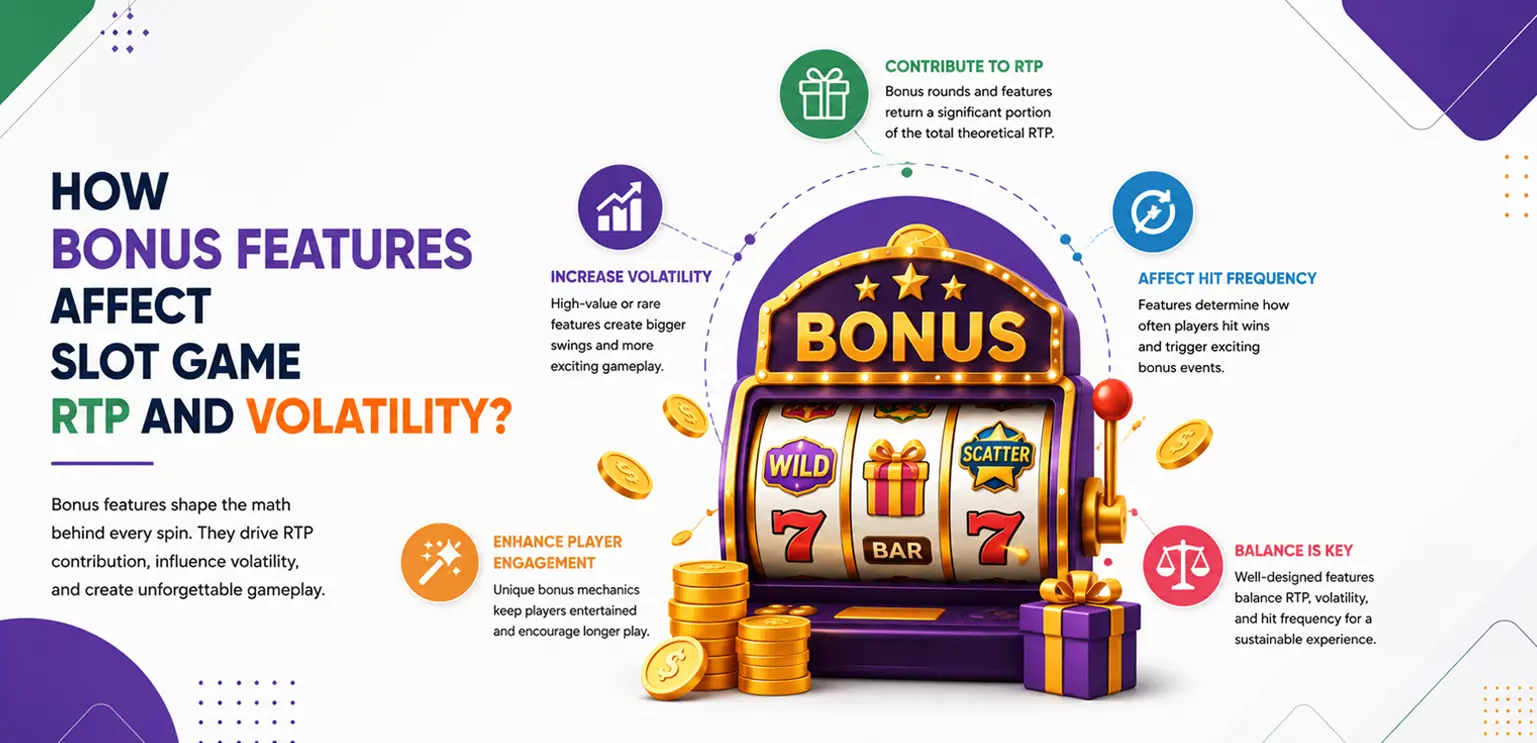
A common misconception is that developers add bonus features after the base game is complete. In reality, experienced slot studios design bonus mechanics alongside the mathematical model. Every free spin, multiplier, expanding wild, or jackpot is carefully balanced to ensure the game achieves its intended RTP while delivering the desired player experience.
This guide explores how bonus features affect RTP and volatility, how developers balance these mechanics, and why extensive simulation testing is essential before a slot game reaches certification and launch.
Why Bonus Features Matter in Modern Slot Games
The earliest slot games relied almost entirely on base game wins. Today's players expect richer gameplay that offers progression, anticipation, and rewarding moments beyond standard symbol combinations. Well-designed bonus features contribute to a game in several important ways:
- Increase player engagement: Interactive features break the repetitive nature of continuous spins by introducing new mechanics and rewarding experiences.
- Create gameplay variety: Different bonus systems keep sessions fresh and encourage players to explore the full game.
- Differentiate the product: Unique feature combinations help a slot stand out in an increasingly competitive market.
- Support long-term retention: Memorable bonus experiences often encourage players to return and continue exploring the game.
From a mathematical perspective, however, every feature must be carefully integrated into the overall game model rather than treated as an isolated addition.
Understanding RTP Before Looking at Bonus Features
Return to Player (RTP) represents the theoretical percentage of total wagers that a game is designed to return over a very large number of spins. A slot game with a theoretical RTP of 96% is mathematically designed to return an average of $96 for every $100 wagered over millions of simulated game rounds. Since RTP represents a long-term statistical average, individual sessions may produce results that are either above or below the theoretical return.
One important concept developers understand is that RTP belongs to the entire game, not just the base game or a specific feature. This means the total RTP is typically distributed across different gameplay components, including:
- Base game payouts: Regular symbol combinations provide a significant portion of the overall return and establish the game's day-to-day playing experience.
- Bonus features: Free spins, respins, bonus rounds, and other special mechanics are mathematically balanced to contribute a predetermined share of the game's overall RTP, ensuring they align with the intended volatility, hit frequency, and gameplay experience.
- Special mechanics: Multipliers, expanding symbols, progressive-style features, or other advanced systems can also account for part of the total mathematical return.
Every component contributes to the final RTP target.
How Bonus Features Contribute to RTP
One of the first tasks for slot mathematicians is deciding how much of the overall RTP should be allocated to bonus mechanics. Rather than designing bonus features first, developers usually begin with the mathematical target and then distribute the RTP across the game's various systems. For example, a theoretical model might allocate:
- Base game contribution: Responsible for delivering regular wins and maintaining consistent gameplay between feature triggers.
- Free Spin Feature Contribution: Free spin rounds contribute a portion of the game's overall RTP by offering additional winning opportunities without requiring extra wagers.
- Wild and multiplier mechanics: Increase payout potential during qualifying spins while supporting the intended volatility profile.
- Special events or jackpots: Contribute a smaller but strategically important portion of the total RTP, depending on the game's design.
The allocation of RTP across the base game and bonus features is unique to each slot game, reflecting its mathematical model, gameplay mechanics, volatility targets, and overall player experience.
How Bonus Features Influence Volatility
Volatility describes how wins are distributed over time rather than how much a game returns overall. Two games can have exactly the same RTP but feel completely different because of how their bonus features are designed. For example:
- Frequent, low-value bonus features: Players trigger features more often, creating a steadier experience with regular rewards and lower volatility.
- Rare, high-value bonus features: Features appear less frequently but offer the potential for significantly larger payouts, increasing volatility.
- Layered feature systems: Games combining several bonus mechanics often create medium or high volatility by spreading rewards across multiple gameplay events.
This balance allows developers to tailor games for different player preferences while maintaining the intended theoretical RTP.
The Relationship Between RTP, Volatility, and Hit Frequency
These three concepts are often discussed separately, but they work together as parts of the same mathematical model. Changing a bonus feature can influence:
- RTP contribution: Adjusting feature payouts changes how much of the theoretical return comes from bonus gameplay.
- Volatility profile: Increasing maximum feature rewards may require less frequent triggers to maintain the same RTP.
- Hit Frequency: The frequency of bonus features is determined by the game's mathematical model, where trigger conditions, symbol probabilities, and feature mechanics are carefully balanced to deliver the intended gameplay experience.
Because these metrics are interconnected, developers rarely adjust one value without reviewing the entire mathematical model.
Common Bonus Features and Their Mathematical Impact
Modern slot games use many different feature types, each influencing gameplay in unique ways.
🔹 Free Spins
Free spins remain one of the most widely used mechanics because they provide extended gameplay without additional wagers. Mathematically, they often:
- Contribute a significant portion of the game's RTP.
- Increase player anticipation through feature progression.
- Support larger payout opportunities than the base game.
🔹 Wild Multipliers
Multipliers amplify qualifying wins and can dramatically change payout potential. Their mathematical impact includes:
- Increasing volatility when larger multipliers are rare.
- Enhancing feature value without changing every spin.
- Creating memorable high-win moments.
🔹 Respins
Respins allow players additional opportunities to improve outcomes during qualifying situations. Developers use them to:
- Extend player engagement.
- Increase excitement during near-win scenarios.
- Adjust payout distribution while maintaining RTP targets.
🔹 Cascading Reels
Instead of ending after one winning combination, cascading systems create additional opportunities within the same paid spin. These mechanics can:
- Increase average feature value.
- Improve gameplay pacing.
- Support combination-based bonus systems.
🔹 Expanding or Sticky Wilds
These features increase winning opportunities by modifying reel behavior during bonus rounds. Depending on implementation, they may:
- Increase average bonus payouts.
- Raise volatility.
- Improve feature excitement without changing base game mathematics significantly.
Balancing Bonus Features During Development
Designing exciting bonus mechanics is only part of the challenge. Developers must ensure that every feature works correctly within the overall mathematical framework. Teams generally evaluate:
- Trigger frequency: Bonus rounds should occur often enough to maintain player interest without overwhelming the base game.
- Average feature payout: Developers estimate the expected value of each bonus over long-term play.
- Maximum win potential: Large payouts must remain mathematically balanced with the intended RTP and volatility.
- Interaction between features: Combined mechanics should complement rather than conflict with each other.
Balancing is an iterative process that continues throughout development.
Why Simulation Testing Is Essential
Even a mathematically sound design must be validated through extensive testing. Simulation systems execute millions—or even hundreds of millions—of automated game rounds to verify that implemented behavior matches theoretical expectations. Simulation testing helps developers:
- Measure RTP contribution: Confirm that each bonus feature contributes the intended percentage to the overall return.
- Validate volatility: Analyze payout distribution across long-term gameplay to ensure the desired player experience.
- Verify trigger rates: Compare actual feature frequency with mathematical expectations.
- Identify edge cases: Detect rare interactions or unexpected behavior that manual testing may never uncover.
This stage plays a critical role before certification and commercial release.
Common Mistakes Developers Make
Many mathematical issues arise not because bonus features are poorly designed, but because they are not fully integrated into the overall game model. Some common mistakes include:
- Designing features before defining the math model: Exciting mechanics should support mathematical goals, not dictate them.
- Overloading the game with bonuses: Too many overlapping features can make gameplay difficult to balance and understand.
- Ignoring simulation data: Mathematical assumptions should always be validated through extensive automated testing.
- Focusing only on maximum wins: Consistent gameplay quality is often more important than occasional large payouts.
- Delaying feature balancing: Waiting until late production to adjust bonus mechanics often creates unnecessary rework.
Avoiding these issues leads to smoother development and stronger final products.
Best Practices for Designing Bonus Features
Professional studios generally follow several principles when creating bonus mechanics. These include:
- Define mathematical objectives early. Establish RTP, volatility, and gameplay goals before designing bonus systems.
- Build features around player experience. Bonus mechanics should enhance gameplay while remaining mathematically balanced.
- Validate continuously through simulations. Long-term testing provides confidence before certification.
- Collaborate across departments. Mathematicians, developers, designers, QA teams, and producers should refine features together.
- Document every adjustment. Clear records simplify internal reviews and external certification preparation.
These practices produce bonus systems that are engaging, technically reliable, and easier to maintain.
How Gamix Labs Designs Balanced Bonus Systems
At Gamix Labs, bonus mechanics are developed as part of the complete slot mathematics workflow rather than being treated as standalone features. The team combines mathematical modelling, large-scale simulation testing, gameplay balancing, QA, and structured development pipelines to ensure bonus systems integrate seamlessly with the overall RTP and volatility targets.
This collaborative approach helps studios build engaging slot experiences while supporting certification readiness and long-term game performance.
Conclusion
Bonus features are far more than visual enhancements or marketing highlights. They are integral components of a slot game's mathematical foundation, influencing RTP distribution, volatility, hit frequency, and the overall player experience.
By designing bonus mechanics alongside the math model, validating them through extensive simulation testing, and continuously refining their behavior, developers can create games that feel exciting without compromising long-term balance. Whether the goal is steady entertainment or high-volatility gameplay, successful bonus features are always the result of careful planning, rigorous testing, and close collaboration across the development team.
FAQs
Do bonus features increase a slot game's RTP?
Not necessarily. Bonus features usually redistribute part of the game's existing RTP rather than increasing the total theoretical return.
Can two slot games have the same RTP but different bonus experiences?
Yes. Games with identical RTP values can feel very different because their bonus features, volatility, and hit frequency are designed differently.
Why do developers use simulation testing for bonus features?
Simulation testing validates RTP contribution, trigger frequency, volatility, and feature behavior across millions of automated game rounds.
Do all bonus features increase volatility?
No. Some mechanics create more frequent, smaller rewards, while others are designed to deliver rarer but larger payouts. Their impact depends on how they are balanced within the game's mathematical model.
Why are bonus features planned during mathematical design?
Because every feature affects RTP, volatility, and player experience. Designing them alongside the math model helps maintain balance and reduces costly adjustments later in development.