How to Design Production-Ready Slot Game Assets That Perform
Every successful slot game is built on more than exciting gameplay mechanics or engaging mathematical models. The visual assets—symbols, backgrounds, interfaces, animations, effects, and icons—play an equally important role in shaping the player's experience. These assets create the game's identity, communicate gameplay, and influence how polished the final product feels.
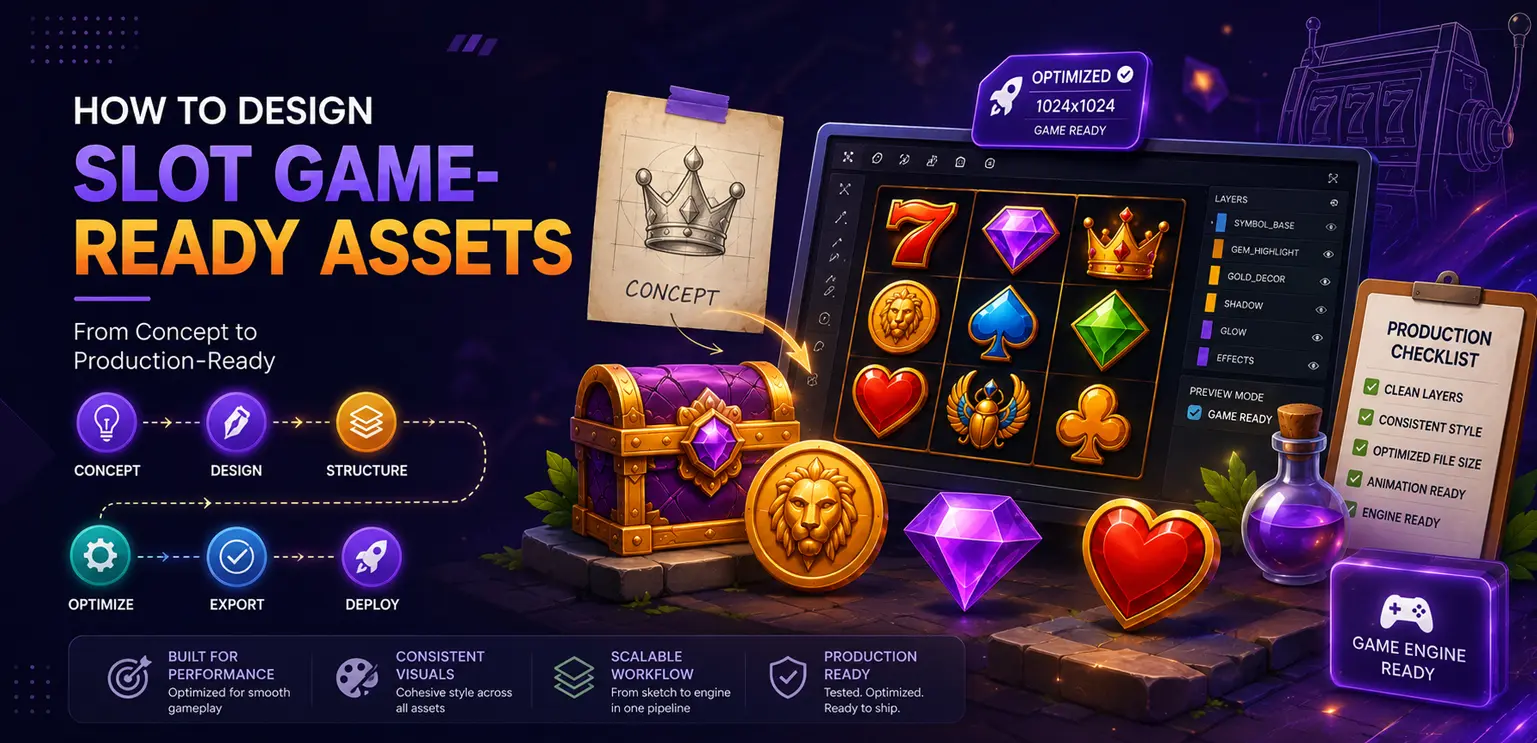
However, designing assets for slot games is very different from creating artwork for illustrations or marketing materials. Every asset must meet artistic, technical, and production requirements simultaneously. It should look visually appealing while remaining optimized for game engines, scalable across different devices, and easy for developers to integrate into production pipelines.
Many beginners focus only on creating beautiful artwork. Professional studios, on the other hand, focus on creating production-ready assets that balance creativity with technical performance.
This guide explains how game studios design slot game-ready assets that support efficient development, consistent quality, and long-term scalability.
What Makes an Asset "Game-Ready"?
Rather than being just visually appealing, a game-ready asset is carefully prepared to meet production standards, making it easy for developers to integrate, animate, optimize, and deploy within the game engine. It is not simply a high-quality illustration. It has been designed with gameplay, animation, optimization, and engine compatibility in mind. A production-ready asset typically meets several criteria:
- Consistent visual quality
- Organized layer structure
- Engine-compatible format
- Optimized file size
- Animation-ready design
- Clear naming conventions
- Easy integration into the production pipeline
The more prepared an asset is before implementation, the smoother the overall development process becomes.
Start with the Game's Visual Direction
Every asset should contribute to a unified visual identity. Before creating any symbols or backgrounds, studios define an art direction that guides every artistic decision throughout production. This usually includes:
- Theme and setting
- Color palette
- Lighting style
- Symbol hierarchy
- UI design language
- Animation style
- Visual effects approach
A well-defined art direction establishes visual consistency, ensuring every asset contributes to a cohesive and immersive game experience.
Understand the Purpose of Every Asset
Every visual element in a slot game serves a specific gameplay purpose. Premium symbols, standard symbols, bonus icons, wilds, scatters, buttons, and backgrounds all communicate different information to the player. Rather than treating every asset equally, designers prioritize clarity and functionality. For example:
- Bonus symbols should immediately attract attention.
- Wild symbols should remain recognizable even during fast gameplay.
- On smaller screens UI buttons should be easy to identify.
- Backgrounds should support the theme without distracting from the reels.
Successful design balances artistic appeal with gameplay readability.
Build Assets for Animation
Production-ready slot assets are created with animation requirements in mind from day one. Instead of delivering flattened artwork, artists organize symbols into structured layers that allow individual elements—such as highlights, glow effects, decorative details, and visual accents—to move independently during implementation. This modular workflow reduces rework, improves collaboration between artists and animators, and enables developers to integrate dynamic animations more efficiently while supporting future updates and content variations.
This layered approach also minimizes production revisions because developers and animators can modify individual components without recreating the entire asset. As a result, the artwork becomes easier to maintain and more adaptable for future updates.
Design with Optimization in Mind
Optimization is one of the biggest differences between professional game art and general digital illustration. Every asset consumes memory, affects loading times, and contributes to rendering performance. Professional artists consider optimization throughout production by managing:
- Texture resolution
- Layer complexity
- Sprite atlas usage
- Transparency
- File formats
- Asset dimensions
Optimized assets improve performance across desktop, mobile, and browser-based platforms without sacrificing visual quality.
Create Assets That Scale Across Devices
Today's slot games are played on a wide variety of screen sizes and resolutions. An asset that looks excellent on a desktop monitor may lose clarity on a smartphone if scalability is ignored. To maintain consistency, studios evaluate:
- Resolution independence
- Readability
- UI spacing
- Safe margins
- Responsive layouts
Planning for multiple platforms early reduces redesign work later in production.
Maintain Consistency Across the Entire Asset Library
Large slot games may contain hundreds of visual assets. Without clear standards, inconsistencies quickly appear in colors, proportions, lighting, iconography, and visual effects. Professional teams rely on style guides that define:
- Shape language
- Material rendering
- Shadow intensity
- Highlight behavior
- Typography
- Animation timing
Consistency strengthens the game's visual identity while simplifying collaboration between artists.
Organize Files for Efficient Collaboration
Professional game art production combines creative excellence with practical workflows, ensuring every asset is easy to manage, integrate, and collaborate on throughout development. Well-organized files typically include:
- Logical layer naming
- Grouped components
- Version tracking
- Standard folder structures
- Export-ready assets
Organized documentation helps developers, technical artists, and animators integrate assets without unnecessary revisions.
Prepare Assets for Engine Integration
Creating visually appealing artwork is only the beginning. A truly production-ready asset must also meet technical, optimization, and engine integration requirements before it is considered complete. Professional production includes technical preparation before assets reach the game engine. Teams verify:
- Correct dimensions
- Export settings
- Alpha transparency
- Pivot points
- Naming conventions
- Compression settings
These checks reduce implementation errors and accelerate development.
Design UI Assets Alongside Gameplay
The UI is often the player's primary point of interaction. Buttons, menus, balance displays, settings, and feature indicators should follow the same artistic standards as gameplay assets. Effective UI assets prioritize:
- Readability
- Accessibility
- Consistency
- Responsiveness
- Visual hierarchy
A beautiful interface that is difficult to use ultimately weakens the player experience.
Test Assets in Real Gameplay Conditions
Artwork should never be evaluated only in design software. Professional studios regularly test assets inside the game engine to understand how they behave during actual gameplay. Testing focuses on:
- Symbol visibility
- Animation performance
- Color balance
- UI clarity
- Mobile readability
- Overall visual consistency
Real-world testing often reveals issues that static artwork cannot.
The Role of Technical Artists
Technical artists play a vital role in transforming creative assets into production-ready content. They bridge the gap between art and development by ensuring assets meet engine requirements without compromising visual quality. Their responsibilities often include:
- Asset optimization
- Shader implementation
- Pipeline automation
- Rigging support
- Performance validation
- Engine integration
As production pipelines become more advanced, technical art continues to grow in importance.
How AI Is Supporting Asset Production
Artificial Intelligence is increasingly becoming part of modern art pipelines. Studios use AI to accelerate repetitive production tasks while leaving creative direction to experienced artists. AI commonly assists with:
- Concept exploration
- Asset variations
- Background generation
- Workflow automation
- Image enhancement
- Production planning
Rather than replacing artists, AI improves productivity and allows creative teams to focus on design quality.
Why Many Studios Outsource Slot Game Art
As slot games become more content-intensive, studios increasingly turn to specialized outsourcing partners to deliver production-ready assets efficiently while maintaining consistent quality standards. External partners help studios scale asset production without increasing permanent internal teams. Outsourcing commonly includes:
- Symbol design
- Background art
- Character illustration
- UI/UX assets
- Animation
- Visual effects
- Technical art support
Studios such as Gamix Labs provide production-ready slot game assets that integrate seamlessly into established development pipelines, helping clients accelerate production while maintaining artistic consistency and technical standards.
Common Mistakes When Designing Slot Game Assets
Many production issues originate during the art creation phase rather than during development. One of the most common mistakes is focusing entirely on visual appeal while overlooking how the asset will function inside the game. Artwork that ignores gameplay context may look impressive in isolation but can reduce readability once integrated into the reels or user interface.
Another frequent challenge is neglecting optimization until the end of production. Large textures, inconsistent visual styles, poorly organized project files, and assets that are difficult to animate often lead to unnecessary revisions and implementation delays. Professional studios avoid these problems by following standardized art pipelines and validating assets throughout production instead of waiting until the final review stage.
Future Trends in Slot Game Asset Production
Game art production continues evolving as new technologies reshape development workflows. Several trends are influencing modern pipelines:
- AI-assisted asset generation
- Procedural art workflows
- Real-time rendering
- Cross-platform asset libraries
- Automated optimization
- Cloud-based collaboration
Despite these advances, the core principles of structured production, consistency, and technical preparation remain essential.
Strategic Takeaways
Creating production-ready slot game assets requires much more than artistic talent. Successful studios consistently focus on:
- Defining a strong visual direction.
- Designing for gameplay.
- Building animation-ready assets.
- Optimizing throughout production.
- Maintaining visual consistency.
- Organizing files for collaboration.
- Preparing assets for engine integration.
- Combining AI with professional artistic expertise.
These practices help studios deliver visually engaging games while reducing production costs and improving long-term scalability.
Conclusion
Designing slot game-ready assets is a multidisciplinary process that combines creativity, technical planning, optimization, and structured production workflows. Every asset must support gameplay, integrate efficiently into the game engine, and maintain consistent quality across the entire project.
As slot games become increasingly sophisticated, the demand for production-ready art continues to grow. Studios that prioritize strong art direction, organized pipelines, animation-ready assets, and continuous optimization are better equipped to deliver engaging player experiences while maintaining efficient development schedules.
Whether you're an independent artist or part of a large production team, mastering these fundamentals will help you create assets that not only look exceptional but also perform reliably throughout the game's lifecycle.
Frequently Asked Questions
What is a game-ready slot asset?
A game-ready slot asset is artwork that is optimized, organized, animation-ready, and prepared for seamless integration into a game engine.
Why is optimization important for slot game assets?
Optimization improves loading times, reduces memory usage, and ensures smooth performance across desktop, mobile, and browser platforms.
Should artists think about animation while designing assets?
Yes. Layered, modular artwork makes animation easier and reduces production revisions later in the pipeline.
How do technical artists contribute to slot game production?
They optimize assets, implement shaders, automate workflows, and ensure artwork meets engine requirements.
Can AI replace slot game artists?
No. AI supports concept exploration and production efficiency, but artistic direction, creativity, and quality control remain human responsibilities.
Why do studios outsource slot game art?
Outsourcing provides access to specialized artists, scalable production resources, and faster delivery while maintaining consistent quality.