What Happens When Slot Game Development Fundamentals Are Ignored?
Every successful slot game is built on a foundation of thoughtful planning, disciplined execution, and collaboration across multiple teams. Players may only see the finished product, but behind every polished release is a structured production process involving designers, artists, developers, technical artists, QA engineers, producers, and product managers working toward a common goal.
When that foundation is strong, studios can deliver games that are visually engaging, technically stable, and easier to expand through future updates. When those fundamentals are overlooked, however, problems begin to surface throughout the production pipeline. Minor issues in planning or architecture often grow into expensive revisions, delayed launches, inconsistent player experiences, and increased maintenance costs.
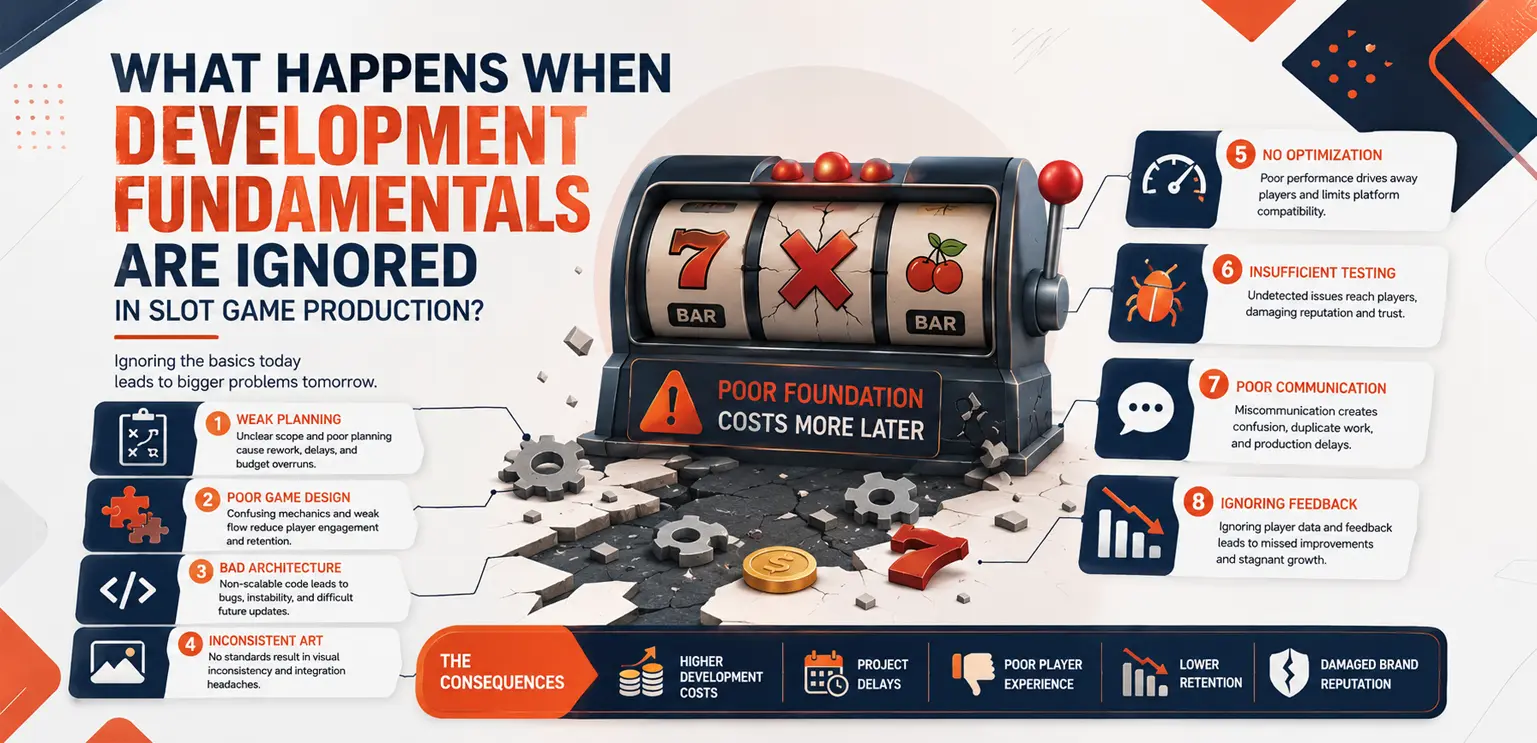
The consequences are rarely immediate. A game may launch successfully despite rushed planning or weak technical decisions, but over time those shortcomings become harder—and more expensive—to fix. In a competitive market where players expect polished experiences and operators demand reliable content, ignoring development fundamentals is a risk few studios can afford.
This article explores the most common production mistakes that arise when core development principles are neglected and explains how studios can avoid them through stronger planning, scalable workflows, and disciplined production practices.
Development Fundamentals Are More Than Technical Rules
Development fundamentals are often misunderstood as coding standards or engineering practices alone. In reality, they influence every stage of slot game production. From concept creation and mathematical planning to art production, UI design, animation, optimization, testing, and deployment, each discipline depends on a structured workflow. Strong fundamentals help studios:
- Maintain production consistency.
- Reduce unnecessary revisions.
- Improve collaboration across teams.
- Deliver stable, scalable games.
- Support long-term content updates.
Ignoring these principles usually creates problems that affect the entire production pipeline rather than a single department.
Weak Planning Leads to Expensive Production Changes
Many production challenges begin before development officially starts. Without a clearly defined project scope, teams often move into production while key decisions remain unresolved. Themes change midway through development, feature requirements expand unexpectedly, or technical limitations are discovered after assets have already been completed.
These changes create a ripple effect. Artists redesign symbols, developers rewrite systems, animators recreate sequences, QA repeats testing cycles, and producers adjust delivery schedules. What could have been resolved during pre-production becomes a costly production issue.
Successful studios invest time in planning because early decisions are significantly less expensive than late-stage corrections.
Unclear Game Design Creates Inconsistent Player Experiences
Every slot game should communicate a clear identity. Players should immediately understand the theme, recognize important symbols, navigate the interface comfortably, and follow gameplay without unnecessary confusion. When game design lacks consistency, players encounter experiences that feel disconnected. Common symptoms include:
- Confusing bonus mechanics.
- Inconsistent visual styles.
- Unclear reward feedback.
- Difficult navigation.
- Over complicated interfaces.
Rather than improving engagement, these inconsistencies create friction that affects player satisfaction. Strong design documentation helps every department work toward the same creative vision.
Poor Technical Architecture Limits Future Growth
Modern slot games rarely remain unchanged after launch. Studios frequently introduce new events, promotional campaigns, localized versions, feature updates, and platform integrations. Without scalable architecture, every update becomes more difficult to implement. Common architectural problems include:
- Tightly coupled systems.
- Hard coded configurations.
- Limited asset reusability.
- Difficult engine integration.
- Poor version management.
Although these shortcuts may save time initially, they often increase development costs throughout the game's lifecycle. Scalable architecture enables teams to adapt more efficiently as business requirements evolve.
Ignoring Art Production Standards Reduces Visual Quality
Art production involves much more than creating attractive illustrations. Successful game art production relies on standardized workflows that define how assets are organized, named, layered, exported, and optimized for seamless integration into the game engine. Without these standards, production teams often experience:
- Duplicate assets.
- Inconsistent visual styles.
- Integration delays.
- Difficult revisions.
- Increased production errors.
Organized art pipelines improve collaboration between artists, animators, developers, and technical teams while reducing unnecessary production overhead.
Animation Without Purpose Weakens Gameplay
Animation plays a critical role in player communication. Well-designed motion highlights important events, reinforces rewards, and improves visual clarity. Poorly planned animation, however, can distract players or reduce gameplay responsiveness. Studios sometimes make the mistake of adding excessive visual effects simply because modern tools make them easy to create. Effective animation should:
- Support gameplay.
- Guide player attention.
- Reinforce important actions.
- Maintain visual clarity.
- Respect performance limitations.
Purposeful animation is more valuable than excessive animation.
Weak UI/UX Design Creates Player Friction
Even the strongest gameplay systems struggle if players cannot interact with them comfortably. Casino games require intuitive interfaces that allow players to understand features quickly without interrupting gameplay. Poor UI/UX often results in:
- Hidden functionality.
- Confusing navigation.
- Poor information hierarchy.
- Difficult feature discovery.
- Reduced accessibility.
Modern studios increasingly use player testing, analytics, and AI-assisted usability analysis to identify these issues before launch.
Delaying Optimization Is an Expensive Mistake
Some teams treat optimization as the final stage of production. In reality, optimization should begin early and continue throughout development. Ignoring optimization until the end often creates:
- Frame-rate issues.
- Long loading times.
- High memory usage.
- Device compatibility problems.
- Larger development delays.
For HTML5 and mobile slot games, where performance directly affects player retention, continuous optimization is particularly important.
Insufficient Testing Increases Production Risk
Testing is not simply about finding bugs. Quality assurance validates gameplay, performance, usability, compatibility, localization, and technical stability. When testing is rushed or minimized, studios increase the likelihood of releasing games with issues that affect both players and operators. Effective QA evaluates:
- Functional stability.
- UI behavior.
- Mathematical accuracy.
- Animation consistency.
- Performance across devices.
- Integration reliability.
Testing throughout production reduces expensive post-launch corrections.
Poor Communication Slows Every Department
Slot game production depends on collaboration. Artists, developers, designers, mathematicians, QA engineers, producers, and external partners all contribute to the final product. Weak communication often results in:
- Misinterpreted requirements.
- Duplicate work.
- Delayed approvals.
- Conflicting priorities.
- Increased revision cycles.
Structured documentation and regular production reviews help teams remain aligned throughout development.
Ignoring Player Feedback Limits Long-Term Success
Launching a game is only the beginning. Player analytics, operator feedback, and performance metrics provide valuable insights that help studios improve future updates. Studios that ignore this information risk repeating the same production mistakes across multiple projects. Continuous improvement depends on understanding how players actually interact with the game rather than relying solely on internal assumptions.
AI Helps Reinforce Development Fundamentals
Artificial Intelligence is becoming an increasingly valuable production tool, but it does not replace strong development practices. Instead, AI strengthens existing workflows by assisting with:
- Rapid prototyping.
- Asset generation.
- UI/UX analysis.
- Automated testing support.
- Performance monitoring.
- Store asset optimization.
- Workflow automation.
Studios that already follow disciplined production processes gain the greatest value from AI because automation builds upon an organized foundation.
Why Outsourcing Requires Strong Internal Processes
Many slot developers work with external production partners to expand capacity and access specialized expertise. However, outsourcing succeeds only when internal production standards are clearly defined. Successful outsourcing depends on:
- Detailed documentation.
- Technical specifications.
- Art direction guidelines.
- Review processes.
- Communication workflows.
- Version control.
Studios such as Gamix Labs integrate into established production pipelines by delivering engine-ready art, animation, UI/UX, and development services that align with internal standards, helping clients scale production without sacrificing consistency or quality.
Building Strong Development Foundations
Studios that consistently deliver successful slot games share several common practices. They:
- Define project goals before production begins.
- Validate gameplay early.
- Build scalable technical systems.
- Maintain organized asset pipelines.
- Optimize throughout development.
- Test continuously.
- Encourage cross-team collaboration.
- Learn from player feedback.
These practices reduce production risk while improving long-term efficiency.
Future Trends Make Fundamentals Even More Important
Game development continues evolving through AI, cloud collaboration, procedural workflows, and increasingly complex production pipelines. While technology changes rapidly, the importance of strong fundamentals remains constant. Studios adopting new tools without disciplined production practices often struggle to realize their full benefits. The future belongs to teams that combine innovation with structured development processes.
Strategic Takeaways
Ignoring development fundamentals rarely causes one isolated problem. Instead, it creates a chain reaction that affects planning, production, technical quality, and long-term scalability. The most important lessons include:
- Plan thoroughly before production.
- Keep gameplay and player experience at the center of decisions.
- Build scalable systems instead of short-term solutions.
- Establish consistent art and technical standards.
- Optimize and test throughout development.
- Use AI to strengthen—not replace—structured workflows.
- Treat outsourcing as an extension of disciplined production.
Studios that consistently apply these principles produce games that are easier to maintain, more efficient to develop, and better positioned for long-term success.
Conclusion
The quality of a slot game is determined long before players press the spin button. It begins with the decisions made during planning, design, engineering, art production, testing, and collaboration.
Ignoring development fundamentals may appear to accelerate production in the short term, but it often results in technical debt, inconsistent quality, higher costs, and more difficult post-launch support.
Successful studios understand that strong fundamentals are not obstacles to creativity—they are the framework that allows creativity to scale. By investing in disciplined workflows, scalable architecture, continuous optimization, and collaborative production, developers create slot games that deliver better player experiences while remaining easier to maintain and expand over time.
FAQs
Why are development fundamentals important for slot games?
They provide a structured framework that improves quality, scalability, production efficiency, and long-term maintainability.
What happens if a slot game is poorly planned?
Poor planning often leads to scope changes, production delays, increased costs, inconsistent design, and technical challenges later in development.
Why should optimization begin early?
Continuous optimization prevents performance issues, reduces technical debt, and ensures smoother gameplay across different devices and platforms.
Can AI replace strong development practices?
No. AI enhances productivity and automation, but it cannot replace planning, creative direction, technical architecture, or production discipline.
How does outsourcing benefit slot game production?
Outsourcing gives studios access to specialized talent and scalable production resources, especially when supported by clear documentation and structured workflows.
What is the biggest mistake studios make?
One of the most common mistakes is treating development fundamentals as optional rather than essential, leading to long-term production inefficiencies and reduced game quality.