How AI Is Accelerating Game Prototyping for Modern Studios
In modern game development, the ability to prototype quickly can determine whether a studio discovers a successful idea before competitors do. Publishers and developers are under constant pressure to test new mechanics, evaluate player engagement, and validate concepts before committing full production budgets.
Traditionally, building a playable prototype required significant time from designers, artists, programmers, and producers. Even simple concepts could take weeks or months to reach a stage where meaningful feedback could be gathered.
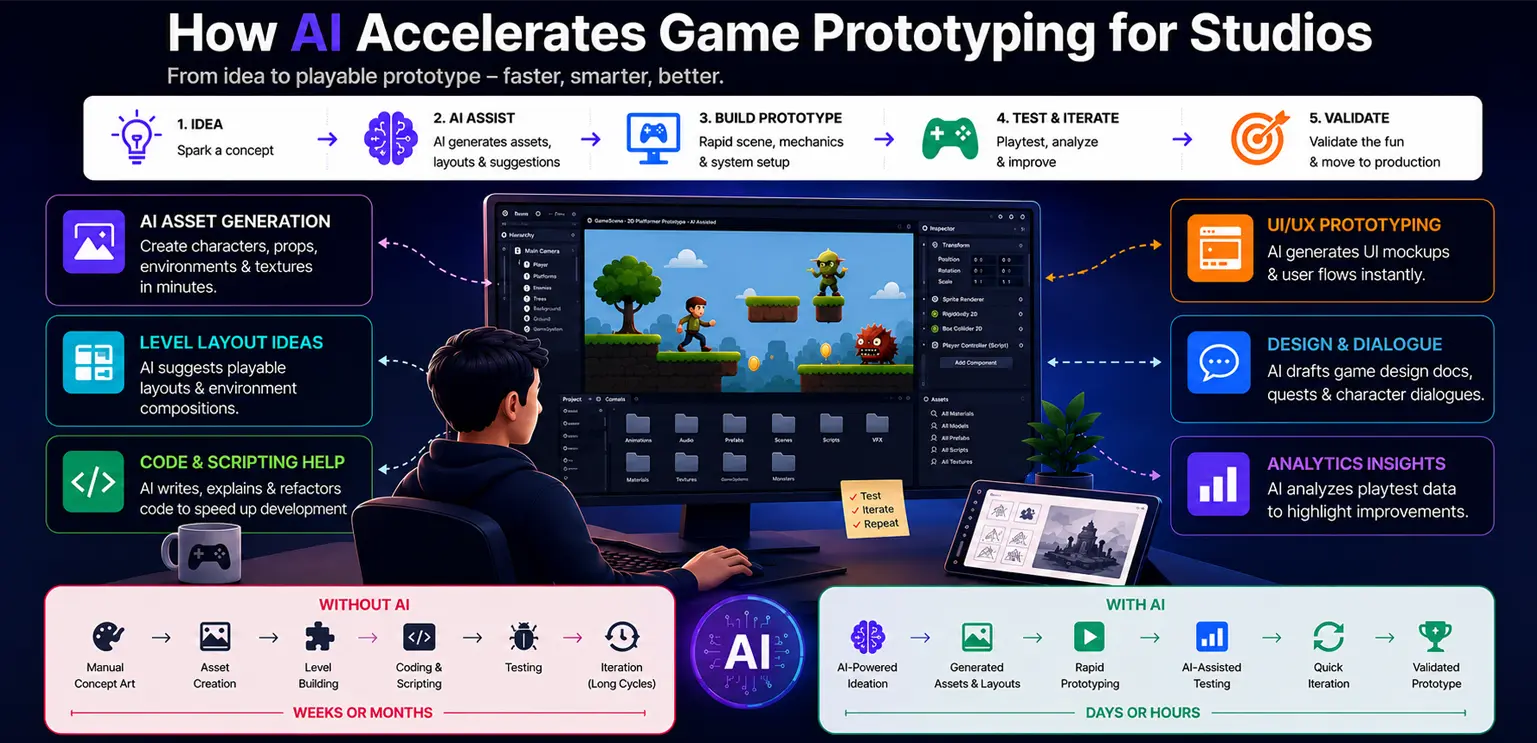
Artificial Intelligence is changing that process.
AI is not replacing game developers, but it is dramatically reducing the time required to move from an idea to a playable prototype. Studios can now generate placeholder assets, explore multiple design directions, accelerate scripting tasks, and iterate on gameplay concepts far faster than before.
As a result, AI-assisted prototyping is becoming one of the most valuable tools for modern game studios.
What Is AI-Assisted Game Prototyping?
AI-assisted game prototyping refers to the use of artificial intelligence tools to accelerate the early stages of game development. Instead of manually creating every asset and system from scratch, teams use AI to support tasks such as:
- Concept generation
- Placeholder art creation
- UI mockups
- Dialogue drafts
- Level layout ideas
- Code assistance
- Design documentation
- Gameplay iteration
The goal is not to produce final-quality content immediately. The goal is to validate ideas faster.
Why Studios Need Faster Prototyping
Game development has become increasingly expensive. Before investing heavily in production, studios need confidence that a concept has potential. Fast prototyping helps teams answer critical questions early:
- Is the core mechanic fun?
- Does the progression system work?
- Will players understand the gameplay loop?
- Is the concept commercially viable?
- Should the project move into full production?
Historically, answering these questions could take months. AI helps reduce that timeline significantly.
AI for Rapid Concept Exploration
One of the biggest advantages of AI is the ability to explore multiple creative directions quickly. Design teams can generate numerous variations of:
- Game themes
- Character concepts
- Environment styles
- UI layouts
- Visual moods
- Feature ideas
Instead of committing to a single direction early, studios can compare many options before making production decisions. This reduces the risk of investing in a concept that may not resonate with players.
Generating Placeholder Assets in Minutes
Early prototypes do not require final-quality art. What they need is speed.
AI helps teams create temporary assets that allow gameplay testing to begin immediately. Studios can rapidly generate:
- Character placeholders
- Environment mockups
- Icons
- UI elements
- Props
- Backgrounds
Designers and developers can then focus on testing mechanics rather than waiting for complete art production.
AI-Assisted Level and Environment Design
Level design is another area where AI can accelerate iteration. AI tools can suggest layout variations, encounter structures, and environmental compositions that designers can refine manually.
This is particularly useful during the experimentation phase, where teams may want to test multiple gameplay scenarios before selecting a final direction. The human designer remains responsible for gameplay quality and player experience, while AI helps generate starting points more quickly.
Faster UI and UX Prototyping
User interface design often becomes a bottleneck during prototyping because teams need enough visual structure to test navigation and player flows. AI can help generate:
- Menu layouts
- HUD concepts
- Inventory screens
- Shop interfaces
- Feature mockups
These prototypes allow usability testing much earlier in development. For mobile and casino games, where UI plays a major role in retention and monetization, early testing can provide valuable insights.
AI for Scripting and Programming Support
Programmers are also benefiting from AI-assisted workflows. AI can help accelerate:
- Boilerplate code generation
- UI scripting
- Gameplay logic prototypes
- Debugging suggestions
- Tool scripting
- Documentation
Developers still review, modify, and optimize the code, but repetitive tasks can often be completed much faster. This is especially valuable during prototyping, where speed matters more than perfect architecture.
AI Helps Teams Test More Ideas
Perhaps the greatest advantage of AI-assisted prototyping is increased experimentation. When prototypes become cheaper and faster to build, studios can test more ideas before choosing a direction. Instead of evaluating two or three concepts, teams may evaluate ten or twenty. This increases the probability of discovering stronger gameplay opportunities and reduces the cost of failed experiments.
Reducing Pre-Production Costs
Pre-production can consume significant resources before a project is even approved. AI helps reduce these costs by shortening:
- Concept creation time
- Asset preparation time
- Prototype development cycles
- Iteration loops
- Internal pitch preparation
Studios can therefore evaluate opportunities more efficiently before committing larger budgets.
The Human Team Still Makes the Decisions
Despite rapid advances, AI does not replace the core creative and technical leadership of a game studio. Humans still define:
- Game vision
- Core mechanics
- Player experience goals
- Art direction
- Monetization strategy
- Production priorities
AI accelerates development workflows and rapid iteration, while creative direction, strategic decisions, and final quality remain firmly in the hands of the studio.
AI in Mobile and Casino Game Prototyping
AI-assisted prototyping is particularly valuable for mobile and casino game development because these markets often require rapid concept validation and frequent experimentation. Teams can quickly test:
- New slot themes
- Bonus mechanics
- UI flows
- Reward systems
- Visual styles
- Feature engagement
Faster testing allows studios to identify promising concepts before investing in full production pipelines.
Integrating AI Into Studio Workflows
Successful studios typically integrate AI into existing workflows rather than replacing established processes. A common approach is:
- Designers define the concept.
- AI generates exploratory assets and ideas.
- Developers build a rapid prototype.
- Teams gather feedback.
- Promising concepts move into structured production.
- Final assets are created by artists and production teams.
This hybrid model combines AI speed with professional production quality.
Challenges and Limitations
AI-assisted prototyping also introduces challenges. Studios must manage:
- Asset consistency
- Copyright considerations
- Quality control
- Technical integration
- Over-reliance on generated content
AI outputs should be treated as starting points, not automatic production-ready solutions.
Why Many Studios Combine AI With External Development
Many game companies now combine AI-powered prototyping with external development partners.
Specialized studios can use AI to accelerate early exploration while providing the professional art, engineering, UI/UX, and production support needed for full-scale development.
Studios such as Gamix Labs often integrate AI-assisted workflows into game concept development, rapid prototyping, and production pipelines, helping clients move from idea validation to market-ready development more efficiently.
Future Trends in AI-Powered Prototyping
The next generation of AI tools is expected to provide even deeper support for game prototyping. Emerging capabilities include:
- AI-generated gameplay scenarios
- Procedural level generation
- Automated playtesting
- Player behavior simulation
- Real-time balance analysis
- Cross-platform prototype generation
These tools could dramatically shorten the path from concept to validated gameplay.
Strategic Takeaways for Studios
AI is changing the economics of experimentation. Studios that adopt AI-assisted prototyping gain several advantages:
- Faster concept validation
- More design iterations
- Lower pre-production costs
- Shorter prototype timelines
- Greater creative exploration
- Earlier player feedback
The ability to test ideas quickly is becoming a significant competitive advantage in modern game development.
Conclusion
Game prototyping has always been about learning as quickly as possible. Artificial Intelligence is accelerating that learning process by helping studios generate assets, explore ideas, build prototypes, and iterate on gameplay faster than traditional workflows alone.
The most successful studios will not be those that rely entirely on AI, but those that combine AI-powered speed with strong creative direction, technical expertise, and production discipline. In the years ahead, AI-assisted prototyping is likely to become a standard part of game development pipelines, helping studios discover better ideas earlier and bring successful projects to market more efficiently.
FAQ: AI for Game Prototyping
What is AI-assisted game prototyping?
It is the use of AI tools to accelerate concept creation, asset generation, scripting, UI design, and early gameplay development.
Can AI create a complete game prototype automatically?
AI can assist significantly, but human designers and developers are still needed to define mechanics, quality standards, and production goals.
What are the biggest benefits of AI in prototyping?
Faster iteration, lower pre-production costs, and the ability to test more ideas before committing to full development.
Is AI useful for mobile and casino games?
Yes. It helps teams rapidly test themes, UI flows, reward systems, and gameplay concepts.
Does AI replace game artists and programmers?
No. AI supports their work by accelerating repetitive tasks and generating exploratory content.
Why are studios investing in AI-assisted prototyping?
Because faster experimentation increases the chances of discovering successful game concepts while reducing development risk.