How AAA Studios Scale Game Development Through Outsourcing Without Losing Creative Control
When people hear that a major game studio outsourced part of a project, they often assume it means the studio handed off creative responsibilities to an external team. This misconception has existed for years and continues to shape how outsourcing is perceived across the gaming industry.
The reality is very different.
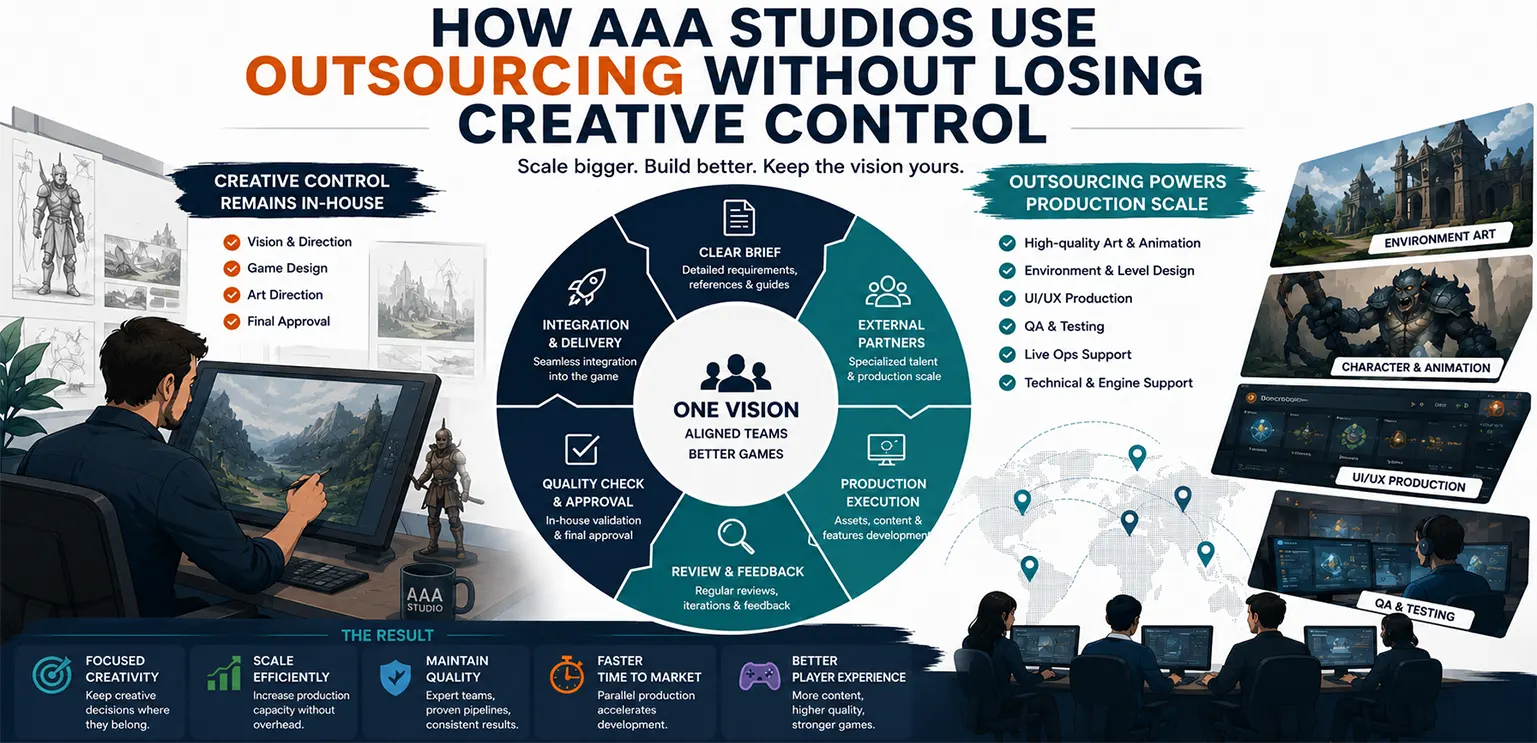
Many of today's largest and most successful AAA games rely heavily on external development partners. From environment art and animation to quality assurance, technical support, and Live Ops content, outsourcing has become a fundamental part of modern game production. However, AAA studios are not outsourcing because they lack creative vision. They outsource because the scale of modern game development has become too large for internal teams alone.
The key difference is that successful studios know how to expand production capacity without sacrificing creative ownership. They build systems that allow external teams to contribute efficiently while keeping artistic direction, gameplay vision, and design decisions firmly under internal control.
Why AAA Games Have Become Too Large for Internal Teams Alone
Game development has changed dramatically over the past decade. Modern AAA projects require:
- Massive open worlds
- Thousands of art assets
- Cinematic-quality animations
- Complex UI systems
- Continuous post-launch content
- Cross-platform optimization
- Live service support
As player expectations increase, production requirements grow alongside them. A single AAA title may involve hundreds of developers working across multiple disciplines for several years. Even large internal teams often struggle to handle every production task efficiently.
Rather than continuously expanding internal departments, studios increasingly rely on specialized external partners to support development at scale. This approach allows them to maintain production velocity while avoiding unsustainable operational growth.
Outsourcing Is About Scale, Not Creative Leadership
One of the biggest misconceptions about outsourcing is that it transfers creative decision-making to external teams. In reality, AAA studios rarely outsource creative leadership. Core responsibilities typically remain internal, including:
- Game vision
- Art direction
- Narrative design
- Gameplay systems
- Creative approval processes
- Product strategy
External teams are generally responsible for production execution rather than creative ownership. This distinction is what allows studios to scale output without losing control of the final product. The studio defines the vision. External teams help bring that vision to life.
The Production Areas Most Commonly Outsourced
AAA studios outsource a wide range of production activities depending on project requirements. Game art remains one of the most common areas of external development. This often includes:
- Environment art
- Prop creation
- Character support assets
- UI production
- Concept art support
- Animation
- Visual effects
Beyond art production, studios also commonly outsource:
- Quality assurance
- Audio production
- Localization
- Technical support
- Live Ops content
- Performance optimization
These tasks are highly specialized and often benefit from dedicated expertise. By leveraging external specialists, studios can maintain quality standards while accelerating production timelines.
The Foundation of Creative Control: Strong Art Direction
Creative control begins with clear direction. AAA studios invest significant effort into creating comprehensive documentation before external production begins. This typically includes:
- Art bibles
- Style guides
- Technical specifications
- Asset standards
- Visual references
- Production workflows
These resources ensure that every contributor understands the project's creative objectives. When documentation is strong, external teams can execute work more effectively while maintaining consistency with the studio's vision. Without these systems, outsourcing becomes significantly more difficult to manage.
How Structured Pipelines Protect Creative Consistency
Successful outsourcing is rarely managed through informal communication alone. AAA studios build highly structured production pipelines that guide asset creation from concept to implementation. A typical workflow includes:
- Internal creative teams establish direction
- Production requirements are documented
- External teams create assets
- Internal reviews evaluate quality and consistency
- Revisions are completed when necessary
- Final approval remains with the studio
This process ensures that all creative decisions pass through internal review channels. External teams contribute production expertise, but final authority remains within the studio.
Why Specialized Partners Improve Production Quality
Modern game development requires expertise across numerous disciplines. An internal team may excel at gameplay systems while lacking specialized resources for high-volume environment production or cinematic animation. External partners often focus on specific production areas and develop deep expertise within those disciplines. This specialization allows studios to access:
- Advanced technical knowledge
- Experienced production artists
- Scalable asset pipelines
- Proven workflows
- Industry best practices
Rather than reducing quality, outsourcing often improves it when the right partners are involved. The objective is not replacing internal talent but complementing it.
Communication: The Most Important Factor in Outsourcing Success
Technology, tools, and workflows are important, but communication remains the single most important factor in successful outsourcing. Most outsourcing failures occur because expectations are unclear. Common problems include:
- Incomplete documentation
- Ambiguous feedback
- Delayed approvals
- Misaligned priorities
- Inconsistent review processes
AAA studios address these risks through regular communication cycles and structured review systems. Frequent collaboration ensures that external teams remain aligned with evolving project requirements.
Embedded Team Models Are Becoming More Common
Traditional outsourcing often involved assigning isolated tasks to external vendors. Modern AAA studios increasingly use embedded team models instead. In these arrangements, external developers function as integrated members of the production team. They participate in:
- Regular meetings
- Production planning
- Review sessions
- Milestone discussions
This approach improves collaboration while reducing communication barriers. As a result, external contributors become more familiar with project goals and quality expectations. The embedded model is now widely considered one of the most effective frameworks for large-scale outsourced game production.
Outsourcing in Live Service and Ongoing Content Production
The rise of live service games has increased demand for external development support. After launch, studios must continue producing:
- Seasonal content
- New environments
- Cosmetic assets
- Event updates
- Marketing materials
Maintaining these content pipelines exclusively with internal teams can be expensive and inefficient. External development partners help studios sustain content production while allowing internal teams to focus on long-term product evolution. This model has become increasingly common among both AAA publishers and large-scale online gaming platforms.
How AAA Studios Choose Outsourcing Partners
Selecting the right partner is often more important than the outsourcing decision itself. Studios evaluate potential partners based on several criteria:
- Portfolio quality
- Industry experience
- Technical expertise
- Communication processes
- Production scalability
- Workflow compatibility
Cost is only one factor among many. The most successful partnerships are built around production alignment rather than simply reducing expenses. Studios such as Gamix Labs often support publishers through specialized game art, animation, UI/UX, and production services that integrate with existing development pipelines rather than operating independently from them.
Common Risks and How Studios Prevent Them
While outsourcing provides significant advantages, it also introduces potential risks. The most common challenges include:
- Quality inconsistency
- Communication breakdowns
- Revision overload
- Production delays
- Technical incompatibility
AAA studios reduce these risks through:
- Detailed production documentation
- Frequent milestone reviews
- Dedicated project managers
- Clear approval structures
- Standardized pipelines
When these systems are in place, outsourcing becomes significantly more predictable and efficient.
The Future of Outsourcing in AAA Development
The role of outsourcing continues to evolve. External partners are no longer viewed solely as asset producers. Increasingly, they contribute to broader production ecosystems. Future trends are expected to include:
- AI-assisted production workflows
- Real-time collaborative pipelines
- Technical art specialization
- Live service support teams
- Cross-platform optimization services
- Advanced co-development partnerships
As projects grow larger and more complex, collaboration between internal and external teams will become even more important. The distinction between in-house and outsourced production may continue to blur as integrated development models mature.
Strategic Takeaways for Studios
AAA studios have demonstrated that outsourcing and creative control are not opposing concepts. In fact, outsourcing often enables greater creative focus by allowing internal teams to concentrate on high-value creative decisions while external specialists handle scalable production work. Successful studios consistently:
- Retain creative leadership internally
- Build strong documentation systems
- Use structured production pipelines
- Prioritize communication
- Select partners strategically
When executed properly, outsourcing becomes a force multiplier rather than a creative compromise.
Conclusion
The modern AAA game industry would not function the way it does today without external development partnerships. As projects become larger, more ambitious, and increasingly content-driven, outsourcing provides the scalability necessary to meet production demands.
The key lesson from leading studios is that outsourcing does not require sacrificing creative control. By maintaining ownership of vision, direction, and approval processes while leveraging specialized external talent, studios can expand production capacity without compromising quality.
In today's development landscape, the most successful studios are not those that do everything internally. They are the ones that know how to collaborate effectively while keeping creative leadership exactly where it belongs.
FAQs
Do AAA studios outsource game development?
Yes. Most AAA studios outsource specific production tasks such as art, animation, QA, localization, and technical support.
Does outsourcing reduce creative control?
Not when managed properly. Creative leadership, design direction, and final approvals typically remain internal.
What game development tasks are most commonly outsourced?
Environment art, character assets, animation, VFX, UI/UX, QA, localization, and Live Ops content.
Why do AAA studios use outsourcing?
To scale production efficiently, access specialized expertise, and accelerate development timelines.
What is the biggest outsourcing challenge?
Maintaining consistent quality and communication across distributed teams.
How do studios maintain quality when outsourcing?
Through style guides, production documentation, milestone reviews, and structured approval processes.