Compliance-First Game Development: Building iGaming Products for Regulated Markets
The global iGaming industry continues to expand into new regulated markets, creating significant opportunities for operators, publishers, and game development studios. However, entering regulated jurisdictions is no longer simply a matter of launching a great game. Success increasingly depends on meeting strict compliance requirements that govern everything from game mechanics and player protection to technical security and reporting standards.
For many years, compliance was often viewed as a final-stage requirement handled shortly before launch. Today, that approach creates unnecessary risks, delays certifications, increases development costs, and can prevent market entry altogether.
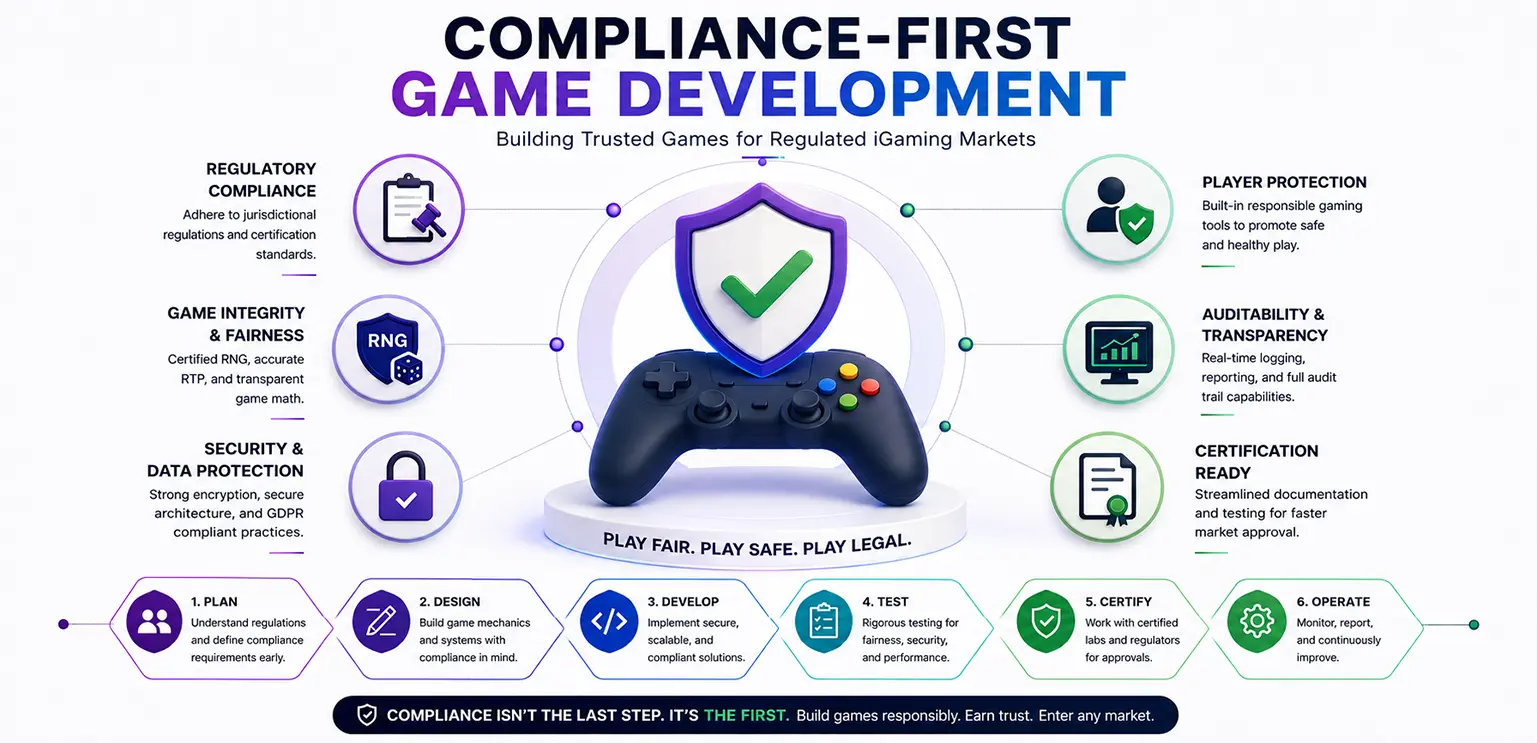
As regulatory frameworks become more sophisticated, leading studios are adopting a compliance-first development strategy. Instead of treating compliance as a post-production task, they integrate regulatory requirements into every stage of the development lifecycle.
This shift allows teams to build products that are not only engaging and scalable but also prepared for certification, deployment, and long-term operation in regulated environments.
What Does Compliance-First Development Mean?
Compliance-first game development is the practice of designing and building games with regulatory requirements integrated from the beginning of production.
Rather than creating a product first and adapting it later, development teams establish compliance considerations during planning, architecture, design, implementation, and testing. This approach influences multiple areas of production, including:
- Game mathematics
- Security architecture
- Player protection systems
- Data management
- Reporting frameworks
- Platform integrations
- Quality assurance processes
By embedding compliance into production workflows, studios reduce the likelihood of costly revisions later in the project.
Why Regulated Markets Require a Different Development Approach
Developing games for regulated jurisdictions is fundamentally different from creating products for unregulated markets. In regulated environments, every aspect of a game may be subject to review, testing, and certification before launch. Regulators often evaluate:
- Random number generation systems
- Return-to-player configurations
- Game fairness mechanisms
- Technical security standards
- Transaction tracking systems
- Responsible gaming features
- Data protection practices
Because these requirements directly affect technical implementation, compliance considerations must be incorporated long before production reaches its final stages. Studios that delay compliance planning often encounter expensive redevelopment efforts and extended certification timelines.
Compliance Begins During Product Planning
The foundation of compliance-first development is established during project planning. Before production begins, development teams should understand:
- Target jurisdictions
- Regulatory requirements
- Certification expectations
- Technical standards
- Reporting obligations
Different markets may impose different requirements, making early planning essential.
A feature that is acceptable in one jurisdiction may require modification in another. Identifying these differences early helps avoid significant development disruptions later. Compliance planning should therefore be treated as a strategic business activity rather than a technical afterthought.
The Role of Game Mathematics in Regulatory Compliance
Game mathematics sits at the heart of regulated gaming products. Mathematical models influence player experience, platform performance, and certification outcomes. Regulators typically require transparency regarding:
- RTP values
- Volatility profiles
- Probability distributions
- Bonus feature behavior
- Random event calculations
Because mathematical systems are deeply integrated into game logic, modifying them late in development can create substantial production challenges. Compliance-first teams ensure that mathematical models align with regulatory expectations from the outset. This reduces testing complications and improves certification readiness.
Security Must Be Built Into the Architecture
Security is no longer viewed as an optional enhancement for regulated gaming products. Modern regulators increasingly expect robust security controls throughout the software ecosystem. Development teams must consider:
- Data encryption
- Access control systems
- Secure communications
- Infrastructure protection
- Transaction integrity
- Audit logging
These systems are most effective when incorporated into platform architecture from the beginning. Attempting to retrofit security features late in production often introduces technical complexity and operational risks.
Responsible Gaming Features Are No Longer Optional
Player protection has become a major focus across regulated markets worldwide. As a result, responsible gaming systems are increasingly embedded within compliance frameworks. Modern platforms may require functionality that supports:
- Session monitoring
- Spending controls
- Self-exclusion tools
- Player notifications
- Behavioral tracking
- Risk management systems
These features affect both frontend user experiences and backend operational systems. Building them early ensures smoother integration and stronger regulatory alignment.
The Importance of Auditability and Reporting
One of the defining characteristics of regulated gaming environments is transparency. Operators and regulators require access to accurate records that demonstrate system integrity and operational compliance. Development teams must therefore design systems capable of supporting:
- Event tracking
- Transaction history
- System monitoring
- Compliance reporting
- Operational auditing
Auditability should not be viewed as a reporting feature added after launch. It should be considered a core architectural requirement. The ability to generate reliable records often plays a critical role during regulatory reviews and certification processes.
Why Documentation Matters as Much as Development
Many studios focus heavily on technical implementation while underestimating the importance of documentation. In regulated environments, documentation is often reviewed alongside the product itself. Development teams typically maintain:
- Technical specifications
- Architecture documentation
- Security procedures
- Mathematical models
- Testing records
- Compliance workflows
Well-organized documentation improves certification efficiency and demonstrates operational maturity. It also simplifies future updates, audits, and market expansion efforts.
Quality Assurance in Compliance-First Development
Quality assurance extends far beyond functionality testing in regulated gaming projects. Compliance-focused QA processes evaluate:
- Regulatory requirements
- Mathematical accuracy
- Security implementation
- Data integrity
- Reporting functionality
- Platform stability
Testing must verify not only that the game works as intended but also that it meets applicable regulatory standards. This often requires specialized testing procedures that differ significantly from traditional game development workflows.
Multi-Market Development Challenges
As operators expand internationally, compliance complexity increases. Different jurisdictions may impose unique requirements related to:
- Certification processes
- Technical standards
- Reporting formats
- Player protection policies
- Data management regulations
Without scalable compliance systems, supporting multiple markets can become increasingly difficult. Many successful studios address this challenge by building flexible architectures that accommodate jurisdiction-specific requirements without requiring complete redevelopment.
This approach improves scalability while reducing long-term operational costs.
The Business Benefits of Compliance-First Development
While compliance is often viewed as a regulatory obligation, it also provides significant business advantages. Organizations that prioritize compliance early typically experience:
- Faster certification cycles
- Reduced redevelopment costs
- Smoother market entry
- Improved operational efficiency
- Lower regulatory risk
- Greater platform scalability
Compliance-first strategies often improve overall product quality because they encourage stronger planning, documentation, testing, and technical discipline. As a result, compliance becomes a competitive advantage rather than a development burden.
How External Development Partners Support Compliance Goals
Many operators and publishers rely on specialized development partners to accelerate production while maintaining regulatory readiness. Experienced external teams often contribute expertise in:
- Game mathematics implementation
- Technical architecture
- Security systems
- QA processes
- Documentation standards
- Market-specific requirements
Studios such as Gamix Labs frequently support regulated gaming projects by aligning production workflows with certification expectations and compliance requirements from the earliest stages of development. This collaborative approach helps reduce risk while improving production efficiency.
Future Trends in Regulated iGaming Development
The regulatory landscape continues to evolve as markets mature and new jurisdictions emerge. Several trends are expected to shape future compliance strategies:
- Increased automation of compliance monitoring
- Real-time reporting systems
- Stronger cybersecurity requirements
- Enhanced responsible gaming frameworks
- Greater transparency expectations
- AI-assisted compliance management
Studios that build adaptable compliance infrastructures today will be better positioned to respond to future regulatory changes. The ability to evolve quickly may become a major competitive differentiator.
Strategic Takeaways for Developers and Operators
Compliance-first development is no longer reserved for large organizations with extensive regulatory resources. As regulated markets continue to expand, integrating compliance into production workflows has become essential for developers of all sizes. Successful teams focus on:
- Early compliance planning
- Secure architecture design
- Regulatory-ready game mathematics
- Comprehensive documentation
- Continuous testing and validation
- Scalable multi-market systems
These practices reduce risk while improving operational efficiency and market readiness.
Conclusion
The growth of regulated iGaming markets has fundamentally changed how successful gaming products are developed. Compliance can no longer be treated as a final checkpoint before launch. It must become an integral part of the development process from the very beginning.
Studios that embrace compliance-first methodologies gain more than regulatory approval. They build stronger architectures, improve production efficiency, accelerate market entry, and create products that are better prepared for long-term growth.
In today's regulated environment, compliance is not simply a legal requirement. It is a strategic foundation for sustainable game development.
FAQ: Compliance-First Game Development
What is compliance-first game development?
It is an approach that integrates regulatory requirements into every stage of the development lifecycle rather than addressing them after production.
Why is compliance important in regulated iGaming markets?
Compliance is required for certification, market entry, player protection, and long-term operational approval.
What areas are most affected by compliance requirements?
Game mathematics, security, reporting systems, responsible gaming features, documentation, and quality assurance.
Why should compliance planning start early?
Early planning reduces redevelopment costs, accelerates certification, and minimizes regulatory risks.
How does compliance impact game architecture?
It influences security systems, audit logging, data management, reporting capabilities, and operational workflows.
What is the biggest benefit of a compliance-first strategy?
Faster market readiness and reduced risk while improving overall product quality and scalability.