Why Technical Art Outsourcing Is in High Demand for Modern Game Development
As modern games become more visually advanced and technically complex, the role of the technical artist has evolved from a niche specialization into one of the most critical positions in game development. Studios today are expected to deliver high-quality visuals across PC, console, mobile, web, and cloud platforms while maintaining smooth performance and efficient production pipelines.
This growing complexity has significantly increased demand for technical artists. However, finding experienced professionals is becoming increasingly difficult due to the specialized nature of the role.
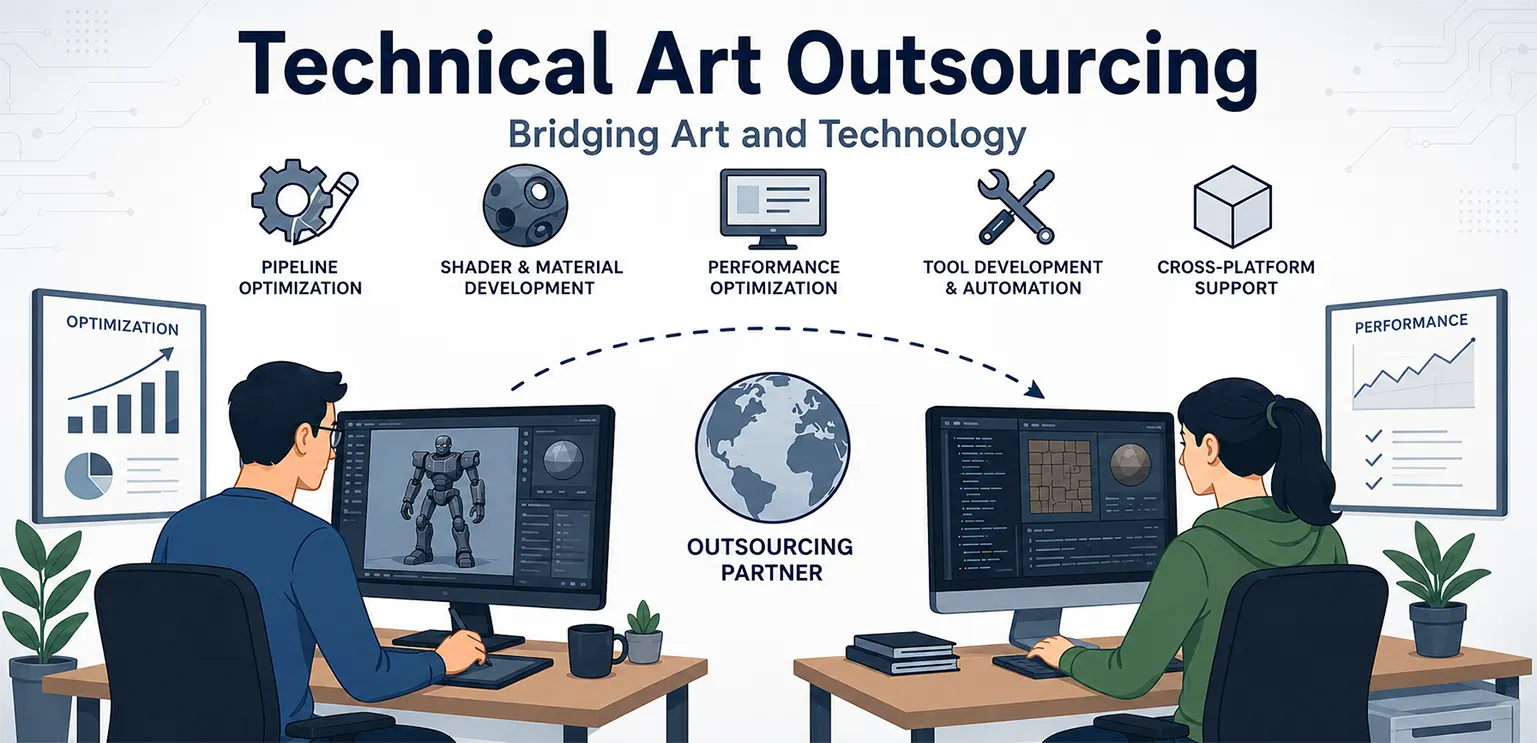
Instead of expanding internal teams indefinitely, many studios now outsource technical art to specialized partners who can provide expertise exactly when it is needed. Outsourcing has become more than a staffing solution—it has become a strategic way to improve production efficiency, reduce technical risks, and accelerate development without compromising quality.
What Is Technical Art?
Technical art sits at the intersection of art and engineering. Unlike concept artists or 3D modelers who focus primarily on creating visual assets, technical artists ensure that those assets work efficiently within the game engine. They bridge the gap between creative teams and programmers by solving production challenges that involve both artistic quality and technical performance. Typical responsibilities include:
- Asset optimization
- Shader development
- Material creation
- Lighting implementation
- Rigging support
- Animation pipelines
- VFX integration
- Performance optimization
- Tool development for artists
- Engine integration
Because technical artists understand both visual production and software systems, they play a vital role in keeping projects efficient and scalable.
Why Demand for Technical Artists Is Growing
Game development pipelines have changed dramatically over the last decade. Modern productions involve:
- High-resolution assets
- Real-time rendering
- Advanced lighting systems
- Complex animation workflows
- Cross-platform deployment
- Live service updates
- Larger production teams
Every new technology introduces additional technical complexity. Studios need specialists who can ensure that artists and engineers work together efficiently while maintaining performance targets across multiple platforms. As development pipelines continue to expand, demand for experienced technical artists continues to outpace supply.
Why Hiring Technical Artists Is So Challenging
Unlike many production roles, technical art requires expertise across multiple disciplines. An effective technical artist often needs knowledge of:
- 3D art production
- Programming fundamentals
- Game engines
- Rendering pipelines
- Animation systems
- Optimization techniques
- Scripting languages
- Production workflows
Professionals with this combination of skills are relatively rare. Competition for experienced technical artists is intense, particularly among AAA studios, mobile developers, casino game providers, and live service teams. For many companies, recruitment cycles can take months, delaying production schedules and increasing project costs.
Why Studios Are Turning to Technical Art Outsourcing
Outsourcing allows studios to access specialized expertise without committing to permanent hiring. Rather than maintaining a large internal technical art department throughout the year, studios can bring in experienced specialists during production phases where their expertise creates the most value. Technical art outsourcing is commonly used for:
- Production optimization
- Engine setup
- Shader development
- Art pipeline improvements
- Performance analysis
- Asset validation
- Platform optimization
- Tool creation
This flexible approach enables teams to solve technical challenges quickly while maintaining efficient resource allocation.
Technical Artists Improve More Than Visual Quality
Many people associate technical artists primarily with graphics. In reality, their contribution extends far beyond visual improvements. A skilled technical artist helps optimize the entire production pipeline by reducing manual work, improving asset consistency, and enabling artists to produce content more efficiently. Their work often leads to:
- Faster asset integration
- Reduced production bottlenecks
- Better collaboration between teams
- Lower rendering costs
- Improved runtime performance
- More efficient iteration cycles
These improvements affect nearly every department involved in game development.
The Role of Technical Art in Mobile Game Development
Mobile platforms introduce unique technical constraints. Limited hardware resources require careful optimization without sacrificing visual quality. Technical artists help mobile teams achieve this balance by optimizing:
- Texture memory
- Draw calls
- Material complexity
- Lighting systems
- Particle effects
- UI rendering
- Animation performance
For mobile casino games in particular, technical artists ensure that visually engaging experiences remain responsive across a wide range of devices.
Supporting Cross-Platform Development
Many modern games launch simultaneously across multiple platforms. Each platform introduces different hardware capabilities and technical limitations. Technical artists play an important role in adapting assets and rendering systems for:
- Mobile devices
- PC
- Consoles
- Web platforms
- Emerging cloud gaming environments
Rather than maintaining separate production workflows, studios often rely on technical artists to build scalable solutions that support multiple deployment targets from a unified pipeline. This improves both development efficiency and long-term maintainability.
Technical Art and Live Service Games
The rise of live service games has increased demand for continuous optimization. Games that receive regular content updates require pipelines capable of supporting rapid asset production without degrading performance over time. Technical artists contribute by:
- Optimizing new content
- Maintaining consistent asset standards
- Improving deployment workflows
- Supporting seasonal updates
- Automating repetitive production tasks
As live service models become more common, technical art has become a long-term operational necessity rather than a one-time production role.
Automation Is Increasing the Value of Technical Artists
Automation is transforming how game assets are created and managed. Technical artists frequently develop tools that automate repetitive production tasks, allowing creative teams to spend more time on artistic work. Examples include:
- Asset validation tools
- Batch processing systems
- Export automation
- Naming convention enforcement
- Material generation workflows
- Pipeline scripting
Automation not only improves productivity but also reduces human error and maintains production consistency across large teams. This ability to improve workflows makes technical artists valuable beyond their immediate production responsibilities.
How Outsourced Technical Artists Integrate with Internal Teams
Successful outsourcing depends on integration rather than isolation. Experienced technical art partners typically work alongside internal artists, programmers, and producers using the studio's existing workflows and collaboration tools. Their responsibilities often include:
- Supporting production pipelines
- Solving technical challenges
- Reviewing asset performance
- Assisting with engine implementation
- Collaborating during milestone reviews
When communication and documentation are well structured, outsourced technical artists become an extension of the internal development team rather than an external service provider.
Choosing the Right Technical Art Partner
Selecting a technical art outsourcing partner requires more than reviewing a portfolio. Studios should evaluate:
- Engine expertise (Unity, Unreal Engine, Cocos Creator, etc.)
- Technical problem-solving capabilities
- Pipeline experience
- Optimization knowledge
- Communication processes
- Scalability
- Experience with similar game genres
A partner who understands both production workflows and engineering requirements will contribute far more effectively than one focused solely on visual asset creation.
Studios such as Gamix Labs support game developers through technical art services that integrate with existing pipelines, helping optimize assets, improve performance, and streamline production for mobile, casino, and cross-platform projects.
Future Trends in Technical Art Outsourcing
The responsibilities of technical artists continue to expand as production technologies evolve. Several trends are shaping the future of technical art:
- AI-assisted asset optimization
- Procedural content workflows
- Advanced shader development
- Real-time rendering improvements
- Automated production pipelines
- Cloud-based collaboration tools
- Cross-platform optimization strategies
As development complexity increases, technical artists will become even more central to successful production pipelines. Studios capable of accessing specialized technical expertise quickly will maintain a significant competitive advantage.
Strategic Takeaways for Studios
Technical art is no longer a supporting discipline confined to large AAA productions. It has become a critical function for studios developing games across virtually every platform and genre. Organizations that outsource technical art effectively gain several advantages:
- Faster production pipelines
- Improved performance optimization
- Better collaboration between artists and engineers
- Reduced production bottlenecks
- Greater scalability
- Access to highly specialized expertise
Rather than replacing internal teams, outsourced technical artists strengthen development pipelines by addressing highly technical challenges that require specialized knowledge.
Conclusion
As game development becomes more technically demanding, the need for experienced technical artists continues to grow. Their ability to bridge creative and engineering disciplines makes them essential for building high-quality, high-performance games that scale across multiple platforms.
Because experienced technical artists remain in limited supply, outsourcing has become an increasingly practical solution for studios seeking flexibility, specialized expertise, and production efficiency.
The future of technical art outsourcing is not driven by cost reduction alone. It is driven by the industry's need for faster workflows, stronger optimization, and smarter production systems.
Studios that integrate technical art expertise into their development strategy—whether internally, externally, or through hybrid teams—will be better equipped to meet the demands of modern game production.
FAQs
What does a technical artist do in game development?
A technical artist bridges the gap between art and programming by optimizing assets, creating shaders, improving pipelines, and ensuring game performance.
Why is technical art outsourcing becoming more popular?
It provides studios with access to specialized expertise without the long-term cost and complexity of hiring full-time specialists.
Which game development tasks are commonly outsourced to technical artists?
Shader development, performance optimization, pipeline automation, rigging support, VFX integration, engine implementation, and asset optimization.
Is technical art important for mobile games?
Yes. Technical artists help optimize memory usage, rendering performance, animations, and visual quality across different mobile devices.
Can outsourced technical artists work with internal teams?
Yes. Most experienced technical art partners integrate directly into existing production pipelines and collaborate closely with artists, engineers, and producers.
How do studios choose a technical art outsourcing partner?
They evaluate technical expertise, engine experience, communication processes, workflow compatibility, optimization skills, and the ability to support long-term production goals.