Outsourcing vs In-House Game Development: When Should You Choose Each?
One of the biggest decisions any game studio, publisher, or startup faces is whether to build an internal development team or work with an external development partner.
For years, many studios believed that hiring in-house was the only way to maintain quality and creative control, while outsourcing was primarily a cost-saving option. Today, that mindset has changed dramatically.
Modern game development is faster, more complex, and increasingly specialized. Studios now build games for multiple platforms, support live service operations, release frequent updates, and compete in a market where production speed is just as important as creative quality. As a result, outsourcing has become a strategic production model rather than simply a way to reduce expenses.
The real question is no longer "Should we outsource?" Instead, it is "Which parts of development should remain in-house, and which can be handled more effectively by external specialists?" Understanding that balance is essential for building sustainable production pipelines.
Understanding the Two Development Models
Before comparing the two approaches, it is important to understand what each model represents.
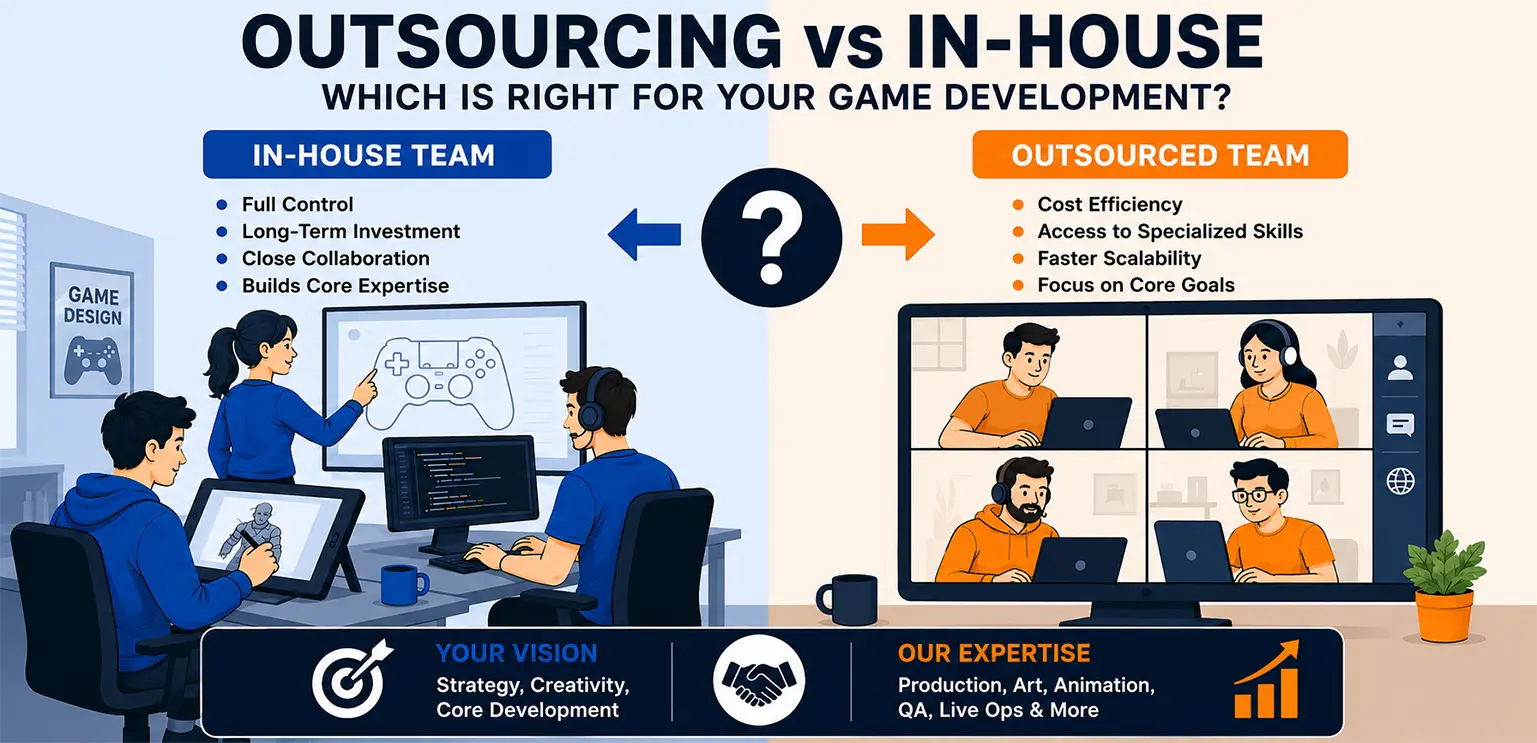
An in-house team consists of full-time employees who work exclusively for the studio. These teams usually manage long-term product vision, core technology, creative leadership, and strategic planning.
An outsourced team consists of external specialists or development studios contracted to deliver specific services, production capacity, or technical expertise. Depending on the engagement, they may support individual milestones or become long-term production partners integrated into the studio's workflow.
Neither model is inherently better. The right choice depends on business goals, project scope, available resources, and production timelines.
When Hiring an In-House Team Makes More Sense
Building an internal team is often the right decision when a studio requires continuous collaboration and long-term ownership of its products.
Internal teams are particularly valuable for areas that define the identity of a game, such as gameplay systems, creative direction, technical architecture, and product strategy. These responsibilities benefit from daily communication and close alignment with the company's vision.
Hiring in-house is also advantageous when a studio plans to develop multiple projects over several years using the same core technology or production pipeline. In these situations, investing in permanent talent creates long-term organizational knowledge and operational stability.
However, building an internal team requires significant investment in recruitment, onboarding, salaries, infrastructure, software licenses, employee benefits, and management. For growing studios, these commitments can quickly become substantial.
When Outsourcing Becomes the Smarter Business Decision
Outsourcing is often the better option when studios need to expand production capacity quickly or require specialized expertise that is not available internally.
Instead of spending months recruiting new employees, external partners can often begin contributing within days or weeks. Studios frequently outsource when they need support with:
- Game art production
- UI/UX design
- Animation
- Technical art
- Quality assurance
- Live Ops content
- Platform integration
- Performance optimization
This approach allows internal teams to remain focused on strategic work while external specialists handle production-intensive tasks. For projects with fixed timelines or temporary workload increases, outsourcing provides flexibility that permanent hiring cannot easily match.
Comparing Cost Beyond Salaries
Many discussions about outsourcing focus solely on labor costs, but the financial comparison is much broader.
Hiring an employee involves more than paying a monthly salary. Studios must also account for recruitment costs, onboarding time, hardware, software, workspace, training, management, and long-term employment commitments.
Outsourcing shifts much of this operational overhead to the development partner. Instead of paying to maintain production capacity year-round, studios pay for the expertise and deliverables they need during a specific phase of development. This often improves cost efficiency, particularly for specialized roles that are only required periodically.
That said, outsourcing should not be viewed as the cheapest option. High-quality external partners provide significant value, and that expertise comes at a premium. The objective is to improve return on investment, not simply reduce expenses.
Speed and Scalability: A Major Advantage of Outsourcing
One of the strongest advantages of outsourcing is scalability. Production demands rarely remain constant throughout a game's lifecycle. Studios often experience spikes during:
- Pre-production
- Vertical slice development
- Content creation
- Feature expansions
- Platform launches
- Seasonal updates
Hiring permanent employees for short-term workload increases can create unnecessary long-term costs. External development allows studios to scale production resources up or down as project requirements evolve. This flexibility is especially valuable for live service games and publishers managing multiple titles simultaneously.
Access to Specialized Expertise
Modern game development covers a wide range of disciplines, and not every studio needs every specialist on a permanent basis.
For example, a project may require an experienced technical artist for a few months, a UI designer during production, or a certification expert before launch. Maintaining all of these specialists internally is rarely practical. Outsourcing gives studios access to experienced professionals without expanding permanent headcount. This enables teams to solve highly specific production challenges while maintaining operational efficiency.
Creative Control Does Not Depend on Team Location
One of the most persistent myths surrounding outsourcing is that creative control is lost when production moves outside the studio. In reality, creative leadership is determined by process—not geography. Successful studios maintain creative control by keeping responsibility for:
- Product vision
- Gameplay design
- Art direction
- Narrative
- Technical standards
- Final approvals
External teams execute work within clearly defined guidelines. When documentation, communication, and review systems are well established, outsourced production can achieve the same level of consistency as internal development.
The Hybrid Model Is Becoming the Industry Standard
Increasingly, studios are choosing a hybrid approach rather than committing exclusively to one model. In this structure, internal teams focus on strategic responsibilities while external partners handle scalable production work. A typical hybrid model might look like this:
- Internal teams define product vision and core systems
- External partners produce game art, UI, animation, QA, or Live Ops content
- Internal leadership reviews, integrates, and approves deliverables
This approach combines the stability of internal leadership with the flexibility of outsourced production. Many AAA studios, mobile developers, and casino game providers now operate using hybrid production pipelines because they balance quality, speed, and scalability effectively.
Common Mistakes Studios Make When Choosing Between the Two
The decision between outsourcing and hiring often fails because studios evaluate the wrong criteria. Some organizations hire permanent employees for temporary production needs, creating unnecessary long-term costs. Others outsource highly strategic work without establishing proper documentation or review processes, leading to communication challenges and inconsistent results.
Successful decision-making starts by identifying which responsibilities create long-term value and which are production-intensive. The goal should be to build the right team structure rather than simply choosing one model over another.
A Practical Framework for Making the Right Decision
Instead of asking whether outsourcing or hiring is better, studios should evaluate several practical questions before making a decision.
🔹 Consider outsourcing if:
- You need to scale production quickly
- The project requires specialized expertise
- Workload is temporary or milestone-based
- Time-to-market is a priority
- Internal teams are already operating at capacity
🔹 Consider hiring internally if:
- The role supports long-term product strategy
- Continuous collaboration is essential
- The expertise will be needed across multiple future projects
- The position involves creative leadership or core technology
Studios that evaluate these factors objectively are more likely to build efficient and sustainable production models.
How External Development Partners Support Studio Growth
The role of external development has expanded significantly over the past decade. Rather than functioning solely as vendors, many partners now integrate directly into production pipelines.
Studios such as Gamix Labs support developers through scalable services that include game art, UI/UX, animation, engineering support, Live Ops content, and full-cycle game development. By aligning with internal workflows and production standards, external teams can accelerate delivery without disrupting creative direction. This collaborative approach enables studios to grow efficiently while maintaining consistent quality.
Future Trends in Game Development Team Structures
As games become larger and production cycles become more continuous, the distinction between internal and external teams is expected to become less significant. Several trends are shaping the future of studio organization:
- Hybrid production models
- Embedded external teams
- AI-assisted content creation
- Specialized technical partnerships
- Global collaboration pipelines
- Flexible workforce planning
Studios that embrace adaptable production strategies will be better positioned to respond to changing market demands and development challenges.
Strategic Takeaways for Studios and Publishers
Choosing between outsourcing and hiring is not about selecting a single approach for every situation. The most successful studios build team structures based on project requirements rather than tradition. They retain strategic ownership internally while expanding production through trusted external partners when necessary. Key principles include:
- Keep creative leadership in-house
- Outsource specialized or scalable production tasks
- Build strong documentation and review systems
- Treat external teams as production partners, not isolated vendors
- Align team structure with long-term business goals
When these principles are followed, outsourcing and internal hiring become complementary strategies rather than competing options.
Conclusion
The debate between outsourcing and in-house development is no longer about choosing one over the other. Modern game development requires flexibility, specialized expertise, and scalable production systems that can adapt to changing project demands.
Hiring internally remains essential for long-term leadership, product vision, and core technology. Outsourcing, meanwhile, enables studios to expand production capacity, accelerate delivery, and access specialized talent without the long-term commitments of permanent hiring.
The strongest studios understand that sustainable growth comes from combining both models strategically. Instead of asking which approach is better, the better question is: which model will help this project succeed most efficiently? The answer will often involve a thoughtful combination of both.
FAQs
Is outsourcing game development cheaper than hiring in-house?
Not always. Outsourcing reduces operational overhead but should be evaluated based on overall return on investment rather than hourly costs alone.
What parts of game development are commonly outsourced?
Game art, animation, UI/UX, QA, technical art, engineering support, Live Ops content, and platform integrations.
Should startups outsource game development?
Many startups benefit from outsourcing because it provides access to specialized expertise without the expense of building a large permanent team.
Can studios maintain creative control while outsourcing?
Yes. Creative control remains with the studio when clear documentation, review processes, and approval systems are in place.
What is a hybrid development model?
A hybrid model combines an internal leadership team with external production specialists to improve scalability and efficiency.
When should a studio hire instead of outsource?
Hiring is generally the better option for long-term strategic roles, core technology development, and creative leadership positions.