How AI-Driven UI/UX Testing Improves Casino Game Performance
In casino game development, visual quality and mathematical design often receive the most attention. While both are essential, they do not guarantee a successful player experience. Even a well-designed game can struggle if players find the interface confusing, important controls difficult to access, or core features hard to understand.
User Interface (UI) and User Experience (UX) design have become critical components of modern casino game development. Every interaction—from launching the game and adjusting settings to triggering bonus features and viewing payouts—affects how players perceive the overall experience.
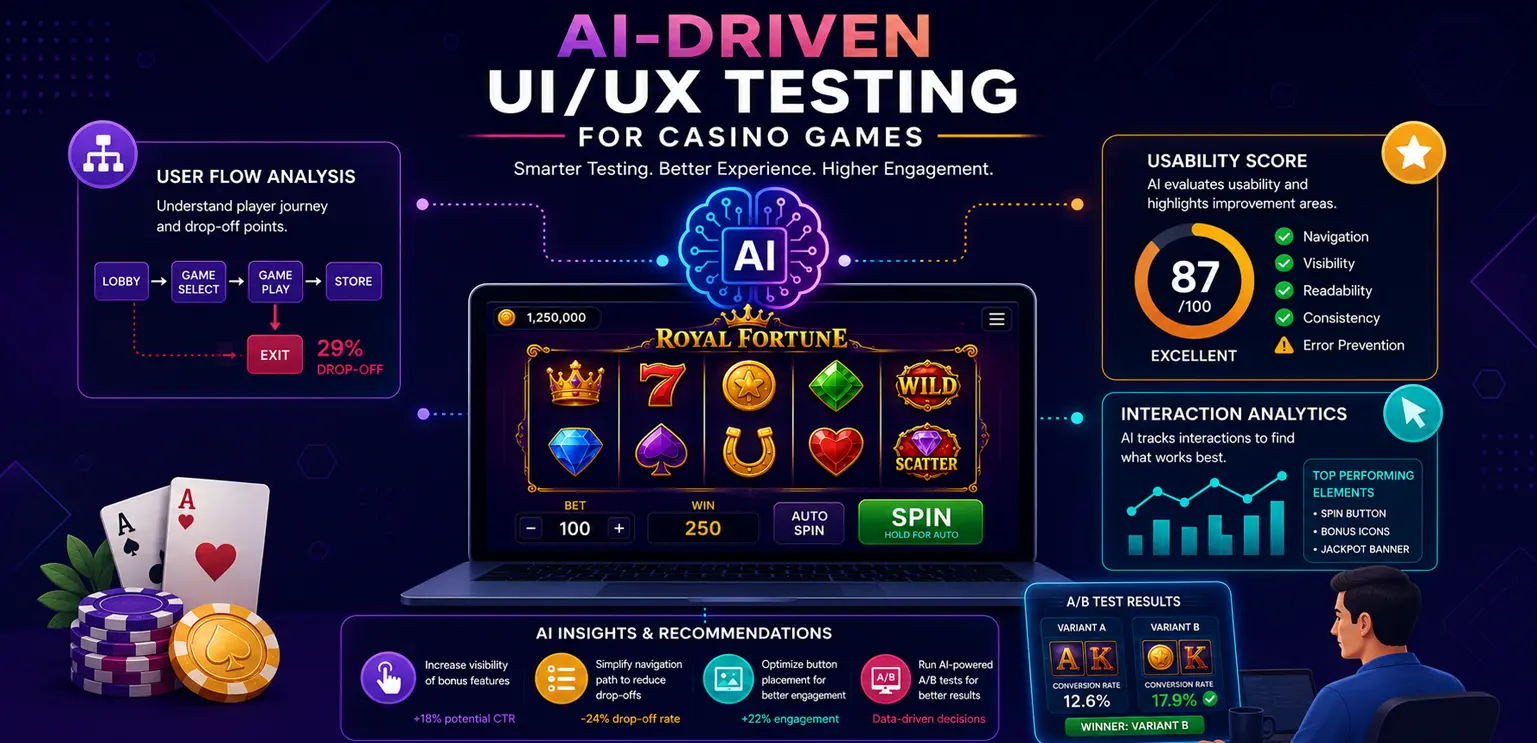
Traditionally, improving UI/UX relied on designer reviews, internal testing, player feedback, and analytics collected after release. Today, Artificial Intelligence (AI) is helping studios evaluate interfaces much earlier in development by identifying usability issues, predicting player behavior, and accelerating testing workflows.
Rather than replacing designers or QA teams, AI provides an additional layer of analysis that enables studios to make faster, data-driven design decisions.
Why UI/UX Matters in Casino Games
Casino games are designed to deliver quick, intuitive, and visually engaging experiences. Players expect to understand the interface almost immediately without reading lengthy instructions. A well-designed UI reduces friction, while a strong UX keeps players engaged by making every interaction feel natural and responsive. Effective UI/UX influences many aspects of the player journey, including:
- First-time onboarding
- Navigation between menus
- Bonus feature discovery
- Accessibility
- Session flow
- Visual clarity
- Feature engagement
- Overall player satisfaction
Small usability improvements often lead to noticeable gains in engagement and retention.
The Challenges of Traditional UI/UX Testing
Conventional usability testing typically combines internal QA sessions, designer evaluations, player interviews, and analytics. Although these methods remain valuable, they also have limitations.
Teams often discover interface problems late in development, after assets have already been finalized or features have been integrated. At that stage, making significant UI changes can increase production costs and delay release schedules.
In addition, human testing alone may overlook subtle patterns in player behavior that become visible only after thousands of interactions. AI helps address these limitations by analyzing larger datasets and identifying usability trends much earlier.
What Is AI-Driven UI/UX Testing?
AI-driven UI/UX testing uses machine learning and data analysis to evaluate how players interact with a game's interface. Instead of relying solely on manual observation, AI analyzes interaction data to identify patterns, predict user behavior, and highlight areas that may create confusion or reduce engagement. Depending on the development workflow, AI can support:
- Interface analysis
- Navigation evaluation
- Interaction heat-maps
- Click pattern analysis
- Session flow optimization
- Accessibility reviews
- Design consistency checks
- Usability reporting
The goal is to help designers improve the player experience before launch.
Identifying Friction Before Players Do
One of AI's greatest strengths is detecting areas where players may hesitate or abandon a task.
For example, AI can identify situations where users repeatedly pause before pressing a button, revisit the same menu several times, or ignore a key feature because it is not visually prominent.
These patterns help designers understand where improvements may be needed. Instead of relying entirely on assumptions, studios can base design decisions on measurable interaction data.
Improving Navigation and Information Hierarchy
Casino games present players with a variety of information, including balance displays, betting controls, game settings, bonus details, and promotional content. If this information is poorly organized, players may struggle to locate important functions. AI assists designers by analyzing navigation flows and identifying opportunities to improve:
- Menu organization
- Button placement
- Visual hierarchy
- Information grouping
- Screen transitions
- Interaction efficiency
These insights contribute to interfaces that feel more intuitive without increasing visual complexity.
AI Helps Optimize Mobile Experiences
Most casino games are now designed with mobile players in mind. Mobile interfaces introduce complex usability challenges, including touch accuracy, adaptive layouts, responsive scaling, and visual clarity across different devices—areas where AI-driven testing can identify optimization opportunities early in development. AI supports mobile optimization by evaluating:
- Touch target sizes
- Layout responsiveness
- Screen readability
- Gesture interactions
- Orientation changes
- Device compatibility
These evaluations help ensure that the interface performs consistently across a wide range of smartphones and tablets.
Supporting Accessibility in Casino Games
Accessibility is becoming an increasingly important consideration in game development. A more inclusive interface benefits a wider audience and often improves usability for all players. AI can assist accessibility reviews by identifying potential issues related to:
- Text readability
- Color contrast
- Font scaling
- Interface consistency
- Visual clutter
- Navigation complexity
Human designers remain responsible for implementing accessibility improvements, but AI helps identify areas that deserve closer attention.
AI and A/B Testing for UI Decisions
Design teams frequently debate which interface variation will perform best. Rather than relying solely on personal preference, AI supports structured A/B testing by helping analyze player interactions across different UI versions. Studios commonly test:
- Button styles
- Navigation layouts
- Bonus entry points
- Information placement
- Color emphasis
- Call-to-action elements
Performance metrics such as engagement, interaction frequency, and feature discovery provide objective guidance for design improvements.
Enhancing Live Ops Through Continuous Testing
Modern casino games often operate as live products with regular content updates. Every new feature, event, or promotional campaign introduces changes to the interface. AI enables studios to monitor these updates continuously, helping teams identify usability issues before they affect large numbers of players. This ongoing evaluation supports:
- Seasonal events
- Feature updates
- Promotional campaigns
- Loyalty systems
- Tournament interfaces
- Limited-time content
Continuous optimization allows Live Ops teams to improve the player experience over time rather than relying only on pre-launch testing.
Human Designers Still Make the Creative Decisions
Although AI provides valuable insights, it does not replace UX designers. Design professionals understand player psychology, branding, visual storytelling, and emotional engagement—areas where human expertise remains essential. AI answers questions such as:
- Where do players hesitate?
- Which buttons receive the most attention?
- Which layouts perform better?
Designers decide how those insights should influence the final user experience. The strongest interfaces emerge when analytical data and creative thinking work together.
Integrating AI Into UI/UX Workflows
Studios typically integrate AI into existing design processes rather than building entirely new workflows. A common pipeline includes:
- Designers define interface objectives.
- Initial UI concepts are created.
- AI evaluates usability patterns.
- Internal teams review AI-generated insights.
- Selected improvements are implemented.
- QA and player testing validate the results.
- Live analytics continue refining the experience after launch.
This approach allows AI to support decision-making without disrupting established production pipelines.
Challenges of AI-Based UI Testing
Like any technology, AI has limitations.
Studios should avoid relying exclusively on automated recommendations because usability involves emotional and contextual factors that algorithms cannot fully understand. Important considerations include:
- Maintaining brand identity
- Preserving creative intent
- Validating AI recommendations with human testing
- Avoiding excessive optimization
- Protecting player privacy when analyzing interaction data
AI should complement—not replace—professional UX research and player feedback.
Combining AI With Professional UI/UX Services
Many game studios enhance AI-driven testing by collaborating with specialized UI/UX teams. Professional designers interpret AI-generated insights, refine interfaces, and ensure that every screen aligns with the game's visual identity and business objectives.
Studios such as Gamix Labs combine AI-assisted analysis with experienced UI/UX design, usability testing, and game art production to help developers create intuitive casino game interfaces that improve engagement while maintaining consistent brand quality.
Future Trends in AI-Powered UI/UX Testing
AI capabilities continue to evolve rapidly. Several emerging trends are expected to shape the future of casino game interface design:
- Predictive player behavior analysis
- Real-time interface optimization
- Personalized UI experiences
- Automated accessibility validation
- AI-assisted usability reporting
- Intelligent interaction analytics
- Cross-device UX optimization
As these technologies mature, AI will become an increasingly valuable decision-support tool for designers rather than a replacement for creative expertise.
Strategic Takeaways for Game Studios
Strong UI/UX design directly influences how players experience a casino game. Studios that integrate AI into usability testing gain several advantages:
- Earlier identification of usability issues
- Faster design iteration
- Improved navigation
- Better mobile optimization
- More informed A/B testing
- Higher production efficiency
- Data-driven design decisions
When combined with experienced designers and structured testing processes, AI helps create interfaces that are both intuitive and visually engaging.
Conclusion
A successful casino game depends on more than attractive graphics or engaging mechanics. The interface through which players interact with the game plays an equally important role in shaping the overall experience.
Artificial Intelligence is transforming UI/UX testing by enabling studios to analyze player interactions, identify usability challenges, and refine interface designs more efficiently than traditional methods alone.
However, AI delivers its greatest value when paired with experienced designers who understand player behavior, accessibility, branding, and creative storytelling.
By combining AI-powered analysis with human expertise, studios can build casino games that are easier to navigate, more enjoyable to play, and better positioned for long-term player engagement.
FAQ: AI-Driven UI/UX Testing for Casino Games
What is AI-driven UI/UX testing?
AI-driven UI/UX testing uses machine learning and interaction analysis to evaluate how players use a game's interface and identify opportunities for improvement.
How does AI improve casino game interfaces?
AI analyzes navigation patterns, interaction data, and usability metrics to help designers optimize layouts, controls, and player flows.
Can AI replace UI/UX designers?
No. AI provides analytical insights, but designers remain responsible for creative direction, branding, accessibility, and the overall player experience.
Why is UI/UX important in casino games?
A clear and intuitive interface improves usability, supports player engagement, and makes game features easier to understand.
Does AI help with A/B testing?
Yes. AI assists in evaluating different interface variations by analyzing and identifying which designs perform better and player behavior.
Should studios combine AI with professional UI/UX services?
Yes. Combining AI-powered insights with experienced UI/UX designers results in more effective interfaces and better overall game experiences.