How AI Is Transforming Store Asset Creation and A/B Testing for Game Publishing
For years, game studios invested the majority of their resources into gameplay, graphics, and monetization systems. While these elements remain critical, they represent only part of a game's commercial success. Before a player experiences the game, they first interact with its store listing.
Screenshots, feature graphics, icons, trailers, promotional banners, and descriptions collectively shape a player's first impression. Within seconds, users decide whether a game deserves their attention or whether they should continue scrolling.
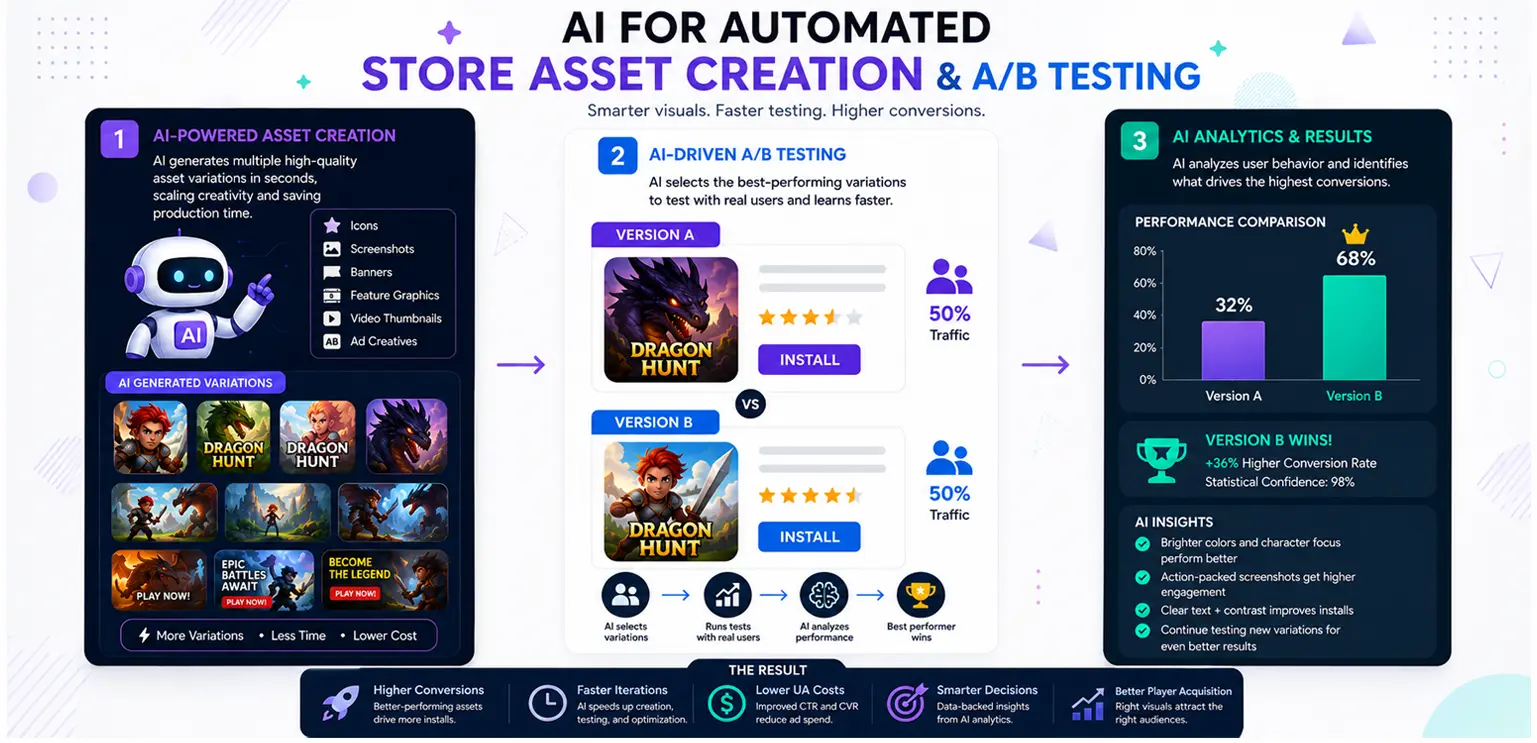
As competition across mobile, PC, HTML5, and casino gaming continues to increase, optimizing store assets has become an essential part of game publishing. Studios are no longer creating a single icon or a handful of screenshots and hoping for the best. Instead, they continuously test creative variations to identify what drives the highest conversion rates.
Artificial Intelligence (AI) is accelerating this process by helping studios generate creative assets faster, analyze performance data, and automate A/B testing workflows. Rather than replacing creative teams, AI enables designers and marketers to iterate more efficiently, allowing them to make data-driven decisions while reducing production time.
Why Store Assets Matter More Than Ever
A game's store page serves as its digital storefront. Regardless of how polished the gameplay may be, poor presentation can significantly reduce installation rates.
Players evaluate visual elements before reading detailed descriptions. An appealing icon, engaging screenshots, and a compelling promotional banner can dramatically influence whether a visitor becomes a player. Store assets commonly include:
- Game icons
- Screenshots
- Feature graphics
- Promotional banners
- Video thumbnails
- Store trailers
- Event artwork
- Localized marketing creatives
Together, these assets communicate the game's identity, visual quality, and value proposition within just a few seconds.
The Traditional Store Asset Workflow
Historically, creating store assets required extensive collaboration between marketing teams, designers, artists, producers, and publishing managers. The typical process involved:
- Designing initial concepts
- Producing multiple visual variations
- Internal reviews
- Manual editing
- Market localization
- Uploading assets
- Running performance tests
- Reviewing analytics
- Repeating the process
While effective, this workflow often consumed considerable time and resources. For games operating under Live Ops models, where promotions and seasonal events occur regularly, repeating this cycle every few weeks becomes increasingly demanding.
How AI Is Changing Store Asset Creation
Artificial Intelligence is significantly reducing the time required to produce marketing assets. Rather than starting every design from a blank canvas, AI-powered tools assist creative teams by generating multiple visual concepts based on predefined design directions. AI can support the creation of:
- Marketing layouts
- Promotional banners
- Screenshot compositions
- Background variations
- Typography suggestions
- Localized visual adaptations
- Seasonal campaign assets
- Color and composition alternatives
Designers remain responsible for creative direction, branding, and quality control, while AI accelerates repetitive production tasks. This collaboration allows studios to test more creative ideas without dramatically increasing production costs.
AI Enables Faster Creative Iteration
One of AI's greatest strengths is its ability to generate multiple design alternatives within minutes. Instead of investing days creating several promotional concepts, marketing teams can review dozens of variations before selecting the strongest candidates. For example, AI can rapidly generate different combinations of:
- Character placement
- Color palettes
- Background styles
- Promotional messaging
- Call-to-action positioning
- Visual hierarchy
Creative teams can then refine the most promising concepts rather than producing every variation manually. This dramatically shortens iteration cycles while encouraging greater experimentation.
Understanding A/B Testing in Game Publishing
A/B testing is one of the most valuable optimization techniques used in digital publishing. Rather than assuming which creative performs best, studios compare multiple asset versions using real player behavior. Common A/B testing elements include:
- App icons
- Store screenshots
- Promotional banners
- Video thumbnails
- Feature graphics
- Headlines
- Short descriptions
Performance is evaluated using metrics such as click-through rates, conversion rates, installs, and engagement. The objective is simple: allow player behavior—not opinion—to determine the most effective creative.
How AI Improves A/B Testing
Traditional A/B testing often requires manual planning, creative production, data collection, and performance analysis. AI helps automate much of this workflow. Modern AI systems can assist with:
- Generating test variations
- Identifying statistically meaningful results
- Detecting performance trends
- Recommending new creative concepts
- Predicting audience preferences
- Organizing testing schedules
Instead of simply reporting which variation performed better, AI can also help explain why certain visuals resonate with specific audiences. This enables more informed marketing decisions over time.
Personalization Through AI
Player preferences vary significantly across regions, age groups, and gaming genres. A promotional banner that performs well in one market may produce completely different results elsewhere. AI enables studios to create localized and audience-specific assets more efficiently by adapting:
- Language
- Colors
- Character emphasis
- Cultural references
- Promotional messaging
- Seasonal themes
This level of personalization improves engagement while reducing the manual effort required for global publishing campaigns.
AI Supports Live Ops Marketing
Live service games depend on continuous marketing updates. Every event, content expansion, or seasonal campaign requires fresh promotional assets. Instead of creating each campaign manually, AI helps teams rapidly generate new materials while maintaining visual consistency. Typical Live Ops assets include:
- Event banners
- Holiday promotions
- Reward announcements
- Tournament creatives
- Update graphics
- Limited-time offer visuals
By accelerating production, AI enables marketing teams to respond more quickly to content schedules and player engagement opportunities.
Human Creativity Still Leads the Process
Despite rapid advancements, AI does not replace creative professionals. Successful marketing still depends on understanding player psychology, brand identity, storytelling, and visual communication. AI excels at accelerating repetitive work and generating alternatives, but it lacks the strategic judgment required to define a game's positioning.
The most effective studios combine AI with experienced designers, marketers, and art directors who evaluate generated content before publication. Human creativity remains responsible for the final decision.
Integrating AI Into Publishing Pipelines
Studios adopting AI typically integrate it into existing production workflows rather than replacing established processes. A common pipeline includes:
- Marketing strategy defines campaign objectives.
- Designers establish creative direction.
- AI generates multiple visual concepts.
- Creative teams review and refine selected assets.
- Publishing teams launch A/B tests.
- Analytics measure player responses.
- AI assists with performance analysis and future recommendations.
This workflow allows organizations to maintain creative quality while increasing production speed and testing capacity.
Challenges of AI-Generated Store Assets
Although AI provides significant advantages, it also introduces several challenges. Studios should monitor:
- Brand consistency
- Visual originality
- Quality control
- Copyright compliance
- Localization accuracy
- Over-reliance on automation
AI-generated content should always undergo human review before publication. Creative oversight remains essential for protecting brand identity and ensuring professional-quality marketing materials.
Why Outsourcing and AI Work Well Together
Many game studios combine AI-powered production with external creative teams. Experienced outsourcing partners use AI to accelerate production while ensuring that assets meet professional design standards and platform requirements. External teams often provide:
- Creative direction
- AI-assisted design workflows
- Asset localization
- Store optimization
- Marketing artwork
- A/B testing support
- Performance analysis
Studios such as Gamix Labs integrate AI-assisted production into their game art and publishing workflows, helping clients create optimized store assets, promotional creatives, and scalable marketing campaigns while maintaining consistent visual quality.
Future Trends in AI-Powered Store Optimization
AI is expected to play an even greater role in game publishing over the coming years. Emerging developments include:
- Predictive conversion analysis
- Automated creative optimization
- Personalized store listings
- AI-generated promotional videos
- Dynamic marketing assets
- Real-time campaign optimization
- Cross-platform publishing automation
As these technologies mature, studios will gain the ability to optimize store performance continuously rather than relying on periodic manual updates.
Strategic Takeaways for Game Studios
Store optimization is no longer a one-time publishing task. It has become an ongoing process that directly influences player acquisition, marketing efficiency, and overall game performance. Studios adopting AI-powered workflows gain several advantages:
- Faster creative production
- More A/B testing opportunities
- Improved conversion optimization
- Better localization efficiency
- Reduced production costs
- Faster marketing iteration
- Data-driven creative decisions
Rather than replacing designers, AI enables creative teams to focus on strategy while automation handles repetitive production work.
Conclusion
The competition for player attention begins long before gameplay starts. Every icon, screenshot, banner, and promotional graphic contributes to a player's first impression and influences installation decisions. Artificial Intelligence is transforming how these assets are created, tested, and optimized by enabling studios to produce more creative variations, conduct smarter A/B testing, and respond more quickly to changing market conditions.
However, the greatest value of AI lies not in replacing creativity but in enhancing it. Studios that combine AI-powered automation with experienced designers and data-driven publishing strategies will be better positioned to improve conversion rates, strengthen brand identity, and scale marketing efforts efficiently.
As game publishing continues to evolve, AI-assisted store asset creation and A/B testing will become a standard component of successful marketing pipelines rather than an experimental advantage.
FAQs
What are store assets in game publishing?
Store assets include icons, screenshots, promotional banners, trailers, feature graphics, and other visual materials displayed on game store pages.
How does AI help create store assets?
AI generates creative variations, assists with layouts, automates repetitive design tasks, and speeds up the production of marketing materials.
What is A/B testing in game publishing?
A/B testing compares multiple versions of store assets to determine which performs better based on player behavior and conversion metrics.
Can AI replace game marketing designers?
No. AI supports designers by accelerating production and generating ideas, but creative strategy, branding, and final approvals remain human responsibilities.
Why is A/B testing important for game stores?
It helps studios identify which visuals and messaging attract more players, improving conversion rates and marketing performance.
Should studios combine AI with outsourcing?
Yes. Many studios work with external creative partners that use AI-assisted workflows to deliver high-quality, optimized store assets faster while maintaining professional design standards.