Branded vs Original Slot Games: ROI Comparison Guide
In the highly competitive iGaming industry, content strategy is everything. Casino operators and game studios constantly face a critical question: should they invest in branded slot games or build original IP titles?
Branded slots use recognizable names such as movies, celebrities, TV shows, music brands, or sports franchises to generate instant attention. Original IP slots, by contrast, give studios full creative control, stronger margins, and long-term ownership over the product and the brand behind it.
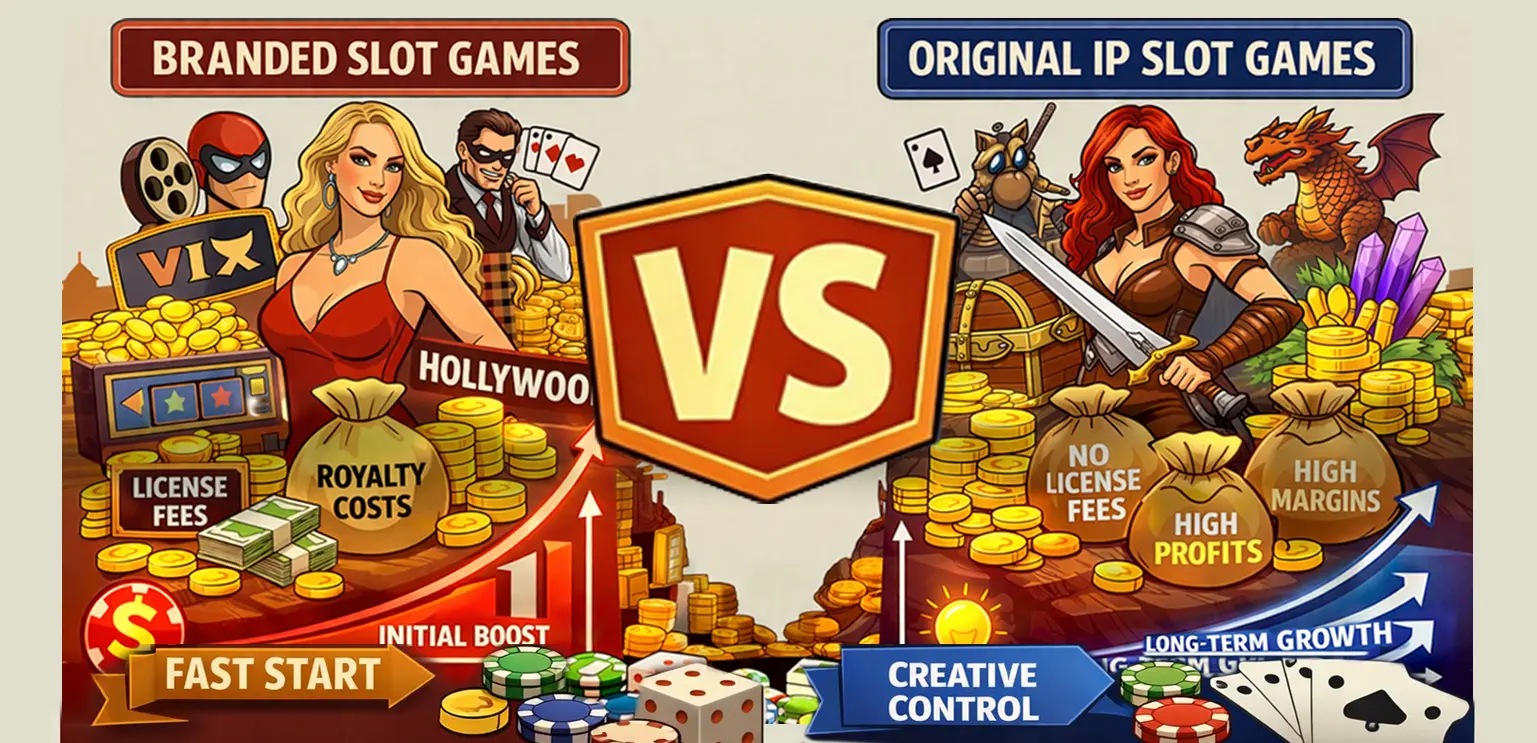
At first glance, branded games can look like the obvious winner because they benefit from built-in recognition and stronger launch visibility. But when you evaluate return on investment across acquisition cost, retention, licensing overhead, development complexity, and long-term scalability, the decision becomes much more nuanced.
This article breaks down the economics behind branded slot games versus original IP slots so studios and operators can make smarter portfolio decisions.
For studios planning a wider content roadmap, this choice also affects slot game art direction, production velocity, and how efficiently a game can evolve after launch.
Industry Context: Why This Debate Matters Now
The slot market has become crowded. Hundreds of new titles launch every month across:
- Regulated online casinos
- Social casino platforms
- Aggregator networks
- White-label casino ecosystems
Standing out is harder than ever.
Operators need games that can:
- Attract players quickly
- Retain engagement over time
- Generate consistent revenue
- Justify production and distribution costs
At the same time, user acquisition costs keep rising. That is forcing studios to think more carefully about where ROI actually comes from. A recognizable brand may help a game win attention at launch, but long-term profitability depends on what happens after that first click.
What Are Branded Slot Games?
Branded slot games are based on licensed intellectual property.
Common examples include:
- Movies and TV shows
- Celebrities and influencers
- Music artists and entertainment brands
- Sports teams and leagues
- Pop culture franchises
These games typically feature:
- Recognizable characters
- Familiar soundtracks or voice references
- Brand-specific visual themes
- Storytelling elements tied to the licensed property
The goal is straightforward: use brand recognition to lower friction and drive player engagement more quickly.
What Are Original IP Slot Games?
Original IP slots are created entirely by the studio or publisher. They are built around unique concepts rather than licensed brands and usually rely on:
- Original themes
- Studio-owned characters
- Unique visual identities
- Proprietary gameplay mechanics
Examples often include:
- Fantasy-themed slots
- Mythology-based games
- Adventure or treasure-hunt slots
- Character-led franchise concepts
Original IP requires the studio to build player interest without the shortcut of external brand recognition, but it also creates far more control over long-term commercial outcomes.
ROI Breakdown: Key Factors to Consider
To compare ROI properly, studios need to evaluate more than launch performance. The most useful comparison looks at acquisition, cost structure, retention, production efficiency, and long-term monetization potential.
1. Player Acquisition Cost (CAC)
🔹 Branded Slots
Branded games usually reduce acquisition friction. Players are more likely to click on a familiar name than on an unknown title, especially in crowded lobbies.
This can lead to:
- Higher click-through rates
- Faster adoption at launch
- Stronger initial conversion
- Better early visibility in casino promotion slots
However, lower friction does not mean lower total acquisition cost. Many licensing deals come with commercial requirements such as:
- Upfront licensing payments
- Minimum guarantees
- Revenue-sharing obligations
- Marketing commitments around the launch
So while branded content may improve top-of-funnel performance, the true CAC picture must include the cost of accessing that brand in the first place.
🔹 Original IP Slots
Original IP games rely much more heavily on:
- Strong art direction
- Differentiated gameplay features
- Effective marketing campaigns
- Platform merchandising support
Acquisition is usually harder at the beginning because players do not know the game yet. Trust and interest must be earned. But once an original title gains traction, acquisition efficiency can improve significantly because the studio is no longer paying for a license every time it wants to scale the title.
2. Licensing Costs and Revenue Share
This is often the biggest financial separation between the two models.
🔹 Branded Slots
Branded slot deals commonly include:
- Upfront licensing fees
- Ongoing royalty payments, often in the 5% to 15% range or higher
- Approval and compliance costs
- Contractual restrictions on how the game is marketed or updated
These costs directly compress profit margins. A title can perform well on revenue and still underperform on ROI if the licensing structure is too heavy.
🔹 Original IP Slots
Original titles usually avoid:
- Licensing fees
- Royalty obligations
- Revenue sharing with external IP holders
That means a larger share of the game's revenue stays with the studio or operator. For companies focused on long-term margin expansion, this is one of the strongest arguments in favor of original IP.
3. Player Retention and Engagement
🔹 Branded Slots
Branded games often win the first session because players recognize the theme. But recognition alone does not guarantee long-term retention.
If the gameplay loop is weak, several things happen quickly:
- The novelty of the brand wears off
- Players stop returning after initial curiosity
- Gameplay quality becomes the real retention driver
In practice, the brand may secure the download or the first spin, but mechanics determine whether the game remains commercially healthy.
🔹 Original IP Slots
Original IP games depend entirely on execution. Retention performance is tied to:
- Core game design
- Feature depth
- Reward pacing
- Bonus mechanics
- Live operations strategy
Studios that invest in compelling feature sets, balanced economies, and post-launch updates can create very strong long-term retention. Teams experienced in slot mechanics balancing and visual iteration often find that original IP gives them more room to refine engagement systems over time.
4. Development Complexity
🔹 Branded Slots
Working with licensed IP adds significant production overhead.
Studios usually need to:
- Follow strict brand guidelines
- Submit concept art and UI for approval
- Revise assets multiple times
- Align storytelling with the license owner
- Manage legal and marketing review cycles
This slows production and can reduce iteration speed. Even simple changes may require external sign-off.
🔹 Original IP Slots
Original IP allows:
- Faster iteration
- Greater creative flexibility
- Fewer approval bottlenecks
- More efficient art and animation pipelines
Studios like Gamix Labs frequently see original-IP projects move faster because teams can experiment more freely with slot symbol design and animation workflows without waiting for external approvals.
5. Long-Term Value and Scalability
🔹 Branded Slots
Branded slot games often have a limited commercial lifespan shaped by:
- License duration
- Renewal costs
- Brand relevance over time
- Restrictions on reuse or expansion
If the agreement expires, the studio may need to remove the game, stop promoting it, or rework it substantially. That makes it harder to build compounding long-term value.
🔹 Original IP Slots
Original IP creates assets the studio fully owns. Successful titles can be expanded through:
- Live Ops events
- Sequels and spin-offs
- Seasonal updates
- Character reuse across multiple games
- Franchise ecosystems
This is where original IP often becomes the stronger ROI play. A hit game is not just a one-time product; it becomes a reusable commercial foundation.
6. Marketing and Visibility
🔹 Branded Slots
Branded games offer clear marketing advantages, including:
- Recognizable themes
- Easier promotion in acquisition campaigns
- Better press and affiliate interest
- Cross-promotion opportunities with the licensed brand
This can make launch performance much stronger, especially for casual audiences or new-market entry strategies.
🔹 Original IP Slots
Original IP marketing depends more on execution, including:
- Strong creative campaigns
- Influencer or affiliate support
- In-platform promotion
- Memorable game identity
The downside is a slower start. The upside is that a successful original title can become its own recognizable brand over time, with no external owner taking a cut of future value.
Real-World ROI Scenario Comparison
To simplify the comparison, consider two hypothetical slot projects.
🔹 Branded Slot Game
- Licensing fee: $500,000
- Revenue share: 10%
- Strong initial acquisition
- Moderate long-term retention
🔹 Original IP Slot Game
- No licensing fee
- No royalty or revenue share
- Slower initial growth
- Stronger long-term retention potential
Outcome Over Time
| Factor | Branded Slot | Original IP |
|---|---|---|
| Launch Performance | High | Medium |
| Profit Margin | Lower | Higher |
| Long-Term Revenue | Medium | High |
| Scalability | Limited | Strong |
In many cases, the branded slot wins the first phase of the commercial cycle, but the original IP title produces better ROI over the full lifecycle of the game.
When Branded Slots Make Sense
Branded slots are often the right choice when the business goal is short-term visibility or accelerated market entry. They work well for:
- Entering new regulated markets
- Supporting high-profile launch campaigns
- Targeting casual audiences who respond to familiar themes
- Leveraging large fan bases attached to a known IP
If the strategic objective is immediate reach rather than maximum lifetime margin, branded content can be a strong fit.
When Original IP Is the Better Choice
Original IP is usually the better option for companies focused on durable portfolio value. It is especially effective for:
- Long-term portfolio building
- Studio-owned franchise development
- Innovation-driven slot roadmaps
- Scalable Live Ops strategies
- Margin-focused growth models
Studios aiming to build sustainable businesses often prioritize original IP because it compounds value instead of renting it.
Hybrid Strategy: The Best of Both Worlds
Many successful slots operators and studios do not treat this as a binary decision. Instead, they use a hybrid portfolio strategy.
That usually means:
- Using branded slots for player acquisition and lobby visibility
- Using original IP slots for retention, margin strength, and long-term portfolio control
This approach balances:
- Short-term growth
- Long-term sustainability
- Brand-driven discovery
- Studio-owned revenue expansion
For many content businesses, that is the most defensible strategy because it reduces dependency on any one commercial model.
Future Trends in Slot Game ROI Strategy
The economics of slot content are changing quickly. Several trends are making the branded versus original debate even more important.
🔹 Increasing Licensing Costs
Premium IP licenses are becoming more expensive as competition intensifies. That raises the threshold for branded games to deliver acceptable ROI.
🔹 Stronger Focus on Live Ops
Original IP titles are usually easier to update, rebalance, and expand over time. That makes them better suited to modern Live Ops models.
🔹 Brand Fatigue
Players are becoming less impressed by generic branded slots that rely on recognition but fail to deliver distinctive gameplay.
🔹 Rise of Studio-Owned Franchises
More studios are trying to build their own recognizable ecosystems rather than depend entirely on third-party entertainment brands. This shift aligns closely with long-term ownership and better margin control.
Conclusion: ROI Is About More Than Launch Performance
The branded-versus-original debate is not really about picking one model forever. It is about understanding what each type of game is designed to achieve.
Branded slots tend to:
- Drive faster acquisition
- Deliver stronger launch visibility
- Carry higher commercial overhead
Original IP slots tend to:
- Produce higher margins
- Support stronger long-term growth
- Depend more heavily on design quality and execution
For most studios and casino operators, the smartest decision is not choosing one side exclusively. It is building a content strategy that uses both models intentionally within a broader portfolio.
Teams that understand when to rent attention and when to own value will be in the strongest position to compete in the evolving iGaming market.
FAQ: Branded vs Original Slot Games
What is a branded slot game?
A branded slot game uses licensed intellectual property such as movies, TV shows, celebrities, or sports brands to attract players through recognition.
Are branded slot games more profitable?
Not always. Branded slot games can deliver strong launch performance, but licensing fees, royalty structures, and approval overhead can reduce long-term profitability.
Why do studios create original IP slot games?
Studios build original IP slot games to retain full ownership, avoid licensing fees, increase long-term margins, and create scalable franchises they control completely.
Which type of slot game has better player retention?
Retention usually depends more on game design quality than brand recognition. Original IP titles often perform better over time when they include strong mechanics, progression, and live operations support.
Do branded slots require longer development time?
Yes. Branded slots often take longer because studios must follow IP guidelines, manage asset approvals, and accommodate stakeholder feedback throughout production.
What is the best strategy for slot studios?
For many studios, a hybrid strategy works best: use branded slot games for visibility and acquisition, while using original IP games to build stronger margins and long-term portfolio value.