How Cross-Promotion Strategies Boost Engagement & Player Revenue in Games
For a long time, cross-promotion in games was treated as a simple marketing tool. Studios used it to redirect players from one title to another through banners or pop-ups. While this approach still exists, it no longer delivers meaningful results in today's competitive environment. Modern players expect seamless, integrated experiences—not interruptions.
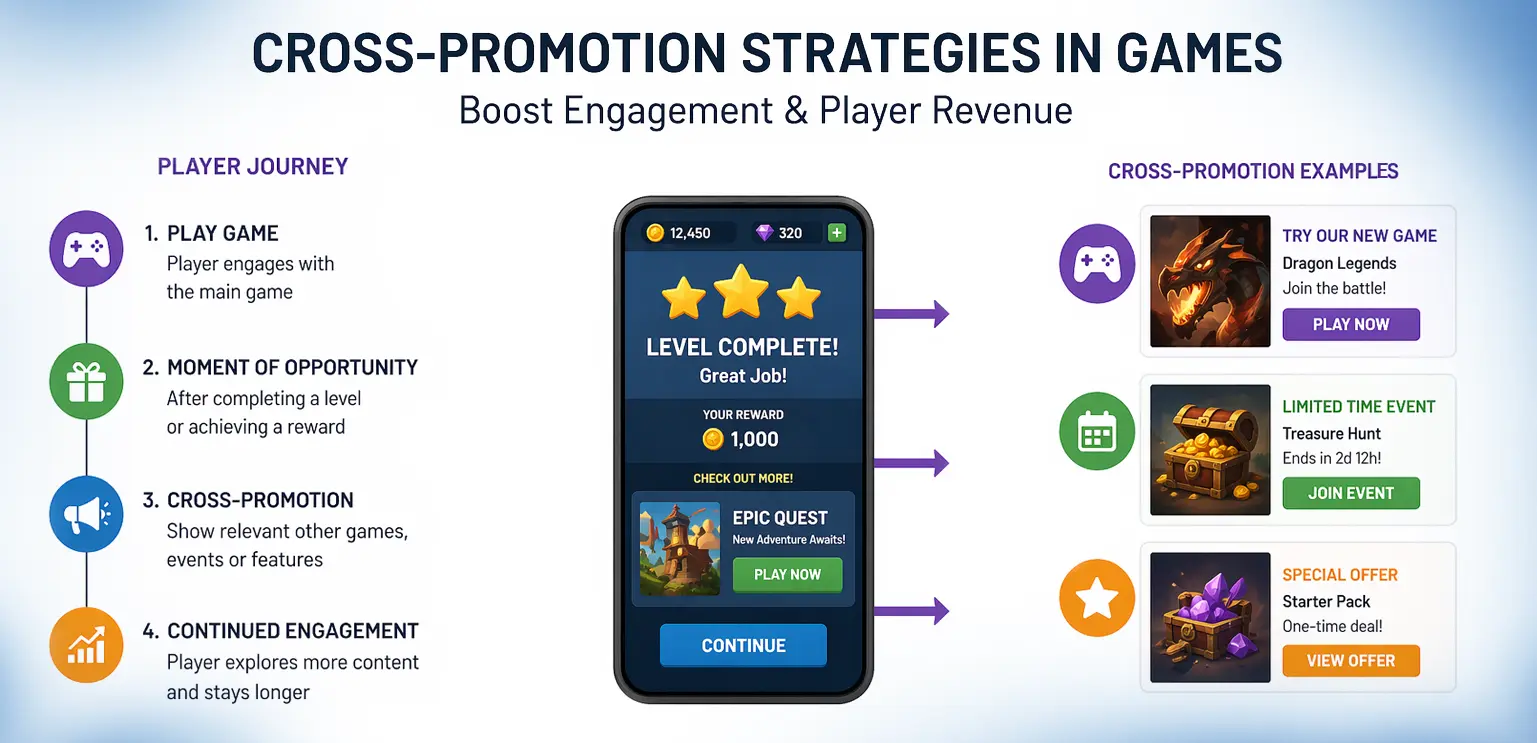
This shift has transformed cross-promotion into something far more important. It is now a core engagement and monetization system, deeply connected to gameplay loops, UI design, and Live Ops strategies. Studios that understand this evolution are not just increasing visibility across their portfolio. They are building connected ecosystems that maximize player lifetime value.
Industry Context: Why Cross-Promotion Matters More Than Ever
The gaming industry is more competitive than ever. User acquisition costs continue to rise, while player attention spans are shrinking. As a result, studios are shifting their focus from acquiring new players to maximizing the value of existing ones.
Cross-promotion plays a critical role in this strategy. Instead of treating games as isolated products, studios are designing ecosystems where players move fluidly between experiences. This reduces churn, increases retention, and strengthens overall engagement. It also aligns with Live Ops-driven models, where continuous updates require consistent visibility to remain effective.
What Is Cross-Promotion in Games?
Cross-promotion refers to promoting content, features, or other games within an existing game experience. However, modern cross-promotion is not just about visibility—it is about integration. Today, it includes:
- In-game feature promotion such as events and updates
- Ecosystem-level promotion across multiple titles
- Progression-linked rewards tied to cross-engagement
The goal is to create a system where players naturally discover new experiences without feeling pushed.
How Cross-Promotion Drives Engagement
🔹 Creating Continuous Player Journeys
One of the most powerful aspects of cross-promotion is its ability to extend player journeys. Instead of reaching a stopping point, players are guided toward new content or experiences. This keeps engagement flowing and reduces the likelihood of churn.
For example, after completing a level or session, players may be introduced to a new event, feature, or related experience within the ecosystem.
🔹 Reducing Player Drop-Off
Player drop-off often happens when there is nothing left to do. Cross-promotion solves this by continuously surfacing new opportunities. It replaces dead ends with new entry points, ensuring that players always have a reason to continue.
🔹 Enhancing Perceived Content Value
Even when core gameplay remains the same, cross-promotion can make a game feel more dynamic. By showcasing new features, events, and experiences, it creates the perception of ongoing content, which is essential for long-term engagement.
Where Cross-Promotion Performs Best in Real Production
In real production environments, cross-promotion performance depends heavily on timing and placement. Studios consistently find that the most effective moments occur during natural pauses in gameplay, when players are more receptive to new information. These moments include:
- After completing a level or session
- Immediately following rewards or achievements
- During transition screens or idle states
At these points, players are not actively focused on gameplay, making them more open to exploring additional content. In contrast, mid-game interruptions tend to perform poorly. They break immersion, reduce satisfaction, and are often ignored or dismissed.
This highlights a critical principle: placement matters more than visibility.
Cross-Promotion and Revenue Growth
🔹 Increasing Player Lifetime Value
Cross-promotion allows studios to extend monetization beyond a single experience. By keeping players within a connected ecosystem, studios can create multiple engagement and spending opportunities over time.
🔹 Driving Spending Through Context
Timing plays a crucial role in conversion. Promotions shown immediately after positive moments—such as rewards or achievements—are significantly more effective than those shown randomly. At these moments, players are more engaged and more likely to respond.
🔹 Supporting Live Ops Monetization
Live Ops relies on visibility. Events, updates, and limited-time content must be surfaced effectively to drive participation. Cross-promotion acts as the delivery layer, ensuring players are aware of and engaged with new opportunities.
Where Cross-Promotion Fits in Game Design
Cross-promotion is most effective when designed as part of the core system rather than added later. It integrates into:
- UI systems and navigation flows
- Gameplay loops and transition moments
- Reward systems and progression mechanics
The key is alignment with player experience. When integrated correctly, cross-promotion feels like a natural extension of the game rather than an external layer.
UI/UX Strategies That Make Cross-Promotion Work
Design determines whether cross-promotion feels helpful or intrusive. Effective systems are subtle, contextual, and visually aligned with the game's overall design language. They do not disrupt gameplay. Instead, they guide attention at the right moments. Studios that excel in this area treat cross-promotion as part of UX design, not marketing.
Teams like Gamix Labs contribute by building UI systems and visual frameworks that allow cross-promotional elements to blend seamlessly into the experience, maintaining consistency and clarity.
Common Mistakes in Cross-Promotion
Despite its importance, cross-promotion is often poorly executed. Overexposure is one of the most common problems. Too many prompts can overwhelm players and reduce effectiveness.
Another issue is poor timing. Promotions shown during active gameplay tend to disrupt the experience and are often ignored. Relevance is equally important. Generic or poorly targeted promotions fail to resonate with players. The result is a system that exists, but does not perform.
What High-Performing Studios Do Differently
The difference between effective and ineffective cross-promotion comes down to execution. High-performing studios treat cross-promotion as a system, not a feature. They focus on:
- Integrating promotions into natural gameplay flow
- Aligning content with player behavior and preferences
- Continuously optimizing placement using data
Less effective implementations rely on static banners or generic messaging, which quickly lose impact. The key distinction is adaptability. Successful systems evolve based on player interaction, while ineffective ones remain fixed.
The Psychology Behind Cross-Promotion Conversion
Cross-promotion works because it aligns with fundamental player behaviors. Players are more likely to engage when certain psychological triggers are present. These include:
- A sense of achievement after completing tasks
- Curiosity about new or unfamiliar content
- Low-effort transitions between experiences
When these elements are combined, cross-promotion feels intuitive rather than forced. This is where design and psychology intersect. Understanding these triggers allows studios to create systems that guide player behavior naturally, without relying on aggressive tactics.
Real-World Application: How Studios Use Cross-Promotion
In real production environments, cross-promotion is often personalized based on player behavior.
For example, players who engage frequently with competitive features may be shown event-based content or leaderboard systems.
Players who prefer casual experiences may be directed toward lighter gameplay modes or new content releases. This behavioral targeting increases relevance, making cross-promotion more effective and less intrusive. It also transforms cross-promotion into a dynamic system, rather than a static layer.
Cross-Promotion in Live Ops Systems
Live Ops has made cross-promotion essential. With constant updates, events, and seasonal content, studios need efficient ways to surface new experiences. Cross-promotion ensures that players are not only aware of updates but are actively guided toward them. It acts as the connection between content creation and player engagement.
Future Trends: Smarter and More Personalized Systems
Cross-promotion is becoming increasingly intelligent. Data-driven systems are enabling studios to tailor experiences based on player behavior, preferences, and engagement patterns. This shift will move cross-promotion away from static placements toward adaptive systems that respond in real time.
In the future, cross-promotion will feel less like marketing and more like guided discovery, helping players navigate content ecosystems effortlessly.
Strategic Takeaways for Studios
Cross-promotion is now a core system in modern game design. Studios that implement it effectively can extend player journeys, reduce churn, and increase overall revenue. Success depends on integration, timing, and relevance. It is not about showing more promotions—it is about showing the right content at the right moment.
Conclusion
Cross-promotion has evolved far beyond its original role as a marketing tactic. It is now a critical part of how games retain players, deliver content, and drive revenue. As the industry continues to shift toward Live Ops and ecosystem-driven models, its importance will only grow. Studios that approach cross-promotion strategically will create more engaging, more connected, and more successful gaming experiences.
FAQs
What is cross-promotion in games?
It is the practice of promoting content, features, or other games within an existing game experience.
How does cross-promotion increase engagement?
It keeps players engaged by continuously introducing new content and experiences, replacing dead ends with new entry points.
Where should cross-promotion be placed?
At natural pauses such as after rewards, level completion, or session transitions—when players are most receptive to new information.
What is the biggest mistake in cross-promotion?
Interrupting gameplay with poorly timed or irrelevant promotions. Mid-game interruptions break immersion, reduce satisfaction, and are often ignored.
Does cross-promotion increase revenue?
Yes, by extending player journeys and creating more opportunities for engagement and spending within a connected ecosystem.
What is the future of cross-promotion?
More personalized, data-driven systems that adapt to player behavior in real time, turning cross-promotion into guided discovery rather than marketing.