Metaverse and Blockchain: How They Are Connected
Over the past few years, the terms "metaverse" and "blockchain" have dominated conversations in gaming and technology. While they are often grouped together, many developers still view them as separate trends. In reality, they are deeply interconnected.
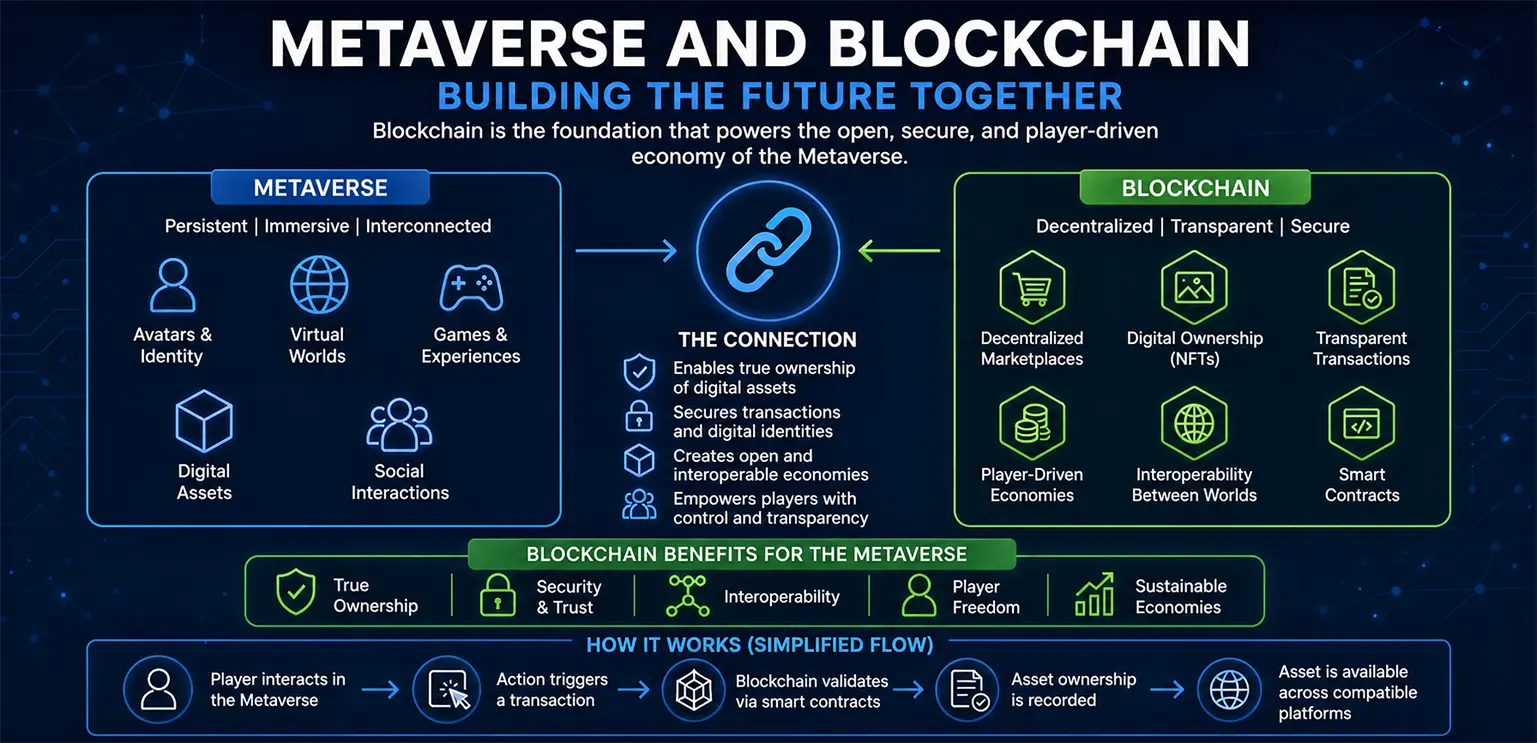
The metaverse represents persistent, shared digital environments where users interact, create, and transact. Blockchain provides the infrastructure that enables ownership, transparency, and decentralized control within those environments.
For game studios and developers, understanding this relationship is not just conceptual—it directly influences how future game systems and economies are designed.
Industry Context: Why This Relationship Matters Now
The gaming industry has already shifted toward persistent worlds, Live Ops systems, and player-driven economies. However, most of these systems remain centralized. Players can earn or purchase assets, but they rarely have true ownership. Everything exists within a controlled ecosystem.
As players invest more time and money into digital environments, this limitation becomes more significant. Blockchain introduces a new layer where ownership is verifiable and transferable, aligning naturally with the vision of persistent virtual worlds.
Understanding the Metaverse
The metaverse is best understood as a network of interconnected virtual environments rather than a single platform.
From a development perspective, it includes persistent identities, real-time interactions, and evolving digital economies. Players exist within these environments continuously, and their progress, assets, and identity remain intact over time. This persistence is what differentiates the metaverse from traditional session-based games.
What Blockchain Brings to the Metaverse
Blockchain provides the infrastructure that enables trust in decentralized systems. Without it, virtual environments rely entirely on centralized control, limiting ownership and interoperability.
Blockchain introduces a system where assets and transactions are transparent and verifiable. This enables:
- True digital ownership — assets belong to the player, not the platform.
- Decentralized marketplaces — peer-to-peer trading without intermediaries.
- Persistent economic systems — economies that are not tied to a single platform.
These capabilities form the core of what makes blockchain gaming fundamentally different from traditional game economies.
How Blockchain Integrates with Game Engines
From a development standpoint, blockchain does not replace game engines—it complements them. Game engines such as Unity or Cocos handle real-time gameplay, rendering, physics, and user interaction. Blockchain systems operate separately, focusing on ownership, transactions, and validation.
In production environments, this leads to a hybrid architecture where:
- Gameplay systems run off-chain for performance.
- Ownership and transactions are handled on-chain.
- Backend services act as a bridge between both systems.
This separation is critical. It ensures that gameplay remains smooth while still benefiting from blockchain capabilities.
Digital Ownership: The Core Connection
The most important connection between blockchain and the metaverse is ownership. In traditional games, assets are locked within the platform. Players can use them, but they do not truly control them.
Blockchain changes this by allowing assets to exist independently. Players can own, transfer, or trade them across systems, depending on compatibility.
For developers, this introduces new responsibilities. Systems must handle:
- Ownership validation — confirming a player's right to an asset.
- Asset synchronization — keeping on-chain and in-game states aligned.
- Cross-environment compatibility — supporting assets across different platforms.
Decentralized Economies and Player-Driven Value
Blockchain enables player-driven economies where value is influenced by demand, scarcity, and utility. This represents a shift from developer-controlled systems to more open economic models.
However, it also introduces complexity. Developers must design systems that remain balanced even when players control asset flow and pricing. This requires a deeper understanding of economic design, not just gameplay mechanics.
Smart Contracts and Game Logic
Smart contracts are a key component in blockchain systems. They automate transactions and enforce rules without relying on centralized systems.
In gaming, they can handle:
- Asset transfers between players.
- Reward distribution based on in-game outcomes.
- Marketplace interactions such as listing, bidding, and purchasing.
However, smart contracts are not suitable for real-time gameplay logic due to latency and cost constraints. This is why most implementations use smart contracts for backend validation while keeping gameplay systems within the game engine.
Real-World Applications in Gaming
In current production environments, blockchain is rarely used as a standalone system. Instead, studios implement it selectively:
- Some games use blockchain for asset ownership and trading, while core gameplay remains unchanged.
- Others experiment with persistent identities or cross-platform economies.
- A growing number of projects explore interoperable digital items that work across multiple game worlds.
The most effective implementations treat blockchain as a supporting system rather than the core experience. Games like Axie Infinity and The Sandbox have demonstrated how play-to-earn models can function at scale when blockchain is thoughtfully integrated.
Hybrid Architecture: On-Chain vs Off-Chain Systems
One of the most critical decisions in blockchain-based game development is determining what data should exist on-chain. Putting everything on-chain is not practical due to performance limitations and transaction costs.
Instead, studios adopt a hybrid model:
| Layer | What Lives Here |
|---|---|
| On-Chain | Ownership records, token balances, marketplace transactions |
| Off-Chain | Gameplay logic, real-time physics, rendering, player input |
| Backend Bridge | Synchronization, validation, state management |
This approach balances decentralization with performance, making it suitable for real-world production environments.
Challenges Developers Must Consider
Despite its potential, integrating blockchain into game systems introduces several challenges.
🔹 Scalability
Blockchain networks are not designed for high-frequency real-time interactions. Transaction throughput and confirmation times can create bottlenecks if systems are not carefully designed.
🔹 User Experience
Wallets, transaction confirmations, and gas fees create friction. Players accustomed to seamless gaming experiences may find these additional steps disruptive.
🔹 Economic Balance
Open systems can lead to inflation, exploitation, or unstable economies if not carefully balanced. Unlike traditional games, developers cannot easily roll back changes once assets are minted and distributed on-chain.
What Goes Wrong in Blockchain-Based Game Development
Many projects struggle not because of technology limitations, but because of poor implementation. One common issue is overusing blockchain for gameplay systems, which results in slow and unresponsive experiences. Another problem is designing economies without proper balancing mechanisms, leading to unsustainable value systems. User experience is often overlooked as well. Complex onboarding processes, wallet management, and transaction steps can create friction that discourages players. These failures highlight an important lesson: blockchain should enhance gameplay, not replace it.
The Role of Game Design in Web3 Environments
Technology alone does not create engaging experiences. Game design remains the most critical factor.
Even in blockchain-enabled environments, players expect:
- Intuitive systems that do not require blockchain knowledge to enjoy.
- Meaningful progression that rewards time and skill.
- Engaging gameplay loops that stand on their own merits.
Successful studios integrate blockchain in a way that feels natural within the experience rather than forcing it into the design. The technology should be invisible to the player while delivering its benefits in the background.
Future Trends: Where the Industry Is Heading
The relationship between blockchain and the metaverse continues to evolve. Several developments are shaping the near future:
- Scalability improvements through Layer 2 solutions and faster consensus mechanisms.
- Better integration with game engines, reducing the friction of development.
- More seamless user experiences that abstract away wallet and transaction complexity.
- Cross-platform identity systems that allow players to carry their reputation and assets between experiences.
As these systems mature, the gap between traditional and decentralized gaming will narrow. The focus will shift toward creating connected ecosystems where players can move between experiences while maintaining identity and ownership.
Strategic Takeaways for Game Studios
For studios, the key is understanding where blockchain adds real value.
- The metaverse represents persistent, connected environments where players invest long-term.
- Blockchain provides the infrastructure for ownership and decentralization within those environments.
- Selective integration outperforms wholesale adoption. Start with ownership and marketplaces before expanding to broader economic systems.
- Game design must lead. Technology decisions should support the player experience, not define it.
Studios that approach this strategically can build more flexible and player-driven systems without compromising performance or usability.
Conclusion
The relationship between the metaverse and blockchain represents a fundamental shift in how digital environments are designed. The metaverse defines the vision of persistent virtual worlds, while blockchain provides the tools to make those worlds more open and player-driven.
For developers, the challenge is not adopting these technologies, but integrating them in a way that enhances gameplay and user experience. Those who succeed will define the next generation of interactive systems.
At Gamix Labs, we help studios navigate these decisions—from architecture to design—ensuring that technology serves the game, not the other way around.
Frequently Asked Questions
What is the connection between blockchain and the metaverse?
Blockchain provides ownership, transparency, and decentralized systems within metaverse environments.
Why is blockchain important for the metaverse?
It enables true digital ownership and player-driven economies.
Can the metaverse exist without blockchain?
Yes, but it would remain centralized and limit ownership and interoperability.
What is hybrid architecture in blockchain games?
A system where gameplay runs off-chain while ownership and transactions are handled on-chain.
What are the biggest challenges in blockchain game development?
Scalability, user experience complexity, and economic balance are the primary challenges developers face when integrating blockchain into game systems.
Is blockchain the future of gaming?
It has strong potential, but success depends on thoughtful integration with gameplay systems.