Building a Scalable Game Art Outsourcing Pipeline for Faster Production
Modern game development demands an enormous amount of visual content. Studios are no longer producing just a handful of environments or character assets. Live Ops systems, seasonal updates, multi-platform deployment, and aggressive production schedules have dramatically increased asset requirements across all game categories—including mobile games, AAA titles, and casino platforms.
As production demands grow, internal art teams often struggle to scale fast enough without increasing operational complexity.
This is why outsourcing game art is no longer viewed as temporary production support. For many studios, it has evolved into a structured pipeline strategy designed to increase throughput without sacrificing quality.
However, outsourcing alone does not solve production problems. Without a scalable pipeline, external production can create inconsistency, communication issues, and revision overload.
The studios that succeed are the ones that treat outsourcing as an integrated production system rather than isolated task delegation.
Industry Shift: From Vendor Support to Pipeline Integration
A decade ago, outsourcing was primarily used for overflow work. Studios would outsource low-priority assets when deadlines became difficult to manage. Today, that model has changed significantly. External art teams are now deeply integrated into production pipelines and contribute to:
- Environment art
- Slot symbols and UI systems
- Character production
- Animation
- VFX
- Live Ops content
- Marketing creatives
This shift happened because game production itself changed. Content cycles became faster, player expectations increased, and Live Ops transformed games into continuously evolving products. As a result, scalable art pipelines became a competitive necessity.
What a Modern Outsourcing Pipeline Actually Looks Like
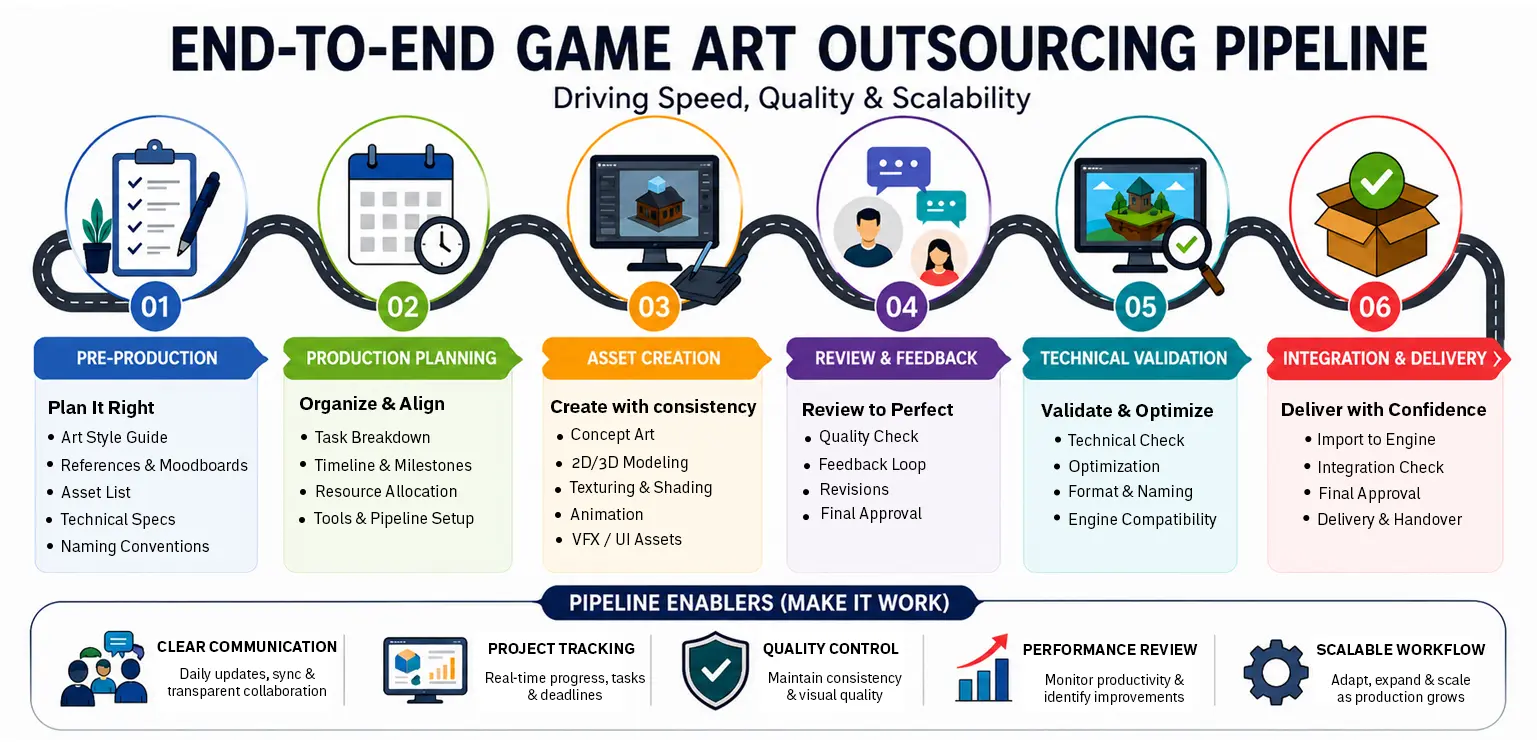
A successful outsourcing pipeline is not simply "sending assets to external artists." It is a structured workflow where internal and external teams operate within the same production ecosystem. In mature production environments, pipelines are typically divided into several layers:
- Art direction and style control
- Production planning
- Asset creation
- Review and feedback systems
- Technical validation
- Implementation and integration
Each layer must be clearly defined before outsourcing begins. Without this structure, even highly skilled external teams struggle to produce consistent results.
Pre-Production: The Most Important Stage
The biggest outsourcing failures usually begin before production starts. Studios often rush into external production without proper documentation, assuming artists will "figure it out" during execution. This creates confusion, inconsistent quality, and endless revisions.
Strong outsourcing pipelines begin with detailed pre-production systems. These typically include:
- Style guides
- Visual references
- Asset naming conventions
- Technical specifications
- File structure standards
- Animation guidelines
The goal is not just artistic consistency—it is production predictability.
Building Modular Production Systems
One of the biggest advantages of scalable outsourcing pipelines is modularity. Instead of treating every asset as unique, advanced studios break production into repeatable systems. For example, slot game production pipelines may separate:
- Symbol creation
- UI assets
- Animation passes
- VFX layers
- Promotional assets
This allows multiple teams to work simultaneously without creating dependency bottlenecks. It also improves scalability because workflows can expand without redesigning the entire production structure.
Asset Tracking and Workflow Management
As outsourcing scales, visibility becomes critical. Studios need systems that track:
- Asset status
- Revisions
- Approvals
- Implementation progress
Without structured tracking, production quickly becomes chaotic. Most professional pipelines rely on centralized management systems that allow both internal and external teams to operate within the same workflow environment. This reduces communication friction and improves delivery consistency.
Why Communication Pipelines Matter More Than Talent
One of the most misunderstood aspects of outsourcing is the assumption that quality problems are caused primarily by artist skill. In reality, pipeline communication is often the larger issue. Even highly talented teams will struggle if:
- Feedback is inconsistent
- Requirements change constantly
- Approvals are delayed
- Documentation is incomplete
Strong production pipelines solve this through structured communication loops. Instead of waiting until final delivery, advanced studios conduct regular milestone reviews and iterative approvals. This dramatically reduces revision cycles and production waste.
Technical Integration: Where Many Pipelines Break
Creating art assets is only part of the workflow. The real challenge often appears during implementation. Assets must integrate correctly into engines such as Unity, Unreal, or Cocos without causing technical problems. This includes:
- Optimization compliance
- Texture standards
- Animation setup
- Prefab structure
- Memory constraints
Without technical validation systems, art teams may deliver visually strong assets that create implementation bottlenecks. This is why many studios now integrate technical artists directly into outsourcing pipelines.
How Outsourcing Pipelines Work in Casino Game Production
Casino production pipelines are particularly dependent on scalable outsourcing systems. Slot games require high asset throughput due to:
- Multiple themes
- UI variations
- Feature animations
- Promotional events
- Live Ops updates
Unlike traditional games, casino titles often rely on repeatable production structures with rapid iteration cycles. Studios such as Gamix Labs typically align outsourced production directly with internal slot frameworks, enabling external teams to contribute symbols, animations, and UI systems without disrupting implementation workflows.
This production alignment is what allows high-output casino studios to scale efficiently.
Hybrid Team Models: The New Industry Standard
Modern outsourcing pipelines rarely operate as fully external systems. Instead, studios use hybrid production models where:
- Internal teams handle direction and validation
- External teams handle execution and scaling
This creates a balance between creative control and production flexibility. The most mature studios treat external teams as production extensions rather than temporary vendors.
Common Pipeline Failures Studios Encounter
Even experienced studios encounter outsourcing problems. One of the most common issues is weak onboarding. External teams cannot work efficiently without understanding production standards and workflow expectations.
Another major issue is fragmented feedback. When multiple stakeholders provide conflicting direction, revision cycles become unmanageable.
Scalability itself can also become a problem. Pipelines that work with five artists may collapse when expanded to fifty contributors.
These failures usually reflect system weaknesses rather than talent limitations.
What High-Performing Studios Do Differently
Studios with successful outsourcing pipelines focus heavily on process design. They prioritize:
- Documentation quality
- Structured review systems
- Modular production workflows
- Technical integration standards
- Centralized communication
Most importantly, they build pipelines for scalability from the beginning rather than adapting reactively as production grows. This proactive approach significantly improves long-term efficiency.
Automation and AI in Art Outsourcing Pipelines
AI-assisted production tools are beginning to reshape outsourcing workflows. Studios now use AI systems for:
- Concept exploration
- Asset variation generation
- Upscaling
- Tagging and organization
- Pipeline automation
However, AI has not reduced the importance of artistic oversight. Instead, it has shifted external teams toward higher-level creative and technical responsibilities. Studios that integrate AI effectively can accelerate iteration while maintaining artistic consistency.
The Role of Technical Artists in Outsourced Pipelines
Technical artists are becoming increasingly important in modern production pipelines. They act as the bridge between art and implementation by ensuring assets meet engine and optimization requirements. In outsourcing environments, technical artists help:
- Validate asset performance
- Standardize shade systems
- Optimize memory usage
- Streamline integration workflows
Without technical oversight, scaling external production becomes significantly harder.
Future Trends in Game Art Outsourcing
The future of outsourcing is moving beyond simple asset production. Studios increasingly expect external partners to contribute to:
- Technical implementation
- Pipeline consultation
- Live Ops scaling
- UI/UX systems
- Procedural workflows
Simultaneously, remote collaboration tools continue improving, making globally distributed pipelines more viable than ever. The competitive advantage will increasingly belong to studios that can coordinate large-scale distributed production efficiently.
Strategic Takeaways for Studios
The rise of scalable outsourcing pipelines reflects a broader shift in game development. Studios are no longer optimizing only for quality—they are optimizing for sustainable production velocity. This requires:
- Structured workflows
- Modular systems
- Strong technical integration
- Scalable communication processes
Outsourcing succeeds when it operates as a production ecosystem rather than a disconnected service.
Conclusion
Game art outsourcing has evolved far beyond cost reduction. Today, it is a strategic production model that allows studios to scale output, accelerate delivery, and maintain flexibility in increasingly demanding development environments.
However, outsourcing alone is not enough. The real advantage comes from building scalable pipelines that integrate external teams seamlessly into production workflows. Studios that master this process gain a measurable advantage in speed, efficiency, and long-term scalability.
Frequently Asked Questions
Why do studios outsource game art?
To scale production, access specialized talent, and accelerate content delivery.
What is the biggest challenge in outsourcing pipelines?
Maintaining consistency and workflow integration across distributed teams.
Why is pre-production important in outsourcing?
Clear documentation and standards reduce revisions and production delays.
How do technical artists help outsourcing pipelines?
They ensure assets meet engine, optimization, and implementation requirements.
Can outsourcing improve production speed?
Yes, when supported by scalable workflows and structured communication systems.
Are AI tools replacing outsourced artists?
No. AI is accelerating workflows, but artistic direction and technical oversight remain essential.