Top Casino Markets Worldwide: Where the Industry Thrives
At first glance, identifying countries with the most casinos might seem like a simple ranking exercise. However, for developers, studios, and casino operators, the real value lies in understanding why certain regions dominate and how that impacts game development, monetization, and product strategy.
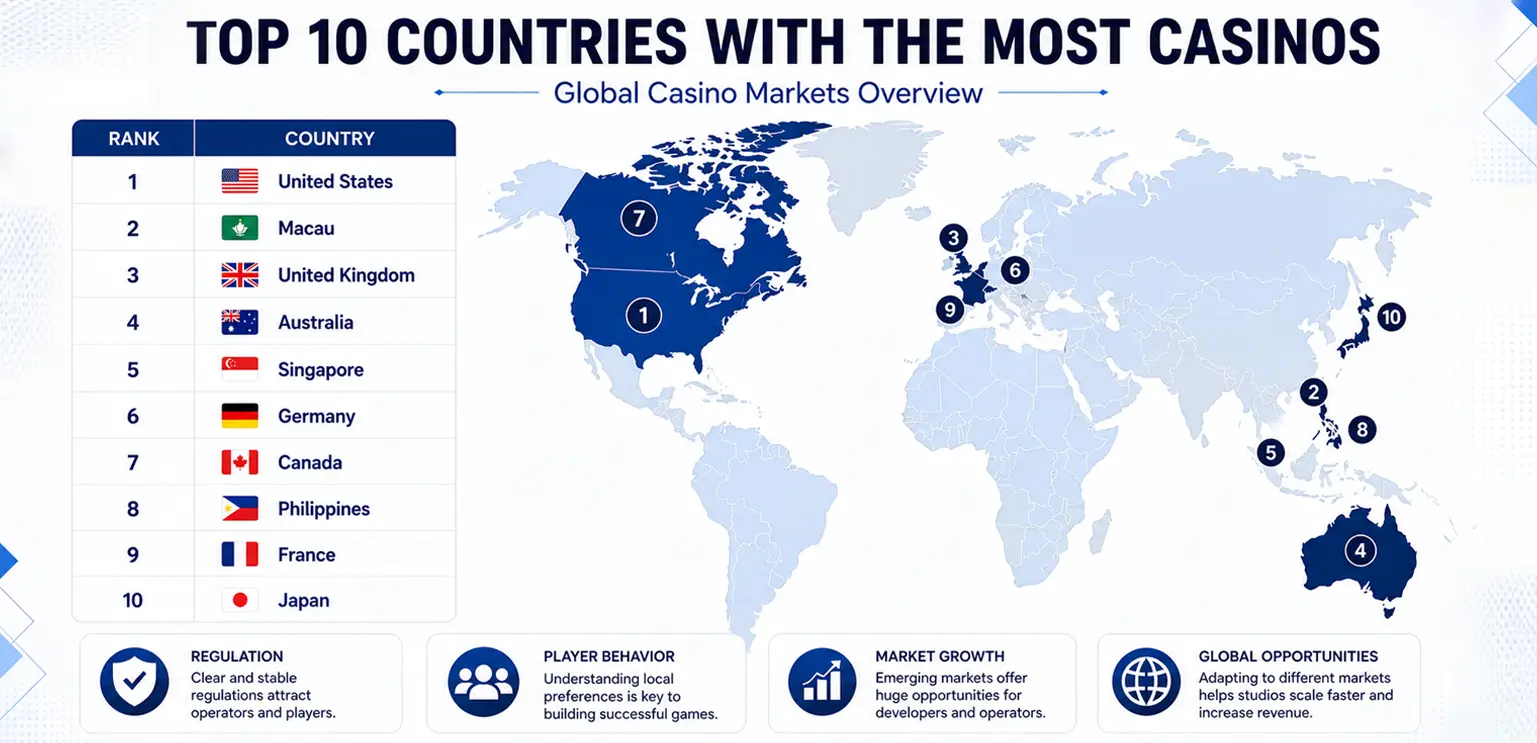
Casino density alone does not define opportunity. Regulatory frameworks, player behavior, platform preferences, and digital adoption all shape how successful a market can be. For studios building slot games or casino platforms, these factors directly influence design decisions—from RTP balancing to UI localization and feature complexity.
What Defines a Strong Casino Market?
Before looking at specific countries, it's important to define what makes a casino market significant. It is not just the number of physical venues. A strong market typically combines:
- High player engagement and spending behavior
- Stable and clear regulatory frameworks
- Strong digital or land-based infrastructure
- Consistent demand for new content
Markets that meet these conditions tend to attract both operators and game developers, creating long-term opportunities.
United States: Scale, Regulation, and Market Diversity
The United States remains one of the largest and most complex casino markets in the world. It combines a vast land-based ecosystem with rapidly expanding digital platforms. States operate under individual regulations, which creates both challenges and opportunities for developers.
For game studios, this means designing adaptable systems that can meet varying compliance requirements. Localization is critical, as player preferences differ significantly between regions. From a development standpoint, the U.S. market rewards flexibility and scalability.
Macau: High Revenue Density and Premium Player Focus
Macau is often considered the global hub of high-revenue casino operations. Unlike other markets, its strength lies in high-value players rather than sheer volume. This creates a very different design environment. Games targeting this market often focus on:
- Premium presentation
- High-stakes mechanics
- Refined visual quality
For developers, this highlights the importance of tailoring game experiences based on player segments rather than applying a universal design approach.
United Kingdom: Mature and Highly Regulated Digital Market
The United Kingdom represents one of the most mature iGaming markets globally. It is heavily regulated, which has pushed developers to prioritize fairness, transparency, and responsible gaming features. This environment has shaped game design significantly. Systems such as RTP visibility, session controls, and player protection mechanisms are now standard. For studios, this market acts as a benchmark for compliance-driven development.
Australia: Strong Land-Based Culture with Unique Player Behavior
Australia has one of the highest concentrations of gaming machines per capita. Player behavior in this region is distinct, with a strong preference for continuous gameplay and recognizable mechanics. For developers, this translates into:
- Longer session design
- Familiar gameplay loops
- Emphasis on accessibility over complexity
Understanding these behavioral patterns is essential when targeting this market.
Singapore: Controlled Growth with Premium Experiences
Singapore operates a highly controlled casino environment with a focus on quality over quantity. The market is built around integrated resorts and premium user experiences rather than mass-scale accessibility. This approach influences game development by prioritizing polished visuals, immersive environments, and high production value.
Germany: Regulatory Complexity and Market Transition
Germany represents a market in transition. Recent regulatory changes have reshaped how digital casino platforms operate, introducing stricter controls on gameplay mechanics and monetization. For developers, this creates challenges in adapting systems to meet compliance requirements while maintaining engagement. It also highlights the importance of building flexible architectures that can respond to regulatory changes.
Canada: Balanced Growth Across Regions
Canada offers a balanced mix of land-based and digital casino growth. Regulation varies by province, which creates a fragmented but stable market environment. Developers targeting Canada must account for regional differences while maintaining a consistent player experience.
Philippines: Emerging Hub for Casino Operations
Philippines has become an important player in the global casino ecosystem, particularly as an operational hub. Its growth is driven by both local demand and international players, making it a hybrid market. For studios, this presents opportunities to design games that appeal to diverse player bases.
France: Tradition Meets Modern Regulation
France combines a strong land-based casino tradition with evolving digital regulations. While the market is more restrictive than others, it remains significant due to its established player base. Developers must focus on compliance while maintaining engaging gameplay within defined limits.
Japan: Future Potential and Market Anticipation
Japan represents one of the most anticipated emerging markets. With integrated resort development underway, the country is expected to become a major player in the coming years. For developers, this is a long-term opportunity that requires early understanding of cultural preferences and regulatory expectations.
What This Means for Game Developers and Studios
Understanding global casino markets is not just about geography—it directly influences product strategy. Different regions demand different approaches in terms of:
- Gameplay mechanics
- UI design
- Monetization systems
- Regulatory compliance
Studios that succeed globally do not build one-size-fits-all products. Instead, they design adaptable systems that can be customized for different markets.
Strategic Insights: Designing for Global Markets
High-performing studios treat market differences as design inputs rather than constraints. They build systems that allow:
- Flexible RTP configuration
- Modular feature toggles
- Localized UI and content
- Scalable backend integration
This approach enables faster adaptation to new markets without rebuilding core systems.
Challenges in Targeting Multiple Casino Markets
Expanding across regions introduces complexity. Regulatory differences can require significant changes in gameplay systems. Player expectations vary widely, making it difficult to standardize design. Technical challenges also arise when supporting multiple currencies, languages, and compliance rules. These factors highlight the importance of scalable architecture and strong production pipelines.
Future Trends in Global Casino Markets
The global casino landscape is evolving rapidly. Digital platforms continue to grow, while land-based markets adapt to new technologies. Emerging regions are becoming more important, and regulatory frameworks are constantly changing.
For developers, this means continuous adaptation. Success will depend on the ability to build flexible systems that can evolve alongside the market.
Conclusion
The countries with the most casinos are not just popular destinations—they represent complex ecosystems that shape how games are designed, developed, and deployed. For game studios and casino developers, understanding these markets is essential for building successful products. The real advantage comes from translating market insights into design decisions. Studios that can do this effectively will be better positioned to compete in a global and rapidly evolving industry.
FAQ: Global Casino Markets
Which country has the most casinos?
The United States leads in total number due to its large and decentralized market structure.
Why is Macau so important in the casino industry?
It generates high revenue through premium players and large-scale integrated resorts.
Are online casino markets growing globally?
Yes, digital platforms are expanding rapidly across most regions.
Do developers need to localize slot games for each market?
Yes, player preferences and regulations vary significantly across regions.
What is the biggest challenge for global casino developers?
Adapting to different regulations while maintaining consistent game quality.
Which market has the most growth potential?
Emerging regions like Japan and Southeast Asia show strong future potential.