Full-Cycle Game Development Guide for Publishers
Modern game production has become significantly more complex than it was a decade ago. Games are no longer built as isolated products with fixed release cycles. Today's studios must manage:
- Continuous content updates
- Live Ops systems
- Multi-platform deployment
- Backend scalability
- Long-term retention mechanics
- Post-launch optimization
As a result, many publishers are shifting toward full-cycle game development partnerships instead of managing fragmented production pipelines internally.
However, "full-cycle development" is often misunderstood. Some assume it simply means outsourcing an entire game project. In reality, it represents a much broader operational model where external teams participate across every stage of production — from concept planning to Live Ops support.
For publishers, understanding what full-cycle development actually includes is critical before selecting a production partner.
What Full-Cycle Game Development Actually Means
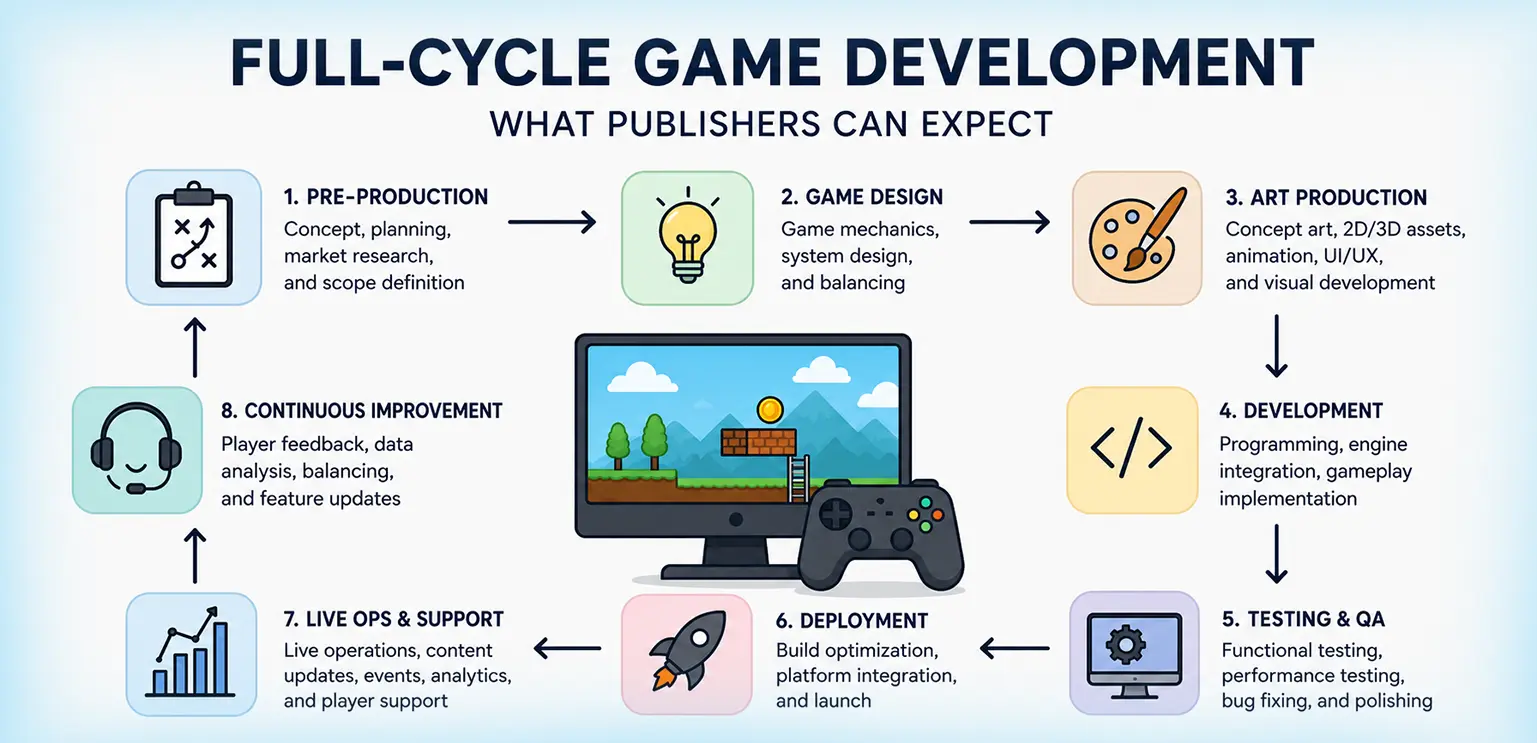
Full-cycle development refers to a production structure where one studio or integrated production ecosystem manages the majority of the game lifecycle. This usually includes:
- Concept development
- Game design
- Art production
- Programming
- Backend systems
- QA testing
- Deployment
- Live Ops support
Instead of coordinating multiple disconnected vendors, publishers work with a centralized production pipeline. This model has become increasingly valuable because modern games require strong coordination between technical systems, content production, and long-term operational planning.
Why Publishers Are Moving Toward Full-Cycle Partnerships
The shift toward full-cycle production is largely driven by scalability challenges. Internal teams often struggle with:
- Hiring speed
- Production bottlenecks
- Cross-team coordination
- Escalating operational costs
Simultaneously, games now require larger content volumes and faster update cycles than many internal pipelines can sustain efficiently. Full-cycle partners help solve this by providing:
- Scalable production infrastructure
- Specialized talent access
- Integrated workflows
- Predictable delivery systems
For publishers, this reduces operational fragmentation while improving production velocity.
Pre-Production: Where Strong Development Pipelines Begin
One of the most important stages in full-cycle development is pre-production. This phase defines:
- Project scope
- Gameplay systems
- Technical architecture
- Production timelines
- Art direction
- Monetization strategy
Weak pre-production creates downstream instability across the entire project. Experienced full-cycle studios spend significant time validating production feasibility before large-scale development begins. This includes evaluating:
- Engine requirements
- Backend scalability
- Feature complexity
- Live Ops expectations
- Content production demands
Publishers should expect strong strategic planning during this phase rather than immediate asset production.
Game Design and System Architecture
Full-cycle development is not simply about creating content — it is about building scalable systems. Modern development partners are expected to design:
- Modular gameplay systems
- Reusable feature frameworks
- Scalable backend structures
- Adaptable monetization systems
This is especially important for casino and Live Ops-driven games where ongoing updates are central to long-term success. A mature production pipeline prioritizes flexibility from the beginning to reduce future technical debt.
Art Production at Scale
Art production is often one of the most resource-intensive parts of development. Full-cycle studios typically manage:
- Concept art
- UI/UX systems
- Environment production
- Animation
- VFX
- Marketing creatives
However, scalable art production requires much more than artistic talent. Studios must also maintain:
- Technical consistency
- Optimization standards
- Engine compatibility
- Asset pipeline organization
Without structured production systems, even visually strong projects can become operationally unstable.
Programming and Technical Development
Technical implementation is where production complexity increases significantly. Full-cycle development partners are expected to manage:
- Gameplay programming
- Backend integration
- Multiplayer systems
- Analytics implementation
- Server communication
- Optimization workflows
For casino projects, this may also include:
- RTP integration
- Wallet systems
- Aggregator compatibility
- Compliance-ready infrastructure
This technical layer is one of the biggest reasons publishers increasingly prefer integrated production teams rather than fragmented outsourcing structures.
QA and Production Validation
Testing has become a continuous process rather than a final production stage. Modern QA pipelines include:
- Gameplay testing
- Device compatibility testing
- Performance analysis
- Monetization validation
- Regression testing
Casino games require especially rigorous validation because gameplay systems must behave consistently across large-scale statistical simulations. Publishers should expect mature full-cycle studios to integrate QA directly into production workflows rather than treating it as a separate department.
Live Ops: The Stage Many Publishers Underestimate
One of the biggest misconceptions in game production is that development ends at launch. In reality, launch is often only the beginning. Modern games rely heavily on Live Ops systems involving:
- Content updates
- Seasonal events
- Feature expansions
- Monetization adjustments
- Retention optimization
Full-cycle partners increasingly support these long-term operational pipelines rather than simply delivering finished builds. For publishers, this ongoing support can significantly improve product lifespan and revenue sustainability.
The Importance of Scalable Production Pipelines
One of the main advantages of full-cycle development is pipeline scalability. As production demands increase, mature studios can expand workflows without destabilizing delivery systems. This usually involves:
- Modular production structures
- Distributed team coordination
- Centralized asset tracking
- Structured review systems
Studios such as Gamix Labs often operate within scalable production models where art, programming, QA, and Live Ops systems function together as part of an integrated pipeline. This operational alignment becomes increasingly important as projects grow in complexity.
What Goes Wrong in Weak Full-Cycle Partnerships
Not all full-cycle partnerships succeed.
One common problem is unclear production ownership. If responsibilities are poorly defined, coordination failures quickly emerge.
Another major issue is pipeline fragmentation. Some studios claim to offer full-cycle development while actually relying on disconnected external vendors with minimal integration. This often leads to:
- Inconsistent quality
- Communication delays
- Technical instability
- Missed deadlines
Publishers should evaluate whether a studio truly operates as a unified production ecosystem.
How Publishers Evaluate Full-Cycle Studios
Experienced publishers assess much more than portfolio visuals. They typically evaluate:
- Production scalability
- Communication systems
- Technical maturity
- Live Ops capability
- Workflow transparency
- Long-term operational support
Strong studios are expected to demonstrate not only creative ability but also production reliability. For large-scale projects, operational structure often matters more than raw team size.
The Role of Agile Production in Full-Cycle Development
Modern full-cycle pipelines rely heavily on agile workflows. Instead of long isolated production phases, development occurs through iterative cycles involving:
- Rapid prototyping
- Milestone validation
- Continuous feedback loops
- Incremental feature integration
This approach improves adaptability while reducing large-scale production risks. Publishers should expect frequent visibility into development progress rather than waiting for major milestone deliveries.
AI and Automation in Full-Cycle Production
AI-assisted workflows are increasingly influencing modern development pipelines. Studios now use automation tools for:
- Asset organization
- Testing support
- Concept iteration
- Pipeline optimization
- Analytics interpretation
However, automation has not replaced structured production management. Instead, it has increased the importance of high-level coordination and technical oversight. The most effective studios combine automation with strong human production systems.
Future Trends in Full-Cycle Game Development
The future of full-cycle development is moving toward more integrated and scalable ecosystems. Studios are increasingly expected to provide:
- Live Ops consultation
- Data-driven balancing
- Monetization optimization
- Technical scalability planning
- Cross-platform deployment support
Simultaneously, publishers are seeking fewer but more capable production partners capable of supporting long-term product ecosystems. This trend will likely continue as games become more operationally complex.
Strategic Takeaways for Publishers
Full-cycle game development is not simply about outsourcing production. It is about building integrated production ecosystems capable of supporting games across their entire lifecycle. For publishers, the biggest advantages include:
- Reduced operational fragmentation
- Faster production scalability
- Centralized workflow management
- Long-term Live Ops support
However, these benefits only emerge when development partners have mature pipelines, strong technical systems, and scalable production structures.
Conclusion
Full-cycle game development has become one of the most important operational models in modern game production. As games become more content-heavy and service-driven, publishers increasingly need development partners capable of supporting not only launch production, but also long-term scalability and Live Ops growth.
The strongest full-cycle studios combine creative production, technical infrastructure, scalable workflows, and operational reliability into a unified ecosystem. For publishers, choosing the right partner is no longer just a production decision — it is a long-term strategic investment.
FAQs
What is full-cycle game development?
It is a production model where one studio manages most stages of development, from concept to Live Ops.
Why are publishers using full-cycle partners?
To improve scalability, reduce operational complexity, and accelerate production workflows.
Does full-cycle development include Live Ops support?
Yes. Modern full-cycle pipelines often support post-launch updates and optimization.
What is the biggest advantage of full-cycle production?
Centralized workflow management and integrated production coordination.
What should publishers evaluate before choosing a partner?
Technical maturity, scalability, communication systems, and long-term operational support.
Is full-cycle development only for large studios?
No. Mid-sized publishers increasingly use full-cycle partnerships to scale production efficiently.