Production Planning Strategies for Successful Cross-Platform Game Launches
Launching a game across multiple platforms is no longer a premium feature reserved for large AAA studios. Today, even mid-sized teams are expected to support mobile, PC, console, and web ecosystems simultaneously. However, cross-platform development is not simply about exporting the same game to different devices. Every platform introduces its own:
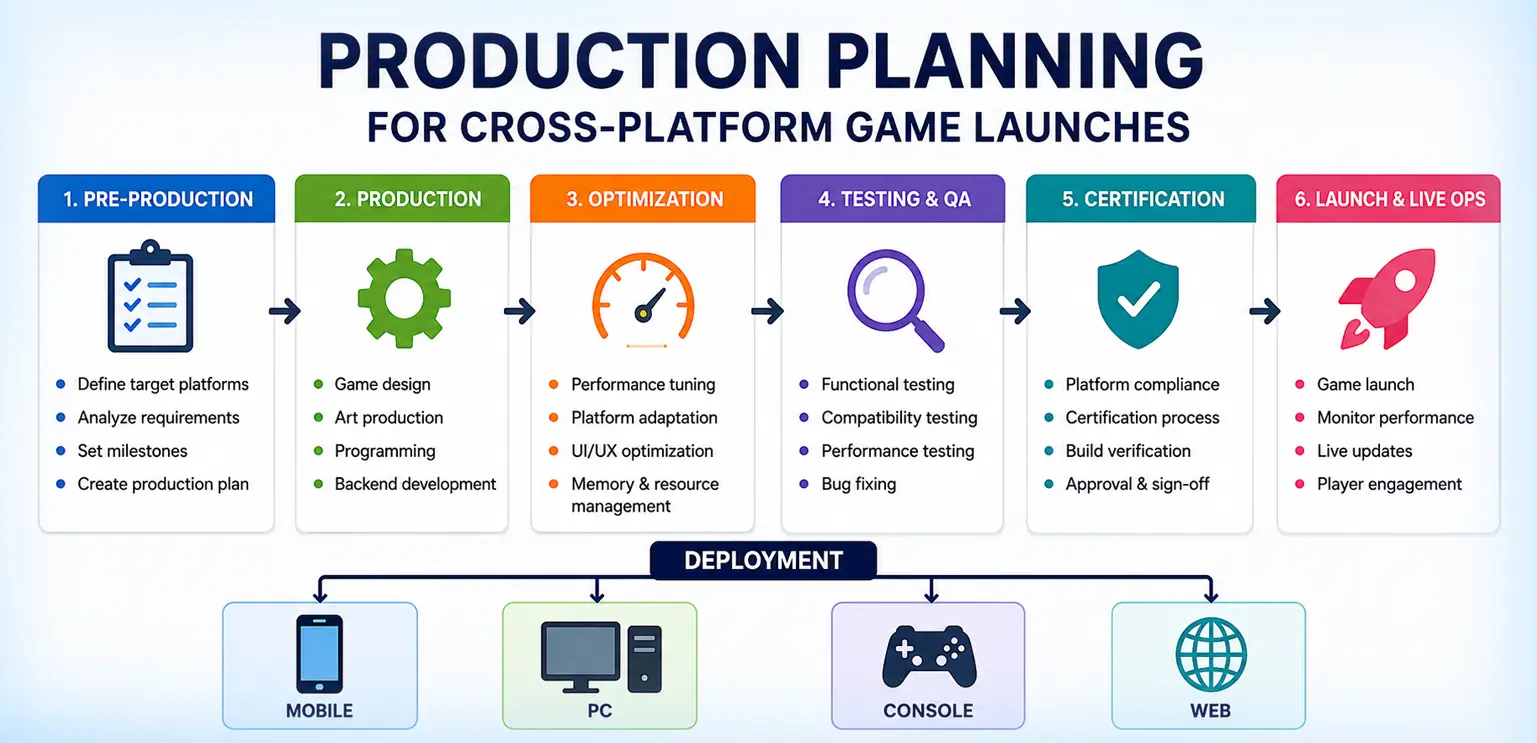
- Hardware constraints
- Certification requirements
- UI expectations
- Performance limitations
- Deployment workflows
Without structured production planning, these differences quickly create delays, technical debt, and unstable launch pipelines. This is why successful studios treat cross-platform launches as a production strategy problem rather than only a technical challenge.
Why Production Planning Determines Launch Stability
Many studios focus heavily on gameplay systems during development but underestimate operational coordination. In reality, launch stability depends heavily on how production pipelines are structured long before deployment begins. Poor planning often leads to:
- Inconsistent platform performance
- Delayed certifications
- Fragmented asset pipelines
- Feature mismatches between devices
- Emergency optimization work near launch
Strong production planning reduces these risks by aligning technical systems, art pipelines, testing workflows, and Live Ops preparation from the beginning.
Understanding the Core Challenges of Cross-Platform Development
Cross-platform production introduces complexity because platforms behave differently at both technical and user-experience levels. A game optimized for high-end PC hardware may struggle on mobile devices. UI systems that feel intuitive on desktop may become unusable on touch interfaces. Even backend behavior can vary depending on platform-specific networking systems. The challenge is not just compatibility—it is maintaining a consistent gameplay experience across fundamentally different environments. This requires coordinated planning across every department.
Defining Platform Scope Early
One of the biggest production mistakes is expanding platform targets too late in development. Studios sometimes begin with a single-platform mindset and attempt cross-platform scaling after core systems are already built. This often creates major architectural problems. Successful production planning starts by clearly defining:
- Target platforms
- Hardware requirements
- Performance expectations
- Input systems
- Deployment priorities
These decisions influence technical architecture, UI design, optimization strategy, and asset production throughout the entire project lifecycle.
Building a Scalable Technical Architecture
Cross-platform games require flexible technical foundations. Studios must design systems that adapt across varying hardware conditions without creating multiple disconnected codebases. This usually involves:
- Modular gameplay systems
- Scalable rendering pipelines
- Configurable UI frameworks
- Platform abstraction layers
Modern engines such as Unity and Unreal support these workflows, but the engine alone does not solve scalability problems. The production architecture itself must be intentionally designed for platform flexibility.
Art Pipeline Planning for Multiple Platforms
Art production becomes significantly more complex during cross-platform development. Assets must often support:
- Different resolutions
- Varying memory budgets
- Device-specific optimization levels
- Multiple aspect ratios
Without structured planning, game art pipelines become bloated and difficult to maintain. High-performing studios usually establish tiered asset systems early in production. Instead of creating entirely separate assets for each platform, they build scalable art frameworks that adjust quality dynamically based on hardware capability. This approach improves efficiency while reducing redundant production work.
UI/UX Challenges Across Platforms
UI systems are among the most difficult aspects of cross-platform launches. A layout designed for widescreen desktop environments may fail entirely on mobile devices. Similarly, controller navigation behaves differently from keyboard or touch interaction systems. Studios must plan UI architecture around adaptability rather than fixed layouts. This often includes:
- Responsive UI systems
- Scalable typography
- Platform-aware interaction logic
- Flexible navigation structures
The goal is not identical interfaces across devices, but consistent usability and player experience.
Performance Optimization Must Begin Early
One of the most common cross-platform production failures occurs when optimization is treated as a late-stage task. By the time performance issues appear near launch, core systems are often too deeply integrated to optimize efficiently. Strong production pipelines integrate optimization from the beginning through:
- Performance budgeting
- Scalable rendering systems
- Memory usage tracking
- Modular effects systems
This proactive approach prevents emergency optimization cycles later in production.
Backend Coordination Across Platforms
Cross-platform launches also create backend complexity. Games must synchronize:
- Player progression
- Account systems
- Analytics
- Monetization data
- Live Ops events
Across multiple devices and ecosystems. This requires backend systems capable of handling platform-specific APIs while maintaining centralized account continuity. Without strong backend planning, player experiences become fragmented across platforms.
Certification and Compliance Planning
Console and mobile ecosystems often require certification approval before launch. Each platform maintains different technical and operational requirements. Missing these standards can delay launches significantly. Studios must prepare for:
- Platform-specific compliance testing
- Submission workflows
- Performance verification
- Security validation
Production teams that ignore certification timelines frequently encounter costly delays near release. This is why mature studios integrate compliance planning directly into milestone scheduling.
The Role of QA in Cross-Platform Production
Testing becomes exponentially more complex when multiple platforms are involved. QA pipelines must validate:
- Gameplay consistency
- Device compatibility
- Input responsiveness
- Network synchronization
- Visual performance
Across many hardware environments. Automated testing frameworks are increasingly important because manual testing alone cannot scale efficiently across modern platform ecosystems. Studios that invest in scalable QA systems significantly reduce post-launch instability.
Live Ops Preparation Before Launch
Cross-platform games are rarely static products. Modern launches are expected to support:
- Ongoing updates
- Seasonal content
- Monetization adjustments
- Event systems
- Retention campaigns
This means Live Ops planning must begin before launch, not after it. Production pipelines should already account for:
- Patch deployment systems
- Content scheduling
- Backend scalability
- Analytics integration
Before the game reaches players.
Outsourcing and Distributed Production
Many cross-platform projects rely on external production partners. Art outsourcing, backend support, QA scaling, and Live Ops assistance have become common in modern development pipelines. However, distributed production only works effectively when workflows are clearly structured.
Studios such as Gamix Labs often contribute within scalable cross-platform ecosystems where art production, implementation pipelines, and optimization workflows are aligned with broader development systems. This integration allows external contributors to support production without disrupting workflow continuity.
Common Production Failures in Cross-Platform Launches
Many launch issues are not caused by poor gameplay—they are caused by weak production coordination. Common failures include:
- Inconsistent optimization between platforms
- Fragmented asset management
- UI scaling issues
- Delayed certification approval
- Unstable backend synchronization
Another major issue is over-committing to too many platforms simultaneously without sufficient production infrastructure. Successful studios scale platform support strategically rather than aggressively.
How High-Performing Studios Manage Cross-Platform Launches
The strongest production pipelines prioritize scalability and visibility. These studios typically rely on:
- Centralized production tracking
- Milestone-based validation
- Modular system architecture
- Integrated QA workflows
- Platform-specific optimization pipelines
Most importantly, they treat production planning as an ongoing operational process rather than a static pre-launch document. This adaptability becomes critical as projects evolve.
AI and Automation in Cross-Platform Production
AI-assisted workflows are increasingly influencing production planning. Studios now use automation systems for:
- Performance monitoring
- Testing support
- Asset organization
- Deployment tracking
- Analytics interpretation
However, automation is not replacing production strategy. Instead, it is allowing teams to scale workflows more efficiently while reducing repetitive operational tasks. The studios that benefit most are those combining automation with strong pipeline management.
Future Trends in Cross-Platform Game Launches
Cross-platform production is moving toward more unified ecosystems. Future pipelines will likely focus on:
- Cloud-based deployment systems
- Shared progression frameworks
- Dynamic asset streaming
- Platform-adaptive UI systems
- Scalable Live Ops integration
As hardware ecosystems continue evolving, production flexibility will become even more important. Studios that build adaptable pipelines today will be better positioned for long-term scalability.
Strategic Takeaways for Studios and Publishers
Cross-platform success is not determined only by technical capability. It depends on how effectively production systems coordinate development across multiple environments. Strong launch pipelines require:
- Scalable architecture
- Structured workflows
- Proactive optimization
- Integrated testing systems
- Long-term Live Ops planning
Studios that treat production planning strategically gain significant advantages in launch stability, scalability, and post-launch sustainability.
Conclusion
Cross-platform game launches have become one of shavings/spacer.gif the most operationally demanding challenges in modern game development. Supporting multiple ecosystems requires much more than compatibility—it requires coordinated production systems capable of scaling across technical, artistic, and operational layers simultaneously.
The most successful studios approach cross-platform launches as integrated production ecosystems rather than isolated technical tasks. For publishers and developers, strong production planning is no longer optional. It is one of the most important factors determining whether a multi-platform launch succeeds or struggles under complexity.
Frequently Asked Questions
What is cross-platform game development?
It is the process of building games that operate across multiple platforms such as mobile, PC, console, and web.
Why is production planning important for cross-platform launches?
Because multiple platforms create technical, operational, and certification complexity that requires coordinated workflows.
What is the biggest challenge in cross-platform production?
Maintaining consistent performance and user experience across different hardware ecosystems.
Why should optimization begin early?
Late-stage optimization often creates technical debt and launch instability.
How do studios manage scalable cross-platform workflows?
Through modular architecture, centralized production tracking, and integrated QA systems.
Does cross-platform development require Live Ops planning?
Yes. Modern games require post-launch content systems and scalable operational support.