Building SDK-Ready Games in Cocos Creator for Publishing Platforms
Developing a game is only one part of the publishing journey. Before a title reaches players, it often needs to integrate with multiple publishing platforms, distribution networks, analytics providers, monetization systems, and operational tools. For studios developing games in Cocos Creator, SDK integration has become a critical production requirement rather than a post-launch enhancement.
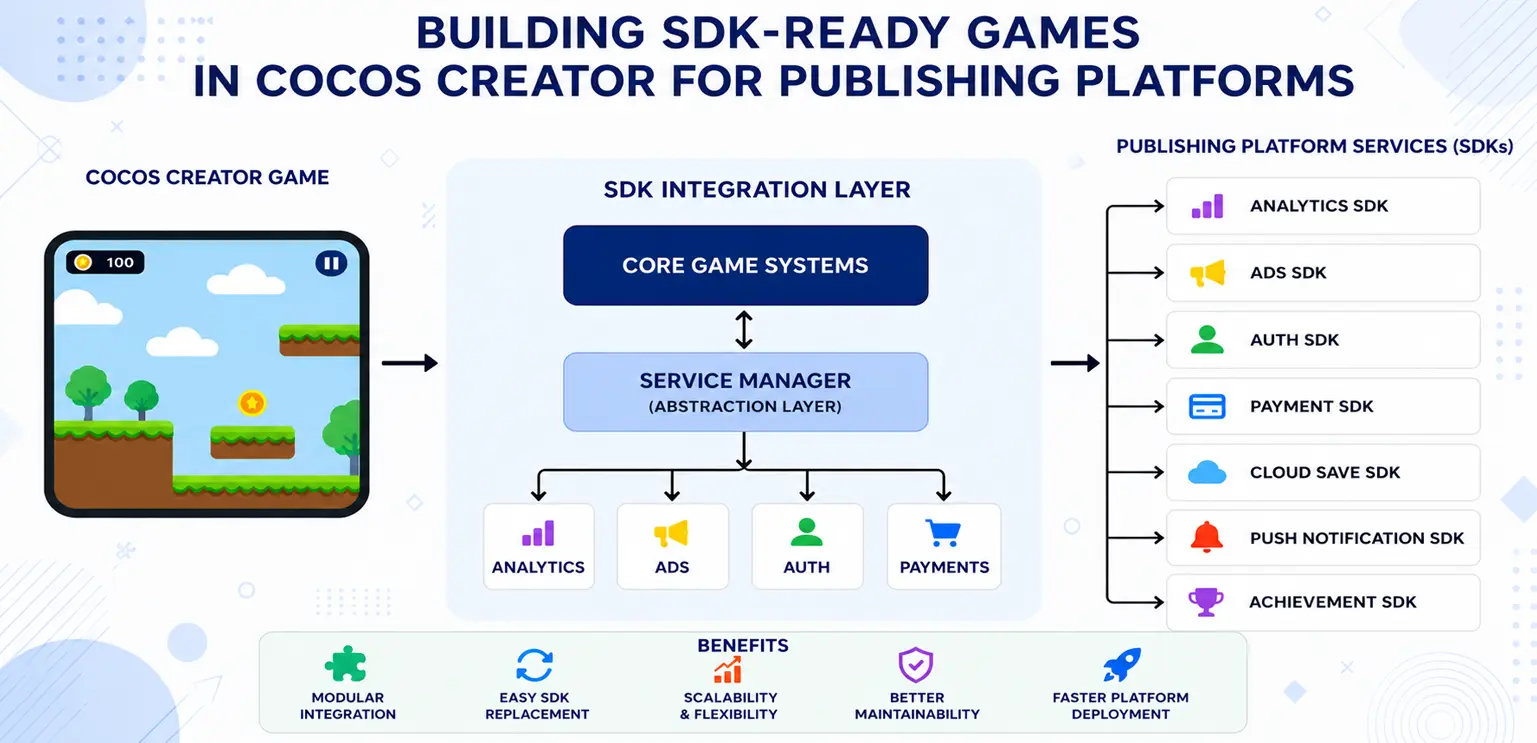
Modern publishing platforms frequently require support for systems such as user authentication, analytics tracking, payment processing, advertising services, achievement frameworks, cloud saving, and Live Ops functionality. Without proper SDK preparation, even a technically polished game can face delays during deployment and certification. This is why experienced development teams build SDK readiness directly into their production pipelines from the earliest stages of development.
What Does "SDK-Ready" Actually Mean?
An SDK-ready game is designed to integrate external platform services efficiently without requiring significant architectural changes. Rather than hard-coding platform-specific functionality throughout the project, developers create flexible systems that allow third-party SDKs to be connected with minimal disruption. In practical terms, SDK readiness means designing a game that can support:
- Analytics platforms
- Advertising networks
- Authentication providers
- Payment systems
- Social features
- Push notifications
- Cloud save services
- Publishing platform APIs
The goal is scalability. As publishing requirements evolve, new integrations can be added without rebuilding core game systems.
Why Publishing Platforms Require SDK Integration
Publishing platforms are no longer simple distribution channels. Most modern ecosystems provide operational tools that help publishers manage user acquisition, monetization, retention, and performance monitoring. These platforms often require SDK integrations to enable:
- Player account management
- Revenue tracking
- Ad monetization
- Event analytics
- User segmentation
- Retention measurement
- Live Ops functionality
Without these integrations, publishers lose visibility into player behavior and platform performance. For developers, this means SDK planning is closely tied to business success rather than being purely technical work.
Why Cocos Creator Is Popular for Publishing-Focused Development
Cocos Creator has become a widely adopted engine for mobile and web-based game production due to its lightweight architecture and flexible deployment capabilities. Studios frequently choose Cocos Creator because it supports:
- Rapid development workflows
- Cross-platform deployment
- JavaScript and TypeScript scripting
- Efficient mobile performance
- Web compatibility
- Flexible plugin systems
These characteristics make it particularly suitable for games targeting multiple publishing environments. However, successful deployment still depends on how well the project is prepared for external SDK integration.
Building a Scalable SDK Architecture from Day One
One of the most common mistakes developers make is delaying SDK planning until the final stages of production. This often creates unnecessary complexity because platform services become tightly coupled with gameplay systems. Instead, studios should establish a dedicated integration layer early in development.
This layer acts as an intermediary between game systems and external SDKs. Rather than calling platform APIs directly from gameplay logic, developers route communication through centralized service managers. This approach provides several advantages:
- Easier SDK replacement
- Faster platform adaptation
- Cleaner code architecture
- Reduced maintenance overhead
Most importantly, it prevents platform-specific code from spreading throughout the project.
Using Service Abstraction for Long-Term Flexibility
Service abstraction is one of the most important concepts in SDK-ready architecture. A well-designed game should not depend directly on a single analytics provider, advertising network, or publishing platform. Instead, gameplay systems communicate with abstract service interfaces.
For example, a reward system should simply request an advertisement display rather than interacting directly with a specific ad SDK. The abstraction layer determines which provider handles the request. This strategy allows developers to swap SDKs without rewriting gameplay functionality. For publishers operating across multiple markets, this flexibility becomes extremely valuable.
Planning Analytics Integration Early
Analytics systems are among the most frequently integrated SDKs in modern game publishing. Many teams treat analytics as a post-launch feature, but this approach limits data quality and operational visibility. SDK-ready games define event structures during production. Common events include:
- Session starts
- Session ends
- Level completion
- Feature usage
- Retention milestones
- Monetization interactions
By establishing event architecture early, developers ensure that analytics systems remain consistent throughout the game's lifecycle. This also improves future Live Ops decision-making.
Advertisement SDK Integration Considerations
Advertising remains a major monetization strategy for many mobile games. However, ad SDK implementation can become problematic when not properly planned. Many developers embed advertising logic directly into gameplay systems, creating dependencies that become difficult to manage later. A more scalable approach involves creating dedicated monetization controllers that manage:
- Rewarded video ads
- Interstitial ads
- Banner placements
- Ad frequency controls
This separation improves maintainability while simplifying future SDK replacements.
Authentication and Account Systems
Many publishing platforms require player identity systems. These may include:
- Guest accounts
- Social logins
- Platform authentication
- Cloud save synchronization
Developers should avoid tying gameplay progression directly to a specific authentication provider. Instead, player profiles should operate independently from authentication services. This allows multiple login methods to coexist without disrupting progression systems. Such flexibility becomes increasingly important when supporting multiple publishing ecosystems.
Payment and Commerce Integration
For games involving purchases or premium content, payment SDKs are often mandatory. However, payment systems vary significantly between platforms. App stores, publisher ecosystems, and regional marketplaces may each use different transaction workflows. To accommodate these variations, developers should build centralized commerce management systems that handle:
- Product catalogs
- Purchase validation
- Transaction processing
- Reward fulfillment
A modular commerce architecture reduces platform-specific complexity and improves deployment efficiency.
Preparing for Multi-Platform Publishing
Many Cocos Creator projects eventually target multiple platforms. A game may launch on mobile and later expand to web portals, publishing networks, or regional marketplaces. This expansion often introduces new SDK requirements. Successful teams prepare for this possibility by separating:
- Platform logic
- Gameplay systems
- Backend communication
- User services
This architectural separation ensures that platform-specific services can be updated, replaced, or expanded without affecting core gameplay systems. As a result, studios can support new publishing platforms more efficiently while minimizing development overhead.
Testing SDK Integrations Effectively
SDK integration is not complete when functionality appears to work. Publishing-ready games require extensive validation across various environments. Testing typically includes:
- Sandbox environments
- Platform-specific builds
- Device compatibility checks
- Analytics validation
- Transaction testing
Many deployment failures occur because SDK behavior differs between development and production environments. Comprehensive testing helps identify these issues before launch.
Common SDK Integration Mistakes
Many integration problems stem from architectural decisions made early in development. Some of the most common mistakes include:
- Hard coded platform dependencies
- Direct SDK calls throughout gameplay systems
- Inconsistent event tracking
- Poor error handling
- Lack of abstraction layers
These architectural shortcomings often lead to higher maintenance overhead, slower platform integrations, and increased complexity when scaling games across multiple publishing ecosystems.
Studios that invest in modular integration frameworks and clean system architecture are better positioned to support future platform expansion while maintaining long-term development efficiency.
How Outsourcing Teams Support SDK-Ready Development
As game production becomes more specialized, many studios rely on external development partners for SDK implementation and platform preparation.
Teams such as Gamix Labs frequently contribute to production pipelines by helping developers establish scalable architectures, optimize integration workflows, and prepare games for publishing platform requirements.
This support becomes particularly valuable when projects target multiple ecosystems simultaneously. Proper coordination between development, backend, QA, and publishing teams ensures smoother deployment and long-term maintainability.
Future Trends in SDK Integration
Publishing ecosystems continue evolving rapidly. Future SDK requirements will likely focus on:
- Real-time analytics
- AI-driven personalization
- Cross-platform account systems
- Cloud-native services
- Enhanced Live Ops tooling
As these systems become more sophisticated, architectural flexibility will become increasingly important. Studios that invest in SDK-ready foundations today will be better positioned to adapt to future publishing demands.
Strategic Takeaways for Developers
Building Stake SDK-ready games is ultimately about creating scalable production systems. The most successful Cocos Creator projects are not designed around a single platform or provider. Instead, they are built to accommodate change. Strong SDK architecture delivers several long-term benefits:
- Faster platform integration
- Easier maintenance
- Improved scalability
- Reduced deployment risk
- Better publishing flexibility
For modern game studios, SDK-ready architecture plays a critical role in improving production scalability, accelerating platform integrations, and supporting long-term publishing growth.
Conclusion
SDK integration has become an essential component of modern game publishing. As platforms expand their requirements and operational ecosystems become more sophisticated, developers must think beyond gameplay implementation alone. For Cocos Creator teams, building SDK-ready architecture from the beginning provides the flexibility needed to support analytics, monetization, authentication, Live Ops, and future platform requirements.
Studios that prioritize scalable integration strategies gain a significant advantage in deployment speed, maintainability, and long-term publishing success. The strongest games are not only enjoyable to play—they are also engineered to integrate seamlessly into the evolving publishing ecosystem.
Frequently Asked Questions
What is an SDK-ready game?
A game designed to integrate external platform services efficiently without major architectural changes.
Why is SDK planning important in Cocos Creator?
It reduces integration complexity and improves scalability across publishing platforms.
Which SDKs are commonly integrated into games?
Analytics, advertising, authentication, payment processing, cloud saves, and Live Ops systems.
What is service abstraction?
A development approach that separates gameplay systems from specific SDK providers, making integrations easier to manage.
When should SDK architecture be planned?
During the early stages of development rather than near launch.
How does SDK readiness benefit publishers?
It accelerates deployment, simplifies platform support, and improves operational flexibility.