White Label vs Custom Slot Development: Which Model Delivers Better Long-Term Value?
Launching a successful casino platform requires more than simply offering a collection of games. Operators must balance technology infrastructure, content strategy, scalability, and brand differentiation to remain competitive in an increasingly crowded market.
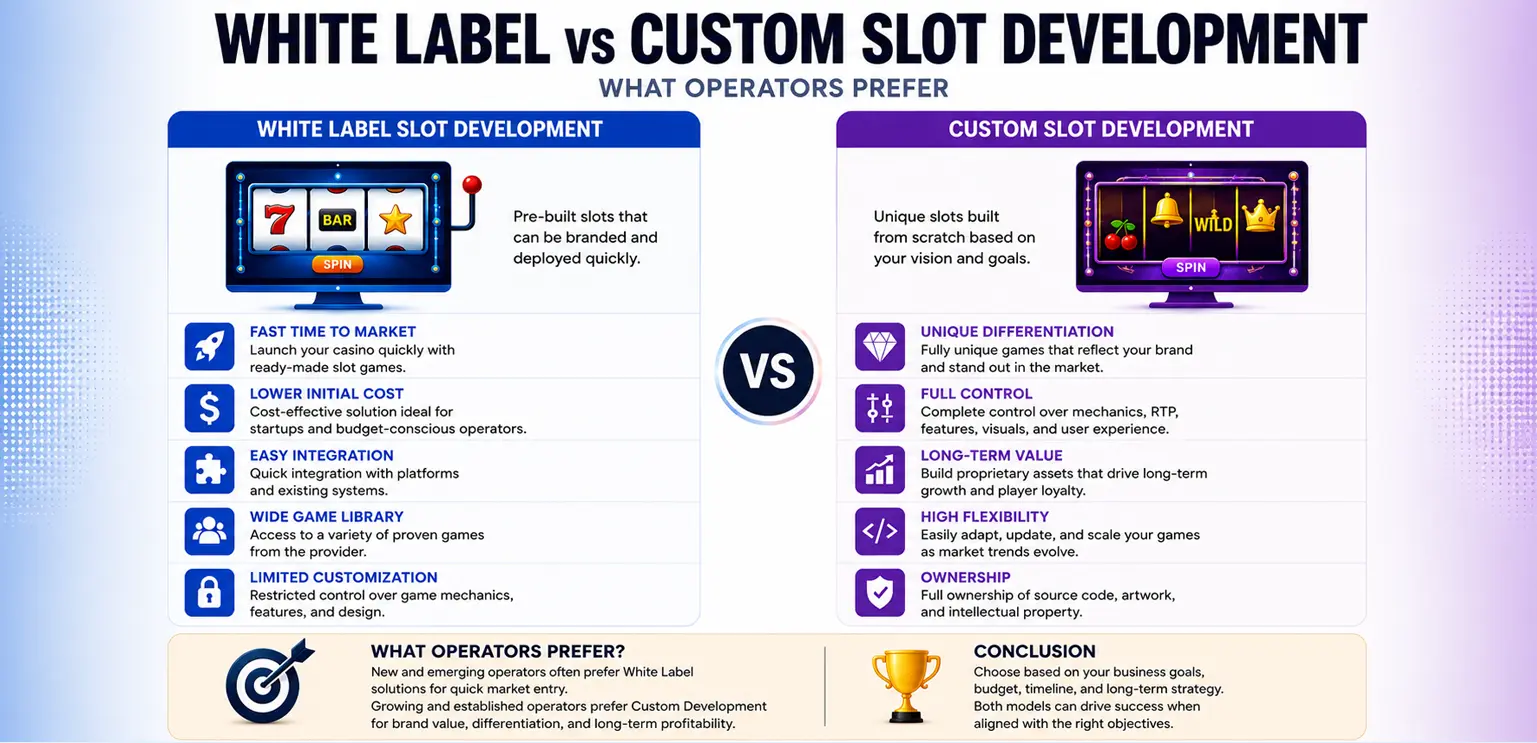
One of the most important choices is whether to adopt white label slot solutions or invest in custom slot game development. At first glance, the decision appears straightforward. White label solutions offer speed and lower initial costs, while custom development provides greater control and flexibility. However, the reality is more complex.
The choice directly affects player acquisition, retention, brand positioning, operational efficiency, and long-term revenue potential. As competition continues increasing across online casino markets, operators are becoming more strategic about which model aligns with their business objectives.
Understanding White Label Slot Development
White label slot development involves licensing pre-built games or game frameworks that can be branded and deployed quickly. The core mechanics, game mathematics, backend systems, and production assets are typically created by the provider. Operators customize selected elements such as branding, themes, promotional content, or interface components before launch.
The primary appeal of white label solutions is speed. Rather than investing significant time and resources into building games from the ground up, operators can launch more quickly by leveraging established game portfolios and ready-to-deploy operational frameworks. For startups and emerging platforms, this significantly reduces initial development complexity.
Understanding Custom Slot Development
Custom slot game development takes a completely different approach. Rather than licensing existing content, operators invest in creating proprietary games tailored to their specific audience, market strategy, and platform goals. Custom development allows complete control over:
- Game mechanics
- Mathematical models
- Visual identity
- Feature design
- Bonus systems
- Monetization strategies
- Player experience
Because every component is developed specifically for the operator, the resulting product becomes a unique business asset rather than a shared market offering. This exclusivity is one of the main reasons larger operators increasingly prioritize custom production.
Why White Label Solutions Became Popular
The rapid growth of online casino platforms created demand for faster market entry. New operators often faced challenges related to:
- Development costs
- Technical expertise
- Content acquisition
- Platform integration
White label providers emerged as a solution by offering ready-made ecosystems that significantly reduced launch timelines. For operators focused on entering the market quickly, this model provided immediate access to established infrastructure without requiring extensive in-house development resources. As a result, white label solutions became particularly attractive for startups and smaller brands.
The Biggest Advantage of White Label Development: Speed
Speed remains the strongest argument in favor of white label solutions. A custom slot game may require several months of production involving:
- Design
- Mathematics development
- Art creation
- Programming
- Testing
- Platform integration
A white label solution can often be deployed within a fraction of that timeframe. For operators seeking rapid market validation or short-term expansion opportunities, this speed can create significant competitive advantages. However, faster deployment often comes with trade-offs.
The Limitations of White Label Slot Solutions
While white label platforms accelerate launch timelines, they often restrict flexibility. Operators typically have limited control over:
- Core gameplay systems
- RTP configurations
- Feature innovation
- Technical architecture
- Future scalability
Because multiple brands may use similar content, differentiation becomes increasingly difficult. This creates a common challenge in mature markets where players have access to thousands of similar games. Without unique content, operators frequently compete on acquisition spending rather than product differentiation. Over time, this can reduce profitability and weaken brand identity.
Why More Operators Are Investing in Custom Development
As market competition continues to grow, operators are placing greater emphasis on long-term differentiation rather than simply achieving faster launches. Many operators now consider proprietary content a key competitive advantage that supports long-term growth and market differentiation. Custom development allows operators to create experiences specifically aligned with:
- Target demographics
- Regional preferences
- Retention strategies
- Brand positioning
Instead of relying on shared content ecosystems, they gain complete ownership over the player experience. This ownership often becomes a major competitive advantage.
The Role of Game Mathematics in Custom Development
One of the most overlooked benefits of custom slot production is control over mathematical design. White label solutions typically offer predefined configurations. Custom development allows operators to optimize:
- RTP structures
- Volatility profiles
- Bonus frequency
- Session pacing
- Retention mechanics
These factors have a direct impact on long-term player engagement and revenue performance. Experienced operators recognize that long-term revenue performance is often driven more by game mathematics than visual presentation alone.
Branding and Market Differentiation
Brand identity has become increasingly important within the casino industry. Players encounter countless games featuring similar themes, mechanics, and bonus structures. Custom development enables operators to build experiences that reinforce their unique brand positioning. This may include:
- Exclusive themes
- Proprietary features
- Unique visual styles
- Custom progression systems
The result is a stronger connection between the player and the platform. Over time, this can improve retention and reduce dependence on external content providers.
Scalability and Long-Term Growth
Scalability is another area where custom development often provides advantages. White label solutions are designed to serve multiple operators efficiently, which can limit future flexibility. Custom platforms allow teams to:
- Introduce new features
- Expand game portfolios
- Integrate advanced analytics
- Support evolving business strategies
As operational requirements become more complex, this flexibility becomes increasingly valuable. Operators planning long-term growth often prioritize scalable architecture over short-term convenience.
The Cost Perspective: Looking Beyond Initial Investment
While lower upfront cost is often a key reason operators choose white label solutions, it represents only a portion of the overall financial picture. Over time, operators may encounter:
- Licensing fees
- Revenue-sharing agreements
- Customization limitations
- Vendor dependency
Custom development requires higher initial expenditure but often provides greater ownership and long-term control. The key question is not simply which model costs less, but which model delivers better lifetime value. For many growing operators, the answer increasingly favors custom solutions.
Hybrid Approaches Are Becoming More Common
The discussion is not always limited to choosing one model exclusively. Many operators now adopt hybrid strategies. For example, they may:
- Launch with white label content
- Validate market demand
- Build player acquisition channels
- Gradually invest in proprietary games
This approach balances speed with long-term differentiation. It also allows operators to spread development investment across multiple growth stages. As a result, hybrid models are becoming increasingly popular across the industry.
How Technology Influences the Decision
Modern game engines and development pipelines have significantly reduced the barriers associated with custom production. Technologies such as:
- Unity
- Cocos Creator
- Modular backend systems
- Automated testing pipelines
Allow studios to build scalable slot games more efficiently than ever before. Development partners such as Gamix Labs increasingly support operators through full-cycle production pipelines, helping bridge the gap between white label convenience and custom development flexibility. This trend is making proprietary content more accessible to mid-sized operators that previously lacked the resources for custom production.
What Operators Actually Prefer Today
The answer largely depends on business maturity and growth objectives. New operators often prioritize speed, making white label solutions an attractive option during early market entry. Established operators, however, increasingly focus on ownership, scalability, and differentiation.
As a result, many industry leaders are investing heavily in custom game portfolios that strengthen their competitive position and reduce dependence on shared content ecosystems. The trend suggests a growing preference for custom development among operators pursuing long-term growth.
Future Trends in Slot Development
The industry is gradually shifting toward greater personalization and proprietary content. Future slot production strategies will likely emphasize:
- Unique player experiences
- Data-driven optimization
- Custom mathematics
- Brand-specific ecosystems
- AI-assisted content development
As these trends continue, custom development will become increasingly important for operators seeking sustainable competitive advantages. White label solutions will remain relevant, but their role may shift toward acceleration and market entry rather than long-term differentiation.
Strategic Takeaways for Casino Operators
The decision between white label and custom slot development should be based on long-term business objectives rather than short-term convenience. Operators should evaluate:
- Market entry timelines
- Budget constraints
- Scalability requirements
- Brand differentiation goals
- Content ownership priorities
Neither approach is universally superior. The optimal solution depends on where the operator is in its growth journey and how it plans to compete in the future.
Conclusion
White label and custom slot development each offer distinct advantages. White label solutions provide speed, simplicity, and lower initial investment, making them attractive for early-stage operators and rapid market launches. Custom development delivers ownership, scalability, differentiation, and long-term strategic value, making it increasingly appealing to growth-focused operators.
As competition within the casino industry continues intensifying, more operators are recognizing the value of proprietary content as a sustainable competitive advantage. The most successful businesses are not simply choosing between speed and customization—they are aligning their development strategy with long-term operational goals.
FAQS
What is white label slot development?
It involves licensing pre-built slot games or platforms that can be branded and deployed quickly.
What is custom slot development?
Custom development creates proprietary slot games tailored to an operator's specific requirements and audience.
Which option is faster to launch?
White label solutions typically offer significantly faster deployment timelines.
Why do operators choose custom development?
For greater control, scalability, differentiation, and long-term ownership.
Is custom development more expensive?
Generally yes, but it often provides greater lifetime value and strategic flexibility.
Can operators combine both approaches?
Yes. Many platforms use white label content initially while gradually investing in custom game portfolios.