How to Build Slot Games with Cocos Creator for Casino Platforms
Cocos Creator has quietly become one of the most practical engines for slot game development, especially for studios targeting mobile and web-based platforms. Unlike heavier engines, it provides a streamlined 2D pipeline, efficient rendering, and a flexible scripting environment. These qualities are particularly valuable for slot games, where performance, UI responsiveness, and animation timing directly impact player experience.
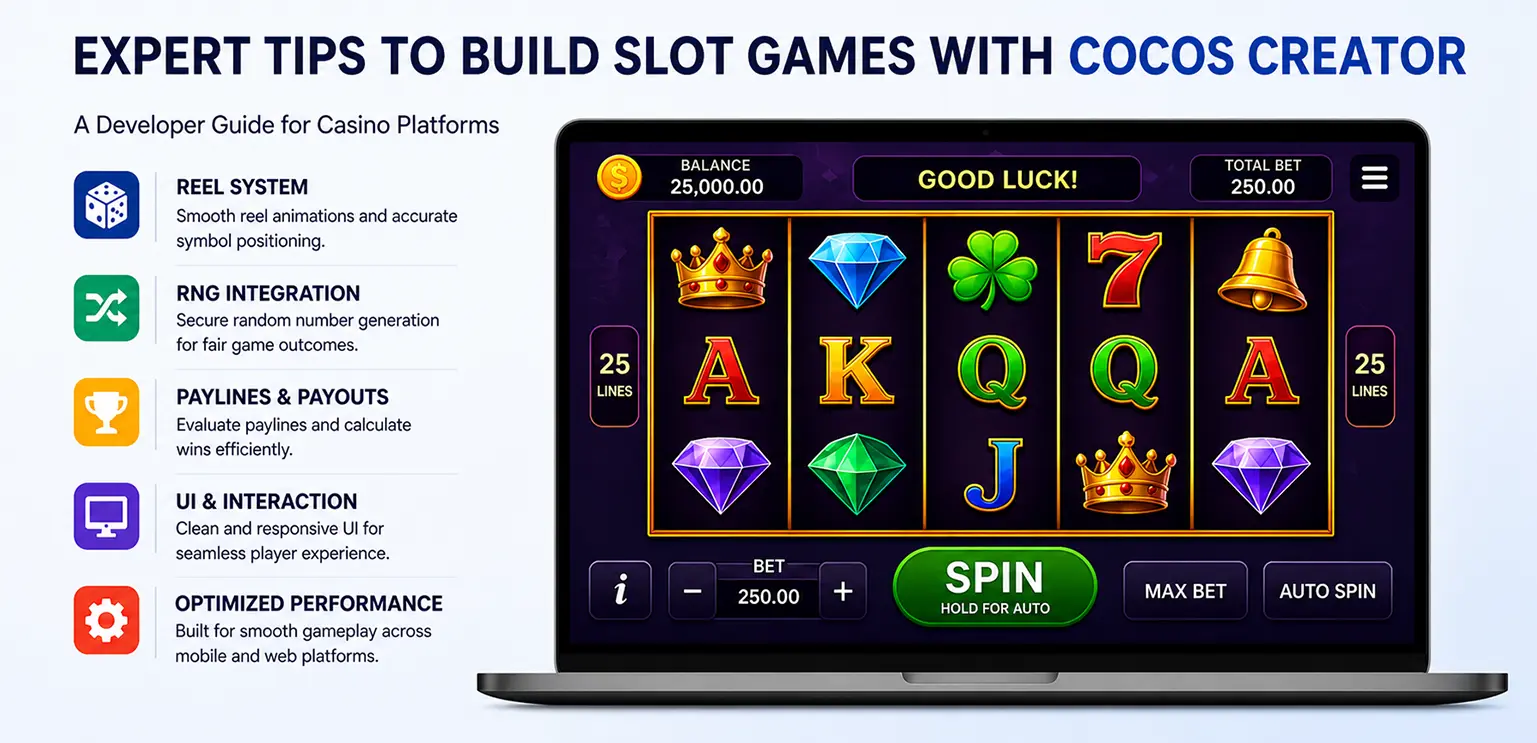
However, building a production-ready slot game involves much more than spinning reels. It requires a well-structured system that combines logic, visuals, and backend integration in a scalable way.
Understanding Slot Game Architecture
Before writing any code, it's important to understand how a slot game is structured internally. At a high level, a slot game consists of multiple independent systems working together. The most critical ones include:
- Reel system (Visual + Logical separation)
- RNG (Random outcome generation)
- Payout and payline evaluation
- UI and interaction systems
- Animation and feedback layer
Each system should be modular. This allows teams to update features, fix issues, or reuse components across projects without breaking the entire game. A common mistake is tightly coupling these systems, which creates long-term maintenance issues.
Real Development Workflow in Slot Production
In real production environments, slot development does not happen in isolated layers—it follows a structured pipeline.
Teams typically begin with core systems such as RNG logic and reel configuration, since these define how the game behaves. Once probabilities and outcomes are stable, developers move on to building the visual reel system that reflects those results accurately.
UI systems are then layered on top to handle player interaction, followed by animation and feedback systems that enhance engagement and clarity. Backend integration often runs in parallel or slightly later, depending on platform requirements.
This staged workflow ensures that core functionality is validated early, reducing rework and making the overall pipeline more efficient.
Setting Up a Scalable Project in Cocos Creator
A clean project structure is essential for both speed and scalability. In Cocos Creator, developers should organize assets and scripts in a way that reflects system boundaries rather than just file types. Scenes should be separated by game states such as lobby, gameplay, and bonus modes.
Prefabs should be used extensively for reusable elements like symbols, UI buttons, and panels. Scripts should be modular and focused, with each handling a specific responsibility. This kind of structure becomes especially important when the game moves into Live Ops, where frequent updates are required.
Designing the Reel System
🔹 Separating Logic from Visuals
A well-designed reel system separates what the player sees from how the game calculates results. The logical reel determines the outcome based on symbol sequences and probabilities, while the visual reel simply animates those results. This separation ensures accuracy and prevents inconsistencies between gameplay logic and presentation.
🔹 Reel Spin and Stop Behavior
Reel animation is not just about movement—it is about timing and perception. In Cocos Creator, developers typically use tweening systems to create smooth spin and stop animations. Reels should feel independent but still resolve cleanly into the outcome. Subtle delays between reel stops create anticipation and improve engagement without affecting the underlying results.
RNG Integration and Outcome Flow
Random number generation is the foundation of slot gameplay. In production environments, RNG is usually handled externally to ensure fairness and compliance. From the client perspective, the flow remains consistent.
- Player initiates spin
- System determines outcome
- Outcome maps to reel positions
- Animation reflects the result
The important detail is that the outcome is finalized before animation begins. The visual layer only communicates the result.
Paylines and Payout Systems
Once the reels stop, the system evaluates results. Paylines define how symbols align across reels to produce wins. Most studios implement paylines using data-driven configurations rather than hardcoded logic. This allows designers to modify behavior without changing code, making the system more flexible and easier to maintain. Efficient evaluation becomes increasingly important as the number of paylines and features grows.
UI Systems and Player Interaction
Slot games rely heavily on UI clarity. Players need immediate understanding of their balance, bets, wins, and available actions. Poor UI design can reduce engagement even if the underlying game is strong. Cocos Creator allows developers to build structured UI systems using reusable components. The focus should be on maintaining clarity while supporting complex interactions.
Animation and Feedback Systems
Animation is a functional part of slot design, not just visual polish. It communicates results, builds excitement, and reinforces player actions. Effective animation systems are synchronized with gameplay events to ensure consistency.
Studios often build reusable frameworks that trigger animations dynamically based on outcomes. This approach improves scalability and maintains consistency across different features. Teams like Gamix Labs often support this stage by developing production-ready animation pipelines that align UI, symbols, and effects into a cohesive system.
Feature Systems and Bonus Mechanics
Modern slot games rely on layered features to maintain engagement over time. These may include free spins, multipliers, or bonus modes. From a development standpoint, these systems should be modular and event-driven rather than tightly integrated into the core loop. This allows features to be reused, updated, or expanded without affecting the entire system.
What Goes Wrong in Real Slot Development
Even well-planned projects encounter challenges during production. One common issue is desynchronization between RNG outcomes and reel animations, which can create visual inconsistencies. Another frequent problem is overly complex feature interactions, where multiple bonus systems conflict or behave unpredictably.
Performance issues also arise when too many animations or effects run simultaneously, especially on lower-end devices. These problems highlight the importance of validating systems independently before combining them into a complete gameplay experience.
Performance Optimization in Cocos Creator
Performance is critical, particularly for mobile-first slot games. Even though slot games appear simple, they often involve layered UI, continuous animations, and multiple active systems.
Optimization involves reducing unnecessary rendering work, managing assets efficiently, and ensuring that animations are lightweight. Memory usage must also be carefully controlled to prevent slowdowns during extended sessions.
Backend Integration for Platform Deployment
For deployment on casino platforms, frontend systems must integrate with backend services. These systems handle player sessions, balance updates, and validation processes. Communication is typically managed through APIs, ensuring that critical logic remains secure and centralized. This separation between client and server is essential for scalability and reliability.
Testing and Quality Assurance
Testing in slot games requires a higher level of precision than many other genres. Every possible outcome must be validated to ensure accuracy and consistency. This includes verifying payout calculations, reel alignment, and feature triggers. Automated testing is often used to handle large-scale validation efficiently, especially in games with complex configurations.
Live Ops and Continuous Updates
Slot games are designed to evolve after launch. Studios regularly introduce new content, features, and updates to maintain engagement. A well-structured system makes it easier to implement these changes without disrupting existing functionality. Cocos Creator supports this approach through modular design and flexible asset management.
Common Development Mistakes
Common issues in slot development often stem from poor system design. Mixing logic with visuals can make debugging difficult, while weak UI structure can confuse players. Lack of modularity slows down development and limits scalability. Avoiding these mistakes requires careful planning from the beginning.
Future Trends in Slot Development
Slot development is moving toward more dynamic and adaptive systems. Studios are adopting data-driven design, personalized experiences, and faster production pipelines. As tools evolve, the focus will remain on delivering richer experiences while maintaining performance.
What High-Performing Slot Teams Do Differently
High-performing teams approach slot development as a scalable system rather than a single project. They prioritize clean separation between logic, visuals, and UI. They rely on reusable components and data-driven configurations instead of hardcoded systems. More importantly, they design their pipelines for long-term efficiency, allowing them to produce and update games faster without sacrificing quality. This mindset is what separates average production workflows from highly optimized ones.
Strategic Takeaways for Developers
Building slot games with Cocos Creator requires more than technical execution. It demands structured architecture, modular systems, and a strong focus on player experience. Developers who approach projects with this mindset can scale more effectively and deliver higher-quality results.
Conclusion
Cocos Creator provides a strong foundation for slot game development, particularly for mobile and web platforms. Its flexibility and performance make it a practical choice for modern casino-style games. However, the real advantage comes from how systems are designed and integrated.
Studios that focus on clean architecture, efficient workflows, and player-centric design will be better positioned to succeed in an increasingly competitive market.
FAQ: Slot Game Development in Cocos Creator
Is Cocos Creator suitable for slot games?
Yes, especially for 2D slot games targeting mobile and web platforms.
How are slot results generated?
Through RNG systems that determine outcomes before animations play.
Why separate reel logic from visuals?
To ensure accuracy, maintainability, and easier debugging.
What is the biggest technical challenge?
Balancing performance, scalability, and engaging player experience.
Can slot games be updated after launch?
Yes, through Live Ops systems and modular architecture.