Aggregator Integration Guide for New Online Casinos
Launching an online casino today is not just about building a platform—it’s about delivering high-quality, diverse, and constantly updated game content from day one.
Players expect instant access to:
- Thousands of slot games
- Live casino experiences
- Table games
- Jackpot networks
Building direct integrations with dozens of game providers is possible—but for most new casinos, it’s impractical, slow, and expensive.
This is why aggregators have become the backbone of modern iGaming ecosystems.
An aggregator acts as a content hub, connecting casinos to multiple game providers through a single integration.
For new operators, this dramatically reduces:
- Time to market
- Technical complexity
- Operational overhead
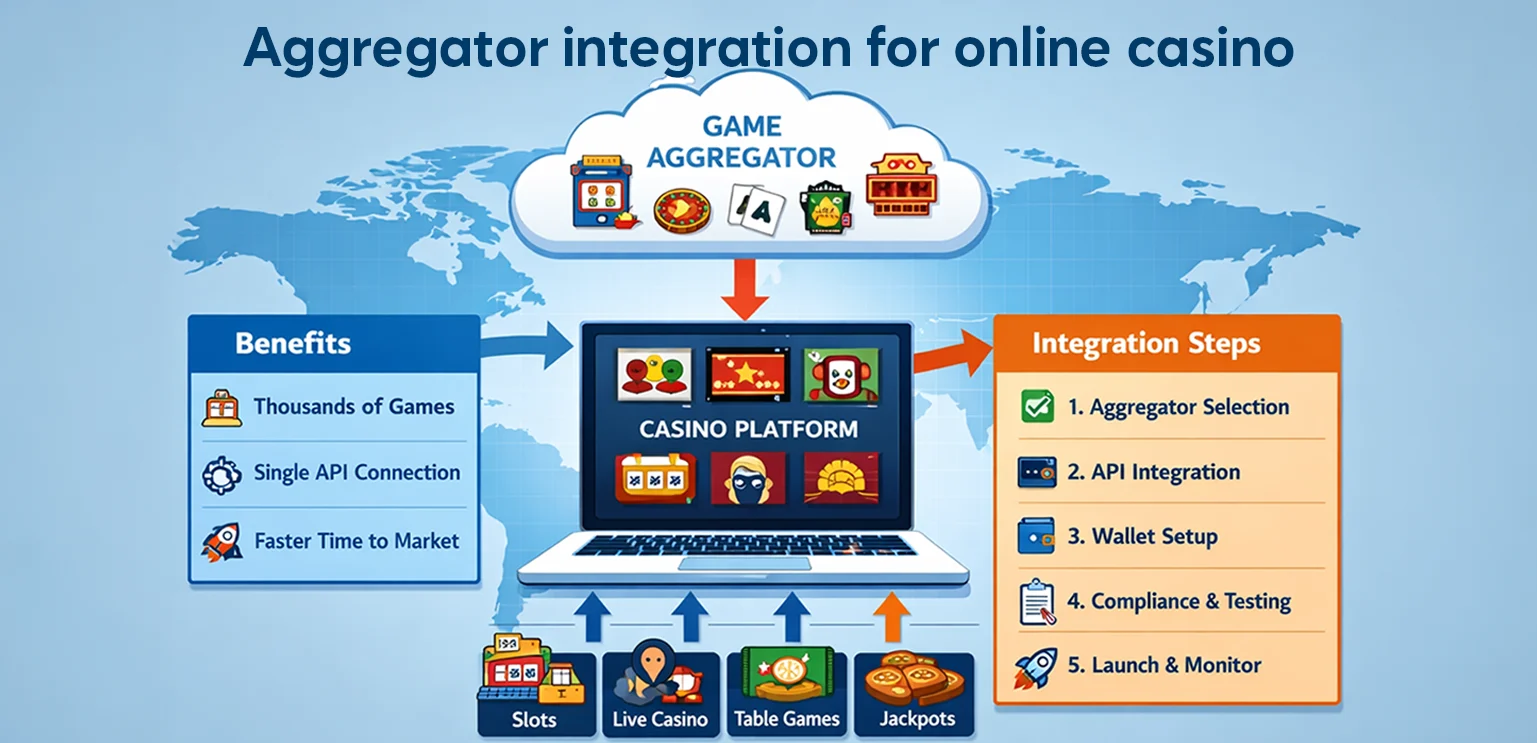
This guide explains how aggregator integration works, what new casinos need to consider, and how to build a scalable integration strategy.
What Is a Casino Aggregator?
A casino aggregator is a platform that provides access to multiple game providers via a single API integration.
Instead of integrating with:
- 20 different slot studios
- Multiple live casino providers
- Jackpot systems
A casino integrates with one aggregator, which connects everything.
Aggregators typically offer:
- Slot games
- Live dealer games
- Table games
- Crash and instant games
- Jackpot systems
Examples in the industry include major aggregation platforms (not named here intentionally for neutrality).
Why New Casinos Choose Aggregators
For new operators, aggregators offer several key advantages.
🔹 Faster Time to Market
Direct integrations with multiple providers can take months. Aggregator integration can reduce launch timelines to:
- 4–8 weeks (in many cases)
🔹 Access to Large Game Libraries
Aggregators often provide:
- 2,000+ slot titles
- Multiple providers
- Diverse game categories
This allows casinos to launch with a competitive content offering immediately.
🔹 Simplified Technical Integration
Instead of managing multiple APIs, casinos work with:
- A single API
- Unified documentation
- Centralized support
🔹 Reduced Operational Complexity
Aggregators handle:
- Game updates
- Version management
- Provider onboarding
This reduces the burden on internal teams.
Aggregator vs Direct Integration: Key Differences
Understanding the trade-offs is critical.
🔹 Aggregator Integration
Pros:
- Fast setup
- Large game library
- Simplified maintenance
Cons:
- Revenue sharing
- Less control
- Dependency on aggregator
🔹 Direct Provider Integration
Pros:
- Higher margins
- Direct relationships
- More control
Cons:
- Slower setup
- Higher development effort
- Ongoing maintenance complexity
How Aggregator Integration Works
The integration process typically involves several stages.
Step 1: Choosing the Right Aggregator
Not all aggregators are equal. Key evaluation criteria include:
- Game Portfolio: Number of providers, quality of games, exclusive content.
- Platform Stability: Uptime guarantees, performance metrics.
- API Quality: Documentation clarity, ease of integration.
- Compliance Coverage: Supported jurisdictions, certification standards.
Step 2: API Integration
Aggregators provide APIs that connect the casino platform to their system. Typical API functions include:
- Game launch requests
- Player authentication
- Session management
- Balance updates
- Transaction reporting
Developers integrate these APIs into the casino backend.
Step 3: Wallet Integration
One of the most critical components is wallet integration. Two main models exist:
Seamless Wallet (Recommended)
- The casino manages player balances.
- Aggregator communicates via API.
- Benefits: Better control, unified player experience.
Transfer Wallet
- Funds are transferred to the aggregator system.
- Drawbacks: More complex user experience, potential latency issues.
Step 4: Game Launch Flow
When a player launches a game:
- Player selects a game.
- Casino sends request to aggregator.
- Aggregator returns game URL.
- Game launches in iframe or new window.
- The game communicates with the aggregator, which syncs with the casino backend.
Step 5: Compliance and Certification
Aggregators typically provide pre-certified games. However, casinos must ensure:
- Regulatory compliance
- Jurisdiction approvals
- Responsible gaming features
This step is critical for regulated markets.
Step 6: Testing and QA
Before launch, casinos must test:
- Game loading
- Currency handling
- Bet limits
- Transaction accuracy
- Error handling
Thorough testing prevents costly issues post-launch.
Step 7: Launch and Monitoring
After integration:
- Games go live
- Performance is monitored
- Analytics are tracked
Operators continuously evaluate player engagement, game performance, and revenue metrics.
Content Strategy: Not All Games Perform Equally
One common mistake new casinos make is assuming that more games = better performance. In reality, success depends on game selection, player preferences, and market targeting.
🔹 Curated Game Libraries
Instead of offering thousands of games blindly, successful casinos:
- Highlight top-performing titles
- Organize games by category
- Promote featured content
🔹 Market-Specific Content
Different markets prefer different types of games. For example:
- Europe → classic slots + high RTP games
- Asia → high volatility + jackpot slots
- Emerging markets → mobile-friendly games
UI and Game Discovery Optimization
Aggregator integration is not just technical—it affects user experience. Casinos must design interfaces that help players discover games easily. Key UI considerations:
- Search functionality
- Filtering options
- Game categories
- Personalized recommendations
Studios specializing in slot UI systems, such as Gamix Labs, often design game browsing interfaces and visual asset systems that improve discoverability and player engagement.
Common Integration Challenges
New casinos often face several issues.
🔹 API Misalignment
Incorrect implementation can cause failed game launches and transaction errors.
🔹 Currency Handling Issues
Multi-currency support must be aligned between the casino platform and aggregator system.
🔹 Latency and Performance
Poor server response times can affect gameplay experience.
🔹 Compliance Gaps
Failing to meet regulatory requirements can delay launch.
Best Practices for Successful Integration
- Start with One Aggregator: Avoid integrating multiple aggregators initially. Focus on stability first.
- Prioritize Seamless Wallet Integration: This provides a better player experience.
- Build a Strong QA Process: Test all edge cases before launch.
- Monitor Game Performance: Use analytics to identify top-performing games.
- Plan for Future Expansion: Design systems that allow adding new aggregators or integrating direct providers later.
Future Trends in Aggregator Integration
The aggregator ecosystem is evolving rapidly.
- Unified Platforms: Some platforms are combining aggregation, player management, and analytics into a single solution.
- AI-Driven Game Recommendations: Aggregators may provide personalized content feeds based on player behavior.
- Faster Integration Frameworks: New APIs and SDKs are reducing integration time further.
- Cross-Platform Content: Games are increasingly optimized for
- mobile
- desktop
- instant play
Conclusion
Aggregator integration is one of the most important steps for new online casinos. It enables operators to launch quickly, access large game libraries, and reduce technical complexity. However, successful integration goes beyond connecting APIs.
Casinos must focus on:
- Content strategy
- UI design
- Compliance
- Performance optimization
By building a strong foundation and planning for scalability, new casinos can leverage aggregators to compete effectively in the global iGaming market.
FAQs
What is a casino aggregator?
A casino aggregator is a platform that provides access to multiple game providers through a single API integration.
How long does aggregator integration take?
Typically between 4 to 8 weeks, depending on platform complexity and testing requirements.
What is a seamless wallet in casino integration?
A seamless wallet allows the casino to manage player balances while the aggregator communicates transactions via API.
Can casinos use multiple aggregators?
Yes, but it increases complexity. Many casinos start with one aggregator and expand later.
Do aggregators handle game certification?
Yes, most aggregators provide certified games, but casinos must still meet jurisdictional requirements.
Is aggregator integration better than direct integration?
For new casinos, aggregators are usually faster and easier. Larger operators may later add direct integrations for better margins.