Build vs Buy: Should Operators Develop In-House Casino Games?
Every online casino operator eventually reaches the same strategic crossroads: should the business build its own games, or keep buying content from external providers?
At first glance, buying looks like the obvious answer. Aggregators and studio partnerships give operators instant access to thousands of slots, table games, crash games, and live dealer titles. That speed matters, especially in the early stages of launch.
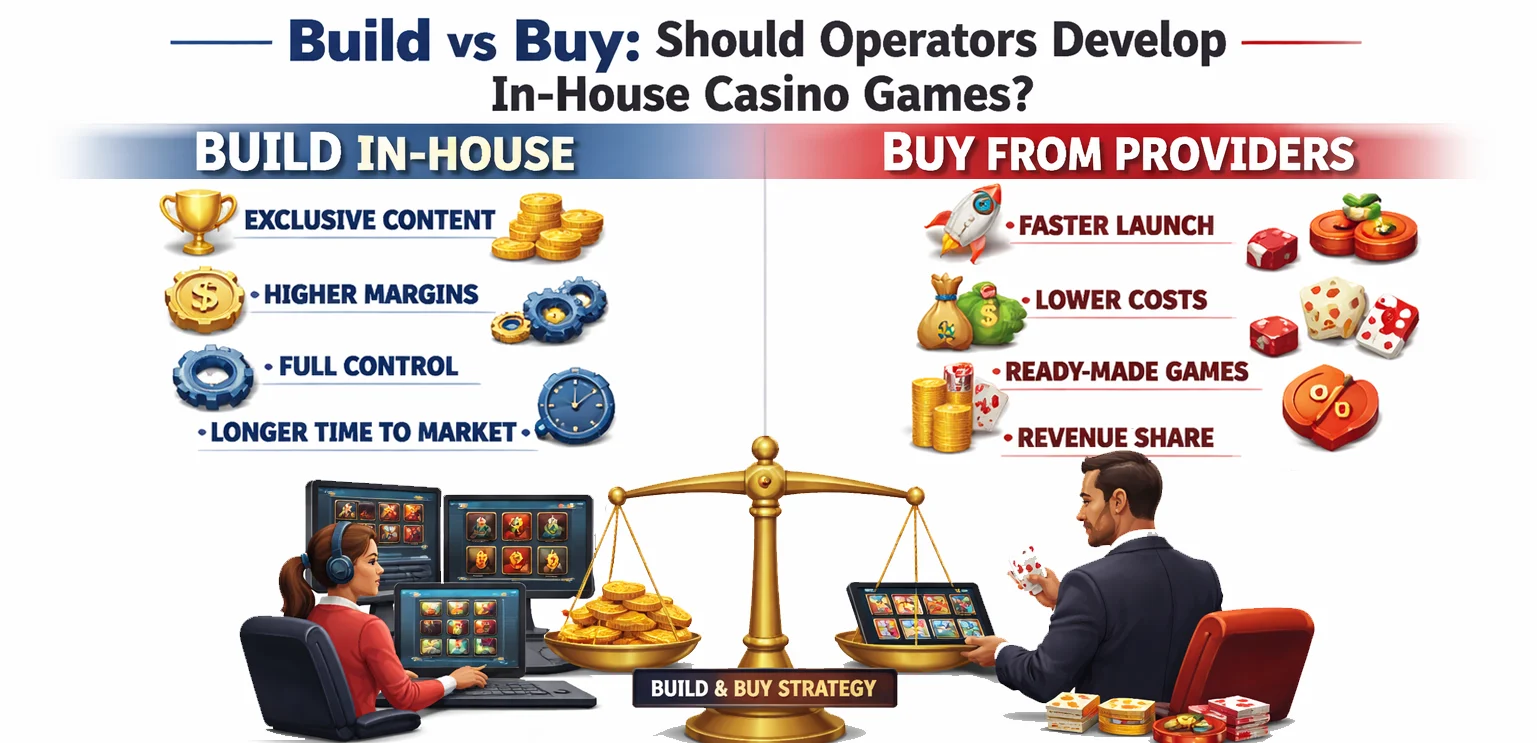
But once a platform starts growing, the same questions begin to surface:
- Why are margins getting tighter?
- Why do competing casinos offer nearly identical game libraries?
- Why is it so hard to create a distinctive player experience?
- How do we turn content from a dependency into an asset?
That is where the build-versus-buy debate becomes real.
Developing games in-house can create stronger control, better branding, and higher long-term value. Buying games from providers delivers speed, scale, and operational simplicity. Neither path is universally correct.
The right answer depends on several business variables:
- Business stage
- Technical capabilities
- Market strategy
- Long-term vision
For many operators, this is less a product decision and more a growth-model decision. It affects margins, scalability, brand identity, and the degree of control a casino has over its own roadmap.
This article examines the real trade-offs behind building vs buying casino games, with a practical focus on ROI, content strategy, and operational execution.
Industry Context: Why More Operators Are Considering In-House Development
The iGaming market has changed significantly over the last few years. Historically, most operators relied almost entirely on:
- Aggregators
- Third-party game studios
- White-label content ecosystems
That model still works, especially for fast launches, but market pressure has changed how operators think about content.
Today, more casino brands are investing in:
- Proprietary game studios
- Exclusive content pipelines
- Branded gaming experiences
- Original slot concepts tailored to their own player data
The reason is straightforward: content is no longer just inventory. It is a competitive lever.
When every casino offers the same third-party catalog, differentiation becomes difficult. Bonus systems, CRM campaigns, and UX improvements can help, but they rarely create the same defensible advantage as exclusive content. Owning even a small portfolio of proprietary games can shift that equation.
Operators are also becoming more data-driven. Instead of treating games as static supplier products, they increasingly view them as tunable assets connected to player retention, session length, monetization, and brand perception. That shift makes in-house development much more attractive than it was in the past.
If you are still in the early platform phase, third-party content remains essential. But as discussed in Aggregator Integration Guide for New Online Casinos, dependency on external content alone can become limiting once scale and margin pressure start to matter.
What Does Building In-House Really Mean?
One common misconception is that in-house development always means building a large internal studio from scratch. In reality, there are several models, each with different costs, risks, and levels of control.
🔹 Full In-House Studio
In the most ambitious version, the operator builds a complete game studio internally. That usually includes:
- Game designers
- Frontend and backend developers
- Mathematicians
- Technical artists and animators
- QA engineers
- Compliance and certification specialists
- Product managers and Live Ops support
This structure provides maximum ownership and flexibility. The operator controls the roadmap, the math model, the visual identity, and how content evolves after launch. The trade-off is obvious: it is expensive, slow to establish, and operationally demanding.
🔹 Hybrid Production Model
This is the model many serious operators prefer because it balances control with practicality.
In a hybrid setup, the operator keeps the strategic and creative core in-house, such as:
- Game concepts
- Product direction
- Market positioning
- Monetization goals
- Performance analysis
Then selected production functions are outsourced to specialized partners, including:
- Slot art production
- Animation
- UI systems
- Engineering support
- QA capacity
This allows the operator to retain ownership of the idea and the business logic while scaling production more efficiently. For example, external partners like Gamix Labs can support asset pipelines, production workflows, and game-ready visual delivery without forcing operators to build every capability internally on day one.
🔹 White-Label Customization
At the low-investment end of the spectrum, operators may license existing games and customize branding, themes, or small features. This is sometimes described as a proprietary strategy, but it offers limited real differentiation.
White-label customization works when the goal is quick market adaptation or thematic alignment. It does not work well when the business wants true exclusivity or long-term IP value.
What Does Buying Games Involve?
Buying games typically means integrating content through:
- Individual game providers
- Aggregators
- Content distribution platforms
Commercially, operators usually pay through one or more of the following:
- Revenue share agreements
- Licensing fees
- Platform commissions
- Minimum guarantees in some partnerships
The appeal is obvious. Instead of spending months building a single title, operators can activate large game libraries almost immediately. This is why buying remains the default route for:
- New operators
- Market entrants
- Brands testing a new geography
- Casinos expanding content variety quickly
The downside is structural. Because the games are not owned by the operator, important levers remain outside internal control. Product updates, feature experimentation, RTP options, and monetization decisions may all depend on supplier capabilities and commercial terms.
Buying content is fast, but it also means sharing revenue on an activity that may become central to the casino's profitability.
Build vs Buy: Core Comparison Across Business Priorities
The best way to evaluate the decision is not by asking which approach is better in general, but by asking which approach performs better against the priorities of your business.
🔹 Time to Market
Buying Games
Buying wins decisively on speed.
- Immediate access to large game libraries
- Launch-ready content
- Minimal production overhead
- Faster response to market opportunities
This is ideal for operators that need to launch quickly or expand their content depth without delaying go-to-market plans.
Building In-House
Building is much slower.
- A single slot may take 3 to 9 months to produce
- Certification adds time
- Internal review and iteration extend schedules
- Studio formation itself can take months
This route only makes sense when the operator is optimizing for long-term strategic value rather than near-term speed.
🔹 Cost Structure
Buying Games
Buying has lower upfront cost but ongoing commercial drag.
Typical costs include:
- Revenue share, often in the 10% to 30% range or higher
- Aggregator fees
- Technology and platform commissions
- Supplier-specific commercial terms
This model is operationally convenient, but it scales linearly with success. The more the games perform, the more margin is shared away.
Building In-House
Building requires meaningful upfront investment.
Common cost areas include:
- Salaries and contractor costs
- Engine and tooling expenses
- Compliance and certification costs
- Art, animation, and production management
- Post-launch support infrastructure
However, once pipelines are in place, the marginal cost of producing additional games tends to improve. That is where long-term leverage starts to appear.
🔹 Profit Margins
Buying Games
With third-party content, operators only capture a portion of the game revenue. Even when the content performs strongly, part of the upside belongs to providers, aggregators, and other intermediaries.
Building In-House
With proprietary content, operators retain much more value.
- Higher effective margins
- Greater control over monetization rules
- Stronger ability to capture lifetime revenue from successful titles
This does not mean every in-house game is automatically more profitable. It means the ceiling is materially higher when the operator owns the asset.
🔹 Content Differentiation
Buying Games
Third-party content is often widely distributed. A good game may appear on dozens or hundreds of competing platforms.
That creates content parity, which weakens brand distinction.
Building In-House
Exclusive games create a very different dynamic.
- Unique mechanics
- Distinct themes
- Tailored retention features
- Branded experiences competitors cannot mirror directly
This advantage becomes especially important when an operator wants to own a recognizable identity instead of competing on bonuses alone.
🔹 Control and Flexibility
Buying Games
When content is purchased, operator control is limited.
Typical constraints include:
- Fixed or narrowly configurable RTP choices
- Limited influence over mechanics
- Slow update cycles
- Supplier dependency for features and fixes
Building In-House
Building gives the operator direct control over:
- Game design
- Math models
- Feature roadmap
- Event-based content updates
- Live Ops experimentation
That flexibility is especially valuable when paired with internal performance data. Operators can iterate faster when they are not waiting on an external supplier queue.
🔹 Scalability
Buying Games
Buying is easier to scale in volume. Operators can add more suppliers and expand the library quickly. The trade-off is that cost and dependence also scale, while differentiation remains weak.
Building In-House
Building is harder to scale operationally because it requires:
- Larger teams
- Better production systems
- Reusable frameworks
- Stronger cross-functional leadership
But unlike bought content, in-house production creates compounding asset value. Each game, pipeline improvement, and reusable system strengthens the operator's long-term position.
Real-World ROI Scenario: How the Economics Change Over Time
To make the trade-off more concrete, consider two hypothetical operators.
🔹 Operator A: Buy-Only Strategy
This operator launches with an aggregator and quickly offers more than 3,000 games. Commercially, it pays a 20% revenue share across core content partnerships.
Short-term outcome:
- Fast launch
- Strong acquisition potential
- Low development complexity
Long-term outcome:
- Margin pressure increases as revenue scales
- No proprietary content assets are created
- Competitive differentiation remains weak
🔹 Operator B: Hybrid Strategy
This operator also launches with third-party content but gradually builds a portfolio of 10 exclusive games over time through a hybrid internal-plus-outsourced production model.
Short-term outcome:
- Slower proprietary rollout
- Higher planning and production overhead
Long-term outcome:
- Better blended margins
- A growing bank of proprietary IP
- Exclusive content that strengthens retention and brand identity
🔹 Why the Hybrid Model Often Wins on Lifetime ROI
Operator B may grow more slowly at the beginning, but it is building assets instead of relying solely on rented inventory. Over time, the economics usually improve because:
- Revenue share exposure decreases on owned titles
- Exclusive content improves retention and repeat visits
- Internal knowledge compounds across future releases
- High-performing games can be updated rather than replaced
In other words, buy-only often wins the first phase of growth, while hybrid or in-house models tend to win the later phases of value creation.
When Buying Games Makes More Sense
Buying is not the inferior path. In many situations, it is clearly the correct one.
🔹 Early-Stage Casino Launches
If the business needs speed, variety, and low operational complexity, external content is the right foundation.
This applies especially when the operator has:
- Limited internal resources
- No game production team
- Aggressive launch deadlines
🔹 Market Validation
When entering a new region or testing a new player segment, buying games reduces strategic risk. It lets operators validate acquisition channels, player preferences, and retention behavior before committing to original content investment.
🔹 Fast Library Expansion
If the current goal is increasing breadth rather than exclusivity, adding providers is the fastest route. This is useful when the casino must meet player expectations around content depth or support multiple verticals quickly.
🔹 Operational Simplicity
Buying also makes sense for businesses that want to focus internal resources on:
- CRM
- Acquisition
- Payments
- KYC and compliance
- Platform UX
Not every operator needs to become a content studio. Some are better served by staying commercially agile and supplier-led.
When Building In-House Is the Better Choice
In-house or hybrid development becomes strategically attractive once the operator has enough stability, data, and ambition to justify the investment.
🔹 You Need Real Differentiation
If the casino is struggling to stand out in a saturated market, proprietary content can create a stronger moat than generic supplier catalogs.
🔹 You Want Better Margins
If supplier fees are eroding profitability, owned content improves the economics of every successful session played on proprietary titles.
🔹 You Are Optimizing for Long-Term Growth
Internal content pipelines are not just about immediate releases. They create reusable systems, production knowledge, and intellectual property that can support the business for years.
🔹 You Have Stable Traffic
Development investment is easier to justify when the operator already has consistent player traffic and enough distribution to put proprietary games in front of a meaningful audience.
Without traffic, even great content may struggle to show commercial return. With traffic, owned content becomes much more powerful.
The Hybrid Model: Why It Has Become Industry Best Practice
For most serious operators, the smartest answer is not purely build or purely buy. It is a layered content strategy.
The hybrid model typically looks like this:
- Third-party games provide scale and category coverage
- Proprietary games create exclusivity and higher-margin engagement
- Specialized partners extend production capacity without bloating the internal team
This approach balances the trade-offs more effectively than either extreme.
It gives operators:
- Speed through external content
- Control through owned concepts
- Better economics over time
- Scalable production without building every function internally
This model also aligns well with how modern game pipelines work. Art, math, frontend systems, QA, and compliance do not all need to sit under the same roof for the operator to retain strategic ownership.
Production Considerations for In-House Games
Building games is not only a coding problem. It is a production-system problem.
🔹 Art and Asset Production
Slot games require:
- Symbols
- UI systems
- Animations
- Visual effects
Studios like Gamix Labs often support operators by delivering production-ready slot art and scalable asset pipelines, helping reduce internal workload while maintaining quality.
🔹 Math and Game Design
Strong game performance depends on well-structured math. That includes:
- RTP configuration
- Volatility tuning
- Bonus pacing
- Hit frequency
- Feature balancing
These choices influence how a game feels just as much as its visuals do. For operators building their own portfolio, math design should be treated as a commercial discipline, not just a technical one. The broader strategy behind these decisions is explored further in Choosing the Right RTP & Volatility for Global Slot Markets.
🔹 Compliance and Certification
No casino game is commercially useful until it meets jurisdictional requirements. Certification can affect both timelines and production cost, especially when multiple markets are involved.
🔹 Live Ops and Post-Launch Updates
Once a game is live, work does not stop. Ongoing support is needed for:
- Retention improvements
- Event tie-ins
- Feature updates
- Bug fixes
- Performance optimization
Operators should not enter in-house development without planning for post-launch ownership.
Risks of Building In-House
The upside of ownership is real, but the risks are equally real.
🔹 High Initial Investment
Hiring a capable team, building workflows, and producing certified content requires substantial capital before returns are visible.
🔹 Longer Time to ROI
The business may wait months before the first proprietary game launches, and even longer before the investment starts outperforming supplier-based economics.
🔹 Talent Acquisition Challenges
Experienced game designers, mathematicians, technical artists, and iGaming engineers are not easy to hire. In many markets, specialist talent is scarce and expensive.
🔹 Operational Complexity
Game production introduces new management demands:
- Scheduling
- QA discipline
- vendor coordination
- compliance planning
- roadmap prioritization
Without strong leadership, internal development can become a cost center instead of a growth engine.
Future Trends: Where the Industry Is Heading
Several trends suggest the build-versus-buy decision will become even more important over the next few years.
🔹 More Operators Are Becoming Content Creators
The distinction between operator and studio is becoming less rigid. More brands want to own part of the player experience instead of acting only as distributors.
🔹 Exclusive Content Is Becoming a Stronger Retention Tool
As acquisition costs rise, retention matters more. Exclusive games help give players a reason to return to one platform instead of rotating across identical catalogs.
🔹 Data-Driven Development Is Improving Content Decisions
Operators have direct access to player behavior data. Those insights can inform concept design, volatility selection, bonus pacing, and feature prioritization.
🔹 Modular Development Will Reduce Production Burden
Reusable systems for UI, core mechanics, analytics, and event hooks will make proprietary production more efficient. This lowers the barrier to building internal portfolios over time.
Conclusion: It Is Not Build or Buy. It Is Build and Buy.
The real question is not whether operators should build or buy casino games in absolute terms. The better question is when each model creates the most value.
Buying games remains essential for:
- Fast launch
- Large content libraries
- Market entry
- Lower operational complexity
Building games becomes essential for:
- Differentiation
- Stronger margins
- Brand ownership
- Long-term strategic growth
The most effective operators understand that third-party content drives breadth and acquisition, while proprietary content drives retention, control, and long-term profitability.
That is why the strongest iGaming content strategy is usually hybrid. It uses bought content to stay competitive now, while building owned content that strengthens the business over time.
If the goal is to create a sustainable casino brand rather than a commodity platform, content ownership should be part of the roadmap.
FAQs
Should new casinos build their own games?
Most new casinos should start by buying games through aggregators or providers so they can launch quickly and validate demand before investing in proprietary development.
Is in-house game development profitable?
Yes, in-house game development can be highly profitable over time because operators keep more of the game revenue and build reusable intellectual property, but it requires meaningful upfront investment.
How long does it take to build a slot game?
A slot game typically takes 3 to 9 months to build, depending on art complexity, math design, compliance requirements, and team structure.
What is the hybrid strategy in iGaming?
A hybrid strategy combines third-party content for fast scale with in-house or exclusive games for differentiation, better margins, and stronger long-term positioning.
Do operators need a full team to build games?
No. Many operators use hybrid production models where concept ownership stays internal while art, animation, engineering, or QA are handled by specialist external partners.
What is the biggest advantage of building games in-house?
The biggest advantage is control: operators can own the content, keep more revenue, move faster on feature updates, and create exclusive player experiences that competitors cannot replicate.