Why LiveOps Is Essential for Slot Games and Online Casinos
Today, it's just the beginning. Whether you're building mobile games, slot titles, or social casino products, the real success of a game is determined after launch — through how well it evolves, adapts, and retains players over time.
This is where LiveOps (Live Operations) becomes essential. LiveOps is not just about pushing updates. It's about continuously shaping the player experience based on behavior, data, and market trends. Studios that embrace LiveOps don't just release games — they build long-term products.
Industry Context: Why LiveOps Has Become Non-Negotiable
The shift toward LiveOps is driven by how players consume games today. Players expect:
- Frequent content updates
- Seasonal events
- Personalized experiences
Simultaneously, competition in mobile and casino gaming has intensified. User acquisition costs are high, and retention has become the primary driver of profitability. Without LiveOps, even a well-designed game risks becoming irrelevant within weeks of launch.
In slot and casino environments, where player engagement cycles are shorter, LiveOps is often the difference between a game that fades quickly and one that generates consistent revenue over months or even years.
What Is LiveOps in Game Development?
LiveOps refers to the ongoing management and evolution of a game after it goes live. This includes:
- Content updates
- Event scheduling
- Feature roll-outs
- Economy adjustments
- Performance optimization
But more importantly, LiveOps is a data-driven discipline. It relies on player behavior, analytics, and experimentation to continuously improve the game experience.
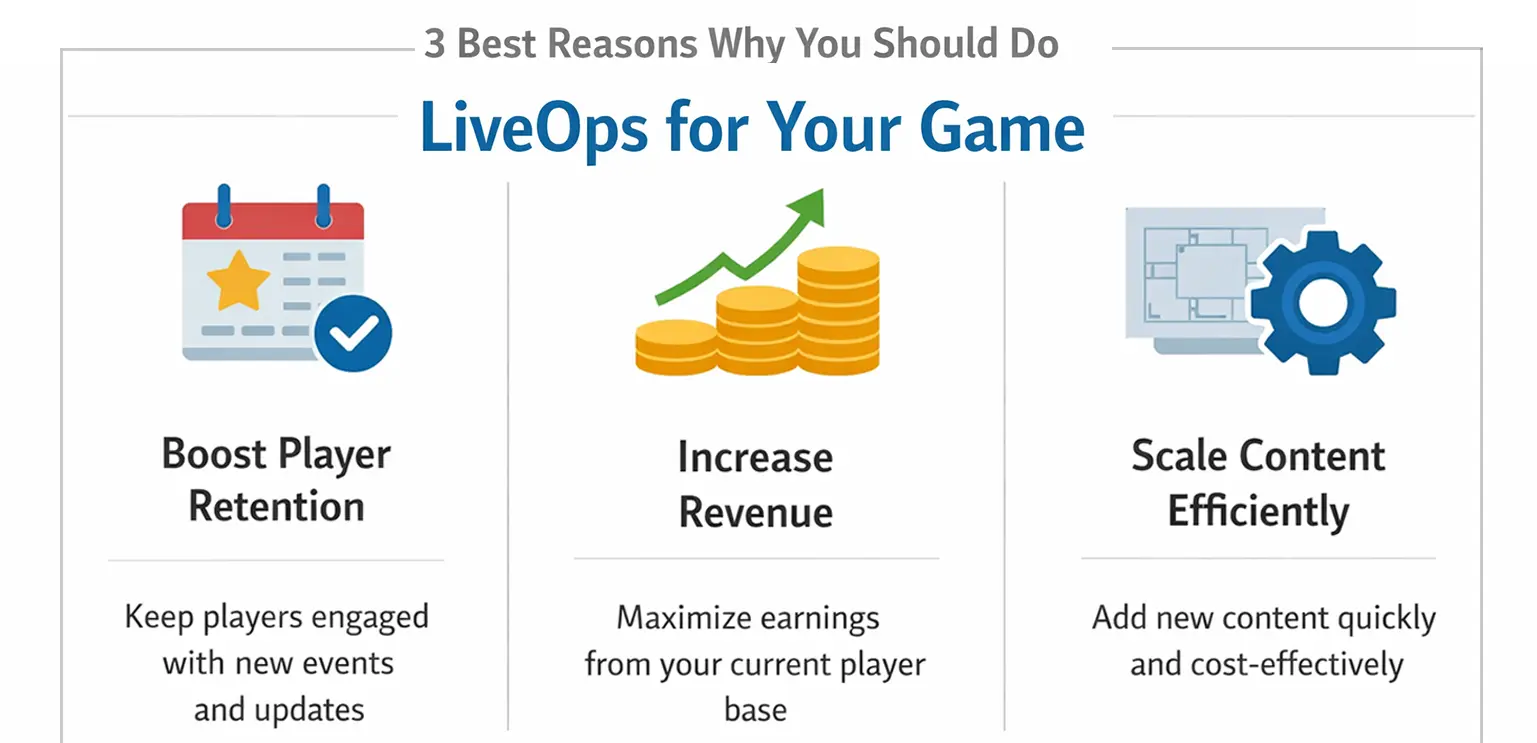
Reason 1: LiveOps Drives Long-Term Player Retention
Retention is the foundation of any successful game. Acquiring players is expensive. Keeping them engaged is where real value is created. LiveOps enables studios to keep the experience fresh without rebuilding the entire game.
Instead of static gameplay, players encounter:
- New challenges
- Limited-time events
- Evolving reward systems
This creates a sense of progression and anticipation.
For example, in slot games, LiveOps might introduce themed events tied to holidays or cultural moments. These events don't just add visual variety — they create urgency and encourage players to return.
From a design perspective, this requires planning ahead. Features must be built in a way that supports ongoing updates. Studios that integrate LiveOps early into their roadmap — rather than treating it as an afterthought — see significantly stronger retention curves.
Reason 2: LiveOps Maximizes Revenue Without Increasing Acquisition Costs
One of the biggest advantages of LiveOps is its ability to increase revenue from existing players. Instead of constantly spending on user acquisition, studios can focus on monetizing engaged users more effectively.
LiveOps supports this through:
- Targeted offers
- Dynamic rewards
- Personalized experiences
In casino games, this might involve adjusting bonus frequency or introducing special promotions for high-value players. The key is that these changes are not static — they evolve based on real-time data. This creates a more efficient revenue model where the game adapts to player behavior rather than relying on fixed systems. Over time, this leads to higher lifetime value (LTV) per player.
Reason 3: LiveOps Enables Scalable Content and Faster Iteration
Modern games cannot rely on one-time content production. They need systems that support continuous expansion. LiveOps encourages studios to think in terms of scalable pipelines rather than individual assets.
For example, instead of designing a single slot theme, a studio might build a framework where multiple themes can be introduced with minimal additional effort.
This is where production design becomes critical. Studios like Gamix Labs often focus on creating modular art systems — symbol sets, UI components, and animations that can be reused across different events and themes.
This approach allows teams to:
- Release content faster
- Maintain visual consistency
- Reduce production costs
It also enables rapid experimentation. New features or events can be tested quickly, and underperforming elements can be adjusted or removed without major disruption.
Real-World Use Case: LiveOps in Slot Games
Slot games are a perfect example of LiveOps in action.
🔹 A Base Game With LiveOps Layers
A base game might remain unchanged, but LiveOps layers add:
- Seasonal reskins
- Bonus events
- Limited-time rewards
These updates keep the experience engaging without altering the core mechanics.
🔹 Technical Requirements for LiveOps at Scale
From a technical perspective, this requires:
- Flexible UI systems
- Dynamic asset loading
- Efficient animation pipelines
Without these foundations, LiveOps becomes difficult to execute at scale.
Challenges Studios Face with LiveOps
While LiveOps offers significant benefits, it also introduces complexity.
Maintaining content quality at speed is one of the biggest challenges. Frequent updates can lead to rushed production if pipelines are not optimized.
Another challenge is data interpretation. Having access to analytics is not enough — teams must understand how to act on that data.
There is also the risk of overloading players with too many events or features, which can reduce engagement rather than improve it. Balancing frequency, quality, and relevance is key.
Development Best Practices for LiveOps Success
Successful LiveOps starts during the initial development phase. Games should be designed with flexibility in mind. Systems must support updates without requiring major rework.
It's also important to establish clear workflows between design, art, and engineering teams. Communication is critical — LiveOps is not a single department, it's a cross-functional effort.
Testing also plays a major role. Updates must be validated quickly to avoid introducing issues into the live environment.
Finally, studios should focus on building a strong feedback loop. Player data should continuously inform design decisions.
Future Trends: The Evolution of LiveOps
LiveOps is becoming more sophisticated with advancements in technology. AI-driven systems are enabling:
- Real-time personalization
- Predictive analytics
- Automated event scheduling
These tools allow games to adapt dynamically to individual player behavior.
At the same time, cross-platform ecosystems are expanding the scope of LiveOps. Players expect consistent experiences across devices, which requires more integrated systems.
The future of LiveOps will be defined by how well studios can combine data, automation, and creative design.
Conclusion
LiveOps is no longer optional — it's a core part of modern game development. It drives retention, increases revenue, and enables scalable content production.
For studios, the key is not just implementing LiveOps, but integrating it into the foundation of the game. Because in today's market, the most successful games are not the ones that launch strong. They are the ones that continue to evolve.
FAQs
What is LiveOps in games?
LiveOps refers to the continuous updating and management of a game after launch to improve engagement and performance.
Why is LiveOps important for player retention?
It keeps the game fresh by introducing new content, events, and features that encourage players to return.
How does LiveOps increase revenue?
By optimizing monetization strategies and engaging existing players more effectively, increasing their lifetime value.
When should LiveOps planning start?
LiveOps should be planned during the initial development phase to ensure systems support ongoing updates.
What types of games benefit most from LiveOps?
Mobile games, slot games, and live-service titles benefit the most due to their ongoing engagement models.
What are the biggest challenges in LiveOps?
Maintaining content quality, managing data effectively, and balancing update frequency without overwhelming players.