Slot Game Art Production Timeline — From Brief to Delivery
Slot game art production is not just a creative process—it is a structured pipeline that directly impacts launch timelines, performance quality, and overall player experience. Modern casino and mobile slot games require a large volume of visual assets, including symbols, backgrounds, UI elements, animations, effects, and promotional materials.
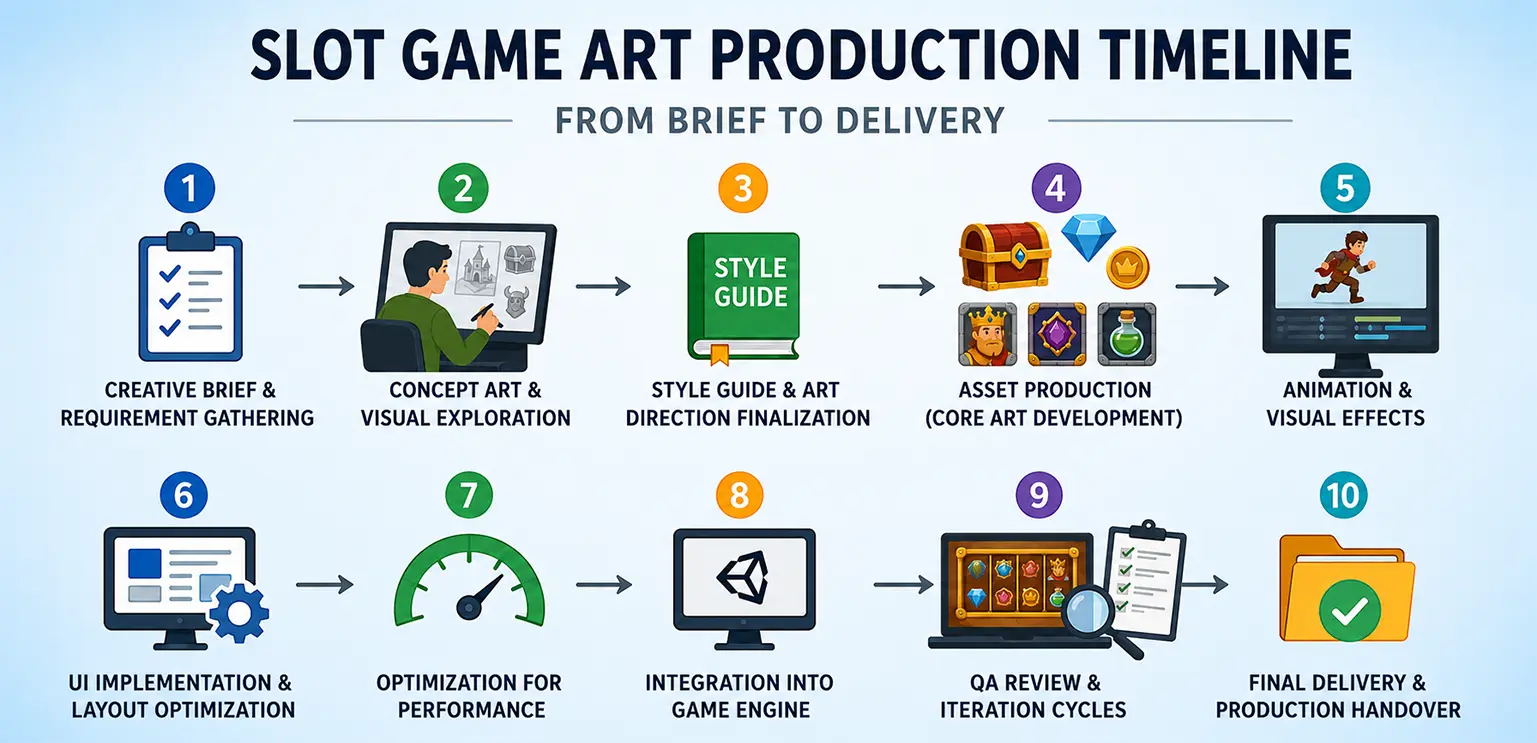
Without a clearly defined production timeline, projects often face delays, inconsistent quality, and inefficient revision cycles. A well-structured pipeline ensures that creative vision, technical constraints, and delivery deadlines remain aligned from the initial brief to final integration.
Stage 1: Creative Brief and Requirement Gathering
Every successful slot game art project begins with a clear and detailed creative brief. This stage defines the foundation of the entire production pipeline.
It typically includes:
- Game theme and narrative direction
- Target audience and platform (mobile, desktop, web)
- Technical specifications and engine requirements
- Asset list (symbols, backgrounds, UI, bonus features)
- Style references and visual benchmarks
- Animation and VFX expectations
At this stage, alignment between developers, artists, and producers is critical. Any ambiguity in the brief often leads to downstream revisions and production delays. A well-defined brief minimizes misunderstandings and establishes clear, measurable delivery expectations from the outset.
Stage 2: Concept Art and Visual Exploration
Once the brief is approved, the production moves into concept development. This stage focuses on establishing the visual identity of the slot game before full production begins.
Concept artists explore multiple creative directions for key elements such as:
- Game background environments
- Slot symbols and character designs
- UI layout styles
- Bonus round themes
- Color palettes and mood direction
Multiple iterations are often created and reviewed before selecting a final direction. This phase is crucial because changes are significantly easier and more cost-effective at the conceptual stage than during production.
Stage 3: Style Guide and Art Direction Finalization
After concept approval, the team develops a comprehensive style guide. This document becomes the production blueprint for all artists involved in the project.
It typically includes:
- Final color schemes and visual tone
- Lighting and shading rules
- Symbol proportions and design rules
- UI spacing and layout standards
- Animation style references
- Technical constraints for assets
The style guide ensures consistency across all assets, especially when multiple artists or outsourcing teams are involved. It also acts as a reference point for quality control during later stages.
Stage 4: Asset Production (Core Art Development)
This is the most resource-intensive stage of the pipeline.
Artists begin creating final production-ready assets based on approved concepts and style guidelines.
Key deliverables include:
- Slot symbols (standard, premium, wild, scatter)
- Background environments and thematic elements
- UI components (buttons, panels, menus)
- Bonus game assets and special feature visuals
- Promotional artwork and store creatives
At this stage, production is highly structured, often divided between specialized artists such as environment designers, UI artists, and character illustrators. Efficient asset management and naming conventions are critical here to avoid pipeline confusion later.
Stage 5: Animation and Visual Effects (VFX Integration)
Once static assets are approved, animation brings the slot game to life.
This phase includes:
- Reel spin animations
- Winning sequences and celebrations
- Symbol animations (idle and triggered states)
- Particle effects and visual enhancements
- Bonus round transitions
The goal is to enhance engagement without compromising performance. Animations must be carefully optimized for mobile and cross-platform environments, as excessive effects can negatively impact frame rates and responsiveness. This stage often requires close collaboration between animators and technical artists.
Stage 6: UI Implementation and Layout Optimization
UI integration ensures that all visual elements function correctly within the game environment. This includes adapting assets for different screen sizes, resolutions, and aspect ratios.
Key tasks include:
- Scaling UI for mobile and desktop devices
- Aligning interactive elements
- Ensuring readability across resolutions
- Integrating dynamic UI states (wins, bonuses, alerts)
UI optimization is especially important in slot games because players interact continuously with interface elements during gameplay sessions. Poor UI design can significantly reduce player retention, even if the core art is strong.
Stage 7: Optimization for Performance and Device Compatibility
Once assets are implemented, they undergo performance optimization. This stage ensures that the game runs smoothly across a wide range of devices.
Common optimization tasks include:
- Texture compression and resizing
- Reducing draw calls using atlases
- Optimizing particle systems
- Streamlining animation states
- Memory usage management
This phase is particularly important for mobile-first slot games, where hardware variability is high. Optimization ensures visual quality is preserved without sacrificing performance.
Stage 8: Integration into Game Engine
At this stage, all finalized assets are integrated into the game engine, such as Unity or Cocos Creator.
Developers and technical artists ensure that:
- Assets are correctly mapped into game systems
- Animations trigger correctly based on events
- UI elements respond to gameplay logic
- Symbol systems function as expected
This is also where final technical adjustments are made to ensure stability and consistency. Any integration issues identified here are typically resolved before testing begins.
Stage 9: QA Review and Iteration Cycles
Quality assurance is a critical phase in the production timeline.
QA teams review:
- Visual consistency
- Animation smoothness
- UI responsiveness
- Asset loading performance
- Cross-device compatibility
Feedback from QA often leads to iterative improvements in both visuals and performance. This stage ensures that the final product meets both artistic and technical standards before release.
Stage 10: Final Delivery and Production Handover
Once QA approval is complete, the final assets and integrated build are delivered.
This includes:
- Optimized asset packages
- Source files and documentation
- Style guides and technical notes
- Engine-ready builds
In outsourced production environments, this stage may also include knowledge transfer sessions to ensure internal teams can maintain and update the game efficiently. A well-documented handover reduces long-term maintenance challenges.
The Importance of Pipeline Efficiency in Slot Game Production
Modern slot games require large-scale asset production within tight deadlines. Without a structured pipeline, teams risk bottlenecks at multiple stages, particularly during animation, optimization, and integration.
Efficient pipelines improve:
- Production speed
- Asset consistency
- Cross-team collaboration
- Final game performance
They also reduce revision cycles, which are one of the biggest cost drivers in game art production.
Common Bottlenecks in Slot Game Art Production
Despite structured pipelines, several common issues often arise:
- Unclear or incomplete initial briefs
- Frequent concept changes during production
- Lack of standardized style guides
- Poor asset naming and organization
- Late-stage optimization requirements
Addressing these issues early in production significantly improves delivery timelines and reduces overall production cost.
Future Trends in Slot Game Art Pipelines
Slot game art production is evolving with advancements in tools and workflows.
Future pipelines will increasingly include:
- AI-assisted concept generation
- Procedural animation systems
- Real-time asset previewing
- Automated optimization tools
- Cloud-based collaboration workflows
These innovations will further reduce production time while increasing creative flexibility.
Strategic Takeaways for Studios and Developers
A well-defined production timeline is essential for delivering high-quality slot games efficiently.
Successful studios focus on:
- Strong upfront planning through detailed briefs
- Clear visual direction via style guides
- Modular and scalable asset production
- Continuous optimization during development
- Structured QA and delivery pipelines
When these elements are aligned, production becomes more predictable, scalable, and cost-efficient.
Conclusion
Slot game art production is a multi-stage process that transforms a creative concept into a fully playable visual experience. From the initial brief to final delivery, each stage plays a critical role in ensuring quality, performance, and consistency.
Studios that invest in structured pipelines not only improve production efficiency but also gain a competitive advantage in delivering visually engaging and technically optimized slot games. In a highly competitive market, production discipline is just as important as creative vision.
FAQs
What is the first step in slot game art production?
It starts with a detailed creative brief defining theme, assets, and technical requirements.
Why is a style guide important?
It ensures visual consistency across all assets and teams.
What is the most time-consuming stage?
Core asset production and animation typically require the most time and resources.
Why is optimization important in slot games?
It ensures smooth performance across different mobile and desktop devices.
What tools are commonly used?
Game engines like Unity and Cocos Creator, along with design tools like Photoshop and Spine.
How long does production usually take?
It depends on complexity, but structured pipelines significantly reduce delays.