The Evolution of 2D Animation in Slot Games: Modern Techniques & Production Insights
There was a time when slot games were visually predictable. Reels spun, symbols aligned, and occasional flashes indicated a win. Animation existed, but it was minimal, more functional than experiential. That era is over.
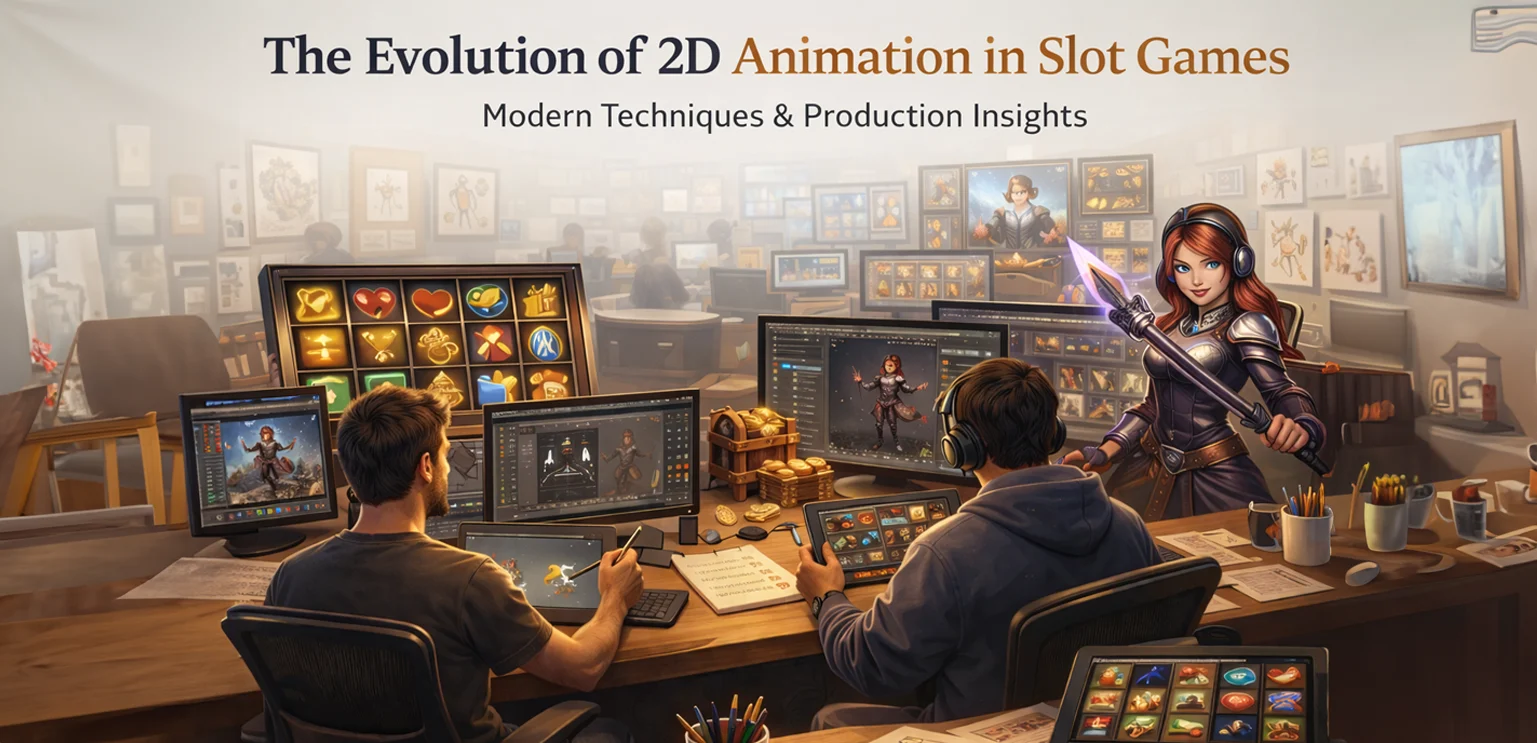
Today, 2D animation is one of the most powerful engagement drivers in slot games. It defines how players perceive wins, how long they stay engaged, and how memorable a game becomes. Modern slot games are no longer just about mechanics. They are about responsive visual systems, and animation sits at the center of that transformation.
Industry Context: Why Animation Became a Core System
The rapid evolution of online casinos forced studios to rethink how games capture attention.
As competition increased, simply offering more games was no longer enough. Players began expecting richer experiences, especially on mobile platforms where attention spans are shorter and competition is immediate. Simultaneously, production demands increased. Games required more assets, more updates, and more variation to support Live Ops strategies.
2D animation became the ideal solution because it offers a balance between visual richness and production efficiency. Unlike full 3D pipelines, 2D animation allows faster iteration, lower performance cost, and easier scalability, making it the backbone of modern slot design.
Studios building modern slot game art pipelines increasingly treat animation as part of the product system rather than a late-stage polish pass. That shift is one of the clearest markers of how mature the category has become.
The Early Phase: Static and Repetitive Animation
Early slot games relied heavily on frame-by-frame sprite animations. Symbols would blink, scale slightly, or flash during win events. While effective for basic feedback, these animations lacked depth and variation.
The limitations were not just technical but also production-related. Creating animations required significant manual effort, and pipelines were not optimized for rapid iteration. As a result, animation was treated as a secondary layer rather than a core system.
At that stage, many visual effects were essentially isolated events. They communicated state changes, but they did not meaningfully shape pacing, emotion, or player perception. This made early slots readable, but rarely memorable.
The Transition: Animation as Feedback, Not Decoration
As tools improved and player expectations evolved, animation began to serve a functional purpose. Instead of static feedback, games introduced motion-driven responses tied directly to gameplay events. This included smoother reel spins, dynamic symbol highlights, and more engaging win sequences.
This shift marked a critical turning point. Animation was no longer just visual polish. It became a way to guide player attention and reinforce game logic.
That distinction matters. When animation is tied to interaction design, it starts influencing readability, reward perception, and overall session quality. In practical terms, animation became part of usability as much as aesthetics.
Modern 2D Animation: System-Driven and Scalable
Today’s slot games use animation as a modular system rather than isolated sequences. A single symbol is no longer a static asset. It exists as a collection of states that respond dynamically to gameplay. These states often include:
- Idle behavior that keeps the screen alive
- Anticipation states that build tension
- Win animations that amplify feedback
- Bonus-trigger sequences that signal progression
What makes modern systems powerful is that these states are not hard coded. They are controlled through logic, allowing animation to scale across multiple features and updates.
This is especially important for teams managing themed variants, feature expansions, or Live Ops content. A well-structured animation system makes it possible to extend a game without rebuilding its motion language from scratch. For production teams, that translates directly into faster iteration and more consistent quality.
Core Techniques Powering Modern Slot Animation
Skeletal Animation: Rig-Based Workflows at Scale
One of the biggest breakthroughs in 2D animation has been the shift from frame-based animation to skeletal systems. Instead of animating every frame, artists create rigs with bones and deformable parts. This allows for smoother motion, easier edits, and significantly smaller file sizes. It also enables rapid iteration, which is critical in Live Ops environments where assets need frequent updates.
Tools such as Spine have become central to this workflow because they allow animators to create reusable motion systems with far less export overhead than traditional sprite-sheet-heavy approaches. This is one reason Spine-based slot animation workflows have become so common in modern production.
Layered Animation Systems
Modern animations are rarely single-layered. A typical win event may combine multiple visual components working together:
- Base symbol motion
- Lighting or glow effects
- Particle overlays
- UI highlights and counters
This layered approach allows teams to adjust specific elements without rebuilding the entire animation, improving both flexibility and efficiency.
It also gives art and technical teams better control over performance. Heavy effects can be scaled back independently on lower-end devices while preserving the core animation read.
Event-Driven Animation Logic
Animation today is deeply integrated with gameplay systems. Instead of playing fixed sequences, animations respond to real-time events such as reel stops, win triggers, or bonus activations. This creates a more responsive experience where visuals feel directly connected to player actions.
When implemented correctly, event-driven animation improves clarity because players instantly understand why something is moving and what it signifies. That tight connection between logic and motion is a major reason modern slots feel more alive than earlier generations.
UI Animation as a Gameplay Driver
UI animation has become a core part of slot design, not just an interface enhancement. Elements such as spin buttons, win counters, and jackpot displays use motion to guide player behavior. A pulsing button encourages interaction, while a dynamically increasing counter reinforces reward perception. In many cases, UI animation directly impacts conversion and retention.
For teams designing mobile-first casino products, slot UI motion systems now sit alongside gameplay feedback as a core production priority rather than a secondary embellishment.
How a Slot Animation Moves from Concept to Final Implementation
In production environments, animation follows a structured pipeline that connects multiple teams. The process typically unfolds in stages:
- Concept artists define visual direction and motion references
- Animators create rigs and animation states using tools like Spine
- Technical artists optimize assets for performance and integration
- Developers connect animation states to gameplay events in the engine
The challenge is not just creating animations, but ensuring alignment across these stages. Even small mismatches between animation timing and gameplay logic can create noticeable inconsistencies. Studios that streamline this pipeline reduce iteration cycles and improve overall production efficiency.
Teams like Gamix Labs approach this by aligning animation systems with UI and gameplay logic from the beginning, ensuring that assets are production-ready rather than requiring constant rework. In practice, that means planning triggers, naming conventions, state transitions, and performance budgets well before final implementation.
The Real Impact: How Animation Affects Player Behavior
Animation is not just visual. It directly influences player psychology and game performance. In well-optimized slot games, animation contributes to measurable outcomes:
- Longer session duration due to improved pacing
- Higher perceived value of wins through visual amplification
- Stronger retention driven by memorable moments
For example, extended animations during bonus rounds can make rewards feel more significant, even when the actual payout remains unchanged.
This is why animation is often treated as part of game economy design, not just aesthetics.
Common Mistakes Studios Make with Slot Animation
Despite its importance, animation is often misused.
One of the most common issues is over-animation. Excessive motion can slow down gameplay and frustrate players, especially in mobile environments where speed matters.
Another mistake is treating animation as a final production layer. When animation is added late, it often conflicts with gameplay logic or UI systems, leading to rework.
Performance is another critical issue. Heavy animations without optimization can cause frame drops on lower-end devices, negatively impacting retention.
The most successful studios avoid these pitfalls by treating animation as a core system integrated early in development. They define motion intent, performance constraints, and implementation rules before content production scales up.
Challenges in Scaling Animation Systems
As games evolve, maintaining animation consistency becomes more difficult.
Live Ops updates introduce new features, themes, and events, all of which require additional animations. Without a structured system, this can lead to fragmentation and inconsistent quality. There is also the challenge of balancing visual richness with performance. High-quality animations must be optimized carefully to ensure smooth gameplay across all devices.
Scalability is not just about creating more animations. It is about creating systems that can handle growth efficiently.
This is where naming standards, reusable templates, shared rig conventions, and engine-side animation logic become essential. Teams that ignore this infrastructure often produce good-looking assets that become difficult to maintain after a few update cycles.
Best Practices for Modern Slot Animation
Studios that consistently deliver high-quality animation tend to follow a few key principles.
They design animation as a system rather than isolated assets, ensuring flexibility across features and updates.
They prioritize performance from the beginning, optimizing assets for mobile environments.
They also maintain strong communication between designers, animators, and developers, ensuring alignment across all systems.
Most importantly, they focus on purpose. Every animation should serve a function, whether it is guiding attention, reinforcing feedback, or enhancing immersion.
The teams that execute well also review motion in context instead of judging assets in isolation. A technically polished animation is not necessarily effective if it breaks pacing, overwhelms UI, or competes with reward messaging.
Future Trends: The Next Phase of Slot Animation
The future of 2D animation in slot games is moving toward hybrid and intelligent systems. We are already seeing the rise of workflows that combine 2D and 3D elements to create richer visual experiences without sacrificing performance. AI-assisted tools are beginning to accelerate animation production, allowing faster iteration and more variation. There is also growing interest in adaptive animation systems, where visuals respond to player behavior, session length, or engagement patterns. As these trends develop, animation will become even more central to how slot games are designed and experienced.
The key shift is that animation will continue moving closer to game logic, personalization systems, and live content strategies. Rather than being a fixed asset set, animation will increasingly behave like a responsive production layer that evolves with the product over time.
Conclusion
The evolution of 2D animation in slot games reflects a fundamental shift in the industry. Games are no longer defined solely by mechanics. They are defined by how they feel, and animation plays a critical role in shaping that experience. From simple sprite animations to complex, system-driven pipelines, 2D animation has become a cornerstone of modern slot development.
For studios, the takeaway is clear.
Investing in animation is not just about improving visuals. It is about building scalable systems that enhance engagement, support Live Ops, and drive long-term success.
FAQs
What is 2D animation in slot games?
It refers to animated visual elements such as symbols, UI components, and effects that enhance gameplay and player engagement.
Why is 2D animation important in slot games?
It improves player experience, reinforces feedback, and increases engagement and retention.
What tools are commonly used for slot animation?
Tools like Spine, After Effects, and Unity are widely used for creating and integrating animations.
How does animation affect slot game performance?
Poorly optimized animation can reduce performance, while well-optimized systems improve smoothness and retention.
Is 2D animation better than 3D for slot games?
2D animation is often preferred for mobile due to better performance and faster production cycles.
What is the biggest challenge in slot animation?
Balancing visual quality, performance, and scalability while maintaining consistency across the game.