Game Testing Types: QA to Advanced Pipelines
Modern game development has outgrown that model entirely. Testing is no longer a phase—it is a continuous system integrated into every stage of production, from early prototypes to post-launch Live Ops. This shift is especially critical in mobile and casino game development. Frequent updates, device fragmentation, and real-money mechanics mean that even small issues can have significant consequences.
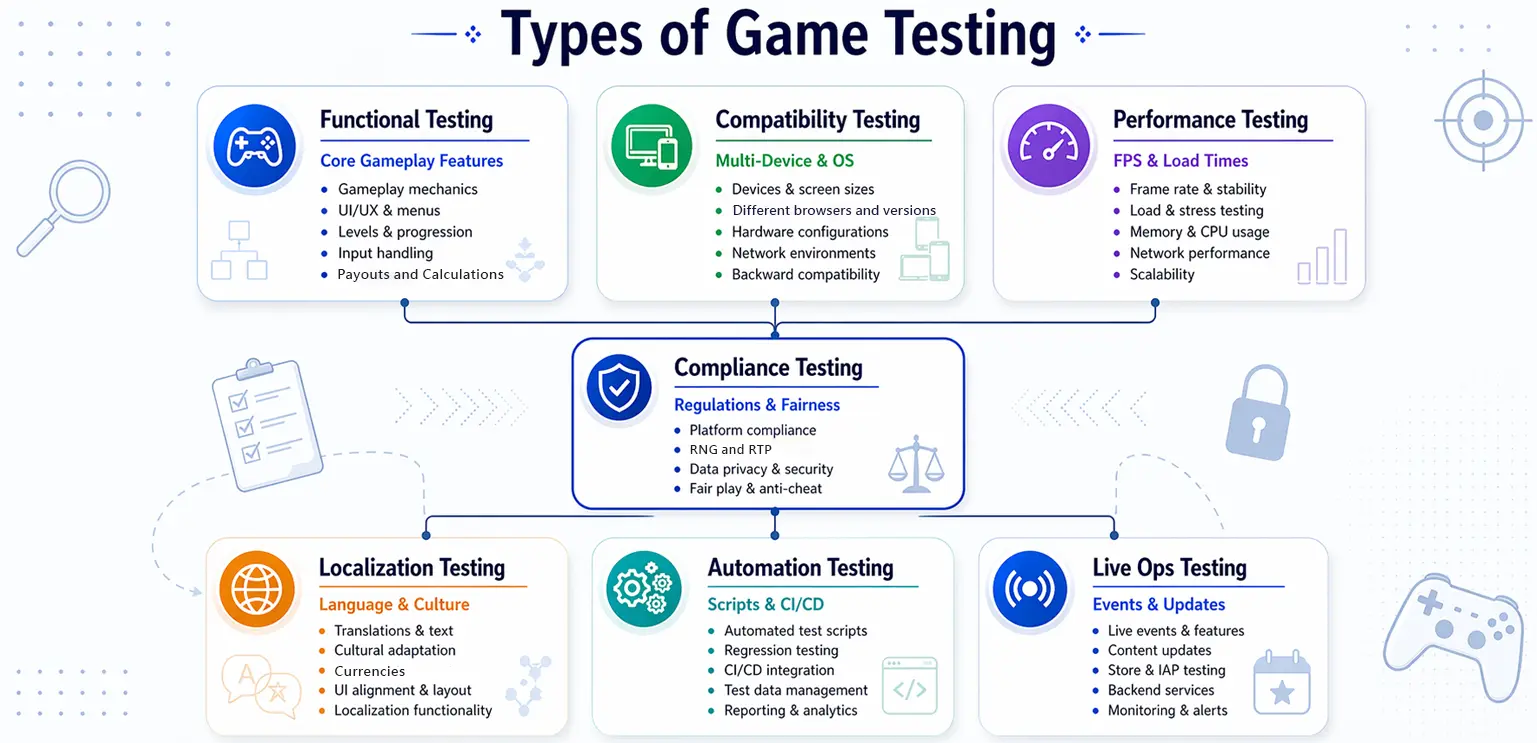
The studios that consistently deliver stable, high-performing games are not just testing more—they are building structured QA pipelines that evolve alongside their games.
Industry Context: Why Game Testing Has Become More Complex
Game development today operates in a much more dynamic environment than it did a few years ago. Games are no longer static releases. They are ongoing systems shaped by:
- Continuous content updates
- Live Ops events
- Real-time player behavior
- Multi-device compatibility
This complexity directly impacts testing.
In casino games, the stakes are even higher. Testing is not only about ensuring that features work—it’s about ensuring fairness, accuracy, and regulatory compliance. A minor issue in a traditional game might cause frustration, but in a casino environment, it can affect payouts, player trust, and legal standing. As a result, modern QA strategies must address not just gameplay, but system reliability, performance, and compliance at scale.
Core Types of Game Testing
🔹 Functional Testing: Ensuring Core Systems Work
Functional testing forms the foundation of any QA process. It verifies that all game systems behave as intended. This includes validating gameplay mechanics, UI interactions, progression systems, and feature logic.
In a slot game, for example, functional testing ensures that reel spins trigger correctly, paylines calculate accurately, and bonus features activate under the right conditions. While this sounds straightforward, even small logic changes can introduce cascading issues, especially in feature-rich games.
🔹 Compatibility Testing: Handling Device Fragmentation
Mobile games must operate across a wide range of devices, each with different capabilities.
Compatibility testing ensures that the game performs consistently across:
- Varying screen sizes and resolutions
- Different operating systems and versions
- Low-end and high-end hardware
Without this layer of testing, games risk poor performance on certain devices, leading to negative reviews and reduced retention.
🔹 Performance Testing: Protecting Player Experience
Performance testing evaluates how the game behaves under real-world conditions. This includes analyzing frame rate stability, memory usage, loading times, and responsiveness. For mobile and instant-playable games, performance is directly tied to retention. A game that stutters or takes too long to load will lose players quickly, regardless of its content quality.
🔹 Regression Testing: Maintaining Stability During Updates
As games evolve, new updates can unintentionally break existing features. Regression testing ensures that previously working systems continue to function after changes are introduced. In Live Ops-driven environments, where updates are frequent, regression testing becomes a continuous requirement rather than a one-time task.
🔹 Localization Testing: Adapting for Global Markets
Localization testing ensures that games are properly adapted for different regions. This includes checking that text fits UI layouts, translations are accurate, and cultural nuances are respected. In casino games, localization also involves adapting currency formats and region-specific rules. A poorly localized game can feel unpolished and reduce player trust.
🔹 Compliance and Certification Testing: Essential for Casino Games
Casino and slot games must meet strict regulatory standards before launch.
Compliance testing ensures that the game adheres to requirements such as:
- Accurate RTP calculations
- Fair and unbiased outcomes
- Jurisdiction-specific regulations
This process often involves collaboration with external certification bodies and requires rigorous validation.
🔹 Usability Testing: Improving Player Experience
Usability testing focuses on how players interact with the game. It identifies friction points, confusing interfaces, and unclear feedback systems. In mobile casino games, usability directly impacts conversion and retention. A game may be technically correct but still fail if players struggle to understand how to interact with it.
🔹 Exploratory Testing: Discovering Edge Cases
Exploratory testing allows testers to interact with the game freely, without predefined scripts.
This approach helps uncover unexpected issues, edge cases, and unusual player behaviors that structured testing may miss.
🔹 Automation Testing: Scaling QA Processes
Manual testing alone cannot keep up with modern development cycles.
Automation testing enables teams to run repetitive checks efficiently, especially for regression and build validation. In Unity-based projects, automation is often integrated with CI/CD pipelines to ensure that every build is tested before deployment. This significantly reduces the risk of critical issues reaching production.
🔹 Live Ops Testing: Ensuring Stability After Launch
Testing does not end at release.
Live Ops testing ensures that ongoing updates, events, and features function correctly in a live environment. This includes validating event triggers, reward systems, and backend integrations. Given the continuous nature of Live Ops, this type of testing requires ongoing monitoring and rapid response capabilities.
How Modern Game Studios Structure Testing Pipelines
In real production environments, testing is not handled as isolated activities. Instead, it is embedded into structured pipelines that run alongside development. A typical workflow begins with developers running functional checks during implementation. Once changes are committed, builds are pushed into CI/CD systems, where automated tests validate core functionality.
QA teams then perform structured and exploratory testing to identify issues that automation cannot detect. Pre-release builds undergo performance and compatibility testing across devices. For casino games, this process extends further into compliance validation and certification. This layered approach ensures that issues are detected early, reducing the cost and risk of fixing them later. Studios that lack such pipelines often face unstable builds and delayed releases.
Testing in Real-Money Casino Environments: What Changes
Casino game testing introduces a level of complexity that goes beyond standard QA practices. The key difference is risk.
A bug in a typical game might affect user experience. In a casino game, it can impact real-money transactions, violate regulations, and damage operator credibility. This is why casino QA includes additional layers such as:
- Statistical validation of RNG systems
- Payout verification across large simulation sets
- Strict adherence to jurisdiction-specific rules
Testing here is not just technical—it is mathematical and regulatory.
Real-World Example: Testing in Slot Game Production
In slot game development, testing is deeply interconnected with design and production pipelines.
A single feature, such as a bonus round, requires validation across multiple dimensions. Functional testing ensures correct triggering, performance testing ensures smooth animation, compliance testing verifies payout logic, and usability testing ensures players understand the feature.
Studios managing high-volume production often align testing with asset pipelines. Teams like Gamix Labs design visual and animation systems in a way that simplifies validation, ensuring that art, animation, and gameplay logic remain synchronized during QA cycles. This integration reduces errors and accelerates production timelines.
How Testing Impacts Game Performance Metrics
Testing is often seen as a cost center, but in reality, it directly impacts business performance. Well-structured QA systems lead to more stable builds, which improves player experience and reduces churn. Faster release cycles allow studios to respond quickly to market demands and player feedback.
In mobile and casino games, even small improvements in stability and performance can lead to measurable gains in retention, session duration, and overall player satisfaction.
Challenges in Game Testing
Despite its importance, testing comes with several challenges. The growing complexity of game systems makes it difficult to achieve full coverage. Dynamic features and player-driven interactions create countless possible scenarios, many of which are hard to predict.
Automation helps scale testing, but it requires careful setup and maintenance. There is also constant pressure to balance speed and quality, especially in Live Ops environments where updates must be delivered quickly. Managing these challenges requires a structured approach rather than ad-hoc testing efforts.
How to Build an Effective Game Testing Strategy
Building an effective testing strategy starts with understanding your game’s risk areas. Early-stage projects may focus on core functionality and usability, while more mature projects require automation, performance optimization, and compliance validation.
The key is to layer testing processes rather than relying on a single approach. Functional testing ensures stability, automation improves efficiency, and exploratory testing uncovers unexpected issues. Most importantly, testing should evolve alongside development. A static QA process cannot support a dynamic product.
Future Trends in Game Testing
Game testing is evolving alongside development practices. Automation will continue to expand, with AI playing a larger role in identifying patterns and predicting potential issues. Cloud-based testing environments will enable broader device coverage without requiring physical hardware.
Another emerging trend is the integration of analytics into QA processes. Instead of relying solely on predefined test cases, studios are beginning to use real player data to identify and prioritize issues. This shift will make testing more proactive and data-driven.
Conclusion
Game testing is no longer a final step—it is a continuous system that supports every stage of development. From functional testing to compliance validation and Live Ops monitoring, each layer plays a critical role in ensuring game quality.
For studios, especially those working in mobile and casino environments, investing in robust testing processes is essential. It not only prevents issues but also improves player experience, retention, and overall business performance.
In today’s competitive market, quality is not just a feature—it is a requirement.
FAQs
What are the main types of game testing?
Functional, compatibility, performance, regression, usability, localization, compliance, automation, and Live Ops testing are the main types.
Why is testing important in game development?
It ensures stability, performance, and a smooth player experience while reducing bugs and improving retention.
How is testing different for casino games?
Casino games require additional compliance and statistical testing to ensure fairness and meet regulatory standards.
What is automation testing in games?
It uses scripts and tools to run repetitive tests efficiently, especially for regression and build validation.
When should game testing start?
Testing should begin early in development and continue throughout the entire lifecycle, including post-launch updates.
What is the biggest challenge in game testing?
Managing complexity and ensuring coverage across all possible gameplay scenarios while maintaining fast release cycles.