Game Development Fundamentals: Core Principles Behind Successful Games
Every successful game, whether it is a mobile title, an indie project, an AAA production, or a casino game, begins with the same objective: creating an experience that players enjoy and continue returning to. Although visuals, marketing strategies, and monetization models often dominate industry discussions, they represent only a few elements of what makes a game truly successful. Behind every successful release is a structured development process built on clear planning, technical expertise, creative execution, and continuous iteration.
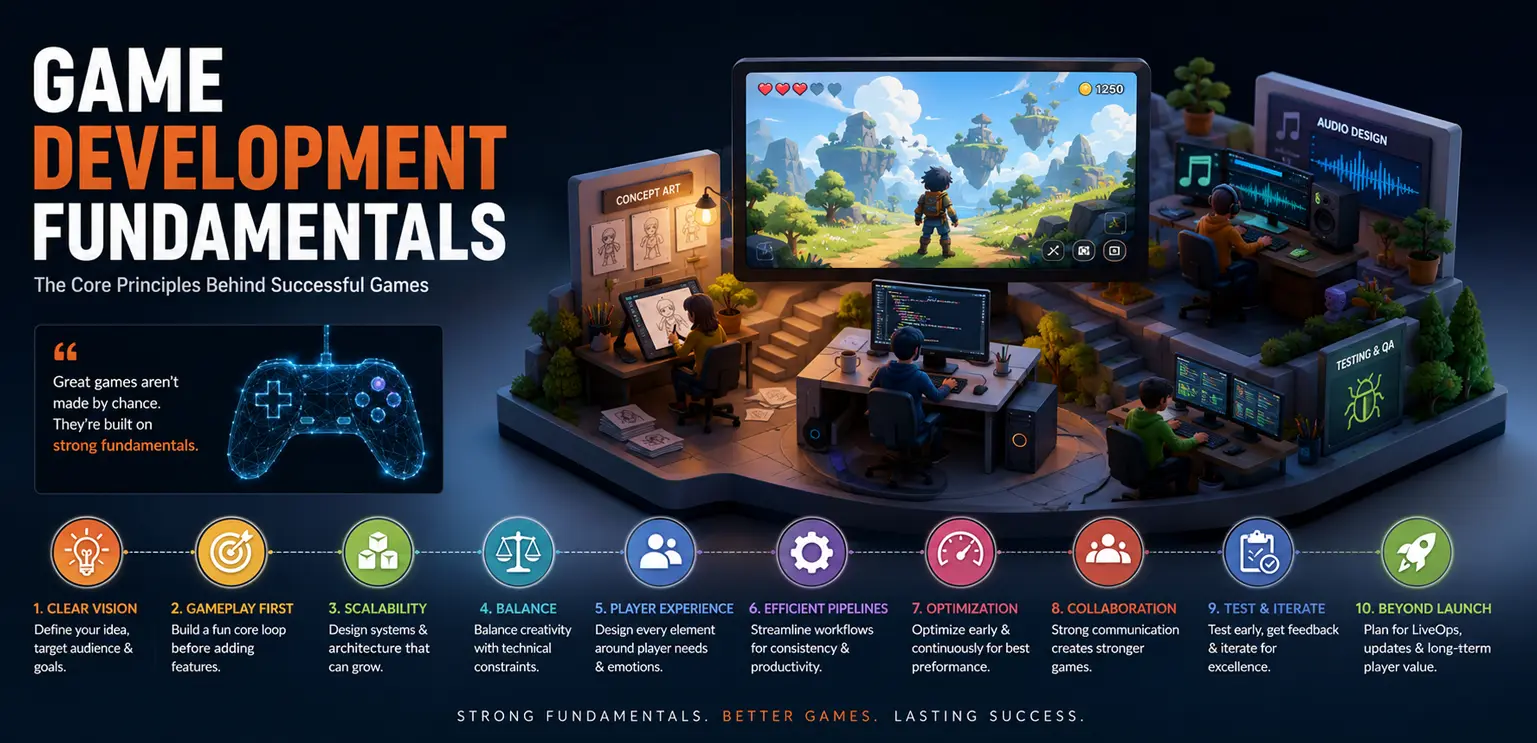
Modern game development has evolved into a multidisciplinary gaming industry that combines game design, programming, art, animation, audio, quality assurance, analytics, and production management. A weakness in any one of these areas can affect the final player experience.
This guide examines the fundamental principles that shape successful game development and explains how they help studios deliver high-quality games across different genres, platforms, and production environments.
Understanding the Foundation of Game Development
Game development is more than writing code or creating attractive artwork. It is the process of transforming an idea into a fully interactive product through collaboration across multiple disciplines.
Every project follows a different path, but successful studios typically build their production around a shared set of principles that emphasize planning, efficiency, scalability, and player experience.
By following these principles, studios can streamline development, improve production quality, minimize project risks, and create games that stand out in today's highly competitive gaming industry.
🔹 Principle 1: Start with a Clear Game Vision
Every successful project begins with a clearly defined vision. Before production starts, the development team should understand:
- Who is the target audience?
- What type of experience should the game deliver?
- Which platforms will it support?
- What makes it different from competing titles?
- What are the project's technical and business goals?
A well-defined vision provides direction for every department, reducing unnecessary revisions and helping teams make consistent decisions throughout development.
🔹 Principle 2: Prioritize Gameplay Before Features
Players are more likely to stay engaged with games that deliver satisfying gameplay than those that rely solely on adding new mechanics or features. Successful studios validate the core gameplay loop early before investing heavily in content production. Rather than building every planned feature immediately, experienced teams focus on proving that the primary gameplay mechanics are engaging and technically stable. Once the core gameplay is validated, studios can confidently expand the game by adding new features, content, and supporting systems without compromising the overall player experience.
🔹 Principle 3: Build for Scalability
Many games continue evolving long after launch. Scalability should be considered from the earliest stages of development, enabling studios to add new content, gameplay features, platform support, and Live Ops updates more efficiently while maintaining a stable and well-structured production pipeline. Important considerations include:
- Modular architecture
- Reusable assets
- Flexible UI systems
- Expandable content pipelines
- Organized project structures
Scalable production reduces long-term maintenance costs while supporting future content releases.
🔹 Principle 4: Balance Creativity with Technical Constraints
Creative ambition drives innovation, but technical limitations determine what can realistically be delivered. Successful teams continuously balance artistic goals with factors such as:
- Performance targets
- Memory budgets
- Device compatibility
- Production schedules
- Team capacity
Finding this balance allows studios to deliver polished experiences without compromising stability.
🔹 Principle 5: Design Around the Player Experience
The best games are built around players rather than internal assumptions. Every design decision should improve the overall experience, including:
- Controls
- Difficulty progression
- User interface
- Visual clarity
- Reward systems
- Accessibility
Studios that consistently evaluate decisions from the player's perspective often create more engaging and intuitive products.
🔹 Principle 6: Build Efficient Production Pipelines
Strong production pipelines improve both quality and development speed. Efficient workflows reduce repetitive tasks, simplify collaboration, and minimize production bottlenecks. An effective pipeline typically includes:
- Clear documentation
- Asset standards
- Version control
- Review processes
- Production milestones
Well-structured game development pipelines become increasingly valuable as projects grow in complexity.
🔹 Principle 7: Optimize Throughout Development
Optimization shouldn't be reserved for the final weeks before release. Successful teams evaluate performance continuously during production. Areas that require ongoing attention include:
- Asset optimization
- Memory usage
- Loading times
- Rendering efficiency
- Animation performance
- Network performance (where applicable)
Early optimization reduces and prevents costly revisions and technical debt later in development.
🔹Principle 8: Collaboration Drives Better Results
Game development is one of the most collaborative forms of software production. Artists, programmers, designers, producers, QA specialists, and technical artists all contribute to the final product. Strong collaboration depends on:
- Clear communication
- Shared production goals
- Structured feedback
- Consistent documentation
- Transparent workflows
Studios with healthy communication processes typically solve problems more quickly and produce more consistent results.
🔹 Principle 9: Test Early and Iterate Often
Few successful games achieve their best design in the first implementation. Iteration is an essential part of development. Regular testing helps teams identify:
- Gameplay issues
- Technical bugs
- UI problems
- Performance bottlenecks
- Balance concerns
- Player confusion
Continuous iteration improves quality while reducing the risk of major redesigns later in production.
🔹 Principle 10: Plan Beyond Launch
Modern games rarely end development when they are released. Many projects continue evolving through updates, seasonal content, events, and Live Ops initiatives. Studios should prepare for:
- Content updates
- Performance monitoring
- Player feedback
- Feature improvements
- Technical maintenance
- Community support
Thinking beyond launch helps build longer-lasting products and stronger player communities.
The Growing Role of AI in Modern Game Development
Artificial Intelligence has become an important part of modern game development, helping studios improve production efficiency without replacing the creativity of developers, artists, or designers. Across every stage of production, AI is being used to accelerate repetitive tasks, shorten iteration cycles, and assist teams in making faster, more informed decisions.
During pre-production, AI helps generate concepts, prototype gameplay ideas, and create placeholder assets that allow teams to validate mechanics more quickly. As development progresses, it supports asset creation, UI/UX analysis, automated testing, localization, documentation, and production planning. These capabilities allow studios to spend less time on repetitive workflows and more time refining gameplay, improving player experience, and delivering higher-quality products.
Despite these advancements, human creativity remains the foundation of successful game development. AI is a productivity tool that enhances existing workflows, while designers, artists, programmers, and producers continue to shape the creative vision, gameplay systems, and overall direction of a project.
Why Outsourcing Has Become Part of Modern Development
Game development has become increasingly specialized, making it difficult for most studios to build every aspect of a project entirely in-house. As production requirements continue to grow, outsourcing has evolved from a cost-saving solution into a strategic production model that enables studios to access specialized expertise while maintaining flexible development capacity.
Today, external development partners contribute across numerous disciplines, including game art, animation, technical art, engineering, quality assurance, UI/UX design, and Live Ops content. Rather than functioning as separate vendors, experienced outsourcing studios integrate directly into existing production pipelines, allowing internal teams to maintain creative control while expanding production capabilities.
Studios such as Gamix Labs operate within this collaborative model by providing scalable development services that align with internal production standards, helping clients accelerate delivery timelines without compromising quality or consistency.
Common Mistakes That Undermine Game Development
Even experienced studios encounter production challenges, but many of these issues can be traced back to weaknesses in planning and communication rather than technical limitations. Projects often run into difficulties when development scope expands without proper evaluation, documentation becomes inconsistent, optimization is postponed until the final stages, or communication between departments begins to break down.
Another common challenge is underestimating the importance of regular testing and player feedback throughout development. Waiting until late production to identify usability issues or gameplay problems often results in costly revisions that could have been avoided through earlier iteration.
Studios that establish clear documentation, realistic production schedules, structured review processes, and continuous testing are generally better equipped to manage risk and maintain healthy development timelines.
Future Trends Shaping Game Development
The game industry continues to evolve as new technologies reshape how studios design, build, and maintain their projects. Artificial Intelligence is streamlining production workflows, cloud-based collaboration is making distributed development more efficient, and cross-platform technologies are allowing games to reach wider audiences with fewer technical barriers.
Simultaneously, Live Service models, procedural content generation, and production automation are changing how studios approach long-term content development. These innovations help teams deliver more frequent updates while improving production efficiency across increasingly complex projects.
Although development tools continue to advance rapidly, the principles behind successful game production remain remarkably consistent. Strong planning, efficient pipelines, technical excellence, and player-focused design will continue to define successful games regardless of future technological changes.
Strategic Takeaways
Successful game development is rarely driven by a single innovative feature or breakthrough technology. Instead, it is built upon disciplined production, thoughtful planning, continuous iteration, and strong collaboration across every department. The most important principles to remember are:
- Define a clear vision before development begins.
- Validate the core gameplay before expanding features.
- Build scalable systems that support future growth.
- Balance creative ambition with technical feasibility.
- Keep the player at the center of every design decision.
- Invest in efficient production pipelines.
- Optimize continuously throughout production.
- Encourage collaboration between all disciplines.
- Test early, iterate often, and plan beyond launch.
- Plan for long-term support beyond launch.
Studios that consistently apply these principles are better positioned to develop games that are technically stable, creatively engaging, commercially competitive, and easier to support over the long term.
Conclusion
The tools, engines, and technologies used in game development will continue to evolve, but the fundamentals behind successful games remain remarkably consistent.
A strong vision, engaging gameplay, efficient production, technical excellence, and continuous iteration form the foundation of every successful project. Whether developing a mobile game, an indie title, a casino game, or a large-scale cross-platform experience, studios that respect these principles build products that are easier to develop, more enjoyable to play, and better prepared for long-term success.
Rather than chasing every new trend, development teams should focus on mastering these fundamentals first. They provide the framework upon which innovation can thrive.
FAQs
What are the fundamentals of game development?
Game development fundamentals include clear planning, engaging gameplay, scalable architecture, optimization, collaboration, testing, and long-term production strategy.
Why is gameplay more important than adding many features?
A strong core gameplay loop keeps players engaged. Additional features are valuable only when the core experience is enjoyable.
Why should optimization start early?
Continuous optimization prevents technical debt, improves performance, and reduces expensive revisions before launch.
How important is collaboration in game development?
Game development relies on close collaboration between designers, programmers, artists, producers, QA teams, and technical specialists to deliver a polished product.
Do all game studios outsource development?
Not all, but many studios outsource specialized tasks such as art, animation, QA, technical art, or engineering support to improve scalability and production efficiency.
How is AI changing game development?
AI helps automate repetitive tasks, accelerate prototyping, support testing, and improve production workflows while leaving creative decision-making to human teams.