Slot Game Simulation Testing Explained - Simulation Farms, Spin Counts & Certification
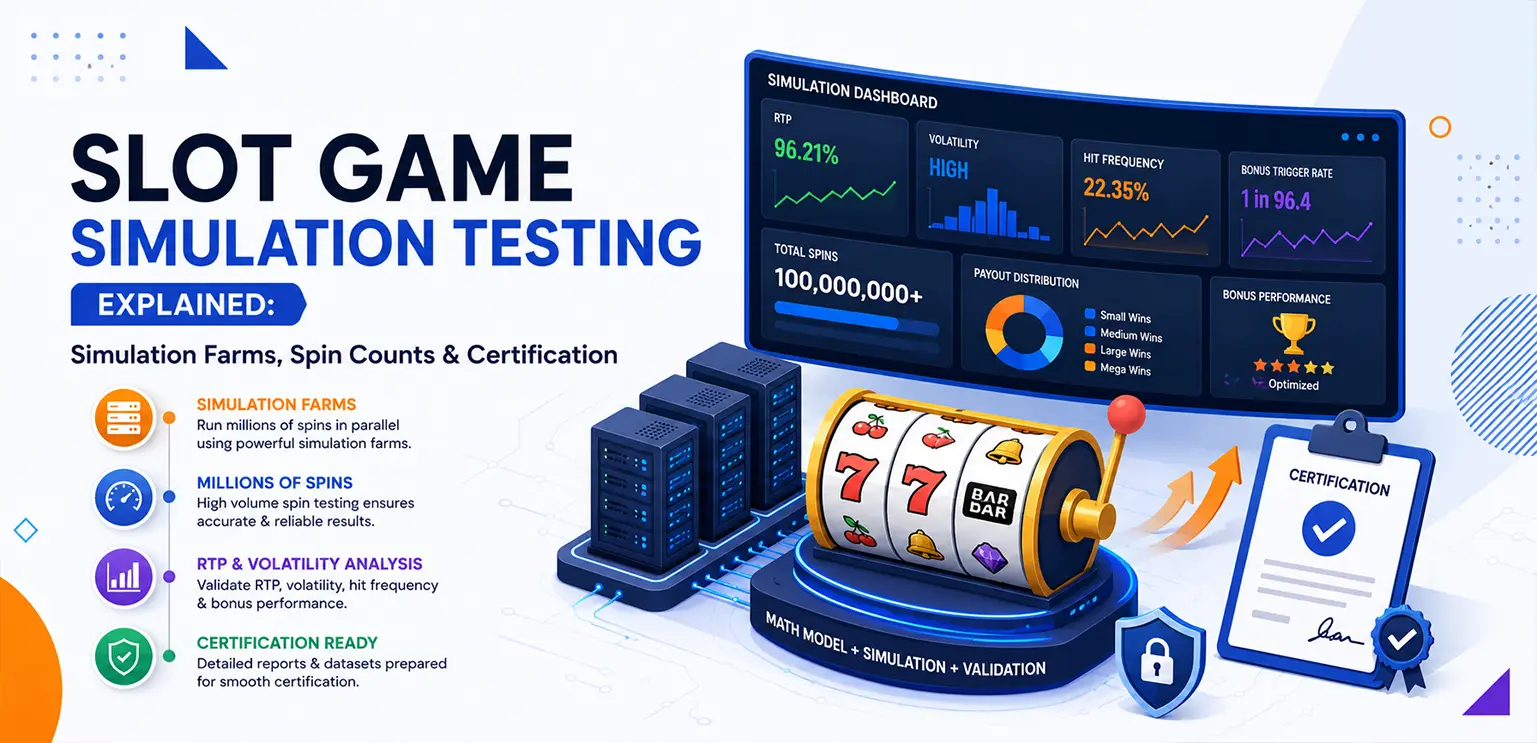
Behind every successful slot game is a mathematical model that has been tested far beyond what any human player could realistically experience. Before a game reaches certification laboratories or live casino platforms, developers need confidence that its RTP, volatility, hit frequency, bonus features, and payout distribution behave exactly as intended. This is where slot game simulation testing becomes essential.
Simulation testing is not simply automated gameplay. It is a structured statistical process that allows developers to run millions—or in many projects, hundreds of millions—of virtual spins in order to validate the game's long-term mathematical behavior. These tests help identify hidden issues, confirm theoretical calculations, and prepare the game for regulatory review.
For casino operators, simulation testing supports product quality and risk management.
For developers, it provides evidence that the implemented game matches the designed mathematical model.
For certification laboratories, well-prepared simulation data often makes technical review more efficient.
This guide explains how slot simulation testing works, what simulation farms are, why spin counts matter, and how simulation results contribute to certification readiness.
What Is Slot Game Simulation Testing?
Slot game simulation testing is the process of executing many automated game rounds to analyze the statistical behavior of a slot game. Instead of manually clicking the spin button, specialized simulation software repeatedly runs the game logic and records the outcome of every spin. The collected data is then analyzed to verify whether the game behaves according to its mathematical design. Simulation testing helps developers answer questions such as:
- Does the implemented RTP match the theoretical target?
- Is the volatility profile behaving as expected?
- Are bonus features triggering at the intended frequency?
- Is the payout distribution balanced over long-term play?
- Are there any rare edge cases or unexpected behaviors?
Because the process is automated, developers can evaluate scenarios that would be impossible to test manually.
Why Simulation Testing Is Essential
A slot game might appear perfectly balanced during a few thousand manual spins while still containing mathematical issues that become visible only after millions of rounds. Simulation testing is valuable because it:
Validates long-term mathematical behavior. Theoretical calculations are confirmed against observed statistical results over very large sample sizes.
Identifies hidden edge cases. Rare symbol combinations, feature interactions, or payout sequences can be detected before launch.
Supports certification preparation. Simulation reports provide useful evidence during internal reviews and external testing.
Reduces commercial risk. Catching mathematical problems before release prevents costly post-launch corrections.
For regulated iGaming markets, simulation testing is an essential part of the development lifecycle. It helps developers validate RTP, volatility, hit frequency, and bonus feature behavior while improving confidence before independent certification and commercial launch.
What Is a Simulation Farm?
A simulation farm is a group of computers or processing systems dedicated to running large-scale slot simulations. Think of it as a high-volume testing environment where many simulation tasks run in parallel. Instead of one machine processing spins sequentially, multiple machines share the workload, dramatically reducing testing time. A simulation farm typically provides:
Parallel processing: Many simulation jobs run simultaneously, allowing hundreds of millions of spins to be completed far more quickly.
Centralized result collection: Data from all simulation nodes is aggregated into a single analysis system.
Scalable capacity: Additional processing power can be added when larger test campaigns are required.
Continuous validation workflows: Teams can run simulations repeatedly throughout development, not just before launch.
Large studios and specialized math providers often maintain dedicated simulation infrastructure to support multiple projects at once.
How a Simulation Farm Works
Although the underlying infrastructure may vary, the overall workflow is straightforward.
- A simulation job is created with specific game settings, build versions, and target spin counts.
- The job is distributed across multiple processing nodes within the simulation environment.
- Each node executes automated spins independently and records detailed outcome data.
- Results from all nodes are combined into a centralized dataset.
- Statistical analysis tools calculate RTP, volatility, hit frequency, feature performance, and payout distribution metrics.
- Developers review the results and compare them with the intended mathematical model.
This distributed approach allows studios to test complex games efficiently while maintaining consistent reporting.
Why Spin Counts Matter
One of the most important concepts in simulation testing is sample size. Small sample sizes produce noisy results, while larger sample sizes provide more reliable statistical estimates.
For example, a game with a theoretical RTP of 96% might show 92% or 101% RTP after only a few thousand spins. As the number of spins increases, the observed RTP gradually moves closer to the theoretical value.
Developers therefore use progressively larger spin counts during production.
| Stage | Typical Spin Range |
|---|---|
| Early prototype testing | 10k-100k spins |
| Feature validation | 100k-1M spins |
| Math balancing | 1M-10M spins |
| Pre-certification analysis | 10M-100M+ spins |
| Deep statistical studies | 100M-1B+ spins |
The exact spin count depends on game complexity, volatility, feature structure, and the confidence level required by the development team.
What Developers Measure During Simulations
Simulation testing produces far more information than a single RTP value. Commonly analyzed metrics include:
Return to Player (RTP): Compares observed return with the theoretical target.
Volatility: Measures how wins are distributed over time.
Hit frequency: Tracks how often any winning outcome occurs.
Bonus trigger rate: Verifies feature activation frequency.
Average bonus value: Evaluates the expected payout of each feature.
Maximum observed win: Helps validate extreme payout scenarios.
Payout distribution: Shows how frequently different win sizes occur.
Together, these metrics provide a detailed picture of the game's mathematical behavior.
RTP Validation in Practice
RTP validation is often the first result stakeholders look at, but experienced mathematicians examine it carefully. A simulation report may include:
| Metric | Value |
|---|---|
| Theoretical RTP | 96.00% |
| Observed RTP | 95.98% |
| Total Spins | 100,000,000 |
| Difference | -0.02% |
The small difference does not mean the game is incorrect. Statistical variation is expected, and larger sample sizes generally reduce the gap between observed and theoretical values.
How Simulations Reveal Volatility
Understanding a slot game's volatility requires far more than short play sessions. Developers use large-scale simulation testing to analyze millions of spins, allowing them to evaluate payout distribution, winning patterns, and long-term gameplay behavior. This data helps confirm whether the game's actual volatility aligns with its intended mathematical design. Volatility analysis includes:
- Losing streaks: Measure how often players experience consecutive non-winning spins.
- Small and medium wins: Evaluate the frequency of regular payouts that shape everyday gameplay.
- High-value wins: Analyze how often larger rewards occur and how they influence player excitement.
- Bonus feature payouts: Assess the distribution and average value of rewards generated during bonus rounds.
- Overall payout distribution: Review how rewards are spread across millions of simulated spins to validate the intended volatility profile.
This information helps designers determine whether the game delivers the intended player experience.
Testing Bonus Features Separately
Professional math teams often simulate bonus features independently before testing the full game. This approach helps isolate feature behavior and verify its contribution to the overall RTP. Typical checks include:
Trigger probability: Confirms how often the feature activates.
Average payout: Measures the expected reward from a single feature session.
Extreme outcomes: Identifies unusually large or rare feature results.
Feature duration: Measures how long bonus features typically last by analyzing the average number of free spins, respins, or bonus rounds awarded each time a feature is triggered.
Isolating features makes debugging and balancing significantly easier.
Detecting Rare Edge Cases
Some mathematical issues occur only once in millions of spins. Examples include:
- Unintended symbol combinations.
- Incorrect multiplier stacking.
- Bonus retrigger loops.
- Overflow conditions in payout calculations.
- Feature interactions that exceed intended limits.
Manual testing is unlikely to encounter these scenarios, which is why large-scale simulation testing is so valuable.
How Simulation Testing Supports Certification
Independent certification laboratories evaluate many aspects of a slot game, including mathematics, game logic, security, and documentation. Simulation testing helps developers prepare by:
Providing evidence that RTP has been validated.
Demonstrating feature behavior over large sample sizes.
Supporting internal compliance reviews.
Identifying issues before external submission.
Improving confidence in the submitted build.
Simulation results do not replace certification, but they greatly improve readiness.
Common Mistakes in Simulation Testing
New development teams often underestimate the importance of rigorous simulation methodology. Some common mistakes include:
- Using too few spins: Small samples can produce misleading RTP and volatility results.
- Testing only the base game: Bonus features may contain hidden mathematical issues.
- Ignoring statistical confidence: A single simulation run is rarely enough for deep analysis.
- Changing game logic without re-testing: Even small code changes can alter mathematical behavior.
- Poor result documentation: Missing records make debugging and certification preparation more difficult.
Avoiding these mistakes leads to more reliable conclusions.
Best Practices for Professional Simulation Testing
Experienced studios generally follow several proven practices.
Start testing early. Run simulations from prototype stage onward rather than waiting until the end of production.
Increase spin counts progressively. Use larger samples as the game approaches release.
Test every feature independently. Validate feature math before evaluating the full game.
Automate result reporting. Consistent reports make comparison between builds much easier.
Maintain strict version control. Always know which build generated each simulation dataset.
Re-run simulations after major changes. Math validation should be repeated whenever payout logic changes.
These practices create a robust mathematical validation workflow.
How Gamix Labs Uses Simulation Testing
At Gamix Labs, simulation testing is integrated into the slot development pipeline rather than treated as a final checkpoint. The team combines mathematical modelling, large-scale automated simulations, feature validation, QA, and certification-focused workflows to help studios build production-ready slot games with greater confidence in their long-term mathematical behavior.
This integrated approach supports faster iteration, stronger quality control, and smoother certification preparation.
Future Trends in Slot Simulation Testing
Simulation technology continues to evolve alongside modern game development practices. Emerging trends include:
- Cloud-based simulation infrastructure.
- AI-assisted statistical analysis.
- Automated anomaly detection.
- Continuous integration simulation pipelines.
- Real-time math dashboards for development teams.
As games become more complex, simulation testing is becoming an even more important part of professional slot production.
Conclusion
Slot game simulation testing is one of the most important stages in modern casino game development. By running millions of automated spins, developers can validate RTP, analyze volatility, measure hit frequency, verify bonus behavior, and detect rare edge cases long before launch.
Simulation farms make this process scalable, while large spin counts provide the statistical confidence needed for professional math validation. Although simulation testing does not replace independent certification, it plays a critical role in preparing games for regulatory review and commercial deployment.
Studios that invest in structured simulation workflows, comprehensive reporting, and continuous mathematical validation are far better positioned to deliver balanced, reliable, and certification-ready slot games.
Frequently Asked Questions
What is a slot simulation farm?
A simulation farm is a group of processing systems used to run large-scale automated slot simulations in parallel, allowing millions of spins to be tested efficiently.
How many spins are usually required for RTP testing?
There is no universal spin count. Most professional slot simulations use millions of spins to validate long-term mathematical performance.
Does simulation testing guarantee certification?
No. Simulation testing improves mathematical confidence, but independent certification also evaluates game logic, security, documentation, and regulatory compliance.
Why are large spin counts important?
Larger sample sizes reduce statistical variation and provide more reliable RTP and volatility measurements.
Can simulation testing find bugs?
Yes. Large-scale simulations can reveal rare edge cases and mathematical issues that manual gameplay may never encounter.