The Complete Guide to Slot RTP: How RTP, Volatility, Hit Frequency & Bonus Features Work
Every successful slot game is built on more than eye-catching visuals and engaging animations. Behind every spin is a carefully designed mathematical model that determines how often players win, how large those wins can be, and how the overall gameplay experience feels over time. This mathematical framework is what separates a balanced slot game from one that feels either too generous or too frustrating.
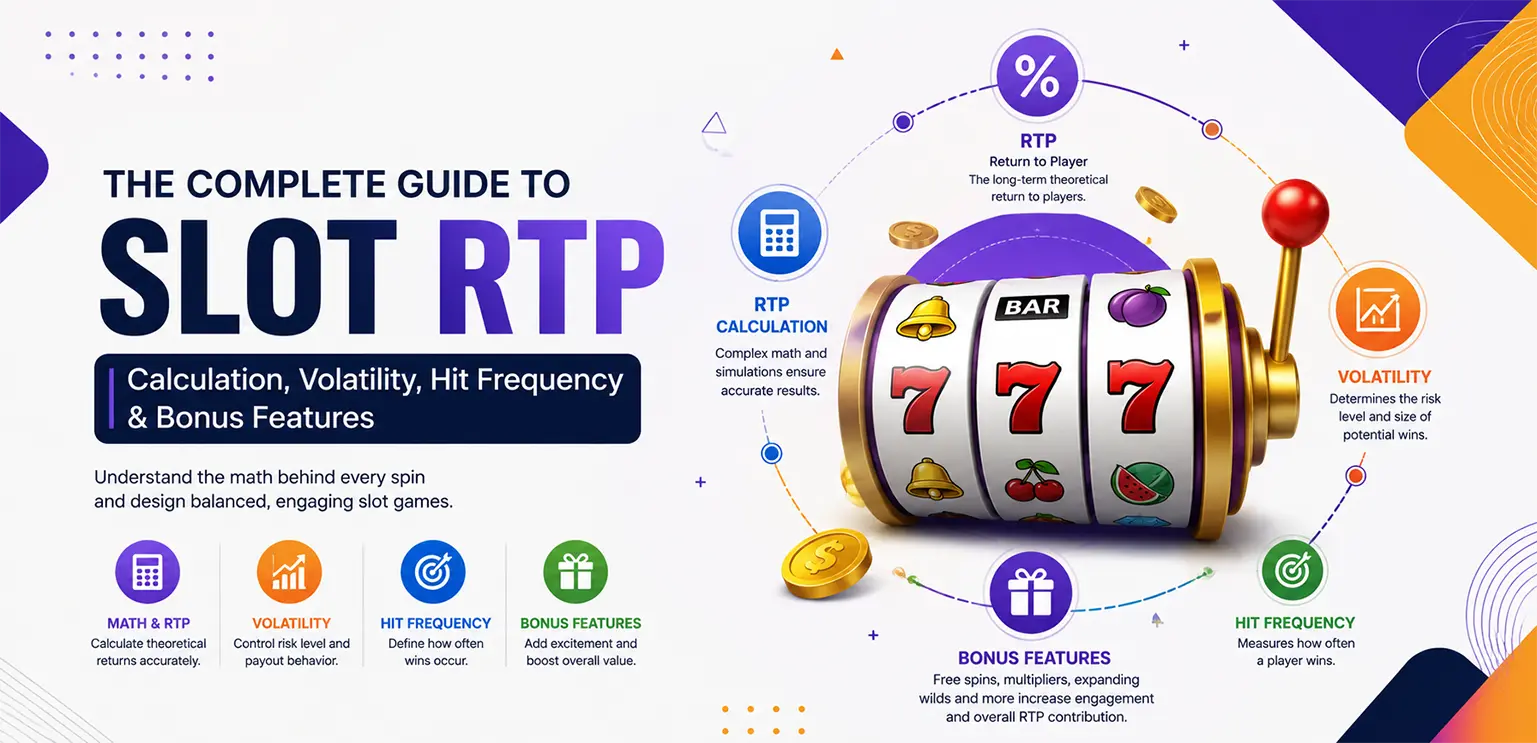
Four concepts form the foundation of almost every modern slot game's math model: Return to Player (RTP), volatility, hit frequency, and bonus features. These elements are closely connected. Changing one often affects the others, which is why experienced developers spend considerable time testing and refining their mathematical models before launch.
For casino operators, these metrics influence player retention, game performance, and portfolio balance.
For developers, they guide game design, simulation testing, and certification readiness. Understanding how these concepts work together is essential for building games that are both engaging and technically sound.
In this guide, we'll explain each concept, explore how they interact, and examine the role they play in creating balanced slot games for regulated markets.
What Is RTP?
Return to Player (RTP) is a theoretical measure that indicates the percentage of total wagers a slot game is expected to return to players over a large number of spins. It serves as a key indicator of a game's long-term mathematical performance rather than the outcome of individual gaming sessions.
For example, a game with a theoretical RTP of 96% is mathematically designed to return approximately 96 units for every 100 units wagered over the long term. The remaining percentage represents the theoretical house edge.
It's important to understand that RTP is a long-term statistical expectation, not a prediction of what will happen during an individual session. A player may experience outcomes that are significantly above or below the theoretical RTP over a short period.
From a development perspective, RTP acts as a design target that influences almost every aspect of the game's mathematical model.
How Is RTP Calculated?
RTP is determined during the mathematical design phase of game development. Developers analyze every possible outcome within the game's mechanics to estimate the theoretical return over an extremely large number of spins. In practice, developers combine mathematical analysis with simulation testing to validate that the implemented game behaves as expected. The process generally includes:
- Defining symbol values and probabilities: Each symbol and winning combination is assigned values that contribute to the game's expected return.
- Designing paylines or winning mechanics: The selected winning mechanic—whether fixed paylines, cluster pays, Megaways-style systems, or other payout models—directly impacts payout distribution, RTP, and the overall gameplay experience.
- Balancing feature contributions: Free spins, expanding wilds, multipliers, jackpots, and other mechanics each contribute a portion of the total RTP.
- Validating through simulations: Automated simulation systems execute millions—or even hundreds of millions—of game rounds to compare observed results with the theoretical model.
Simulation testing helps confirm that the implemented game reflects the intended mathematical design.
Understanding Volatility
Volatility describes how wins are distributed throughout gameplay. It does not determine the total amount returned to players over the long term, but rather how that return is experienced.
A low-volatility slot game typically delivers smaller but more frequent wins, creating a steadier gameplay experience. In contrast, a high-volatility game may have longer periods without significant payouts, but larger wins can occur when they do. Medium-volatility games aim to balance consistent rewards with the potential for bigger payouts.
Understanding volatility is important because it shapes player expectations and influences how long a game remains engaging for different audiences. Generally speaking:
- Low volatility: Smaller wins occur more regularly, creating a steadier and more predictable gameplay experience.
- Medium volatility: Win frequency and payout size are balanced, offering a mix of regular rewards and occasional larger payouts.
- High volatility: Wins may occur less often, but larger rewards can create moments of higher excitement for players who enjoy greater risk.
Choosing the appropriate volatility depends on the intended audience and the overall game concept.
What Is Hit Frequency?
Hit frequency refers to how often players receive a winning spin, helping define the overall pace and feel of a slot game's gameplay experience. Unlike RTP, hit frequency does not indicate how much players win. It simply reflects the percentage of spins that result in a payout.
For example, two slot games might share the same RTP and Volatility but deliver very different experiences because their hit frequencies differ.
A game with a higher hit frequency may produce more frequent wins, while another game may award wins less often but compensate with larger average payouts. When designing hit frequency, developers evaluate factors such as:
- Winning combinations: The number and arrangement of winning possibilities directly influence how often payouts occur.
- Symbol distribution: Adjusting symbol placement can increase or decrease the likelihood of triggering winning combinations.
- Special symbols: The placement and behavior of wilds, scatters, and bonus symbols play a key role in shaping hit frequency and feature activation rates.
- Game mechanics: Cluster pays, cascading reels, expanding symbols, and other mechanics can significantly change hit frequency.
Hit frequency is carefully balanced alongside RTP and volatility to achieve the intended gameplay experience.
How RTP, Volatility, and Hit Frequency Work Together
One of the biggest misconceptions is that RTP, volatility, and hit frequency work independently. In reality, these metrics are closely connected, and adjusting one often influences the others. Consider these examples:
- A game may have 96% RTP, high volatility, and low hit frequency, meaning players experience fewer wins but have the potential for larger payouts.
- Another game might also have 96% RTP, but with low volatility and higher hit frequency, providing more regular wins of smaller value.
Although the long-term theoretical return is identical, the player experience feels completely different. This balance is why developers rarely adjust one metric without reviewing the entire mathematical model.
How Bonus Features Influence RTP
Modern slot games include bonus mechanics that enhance gameplay and contribute to the overall mathematical return. Rather than treating bonus features as separate systems, developers calculate how each feature contributes to the game's total RTP. Common bonus mechanics include:
- Free Spins: These features often account for a significant portion of the game's overall RTP, depending on how frequently they are triggered and the rewards they provide.
- Wild Multipliers: Multipliers increase potential payouts during qualifying wins and influence both volatility and feature value.
- Expanding or Sticky Wilds: These mechanics can dramatically change payout potential during bonus rounds, affecting long-term mathematical behavior.
- Progressive Features or Jackpots: When included, jackpot mechanics require careful balancing so they integrate correctly with the rest of the game's RTP model.
Each feature is evaluated individually and then as part of the complete mathematical system.
Why Simulation Testing Is Essential
Even the most carefully designed mathematical model must be validated before release. Simulation testing allows developers to execute millions—or often, hundreds of millions—of automated game rounds to confirm that the implemented software behaves as intended. Simulation testing helps teams:
- Verify RTP accuracy: Compare observed results against theoretical expectations over large sample sizes.
- Measure volatility: Analyze payout distribution to ensure the intended gameplay profile is achieved.
- Validate hit frequency: Verify that winning spins occur at the intended rate, ensuring the gameplay experience aligns with the game's mathematical design.
- Evaluate bonus performance: Test feature triggers, payouts, and interactions under countless gameplay scenarios.
This stage is essential for identifying statistical anomalies before certification or commercial deployment.
Common Myths About Slot Mathematics
Misunderstandings about slot math are common, especially among new developers and players.
🔹 Myth 1: A higher RTP guarantees frequent wins.
Not necessarily. A game with high RTP can still have high volatility and long periods without significant payouts.
🔹 Myth 2: Hit frequency and RTP are the same.
They measure different aspects of gameplay. Hit frequency reflects how often wins occur, while RTP represents the theoretical long-term return.
🔹 Myth 3: Bonus features are separate from RTP.
Every bonus mechanic contributes to the game's overall mathematical model and is considered during RTP design.
🔹 Myth 4: Simulation testing guarantees certification.
Simulation testing improves confidence in the game's mathematical implementation, but independent certification evaluates additional technical and regulatory requirements.
Best Practices for Designing Balanced Slot Games
Creating a mathematically balanced slot game requires collaboration across multiple disciplines. Successful development teams generally follow practices such as:
- Define mathematical goals early: Establish target RTP, volatility, and gameplay objectives before production begins.
- Design features around the math model: Bonus mechanics should support—not disrupt—the intended player experience.
- Conduct large-scale simulation testing: Run millions of automated game rounds to verify RTP, volatility, hit frequency, bonus performance, and the overall mathematical behavior before submitting the game for external certification.
- Review results iteratively: Mathematical models often require refinement based on simulation data and gameplay testing.
- Integrate QA with math validation: Functional testing and statistical analysis should progress together throughout development.
These practices contribute to games that are engaging, technically reliable, and easier to prepare for certification.
How Gamix Labs Builds Balanced Slot Math
Developing a successful slot game requires more than theoretical calculations. It demands a structured workflow where mathematics, engineering, quality assurance, and production teams collaborate throughout development.
At Gamix Labs Game Development Studio, slot math models are designed with long-term balance in mind. The team combines mathematical planning, extensive simulation testing, feature validation, and production-ready development workflows to help clients create games that deliver engaging gameplay while supporting certification readiness and operator requirements.
This integrated approach helps reduce costly revisions later in production and improves confidence before launch.
Conclusion
RTP, volatility, hit frequency, and bonus features are not isolated concepts—they are interconnected components of every slot game's mathematical foundation. Understanding how they work together enables developers to create games that deliver the intended player experience while maintaining long-term balance and technical integrity.
For casino operators, these mathematical metrics help shape game portfolio performance and long-term player engagement.
For developers, they serve as the foundation for designing balanced gameplay, validating mathematical models through simulation testing, and preparing games for certification. By combining sound mathematics with continuous testing and structured development workflows, studios can create slot games that deliver an engaging player experience while meeting industry standards.
FAQs
What is RTP in a slot game?
RTP (Return to Player) is the theoretical percentage of total wagers that a game is designed to return to players over a very large number of spins.
Does a higher RTP mean players win more often?
Not always. RTP measures long-term return, while hit frequency determines how often winning outcomes occur.
What is slot volatility?
Volatility describes the balance between the frequency and size of payouts, shaping the overall gameplay experience.
Why is hit frequency important?
Hit frequency influences how often players experience winning spins, helping define the game's pacing and perceived engagement.
Why do developers run millions of simulations?
Large-scale simulation testing helps verify RTP, volatility, hit frequency, and bonus feature behavior before certification and launch.