GLI vs BMM vs iTech Labs: Key Differences Every Casino Game Developer Should Know
Launching a slot game in a regulated market involves far more than creating engaging gameplay, polished artwork, and balanced mathematics. Before a game can be offered by many licensed operators, it typically undergoes an independent review to verify that it meets the technical and regulatory requirements of the jurisdictions where it will operate.
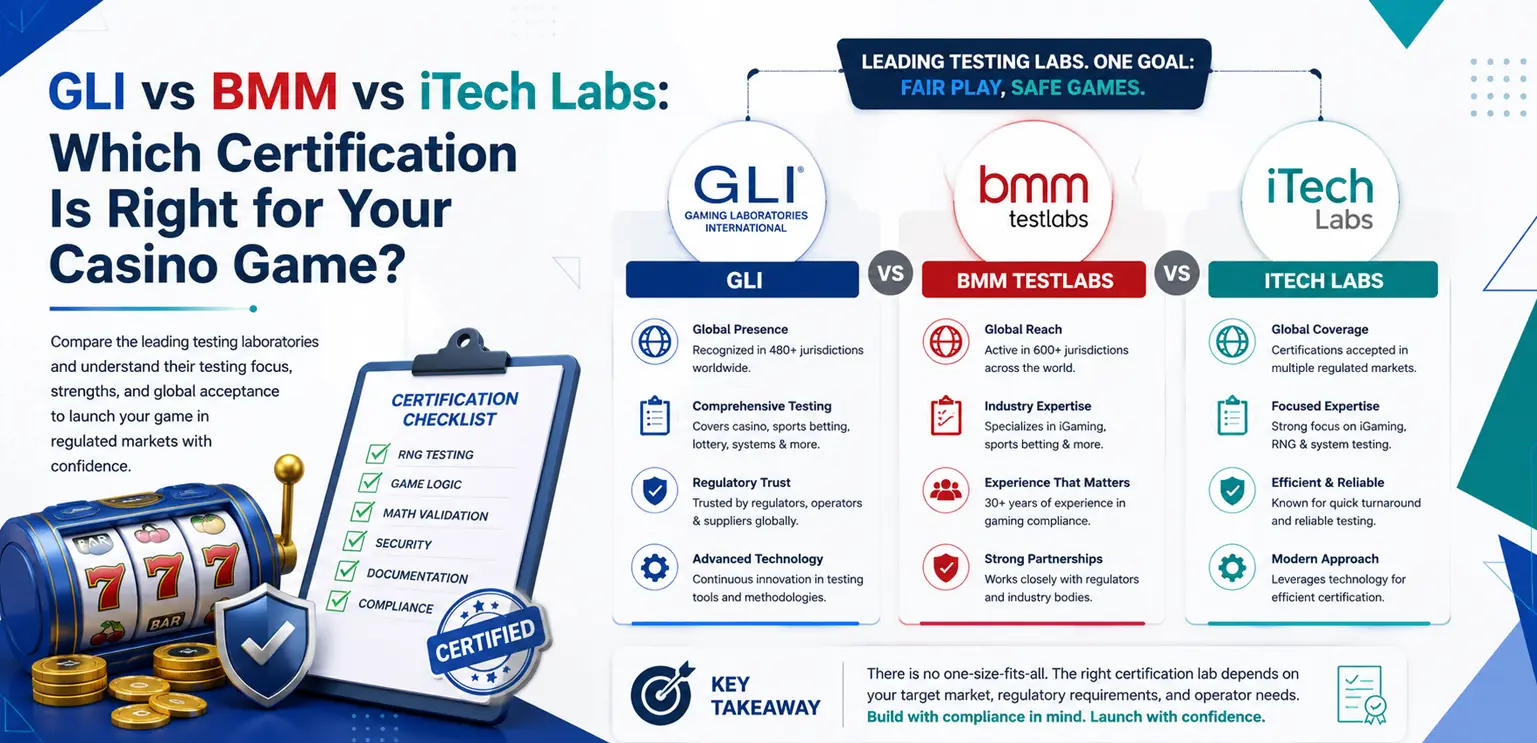
This is where independent testing laboratories play an important role. Organizations such as Gaming Laboratories International (GLI), BMM Test labs, and iTech Labs are widely recognized within the gaming industry for evaluating gaming products against applicable standards and regulatory requirements. Their work helps regulators, operators, and platform providers gain confidence that gaming systems perform as intended.
For developers entering regulated markets, understanding these laboratories is valuable—not because one is universally "better" than another, but because different jurisdictions, regulators, and operators may recognize different testing organizations.
The Role of Independent Certification Laboratories in Gaming
Why Independent Certification Laboratories Exist
Casino games process random outcomes, financial transactions, player interactions, and backend communications. Because these systems directly affect gameplay integrity, regulators generally require independent verification before games are deployed in licensed environments. Independent laboratories help ensure that gaming software:
- Operates according to documented specifications. The implemented game logic should match the published rules, pay-tables, and technical documentation.
- Produces reliable and consistent outcomes. Randomness, mathematical behavior, and gameplay mechanics should function as intended during long-term operation.
- Meets applicable technical standards. Games are evaluated against the requirements established by the relevant regulatory authority or jurisdiction.
- Supports trust within the gaming ecosystem. Independent reviews provide confidence to regulators, operators, suppliers, and business partners.
Rather than replacing internal testing, certification laboratories provide an additional level of technical verification before market launch.
Understanding the Role of GLI, BMM, and iTech Labs
Although these organizations have different histories and global footprints, their primary objective is similar: independently evaluating gaming products against recognized standards and regulatory requirements. They commonly assess areas such as:
- Random Number Generation (RNG): Reviewing the implementation and behavior of the randomization system used within the game.
- Mathematical accuracy: Evaluating whether the game's mathematical documentation aligns with its implemented behavior where required by the applicable standards.
- Game logic: Confirming that gameplay features operate consistently with documented specifications.
- Security and integrity: Assessing technical controls designed to protect the software and maintain system reliability.
- Technical documentation: Reviewing supporting documentation needed to evaluate the software effectively.
The exact scope of testing depends on the project, the jurisdiction, and the applicable regulatory framework.
What Is GLI?
Gaming Laboratories International (GLI) is one of the most established independent testing organizations in the global gaming industry. It works with regulators, operators, suppliers, and manufacturers across numerous jurisdictions. GLI provides testing and certification services for a broad range of gaming technologies, including:
- Casino games
- Gaming systems
- Sports betting platforms
- Lottery technologies
- Online gaming solutions
- Casino management systems
Because GLI works across many regulated markets, developers frequently encounter GLI requirements when preparing games for commercial deployment.
What Is BMM Test Labs?
BMM Test labs is another long-established independent testing laboratory serving the global gaming industry. Its services include testing, inspection, and certification across multiple gaming sectors. BMM commonly works with:
- Casino game developers
- Platform providers
- Equipment manufacturers
- Regulators
- Licensed operators
Like other recognized laboratories, BMM evaluates gaming products against the technical and regulatory standards applicable to the markets being served.
What Is iTech Labs?
iTech Labs is an internationally recognized testing laboratory specializing in online gaming technologies and digital gaming systems. Its work includes testing various gaming products for compliance with applicable technical standards and regulatory requirements. Developers often encounter iTech Labs in projects involving:
- Online casino platforms
- RNG-based games
- Sports betting systems
- Digital gaming products
- Platform integrations
As with GLI and BMM, the laboratory's role is independent evaluation rather than game development or regulatory approval.
GLI vs BMM vs iTech Labs: What Do They Have in Common?
Although each laboratory has its own history and operational processes, they share several important objectives. All three organizations generally aim to provide independent testing, evaluate RNGs, conduct technical compliance testing, review game logic, perform security-related evaluations, and document their findings to support regulated gaming markets.
Common Capabilities Comparison
| Area | GLI | BMM | iTech Labs |
|---|---|---|---|
| Independent testing | ✅ | ✅ | ✅ |
| RNG evaluation | ✅ | ✅ | ✅ |
| Technical compliance testing | ✅ | ✅ | ✅ |
| Game logic review | ✅ | ✅ | ✅ |
| Security-related evaluations | ✅ | ✅ | ✅ |
| Documentation review | ✅ | ✅ | ✅ |
| Support regulated gaming markets | ✅ | ✅ | ✅ |
Rather than competing on a single technical capability, these organizations operate within different regulatory ecosystems and business relationships.
How Are They Different?
The biggest differences are generally not in what they test but in where they are recognized, which jurisdictions they support, and which operators or regulators require their reports. Developers should consider several factors:
- Jurisdictional acceptance: Different regulators recognize different testing laboratories. The appropriate laboratory often depends on the market where the game will be offered.
- Operator requirements: Some operators or platform providers may request certification from specific laboratories based on their licensing obligations or business processes.
- Project scope: Large platform certifications and individual game certifications may involve different testing requirements depending on the product.
- Regulatory framework: Every jurisdiction defines its own compliance standards, reporting requirements, and approval procedures.
For most studios, the certification laboratory is determined by business and regulatory needs rather than personal preference.
Which Certification Laboratory Should Developers Work With?
This is one of the most common questions asked by new studios. The answer is straightforward:
Often, developers do not simply choose whichever laboratory they prefer.
Instead, the appropriate testing laboratory is usually influenced by:
- The target jurisdiction: Regulatory authorities often specify which testing reports they accept for licensed gaming products.
- The operator or platform provider: Commercial partners may require certification from laboratories they already recognize within their compliance processes.
- Licensing obligations: Different licensing frameworks can have different documentation and testing expectations.
- Business expansion plans: Studios entering multiple regulated markets may work with different laboratories over time as their distribution grows.
Understanding these factors early helps developers avoid unnecessary delays later in production.
How Developers Should Prepare Regardless of the Laboratory
One important point is that strong development practices benefit certification regardless of which independent laboratory performs the review. Successful studios typically focus on:
- Building reliable mathematical models: RTP, volatility, hit frequency, and feature behavior should be validated through extensive simulation testing before submission.
- Implementing structured QA processes: Functional testing, regression testing, compatibility checks, and performance validation help identify issues before external review.
- Maintaining complete documentation: Accurate game specifications, mathematical reports, software architecture, and version histories make the evaluation process more efficient.
- Using disciplined version control: Clear build management improves traceability and ensures everyone is working with the correct software version.
- Planning for compliance early: Integrating compliance into the production pipeline is generally more efficient than addressing requirements at the end of development.
These practices improve overall software quality while supporting smoother certification.
Common Misconceptions About Certification Laboratories
There are several misconceptions that often create confusion among new developers.
🔹 Myth 1: One laboratory is always better than another.
Not necessarily. Recognition depends largely on jurisdiction, regulatory requirements, and operator preferences rather than a universal ranking.
🔹 Myth 2: Certification laboratories only test RNGs.
RNG evaluation is important, but reviews may also include software behavior, documentation, security-related controls, game logic, and other technical requirements.
🔹 Myth 3: Certification starts after development ends.
In reality, certification readiness begins during planning, mathematics development, QA, documentation, and production management.
🔹 Myth 4: Passing one certification automatically guarantees approval everywhere.
Different jurisdictions have different regulatory requirements. Additional approvals or documentation may still be required depending on the target market.
How AI Is Supporting Certification Preparation
Artificial Intelligence is becoming a valuable tool for helping development teams streamline certification preparation before external testing. Studios increasingly use AI to assist with:
- Documentation drafting and consistency checks.
- Regression testing and automated test execution.
- Log analysis and issue detection.
- Code review support.
- Workflow automation for repetitive production tasks.
AI helps reduce manual effort, but formal certification still depends on independent testing and regulatory processes.
Why Experienced Development Partners Matter
Preparing a certification-ready game requires coordination across multiple disciplines, including mathematics, engineering, QA, documentation, security, and production management.
Many studios work with experienced development partners to strengthen these areas and reduce project risk.
Companies such as Gamix Labs support clients by building production-ready slot games with validated mathematical models, structured QA workflows, comprehensive documentation, simulation testing, and scalable development pipelines that align with certification requirements across regulated markets.
Best Practices Before Submitting a Game for Certification
Whether your project will be reviewed by GLI, BMM, iTech Labs, or another recognized testing organization, several practices consistently improve certification readiness. These include:
- Start planning early. Consider compliance requirements during pre-production rather than waiting until development is complete.
- Validate mathematical performance. Extensive simulation testing helps verify RTP, volatility, and bonus behavior before external review.
- Keep documentation up to date. Well-maintained technical documentation reduces delays during evaluation.
- Test continuously. Integrate QA into every milestone instead of treating it as a final phase.
- Review security and software integrity. Strong technical foundations support both certification and long-term product stability.
- Communicate with stakeholders. Developers, QA teams, mathematicians, producers, and compliance specialists should remain aligned throughout the project.
Conclusion
GLI, BMM Test labs, and iTech Labs all play important roles in helping regulated gaming markets maintain technical integrity and operational confidence. Rather than viewing these organizations as competitors where one is universally better than another, developers should understand that the appropriate laboratory often depends on jurisdictional requirements, operator expectations, and licensing frameworks.
Rather than concentrating on which testing laboratory will review your game, the smarter approach is to build certification readiness into the development process from day one. By focusing on accurate mathematical validation, thorough quality assurance, well-organized documentation, secure development practices, and structured production workflows, studios can simplify the certification process and improve their chances of a smooth approval—regardless of the independent testing laboratory involved.
Studios that adopt this approach are better positioned to enter regulated markets with confidence while reducing delays, minimizing costly revisions, and delivering high-quality casino games.
Frequently Asked Questions
Are GLI, BMM, and iTech Labs regulators?
No. They are independent testing laboratories that evaluate gaming products against applicable standards and regulatory requirements. Regulatory approval is typically granted by the relevant gaming authority.
Which certification laboratory should I choose?
In many cases, the decision depends on the target jurisdiction, licensing framework, and operator requirements rather than developer preference.
Do all three laboratories test RNGs?
Yes. RNG evaluation is a common part of gaming software testing, although the overall scope of review extends beyond random number generation.
Does certification guarantee a game can launch everywhere?
No. Different jurisdictions have different licensing and regulatory requirements, so additional approvals may be necessary depending on the target market.
How can developers prepare for certification?
By integrating compliance planning, mathematical validation, simulation testing, quality assurance, documentation, and secure development practices throughout the production lifecycle.