How Slot Games Work: What Happens Behind the Reels?
A slot game looks simple on the screen. Players select their bet, press Spin, watch the reels move, and wait for the symbols to settle. But have you ever wondered what actually happens behind those spinning reels?
There is much more happening than a simple animation. Several systems work together to make every spin possible, including Random Number Generators (RNG), mathematical models, virtual reel positions, symbol mapping, winning-combination calculations, and animation systems.
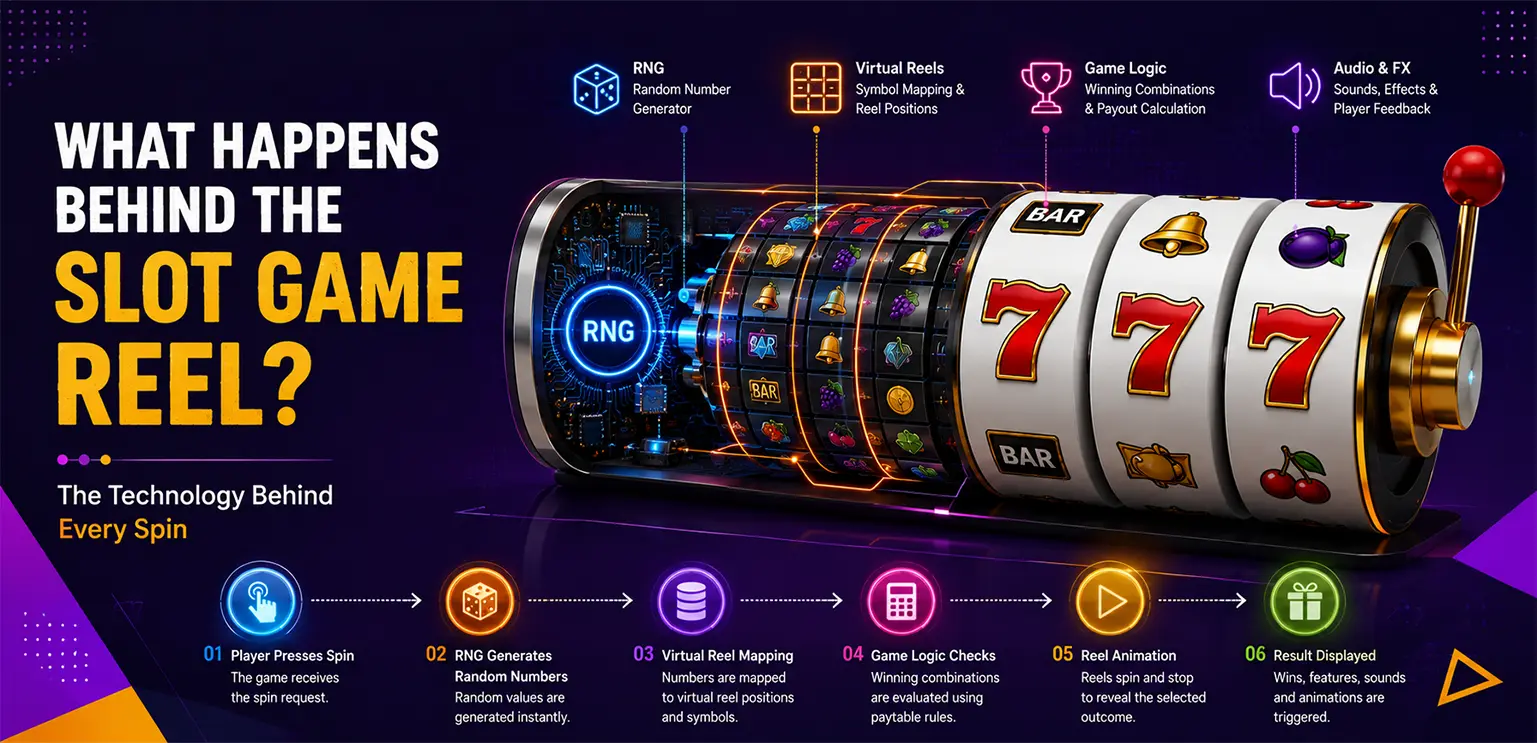
In modern online slot game development, the reels are only the visible part of a much larger technical process. Behind them, mathematics determines possible outcomes, game logic evaluates results, and the frontend brings everything to life through visuals, sound, and animation.
Let's explore what happens behind the slot game reel, from the moment a player presses Spin to the moment the final result appears on the screen.
1. It Starts With the Spin Button
When a player presses the Spin button, the game begins a sequence of operations.
The game first registers the player's action and validates the relevant game state. Depending on the implementation, this may include checking the bet amount, available balance, game rules, and whether another spin is already in progress.
Once the spin request is accepted, the outcome-selection process begins.
In a regulated random slot game, the result is determined through an approved random outcome-generation process. The exact architecture can differ between land-based machines and online games, but the essential principle is that the visual reel animation should faithfully present the selected outcome rather than create a different result.
This distinction is important: pressing Spin does not simply start a random animation that decides the result when it stops.
2. The RNG: The System Behind Random Outcomes
One of the most important components of a modern slot game is the Random Number Generator (RNG).
An RNG is a system designed to produce unpredictable or statistically appropriate random values, depending on its implementation and applicable regulatory requirements.
In slot games, these values are used by the game mathematics to determine an outcome.
For example, imagine a simplified slot game with three reels. The RNG generates values that are mapped to positions on the game's reels. Those positions determine which symbols appear in the result.
The player sees three spinning reels, but the game logic is working with an outcome-selection process behind the scenes.
How does RNG work?
A simplified explanation of the process is:
- The player initiates a spin.
- The game accepts the spin request.
- The RNG produces the required random values.
- The values are mapped to valid game positions or outcomes.
- The game evaluates the resulting symbol arrangement.
- The frontend displays the selected result through reel animations.
The exact implementation depends on the game's architecture. Some systems use separate random values for individual reels, while others use a more complex mathematical model to select complete outcomes.
For regulated gaming products, randomness, game rules, and outcome selection must meet the requirements of the relevant jurisdiction.
The UK Gambling Commission, for example, specifies requirements for acceptable randomness, including unpredictability and statistical distribution.
3. Virtual Reels: What Players Don't See
The reels displayed on the screen are not necessarily the complete mathematical representation of the game.
Many slot systems use virtual reel positions. These are logical positions used by the game's mathematics to represent possible symbol outcomes.
A virtual reel can contain more positions than the visible reel suggests. Different virtual positions may map to the same displayed symbol.
How does virtual reel mapping work?
Consider a simplified example:
A visible reel displays five different symbols:
- Cherry
- Bell
- Star
- Wild
- Seven
Behind the scenes, the mathematical model could contain 20 virtual positions. Some symbols may occupy more virtual positions than others. For illustration:
| Symbol | Virtual positions |
|---|---|
| Cherry | 6 |
| Bell | 5 |
| Star | 4 |
| Wild | 3 |
| Seven | 2 |
| Total | 20 |
In this hypothetical example, Cherry occupies six of the 20 positions, while Seven occupies two.
If virtual positions are selected uniformly, Cherry has a greater chance of being selected than Seven on that reel.
The actual probabilities depend on the complete game mathematics, including how positions are selected and how reels interact.
Why are virtual reels important?
Virtual reels allow game designers and mathematicians to configure symbol distributions and possible combinations beyond what a simple visual reel might suggest. They can influence:
- Symbol probabilities.
- Frequency of specific combinations.
- Frequency of winning outcomes.
- The game's theoretical return.
- The mathematical behavior of special symbols.
This is why counting the symbols visible on a screen is not enough to calculate the actual odds of a modern slot game.
The UK Gambling Commission explains how reel positions and theoretical return work in its article on gaming machine RTP:
UK Gambling Commission: reel positions and theoretical return
4. Symbol Mapping: Turning Numbers Into Symbols
Once the game has its selected values or positions, the next step is translating those results into symbols.
This process is commonly called reel mapping or symbol mapping.
For example, a selected position might correspond to a Cherry symbol on the first reel, a Wild on the second reel, and a Seven on the third reel.
The game then builds the final symbol arrangement according to its reel configuration.
In a five-reel slot game, the process can involve multiple rows of symbols, depending on the game's design.
This is where the mathematical configuration connects with the visible game layout.
A developer needs to ensure that the selected outcome and the symbols displayed by the frontend remain consistent.
5. Game Mathematics: How Winning Combinations Are Calculated
After the outcome is selected and mapped to symbols, the game evaluates the result according to its mathematical rules.
This is where the Pay-table, Pay-lines, symbol values, and special-symbol rules come into play.
Understanding Pay-lines
A Pay-line is a predefined pattern across the reels that determines which symbol combinations qualify for a payout.
For example, a traditional three-reel game might use a single horizontal Pay-line.
A five-reel game could contain several horizontal, diagonal, or more complex Pay-lines.
Understanding ways to win
Some games use a ways-to-win system instead of fixed Pay-lines.
For example, a 5-reel, 3-row game with three eligible positions on each reel could have:
3 × 3 × 3 × 3 × 3 = 243 possible left-to-right symbol paths.
The game evaluates qualifying symbol combinations according to its rules.
What is a Pay-table?
A Pay-table defines the rewards associated with winning combinations and explains relevant symbol behavior. It may include:
- Symbol payout values.
- Wild symbol functionality.
- Scatter symbol rules.
- Bonus-game triggers.
- Multipliers.
- Special combination requirements.
The game's evaluation system checks the selected outcome against these rules and calculates the applicable result.
6. RTP and Volatility: The Mathematics Behind the Game
Two important concepts in slot game mathematics are Return to Player (RTP) and volatility.
What is RTP?
RTP represents the theoretical percentage of total wagers that a game is designed to return as prizes over a very large number of plays.
For example, a theoretical RTP of 96% represents an expected return of 96 units for every 100 units wagered across the relevant long-run mathematical model.
It does not mean that a player receives 96% back during every session or that a particular spin has a 96% chance of winning.
RTP is calculated from the probabilities and payouts of the game's possible outcomes.
What is volatility?
Volatility describes how the game's payouts are distributed over time.
A lower-volatility game generally has a different payout distribution from a higher-volatility game, even if both have the same theoretical RTP.
- Low volatility: Typically involves more frequent, smaller payouts.
- Medium volatility: Offers a distribution between smaller and larger payouts.
- High volatility: Typically involves less frequent payouts with the potential for larger rewards.
RTP and volatility describe different aspects of the mathematical model. Neither predicts the outcome of an individual spin.
For additional information, the UK Gambling Commission explains how theoretical RTP works:
UK Gambling Commission: Return to Player
7. Reel Animation: Bringing the Result to Life
Now comes the part players actually see.
Once the game has a confirmed outcome, the frontend displays it through reel animations.
The reel animation system handles the visual movement of symbols, spinning speed, stopping sequences, transitions, and other effects.
This is where game art and animation play an important role.
A typical reel animation sequence may include:
- Spin initiation: The reels begin moving when the accepted spin action triggers the visual sequence.
- Acceleration: The symbols increase their movement speed to create the spinning effect.
- Continuous spinning: Symbols scroll vertically while the reel appears to rotate.
- Deceleration: The reels slow down as the game prepares to reveal the selected result.
- Reel stopping: The final symbols are positioned according to the selected outcome.
- Win presentation: If the outcome qualifies for a win, the game activates the appropriate visual and audio feedback.
The animation system must display the selected result accurately. It should not independently alter the mathematical outcome.
What happens during reel stopping?
Developers use animation logic to control how the reels stop.
For example, a five-reel slot game might stop the reels one after another to create anticipation.
The stopping sequence can involve:
- Reel-specific timing.
- Symbol positioning.
- Easing curves.
- Bounce or settle animations.
- Sound synchronization.
- Win-line highlighting.
These elements help create a satisfying visual experience without changing the underlying result.
8. What Happens After the Reels Stop?
When the reels finish stopping, the game moves into its result-presentation phase.
The game checks the completed result and activates the relevant response.
If the combination is a win, the game may:
- Highlight the winning symbols.
- Display the corresponding pay-line or winning pattern.
- Calculate and show the payout.
- Trigger symbol animations.
- Play win sounds.
- Activate multipliers or other eligible features.
- Update the credit or balance display according to the game rules.
If the result triggers a bonus feature, the game may transition into another game state.
For example, landing the required number of Scatter symbols might activate a free-spins feature.
The frontend then presents the bonus introduction, transition animation, and feature gameplay.
All these responses must follow the game's predefined rules.
9. How the Game Engine Connects Everything
A slot game is not simply a collection of spinning symbols. It is a software application in which different systems communicate to produce the complete experience.
A simplified architecture includes:
| Component | Responsibility |
|---|---|
| RNG or outcome service | Generates or supplies random outcome values |
| Math model | Defines probabilities, symbol distributions, and payout rules |
| Reel mapping system | Converts selected positions into symbols |
| Game logic | Evaluates combinations and feature conditions |
| Frontend/game engine | Displays the game and manages interactions |
| Animation system | Controls reel movement, transitions, and effects |
| Audio system | Plays spin, stop, win, and feature sounds |
| QA and validation | Checks correctness, stability, and compliance |
In some online architectures, important game logic and outcome selection are handled by a backend service, while the frontend focuses on presenting the result. Other architectures organize these responsibilities differently.
The important requirement is that the displayed outcome, game rules, and calculated result remain consistent.
10. Testing: Making Sure Everything Works Correctly
Before a slot game is released, its different systems need to be tested together.
A reel may spin correctly but display the wrong symbols. A winning combination may be identified correctly but trigger the wrong animation. A bonus feature may work during one test but fail after a particular sequence of game states.
These are reasons why QA is an essential part of slot game development. Testing commonly covers:
- RNG and mathematics validation: Checking that outcome generation and mathematical rules meet the applicable requirements.
- Reel mapping: Verifying that selected positions produce the correct symbols.
- Pay-line and payout testing: Checking winning combinations and calculated rewards.
- Animation testing: Confirming that reel movement and stopping sequences display the correct result.
- Feature testing: Checking Wilds, Scatters, free spins, multipliers, and bonus rounds.
- Performance testing: Monitoring frame rate, loading behavior, and stability.
- Cross-device testing: Checking the game across supported screen sizes, browsers, and devices.
In regulated markets, independent testing and certification requirements may also apply. The exact requirements depend on the jurisdiction and product category.
Final Thoughts
Behind every slot game reel is a combination of mathematics, software engineering, game logic, and visual design.
The RNG and mathematical model determine the outcome in a regulated random game. Virtual reel mapping translates mathematical positions into symbols. Game logic evaluates the result, while the animation system presents it through spinning reels, transitions, and visual effects.
For game developers, understanding these connections is essential to building slot games that are visually engaging, technically reliable, and consistent with their defined rules.
At Gamix Labs, slot game development brings together game art, UI/UX, animation, and technical implementation to create complete iGaming experiences. Explore Gamix Labs to discover more about slot game development and the creative and technical work behind modern slot games.
Frequently Asked Questions
Do slot game reels determine the winning result?
Not necessarily. In a typical regulated random slot game, the outcome is selected through the game's approved outcome-generation process. The reels visually present that result. The exact technical implementation differs between games and platforms.
What is a virtual reel in slot game development?
A virtual reel is a logical representation of reel positions used by a game's mathematical model. It can contain more positions than the symbols visibly displayed on screen. These positions can be mapped to visible symbols, allowing developers to configure symbol distributions and possible outcomes.
What is the difference between RNG and reel animation?
RNG is responsible for generating random values used in outcome selection. Reel animation controls how symbols move and stop visually on the screen. They serve different purposes: one handles outcome generation, while the other presents the result to the player.
How are winning combinations calculated in slot games?
The game evaluates the selected symbol arrangement against its predefined rules. These may include pay-lines, ways to win, symbol combinations, Wild functionality, and pay-table values. The applicable payout is then calculated according to the game's mathematical configuration.
Can developers control which symbols appear on slot reels?
Developers and mathematicians configure the game's reel structure, symbol distribution, mapping, and mathematical rules. However, in a regulated random game, individual outcomes must follow the approved outcome-selection process rather than being manually changed to produce a desired result.
What role does a game engine play in slot game development?
A game engine or rendering framework manages the visual and interactive side of the game. It can handle reel movement, symbol rendering, UI interactions, animation transitions, sound synchronization, and visual effects while communicating with the game's underlying logic.
Why is testing important in slot game development?
Testing helps verify that outcome generation, reel mapping, payout calculations, animations, and bonus features behave according to the defined game rules. It also helps identify performance issues, visual inconsistencies, and compatibility problems before release.
What technologies are used to develop online slot games?
Online slot games can use technologies such as HTML5, JavaScript, TypeScript, PixiJS, Cocos Creator, and other game development frameworks. The choice depends on the project's rendering requirements, target platforms, architecture, and development workflow.