Slot Animation Studio: What They Deliver and How to Hire One
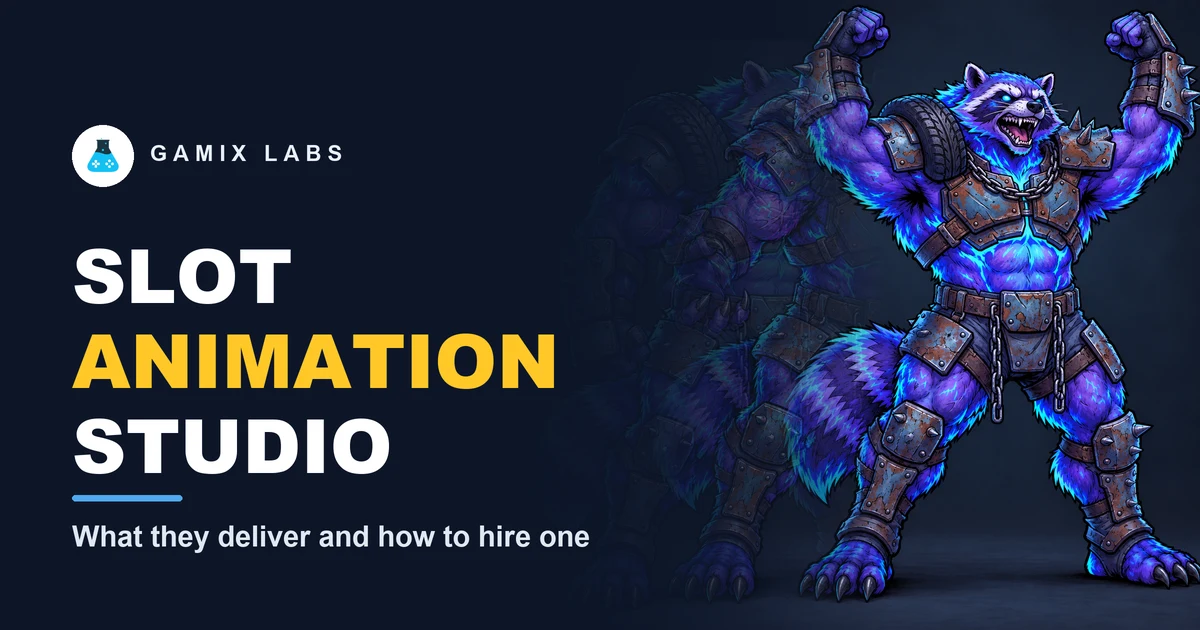
Your slot has finished art. The symbols look sharp in the PSD, the character has personality, the background sets the mood. Then you put it on the reels and nothing moves. That gap between still art and a game that feels alive is the job of a slot animation studio.
This guide is for studios and operators hiring outside help for that job. It covers what a slot animation studio actually delivers, how a project usually runs, what to check before you sign, and a checklist you can use in your first call.
What a slot animation studio delivers
Slot animation is not one task. A typical project covers four groups of work, and a good studio quotes each one clearly.
Symbol animations. Every symbol needs at least an idle state and a win state. High-paying symbols usually get a stronger win animation than low ones, so the player can feel the difference without reading the paytable. Wilds and scatters get their own landing and trigger animations.
Character animation. If your game has a mascot or a hero character, it needs an idle loop that can play for minutes without looking repetitive, plus reaction states for wins, near misses and feature triggers.
Win and bonus sequences. Big win, mega win and feature intro screens are short pieces of choreography: text, coins, light and camera moves timed together. They are the moments players remember and share, so they deserve the most attention.
VFX. Particles, glows, sparks, smoke and light sweeps tie the animation together. Done well they make a win land harder. Done badly they cover the art and slow the game down.
If you need the full scope, see our 2D animation services page for what we include.
Why Spine is the standard for HTML5 slots
Most HTML5 slots are built in Cocos Creator or PixiJS, and both have solid Spine runtimes. That is why most slot animation studios work in Spine rather than frame-by-frame sprite sheets.
Spine animates the art you already have. The artist cuts the symbol or character into parts, rigs them with bones, and animates the bones. The result is a small JSON or binary file plus one texture atlas, instead of dozens of full frames. That keeps the download light and lets the game play the same animation at any speed or scale.
It also changes what you should ask of your art. Art meant for Spine needs to be delivered in layers, with hidden parts painted behind overlaps (an arm behind the body, hair behind the face). If your art studio did not plan for that, the animation studio will have to repaint parts first. We wrote more about the process in creating symbol animations in Spine for slot games.
How a slot animation project runs
The details vary, but a well-run project follows the same steps.
- Brief and art review. The studio checks your layered files, your game's resolution and your target engine. Problems with the art are cheaper to fix here than after rigging.
- Animation list. Every symbol, character state and sequence is listed with its length and whether it loops. This list is the scope. If something is not on it, it is not in the price.
- Rigging and a first symbol. One symbol or the character is rigged and animated first, so you can approve the style and timing before the rest are built.
- Production. The remaining symbols, states and sequences are animated in batches, each reviewed in a preview build rather than as a video.
- Integration check. The files are tested in your engine, at your frame budget, on real mobile devices.
For a full game's worth of animation, our typical timeline is 3 to 5 weeks.
What to check before you hire
Portfolio that moves
Still images tell you nothing about animation. Ask for playable demos or screen recordings of games in motion, and watch the idle loops for at least ten seconds. Loops that hitch or repeat obviously will do the same in your game. You can see how we present ours on the portfolio page.
Performance on mobile
Most slot players are on phones. Ask how the studio keeps animations smooth there: bone counts, mesh use, atlas size and how many particles run at once on a big win. We build Spine animation for 60fps on mobile, and any studio you hire should be able to tell you its own target and how it tests it.
Files that work in your engine
Confirm the Spine version and runtime the studio exports for, and that it matches what your Cocos Creator or PixiJS build uses. A version mismatch is one of the most common reasons animation files fail on delivery. If you are still choosing a renderer, our comparison of PixiJS and other 2D rendering approaches may help.
Ownership of the source files
You should receive the Spine project files, not only the exports, so your team can change timing later without going back to the studio. At Gamix Labs the work is for hire: on final payment you own 100% of the source files and art.
Art and animation under one roof
Splitting art and animation between two vendors works, but every handoff costs time. If you have not commissioned the art yet, a studio that does both can paint the art ready for rigging from day one. Our slot game art and animation teams work from the same brief for that reason. And if art is the part you are still hiring for, read how to choose a slot game art studio.
Checklist for your first call with a slot animation studio
Take this into the call and tick it off:
- Can I see animation in motion from a live or playable game, not only stills?
- Which Spine version and which runtime do you export for?
- What is your frame-rate target on mobile, and on which devices do you test?
- Will you review my art files before quoting, and tell me what needs repainting?
- Is the animation list (every symbol, state and sequence) part of the quote?
- Do I approve one rigged symbol or character before full production?
- How are reviews done: preview builds, or videos?
- Do I get the Spine project files, and do I own them on final payment?
- How many revision rounds are included, and what counts as a change of scope?
- Can you start with a small paid sample before the full project?
A studio that answers all ten clearly is a studio that has shipped slot animation before.
Start small, then scale
The safest way to judge a slot animation studio is to see its work on your own art. Our paid sample is one character or three symbols from your game with Spine idle and win animations, delivered in about a week, and the fee is credited to the full project if you go ahead.
Send us your layered art and a short brief through our 2D animation services page, and we will come back with the animation list and a quote.