How Slot Math Affects Gameplay: RTP, Volatility, Hit Frequency, and Player Experience
Players notice the art first. The symbols, the reel spin, the coin shower when a feature lands. But two slots with the same theme and the same five-reel grid can feel nothing alike once you start spinning, and the reason is almost always the math underneath.
Slot math decides how often wins land, how big they are, how much of the return is held back for the bonus round, and how high the top prize can go. When the math is right, the art, sound, and features all have something solid to build on. When it's wrong, no amount of polish will fix how the game feels.
In this post, we walk through the main parts of a slot math model, what each one does to the player experience, and how studios build and test them before release.
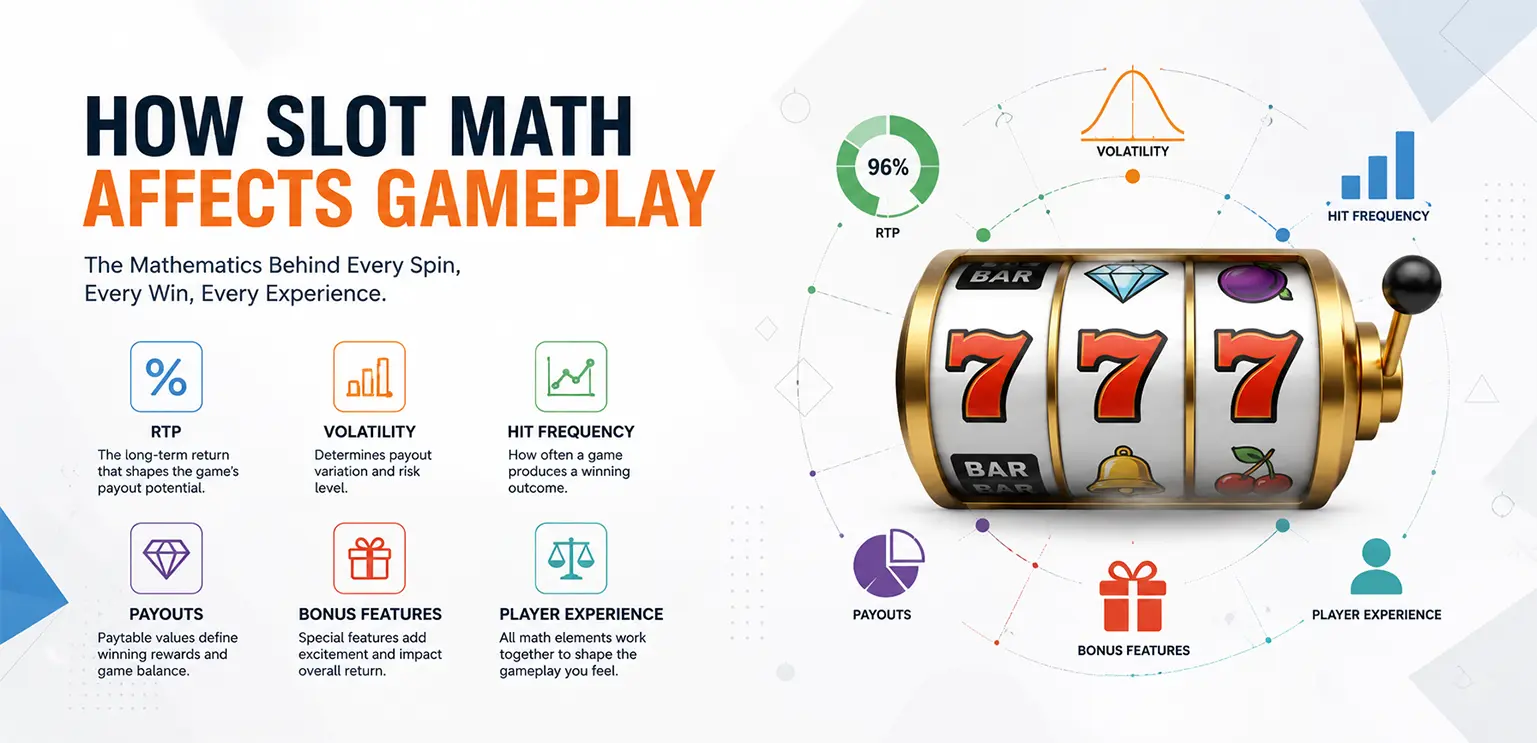
🔹 1. What Is Slot Game Mathematics?
Slot math is the probability model behind a game. It defines every possible outcome, how likely each one is, and what it pays.
A typical model is built from a handful of parts:
-
Reel strips and symbol weights: how often each symbol can land.
-
Paytable: what each winning combination pays.
-
Random number generator (RNG): picks each result. A certified RNG draws every spin independently, so a slot is never "due" for a win. Some games do carry progress between spins, such as collection meters, but that comes from the game rules, not the RNG.
-
Return to Player (RTP): the share of total wagers the game is designed to pay back over a very long run.
-
Volatility: how widely results swing around that average.
-
Hit frequency: how often a spin returns any win at all.
-
Bonus mechanics: how often features trigger and what they are worth.
Change any one of these and the game plays differently. That's why two slots can look like twins and still feel like opposites. One drips out small wins every few spins. The other goes quiet for long stretches and then pays big.
🔹 2. How Slot Math Shapes the Player Experience
Math sets the rhythm of a game, not just its payouts. A few examples:
A game with lots of small wins feels busy and steady, because something is always happening on screen.
A high-volatility game has long dry spells, broken up by occasional large hits.
A feature-heavy game might hold much of its return back for free spins, so the base game feels lean and the bonus becomes the main event.
A game with many ways to win changes how players read the reels, because wins can form across far more positions.
This is why the math needs to be settled early. Tweak a symbol weight or a feature trigger rate late in production and the game can feel completely different, even though not a single frame of art has changed.
🔹 3. RTP: The Long-Term Return
RTP (Return to Player) is the percentage of all money wagered that a game is designed to pay back as prizes over a very large number of spins.
A game with 96% RTP is built to return, on average, 96 units for every 100 wagered across its full mathematical cycle. The remaining 4% is the house edge.
What RTP doesn't tell you
RTP is a long-run average. It says nothing reliable about a single session. Someone playing 200 spins on a 96% game could finish well ahead or well behind. The actual return only settles toward 96% across millions of spins, and the higher the volatility, the longer that takes.
How RTP is calculated
At its simplest:
RTP = (Expected total payout ÷ Total wager) × 100
Each possible outcome contributes its probability multiplied by its payout. Here's a toy example:
| Outcome | Probability | Payout |
|---|---|---|
| No win | 70% | 0x |
| Small win | 20% | 1x |
| Medium win | 8% | 3x |
| Large win | 2% | 10x |
Expected payout = (0.70 × 0) + (0.20 × 1) + (0.08 × 3) + (0.02 × 10) = 0.64x
That works out to an RTP of 64%. That's far too low for a real game. We kept the numbers small so the arithmetic is easy to follow. In regulated US online markets, the average slot returns roughly 96%, while land-based machines usually pay back less.
Real games have thousands or even millions of possible outcomes, but the principle never changes: every outcome adds its probability × payout to the total.
For developers, RTP is the target the whole model is balanced around. It's also the first number you check when comparing designs or verifying a build.
🔹 4. Volatility: Why Games With the Same RTP Feel Different
Volatility measures how much results swing around the average. You'll often hear it called variance. Strictly speaking, volatility is usually expressed as the standard deviation of the return per spin (the square root of variance), but in day-to-day studio talk the two words are used interchangeably.
Volatility is the reason two 96% games can feel nothing alike.
Low volatility
The return is spread across many small and medium wins. Big hits exist, but they don't carry much of the RTP. Sessions feel steady, although no spin is ever guaranteed to pay.
Medium volatility
A mix of regular small wins, occasional mid-sized ones, and the odd larger hit. This gives designers room to build a rhythm without leaning entirely on frequent small wins or rare big ones.
High volatility
A larger share of the RTP sits in rare, big outcomes, often inside bonus rounds. Expect longer dry spells and a much wider spread of session results.
| Factor | Low volatility | Medium volatility | High volatility |
|---|---|---|---|
| Payout pattern | Frequent, smaller payouts | Mixed payout sizes | Rarer, potentially larger payouts |
| Swing in results | Lower | Moderate | Higher |
| Gameplay rhythm | Steady | Varied | Unpredictable |
| Large payouts | Minor part of the model | Occasional | A major part of the model |
One thing to watch: low volatility often goes hand in hand with high hit frequency, but they aren't the same thing. A game can hit often and still be volatile if most of its return sits in a rare top prize. Volatility comes from the whole payout distribution. Providers also label it differently, from low/medium/high to 1-to-5 scales, so treat those labels as descriptions rather than standard measurements.
🔹 5. Hit Frequency: How Often Does a Slot Pay?
Hit frequency is how often a spin returns any win. It's usually written as a percentage or as "1 in X" spins.
Hit frequency = (Winning spins ÷ Total spins) × 100
If a game produces 250 winning spins out of 1,000 simulated spins, its observed hit frequency is 25%, or about 1 in 4.
A win isn't always a profit
Here's the detail people often miss. If a player bets 1 credit and wins 0.5 back, the game records a win, but the player is still down 0.5 credits. Researchers call these "losses disguised as wins."
This matters for design, not just for the math. In Great Britain, online slots are not allowed to celebrate a return that is less than or equal to the stake with win sounds or animations. So when you look at hit frequency, also check how many of those hits actually pay more than the stake.
Same RTP, different hit frequency
| Metric | Game A | Game B |
|---|---|---|
| RTP | 96% | 96% |
| Hit frequency | 30% | 15% |
| Average win when it hits | About 3.2x stake | About 6.4x stake |
| How it feels | Frequent smaller wins | Longer gaps, bigger moments |
RTP equals hit frequency multiplied by the average win size. So if you halve the hit frequency and keep the same RTP, the average win has to double. Same return on paper, very different experience in the player's hands. That's why RTP alone never tells you the whole story.
🔹 6. Symbol Weighting and Reel Strips
Every symbol has a job. A typical set includes:
-
Low-pay symbols, such as card ranks.
-
High-pay symbols, usually the themed premiums.
-
Wilds, which substitute for eligible symbols.
-
Scatters, which trigger bonus features.
-
Special symbols, which bring in extra mechanics.
Symbol weighting controls how often each one can land. On a virtual reel, the model can give a symbol more or fewer stops than it appears to have on screen. That lets designers tune outcomes without redrawing the reels.
But nothing moves on its own. Make a premium symbol more common and its combinations land more often. That pushes RTP up, changes hit frequency, and can shift volatility and feature trigger rates too. Every weight change means running the numbers again.
🔹 7. Paytables: Turning Combinations Into Rewards
The paytable links what lands on the reels to what the player gets paid. A simplified version might look like this:
| Symbol combination | Example payout |
|---|---|
| 3 matching low symbols | 2x |
| 4 matching low symbols | 5x |
| 5 matching low symbols | 10x |
| 3 matching premium symbols | 8x |
| 4 matching premium symbols | 25x |
| 5 matching premium symbols | 100x |
These values are for illustration only. Real payouts depend on the game's rules and full math model.
A big number on the paytable doesn't make a game generous on its own. What counts is payout multiplied by probability. Say a 100x combination lands once every 50,000 spins. It adds just 0.2% to the RTP. A 2x combination that lands once every 20 spins adds 10%. The small, common win does far more of the work.
That's why payouts and probabilities always have to be designed together.
🔹 8. Bonus Features and Their Share of the Math
Bonus features add their own rules and payout paths, and each one has to be modelled as part of the whole game.
Free spins
Free spins give the player extra spins without a new wager. The model has to account for how often the feature triggers, how many spins it awards, whether it can retrigger, and how much an average free spin pays, which is often boosted by special reels or multipliers.
Multipliers
A multiplier increases eligible wins. A 3x multiplier on a 10-credit win pays 30 credits, subject to the game's rules. How often the multiplier appears, and under what conditions, decides how much it adds to the RTP.
Cascading reels
In cascading or tumbling games, winning symbols disappear and new ones drop into place. Each cascade can create another win inside the same paid spin, so the model has to cover every possible chain and what it pays.
Expanding wilds
Expanding wilds cover extra positions and can create new winning lines. Their value depends on how often they land, when they expand, and which symbols they replace.
Why bonus math deserves extra attention
In many modern slots, the bonus round carries a large share of the total RTP. A common approach is to model the base game and the bonus separately, then add their contributions together.
The trap to avoid is a feature that looks exciting but either triggers too rarely to matter, or pays so much that the base game has to be starved to balance it out.
🔹 9. How Studios Balance Slot Math During Production
Building a slot isn't a case of picking an RTP and filling in a paytable. The whole model has to be designed, tested, and tuned. A typical workflow looks like this:
-
Step 1: Define the game structure. Reel layout, symbol set, paylines or ways-to-win, and any special mechanics.
-
Step 2: Build the probability model. Reel strips, symbol weights, outcome probabilities, and the rules that govern them.
-
Step 3: Create the paytable. Assign a payout to every eligible winning combination.
-
Step 4: Set the targets. Decide the RTP, volatility profile, hit frequency, maximum win, and how much the features should contribute.
-
Step 5: Calculate and simulate. Smaller games can be solved exactly by working through every possible outcome. Bigger, feature-heavy games usually need large-scale simulation, and most studios use both.
-
Step 6: Review and adjust. If the numbers miss the target, revise the weights, payouts, or feature rules, then run them again.
-
Step 7: Validate the build. Confirm that the finished game matches the approved math, and that every outcome, payout, and feature behaves correctly.
The approved model is usually written up in a PAR sheet (Probability and Accounting Report, sometimes also called "paytable and reel strips"). It records the reel strips, symbol weights, paytable, probabilities, hit frequency, and RTP calculation. It then becomes the reference document for developers, QA, and certification.
🔹 10. Why Testing and Simulation Matter
Even a carefully designed model needs checking. One wrong symbol weight, payout value, or trigger condition can throw the final numbers off.
Simulation runs huge numbers of spins so you can see whether the game actually behaves the way the math says it should. At Gamix Labs, our math simulation service runs large-scale simulations to check RTP and volatility, with reports for designers, developers, and certification.
The key things to check:
-
Theoretical RTP: does the calculated return hit the target?
-
Simulated RTP: does the observed return land within an acceptable statistical range?
-
Hit frequency: are wins landing at the expected rate?
-
Volatility: does the payout spread match the intended profile?
-
Bonus triggers: are features firing as often as they should?
-
Maximum win: are win caps and max-win conditions working correctly?
-
Game logic: are wilds, multipliers, cascades, and other mechanics evaluated correctly?
Read simulation results with care. A short run can drift a long way from the theoretical RTP, especially in high-volatility games, where one rare hit can swing the whole result.
For regulated markets, testing requirements depend on the jurisdiction and its technical standards. Independent test labs such as GLI and BMM Testlabs typically review a game's math and RNG before it's approved. Our team prepares certification packs and test tooling for these submissions.
🔹 11. Where Math Meets Visual Design
The math decides how a game behaves. The visuals explain that behaviour to the player. Both have to tell the same story:
-
A multiplier animation should show the multiplier that was actually applied.
-
An expanding wild should expand exactly the way the game logic does.
-
A free-spins transition should make it obvious that the feature has triggered.
-
A cascade animation should follow the real order of win evaluations.
-
Big-win celebrations should be tied to real win tiers, defined as multiples of the stake.
That last point is also a compliance issue. As mentioned above, Great Britain's rules stop online slots from celebrating returns that are equal to or below the stake, so win animations and sounds need to be driven by the actual net result, not just by "a win happened."
When math and presentation line up, games are easier to understand, especially those with multiple bonus stages, complex symbol interactions, or changing reel layouts. That's why game mathematicians, developers, artists, animators, sound designers, and UI/UX teams need to work closely from the start.
🔹 Conclusion: Slot Math Is the Foundation of Gameplay
RTP sets the long-term return. Volatility decides how wild the ride is. Hit frequency controls how often something happens. Symbol weights and paytables decide what lands and what it's worth, and bonus features add another layer on top. Simulation and testing then prove the finished game matches the plan.
None of these numbers works alone. The best slots are the ones where the math, the mechanics, and the presentation were designed together, so every spin feels the way the designers intended.
🔹 Build Your Next Slot Game With Gamix Labs
Gamix Labs builds custom slot games end to end, covering math models, simulation, art, Spine animation, frontend and backend engineering, and certification support. Whether you need a complete game or a second opinion on an existing math model, we'd be happy to help.
Explore our slot game development services
🔹 Frequently Asked Questions
1. What is slot game math?
Slot game math is the probability model behind a slot. It defines the possible outcomes, symbol frequencies, payout values, bonus triggers, and the game's theoretical return.
2. How does RTP affect slot gameplay?
RTP is the percentage of total wagers a game is designed to return as prizes over a very long period. It sets the long-term average but doesn't predict the result of any single spin or session.
3. What is the difference between RTP and volatility?
RTP is the long-term average return. Volatility describes how much results swing around that average. Two games with the same RTP can play very differently if their volatility differs.
4. What is hit frequency in slot games?
Hit frequency is how often a spin returns any win. It doesn't tell you how often a player actually comes out ahead, because some wins pay back less than the stake.
5. What is a PAR sheet in slot game development?
A PAR sheet (Probability and Accounting Report) documents a slot's full math model, including reel strips, symbol weights, paytable, probabilities, hit frequency, and RTP. Developers, QA teams, and certification labs use it as the reference for how the game should behave.
6. How do developers test slot game math?
They combine exact calculations with large-scale simulations to confirm that RTP, hit frequency, volatility, bonus triggers, and maximum win behave as designed. Games for regulated markets are then reviewed by independent test labs before release.