How AAA Studios Build High-Performance Game Production Pipelines
When players think about AAA games, they usually notice stunning graphics, cinematic storytelling, realistic animations, and expansive worlds. What they rarely see is the production system that makes those experiences possible.
Behind every successful AAA title is a carefully designed production pipeline that coordinates hundreds—or even thousands—of people working across multiple disciplines.
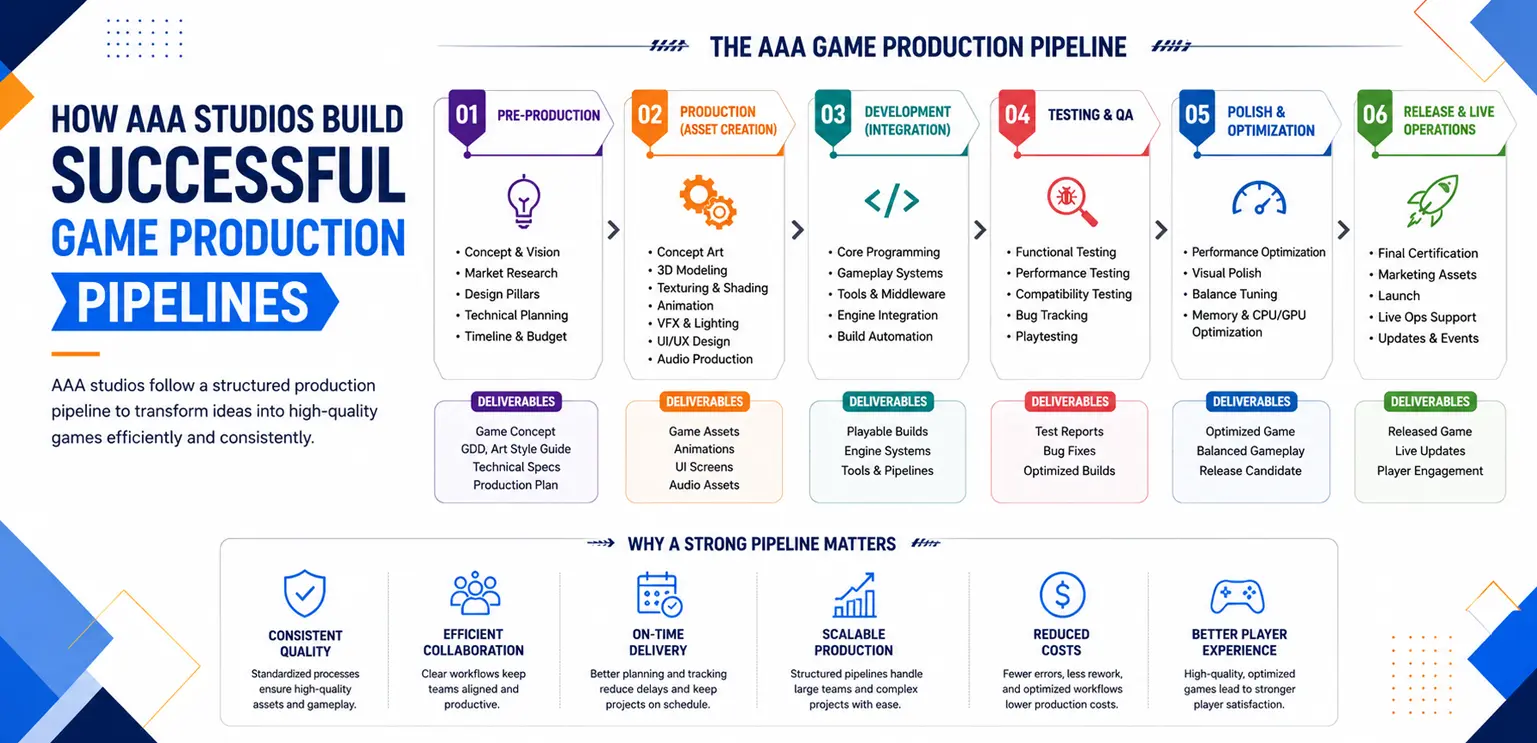
A production pipeline is far more than a project schedule. It is the framework that connects concept artists, game designers, programmers, technical artists, animators, QA engineers, producers, audio teams, and external development partners into a unified workflow. Every asset, feature, and gameplay system moves through this pipeline before reaching players.
Without a structured production process, even the most talented teams struggle with inconsistent quality, missed deadlines, duplicated work, and rising development costs. As game development becomes increasingly complex, building an efficient production pipeline has become one of the most important competitive advantages for modern studios.
This article explores how AAA studios structure their production pipelines, why these workflows are essential for large-scale development, and what independent studios and casino game developers can learn from these proven practices.
What Is a Game Production Pipeline?
A game production pipeline is the complete workflow that transforms an idea into a finished, playable product. It defines how work is planned, created, reviewed, tested, optimized, and delivered across every department.
Rather than treating development as isolated tasks, a production pipeline creates standardized processes that allow teams to collaborate efficiently while maintaining consistent quality. A typical pipeline covers:
- Pre-production planning
- Game design
- Art production
- Programming
- Animation
- Audio implementation
- Quality assurance
- Optimization
- Deployment
- Live Operations support
Every stage has clearly defined responsibilities, review checkpoints, and delivery standards.
Why AAA Studios Invest Heavily in Production Pipelines
AAA games often involve millions of assets, years of development, multiple outsourcing partners, and distributed teams working across different time zones. Managing this level of complexity without structured workflows would be nearly impossible. A strong production pipeline helps studios:
- Maintain consistent quality
- Improve collaboration between departments
- Reduce production bottlenecks
- Scale development efficiently
- Minimize costly revisions
- Deliver predictable production schedules
The larger the project becomes, the more valuable a disciplined production pipeline is.
It Starts with Strong Pre-Production
AAA studios spend significant time in pre-production because early planning reduces risk later in development. Before large-scale production begins, teams define:
- Project vision
- Core gameplay loop
- Art direction
- Technical architecture
- Production milestones
- Team responsibilities
- Platform requirements
This stage ensures that every department works toward shared objectives instead of making conflicting decisions during production. Strong pre-production often determines whether a project remains manageable throughout development.
Standardization Drives Consistency
One of the defining characteristics of AAA pipelines is standardization. Artists, developers, designers, and external partners all follow the same production standards. These standards typically cover:
- File naming conventions
- Folder structures
- Asset specifications
- Version control practices
- Review procedures
- Documentation requirements
Standardization reduces confusion while allowing hundreds of contributors to work efficiently on the same project.
Modular Asset Production Improves Scalability
AAA studios rarely create assets that can only be used once. Instead, they design modular systems that support reuse across multiple environments, characters, interfaces, and gameplay features. Examples include:
- Reusable environment props
- Modular character equipment
- Shared UI components
- Animation libraries
- Material systems
- Visual effect templates
This modular approach reduces production time while maintaining visual consistency.
Collaboration Between Departments Is Continuous
A common misconception is that each department completes its work before handing it to the next team. In reality, AAA production is highly collaborative. Artists regularly communicate with programmers. Designers work alongside technical artists. QA teams provide feedback throughout development rather than only at the end. Successful collaboration depends on:
- Regular production reviews
- Clear documentation
- Shared production goals
- Transparent communication
- Early issue identification
Continuous collaboration prevents small problems from becoming major production challenges.
Technical Art Connects Creativity and Engineering
Technical artists play an increasingly important role in AAA pipelines. They ensure that visual assets remain both artistically impressive and technically efficient. Responsibilities often include:
- Shader development
- Rigging systems
- Pipeline automation
- Asset optimization
- Tool creation
- Engine integration
By bridging the gap between art and engineering, technical artists help improve production speed while maintaining performance targets.
Automation Reduces Repetitive Work
Modern AAA studios automate as many repetitive production tasks as possible. Automation allows developers to spend more time solving creative problems instead of performing manual processes. Automation commonly supports:
- Asset validation
- Build generation
- File organization
- Naming verification
- Testing workflows
- Continuous integration
Automation improves consistency while reducing human error throughout production.
Optimization Begins Early
AAA studios do not wait until the final months of development to address performance. Optimization is integrated into the pipeline from the beginning. Production teams continuously monitor:
- Memory usage
- Rendering performance
- Asset budgets
- Animation efficiency
- Loading times
- CPU and GPU utilization
This proactive approach prevents technical debt from accumulating as projects grow.
Quality Assurance Is Embedded Throughout Production
Testing is no longer viewed as a final production phase. AAA studios integrate QA into nearly every stage of development. Quality assurance evaluates:
- Gameplay functionality
- Technical stability
- Art consistency
- UI behavior
- Platform compatibility
- Performance benchmarks
- Localization accuracy
Early testing reduces expensive revisions and improves production predictability.
External Development Is Part of the Pipeline
Many AAA studios extend their internal teams through strategic outsourcing to meet production demands without sacrificing quality. External teams commonly contribute to:
- Character art
- Environment production
- Animation
- UI/UX
- Technical art
- Quality assurance
- Live Operations content
Rather than operating independently, outsourcing partners become integrated extensions of the internal production pipeline. Studios such as Gamix Labs support this model by delivering engine-ready art, animation, UI/UX, technical development, and production services that align with established studio workflows, enabling clients to scale efficiently while maintaining quality standards.
AI Is Enhancing Modern Production Pipelines
Artificial Intelligence is becoming an increasingly valuable production tool within AAA studios. Rather than replacing creative professionals, AI accelerates repetitive tasks and improves production efficiency. Studios are applying AI to:
- Asset organization
- Prototype generation
- UI/UX analysis
- Automated testing
- Production planning
- Workflow optimization
- Documentation support
The most effective pipelines combine AI-driven automation with experienced human decision-making.
Common Pipeline Mistakes Smaller Studios Should Avoid
Many independent teams struggle because they attempt to imitate AAA visual quality without adopting AAA production discipline. Some common mistakes include:
- Weak documentation
- Inconsistent asset standards
- Delayed optimization
- Poor communication
- Limited version control
- Unstructured review processes
Building a smaller but organized pipeline is often more effective than pursuing unnecessary complexity.
What Casino Game Studios Can Learn from AAA Pipelines
Although casino games differ from narrative AAA titles, many production principles remain identical. Casino developers can benefit from:
- Modular asset libraries
- Standardized animation workflows
- Structured UI production
- Automated testing
- Organized documentation
- Continuous optimization
- Cross-functional collaboration
These practices improve production efficiency while supporting frequent content updates and Live Operations.
Future Trends in Game Production Pipelines
Production pipelines continue evolving as development technologies advance. Several trends are reshaping modern workflows:
- AI-assisted production
- Cloud-based collaboration
- Procedural content creation
- Real-time asset validation
- Cross-engine compatibility
- Automated production analytics
While tools continue to evolve, successful studios remain focused on building structured, scalable, and collaborative production systems.
Strategic Takeaways
AAA production pipelines are designed to solve complexity through organization rather than adding unnecessary processes. The most valuable principles include:
- Invest in thorough pre-production
- Standardize workflows across every department
- Build reusable and modular assets
- Encourage continuous collaboration
- Optimize throughout development
- Integrate QA into the entire pipeline
- Use AI to automate repetitive tasks
- Treat outsourcing as an extension of the internal team
Studios that apply these principles create more predictable production schedules, improve quality, and scale development more effectively.
Conclusion
AAA games are not successful simply because they have larger budgets or bigger teams. Their success is largely driven by disciplined production pipelines that enable thousands of individual tasks to move efficiently from concept to release.
Strong planning, standardized workflows, modular production, continuous optimization, embedded quality assurance, and effective collaboration form the foundation of these pipelines. As game development becomes more ambitious and globally distributed, these practices are becoming increasingly relevant for studios of every size.
Whether developing an open-world AAA title, a mobile game, or a casino platform, adopting production pipeline fundamentals can improve efficiency, reduce risk, and create better experiences for both development teams and players.
Frequently Asked Questions
What is a game production pipeline?
A game production pipeline is the structured workflow used to plan, create, review, optimize, test, and deliver every aspect of a game throughout its development lifecycle.
Why are production pipelines important in AAA development?
They provide a structured workflow that improves collaboration, quality, and development efficiency.
How do AAA studios keep production consistent?
They use standardized documentation, asset guidelines, version control, review processes, and modular workflows across all departments.
Why do AAA studios outsource development?
Outsourcing provides specialized expertise and scalable production capacity while allowing internal teams to focus on core creative and technical priorities.
How does AI improve production pipelines?
AI automates repetitive tasks such as asset organization, testing support, workflow analysis, and documentation, allowing teams to focus on creative work.
Can smaller studios adopt AAA production practices?
Yes. While they may not replicate the scale of AAA studios, smaller teams can benefit from structured planning, standardized workflows, optimization, and effective collaboration.