The Hidden Risks in Game Development Outsourcing And How to Avoid Them
Game development outsourcing has become a fundamental part of modern production. From indie teams building their first title to large publishers managing multiple projects simultaneously, outsourcing allows studios to access specialized talent, accelerate production, and scale more efficiently.
However, while the benefits of outsourcing are widely discussed, the risks often receive far less attention.
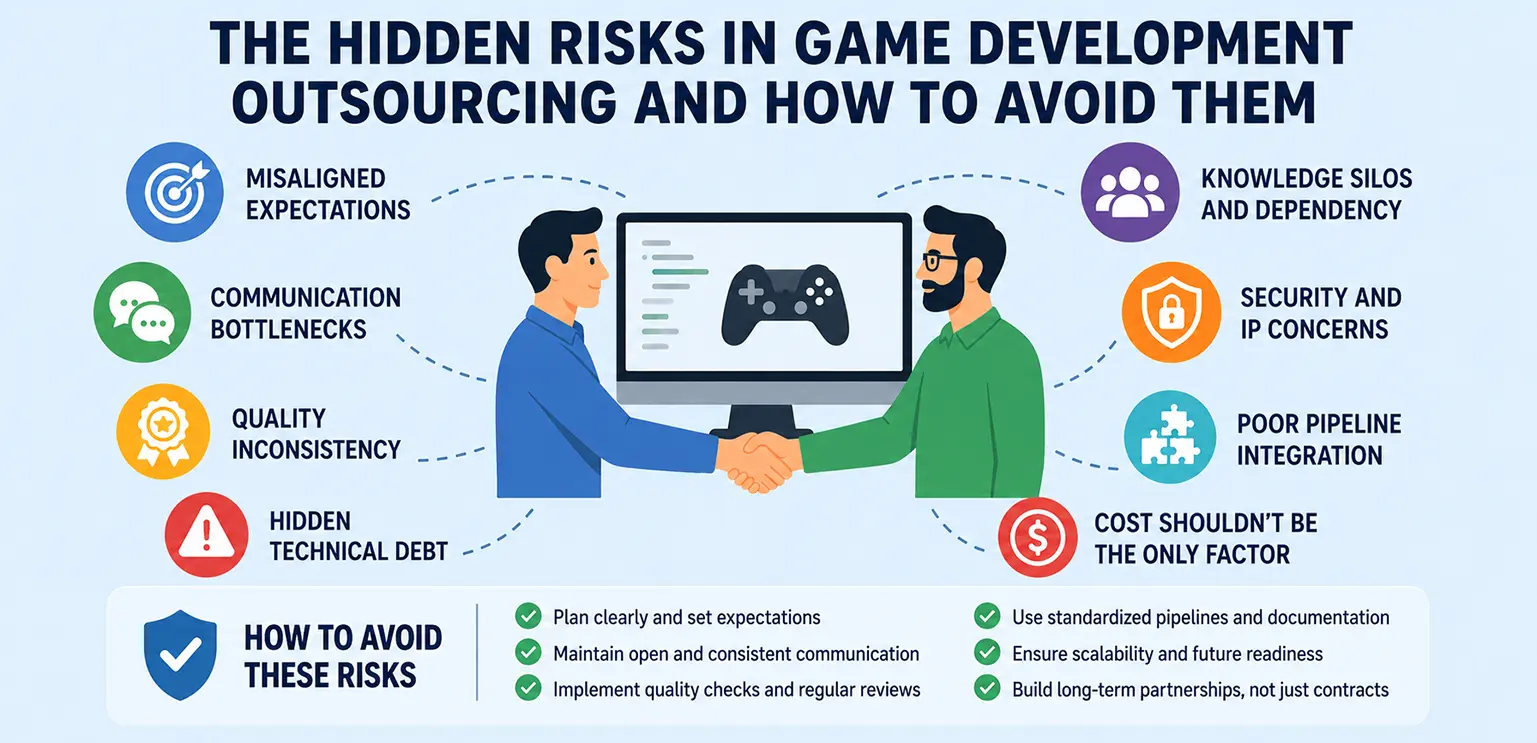
Many outsourcing partnerships begin with optimistic expectations but encounter unexpected challenges that impact schedules, budgets, and product quality. In some cases, the problem is not the outsourcing partner itself. Instead, the issue stems from poor planning, unclear expectations, or production systems that are not designed to support external collaboration.
Understanding these risks before production begins can save studios significant time, money, and operational frustration.
Why Outsourcing Failures Are More Common Than Many Studios Realize
Outsourcing is often presented as a straightforward solution to production bottlenecks. In reality, it introduces an additional layer of complexity into the game development pipeline. Unlike internal teams that operate within established production workflows and communication structures, external partners must be integrated into existing pipelines to ensure alignment, efficiency, and consistent delivery.
The most successful outsourcing relationships are not built on cost savings alone. They are built on structured processes, clear communication, and strong production oversight. Studios that underestimate this reality frequently experience problems that could have been prevented with better planning.
Risk #1: Misaligned Expectations
One of the most common outsourcing failures occurs before production even starts. Studios often assume that external teams understand project goals, quality standards, and production requirements. Unfortunately, assumptions rarely translate into successful execution.
A development partner may interpret requirements differently than intended, leading to assets or systems that technically meet specifications but fail to match expectations. This problem becomes especially common in areas such as:
- Art direction
- UI/UX implementation
- Animation quality
- Technical performance standards
The solution is comprehensive documentation. Clear style guides, visual references, technical specifications, and acceptance criteria reduce ambiguity and improve consistency throughout production.
Risk #2: Communication Bottlenecks
Communication challenges are responsible for a significant percentage of outsourcing failures. As projects grow, communication becomes increasingly complex. Delayed feedback, unclear revision requests, and inconsistent reporting can quickly slow production. The issue becomes even more severe when multiple departments are involved.
For example, an outsourced art team may require feedback from game designers, technical artists, and project managers before an asset can be approved. Without structured communication workflows, review cycles become inefficient and deadlines begin slipping. Successful studios establish regular reporting schedules, milestone reviews, and centralized communication channels to ensure alignment throughout production.
Risk #3: Quality Inconsistency Across Deliverables
Maintaining consistent quality is one of the biggest challenges in outsourced production. Many studios assess outsourcing partners based on portfolio quality. While strong portfolios demonstrate technical capability and artistic expertise, they do not necessarily reflect a team's ability to maintain consistent quality, meet deadlines, or scale effectively across large production cycles. A vendor may produce exceptional initial work but struggle to maintain the same quality under increased production demands.
This risk becomes particularly noticeable in:
- Large asset libraries
- Live Ops content production
- Long-term development partnerships
- Multi-project engagements
The best way to mitigate this issue is through structured review pipelines and incremental validation rather than waiting until final delivery. Quality control should be continuous, not milestone-dependent.
Risk #4: Hidden Technical Debt
Technical debt is often associated with programming, but outsourcing can introduce technical debt across multiple disciplines.
Examples include:
- Poorly optimized assets
- Inconsistent naming conventions
- Weak documentation
- Non-scalable implementation methods
- Engine compatibility issues
These problems may not be immediately visible during production. However, they often create significant maintenance challenges later in development. Studios should establish technical standards before outsourcing begins and conduct regular audits to ensure compliance. Technical oversight is just as important as creative oversight.
Risk #5: Scalability Problems
Many outsourcing partnerships perform well during small projects but struggle when production requirements increase. A vendor capable of producing ten assets per week may not have the infrastructure needed to deliver hundreds of assets across multiple simultaneous projects.
This creates scalability risks that become apparent during:
- Feature expansions
- Live Ops production
- Seasonal content releases
- Multi-title development
Before entering long-term partnerships, studios should evaluate not only current capabilities but also future capacity. A scalable game art outsourcing pipeline should be considered a core selection criterion.
Risk #6: Knowledge Silos and Dependency
Another hidden risk is overreliance on external teams. When critical production knowledge exists only within the outsourcing partner, internal teams can lose visibility into important systems and workflows.
This creates dependency that becomes problematic if:
- Contracts end
- Teams change
- Priorities shift
- Production requirements evolve
To avoid this issue, studios should maintain internal documentation and ensure that knowledge transfer occurs throughout the partnership. Outsourcing should enhance internal production capabilities while ensuring critical project knowledge remains within the studio.
Risk #7: Security and Intellectual Property Concerns
Game development involves valuable intellectual property, proprietary tools, and confidential production data. Without proper safeguards, outsourcing relationships can expose studios to unnecessary risks.
Potential concerns include:
- Asset leaks
- Unauthorized distribution
- Data security vulnerabilities
- Source code exposure
While these issues are relatively uncommon among professional vendors, the consequences can be significant.
Studios should implement:
- Non-disclosure agreements
- Access control policies
- Secure file-sharing systems
- Role-based permissions
Security considerations should be built into the outsourcing framework from the outset rather than addressed after production begins.
Risk #8: Poor Pipeline Integration
Many outsourcing challenges stem from weak production integration rather than poor vendor performance.
When external teams operate separately from internal workflows, issues often emerge in the form of:
- Duplicate work
- Revision overload
- Approval delays
- Production inefficiencies
The most successful studios treat outsourcing partners as extensions of internal teams rather than isolated vendors. This requires shared production tools, clear workflows, and transparent feedback systems. Strong integration reduces friction and improves overall production velocity.
Why Cost Should Not Be the Primary Selection Factor
One of the biggest mistakes studios make is choosing outsourcing partners based primarily on price.
Lower rates may appear attractive initially, but they often introduce hidden costs through:
- Additional revisions
- Project delays
- Quality corrections
- Management overhead
The true cost of outsourcing is determined by production efficiency and reliability, not hourly rates alone.
Experienced studios evaluate partners based on:
- Specialization
- Communication quality
- Technical maturity
- Scalability
- Production compatibility
Long-term value consistently outweighs short-term savings.
Building a Risk-Resistant Outsourcing Strategy
Successful outsourcing is rarely the result of luck. Studios that consistently achieve positive outcomes typically follow a structured approach.
This includes:
- Establishing clear production documentation
- Defining measurable quality standards
- Implementing regular review cycles
- Maintaining transparent communication
- Monitoring technical compliance
- Planning for scalability
These practices create a foundation for predictable and sustainable collaboration. The goal is not eliminating all risk but managing it proactively.
How Modern Studios Approach Outsourcing Differently
The most mature game studios no longer view outsourcing as simple task delegation. Instead, they build integrated production ecosystems where internal and external teams collaborate through shared pipelines. Studios such as Gamix Labs often operate within these models by aligning outsourced production with internal workflows, technical standards, and review systems.
This approach improves consistency while reducing the operational friction that often causes outsourcing failures. The result is a long-term production partnership focused on scalability, consistency, and efficient delivery rather than simple task execution.
The Future of Game Development Outsourcing
As game development becomes increasingly complex, outsourcing will continue evolving.
Future partnerships are likely to involve greater collaboration in areas such as:
- Technical art
- Live Ops management
- Backend development
- Production consulting
- AI-assisted content pipelines
Simultaneously, expectations around communication, transparency, and scalability will continue increasing. Studios that build mature outsourcing frameworks today will be better positioned to leverage these evolving opportunities.
Strategic Takeaways for Developers and Publishers
Outsourcing has become a strategic growth lever for modern game studios seeking to scale production, access specialized expertise, and accelerate development timelines. However, its success depends less on finding external talent and more on creating systems that enable effective collaboration.
Studios should focus on:
- Clear documentation
- Strong communication
- Technical oversight
- Scalable workflows
- Long-term partnership alignment
When these foundations are in place, outsourcing becomes a strategic advantage rather than a production risk.
Conclusion
Game development outsourcing offers tremendous opportunities for scalability, specialization, and production efficiency. Yet it also introduces risks that many studios underestimate. From communication bottlenecks and quality inconsistencies to technical debt and scalability challenges, outsourcing requires active management and structured workflows.
The most successful studios recognize that outsourcing is not simply about reducing workload. It is about building reliable production partnerships that integrate seamlessly into long-term development pipelines. When approached strategically, outsourcing can accelerate growth, improve output quality, and help studios compete more effectively in an increasingly demanding industry.
FAQs
What is the biggest risk in game development outsourcing?
Misaligned expectations and poor communication are among the most common causes of outsourcing failures.
How can studios maintain quality when outsourcing?
By establishing clear standards, conducting regular reviews, and validating work throughout production.
Is outsourcing always cost-effective?
Not necessarily. Long-term value depends on quality, efficiency, and reliability rather than hourly rates.
How can studios avoid technical debt from outsourcing?
Through technical documentation, compliance reviews, and standardized production workflows.
Why is scalability important when selecting an outsourcing partner?
Because production demands often increase over time, requiring partners that can grow alongside the project.
How do successful studios manage outsourcing relationships?
By integrating external teams into shared production pipelines rather than treating them as separate vendors.