How to Design Blockchain Games for Non-Crypto Players Without Friction
Blockchain games have evolved significantly over the past few years, introducing concepts like digital ownership, NFTs, token economies, and decentralized assets. However, despite technological innovation, mainstream adoption still faces one major barrier: complexity.
Most players are not crypto-native. They do not understand wallets, gas fees, seed phrases, or token swaps—and more importantly, they do not want to deal with them.
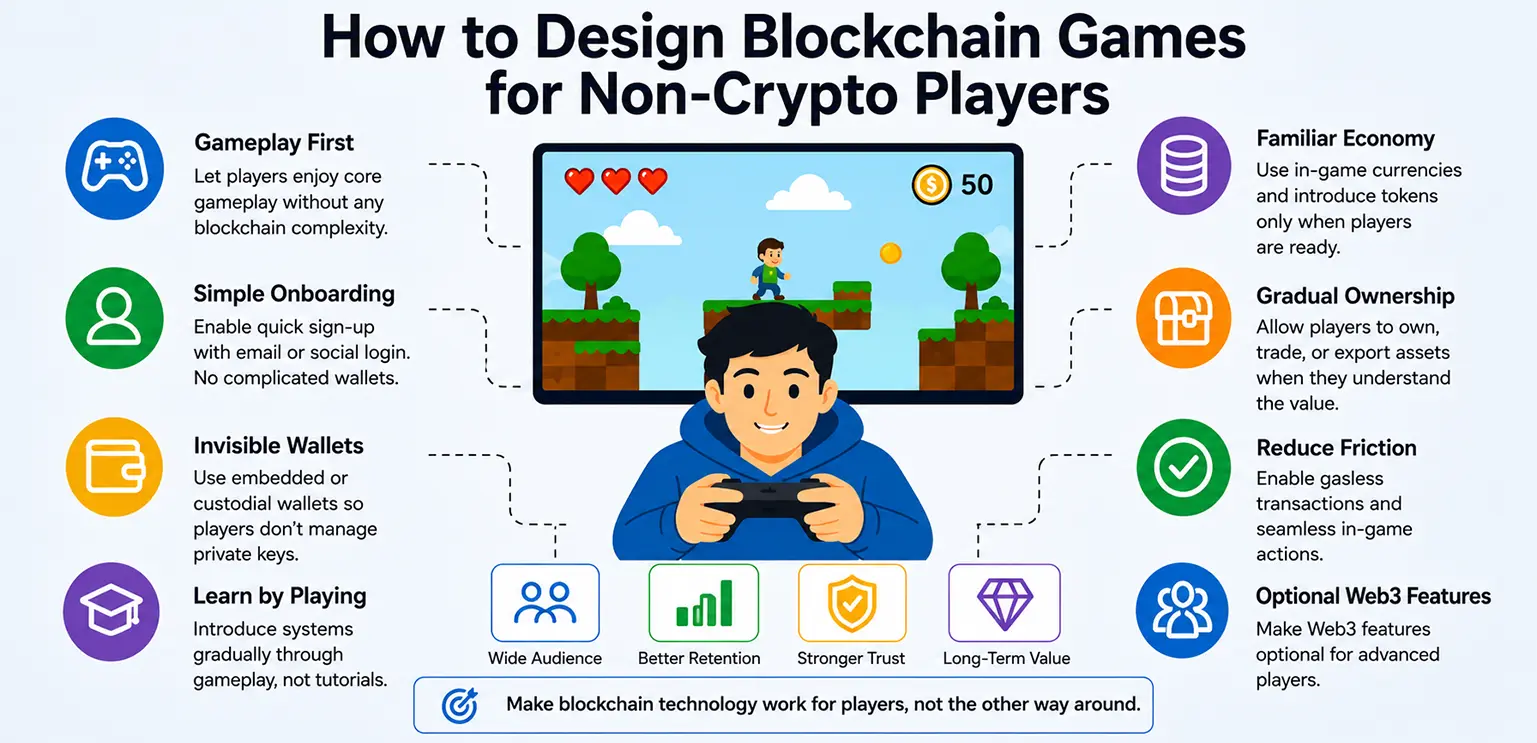
This creates a critical design challenge for developers: how do you build blockchain games that feel completely natural to non-crypto players while still leveraging Web3 infrastructure in the background?
The solution is to make blockchain invisible at first, optional when needed, and gradually introduced through gameplay progression.
Why Non-Crypto Players Avoid Blockchain Games
Before designing for non-crypto users, it is important to understand why they hesitate in the first place. Most friction comes from unfamiliar systems that feel unrelated to gameplay. Players are forced to interact with financial-style interfaces before they even begin playing. Common barriers include:
- Wallet setup complexity
- Confusing onboarding flows
- Fear of losing assets or keys
- Unfamiliar token systems
- Distrust of crypto mechanics
- Extra steps before gameplay starts
If the onboarding experience feels more like a financial application than a game, most users drop off immediately. The goal of modern blockchain game design is to eliminate this perception entirely.
Principle 1: Make Blockchain Invisible at First Touch
The most successful blockchain games do not introduce Web3 concepts immediately. Instead, they prioritize gameplay first and delay blockchain interactions until the player is comfortable. At the initial stage, users should be able to:
- Start playing instantly
- Experience core mechanics without setup
- Progress without wallet creation
- Understand game systems without technical exposure
Blockchain functionality can exist in the background, activated only when needed. This approach mirrors how many successful mobile games handle monetization systems—they are present, but not intrusive.
Principle 2: Simplify or Hide Wallet Complexity
Wallet management is one of the biggest barriers for non-crypto users. Expecting players to manage seed phrases or external wallets creates unnecessary friction. Modern blockchain games solve this by introducing:
- Embedded wallets
- Social login wallets
- Email-based account creation
- Custodial wallet options for beginners
From the user's perspective, the experience should feel identical to signing into a traditional game account. Advanced blockchain interactions can remain hidden until players choose to explore them.
Principle 3: Onboarding Should Feel Like Gameplay, Not Setup
Onboarding is the most critical stage of user retention. In traditional blockchain experiences, onboarding often resembles a technical tutorial. For non-crypto players, this is a major failure point. Instead, onboarding should be designed as part of the gameplay journey. A strong onboarding flow might:
- Introduce mechanics through interactive tutorials
- Unlock features progressively through gameplay
- Delay economic systems until engagement is established
- Reward early actions without requiring wallet interactions
The goal is simple: players should learn by playing, not by reading instructions about blockchain systems.
Principle 4: Separate Gameplay Economy from Blockchain Exposure
One of the most effective design strategies is decoupling gameplay systems from blockchain visibility. In practice, this means:
- Core gameplay uses familiar in-game currencies
- Blockchain assets exist as optional ownership layers
- NFT mechanics are introduced only when relevant
- Token systems are not required for basic progression
This prevents players from feeling overwhelmed while still preserving Web3 functionality for advanced users. The most successful implementations allow players to enjoy the game fully without ever needing to interact with blockchain systems directly.
Principle 5: Use Familiar Game Design Patterns
Non-crypto players already understand traditional game mechanics. Designing blockchain games with familiar structures helps reduce cognitive load. For example:
- Use standard progression systems (levels, XP, rewards)
- Keep UI similar to mainstream mobile games
- Avoid crypto terminology in early gameplay
- Replace technical terms with game-friendly language
Instead of using technical terms like "mint NFT asset," the game can simply say "unlock item." This small change makes the experience feel more natural and significantly improves player accessibility.
Principle 6: Introduce Ownership Gradually
Ownership is a core advantage of blockchain gaming, but it should not be introduced as a requirement from the very start. Instead, it should be introduced progressively:
- Early stage: Players earn items normally
- Mid stage: Items can be upgraded or customized
- Late stage: Ownership options become available (trading, exporting, NFT conversion)
This layered approach allows players to understand value before interacting with blockchain mechanics. By the time they reach advanced features, they already understand the game economy.
Principle 7: Reduce Transaction Friction Completely
One of the biggest challenges in blockchain gaming is transaction complexity. Gas fees, confirmations, and network delays are unacceptable in a seamless gaming experience. Modern design approaches focus on:
- Gas-less transactions
- Batch processing
- Background confirmations
- Pre-approved actions
- Abstracted blockchain interactions
From the player's perspective, actions should feel instant and automatic. Any delay or technical interruption breaks immersion.
Principle 8: Build Player Trust Through Clarity, Not Technical Detail
Non-crypto players often hesitate due to lack of trust. However, trust does not need to come from exposing blockchain mechanics. Instead, it can be built through:
- Clear reward systems
- Transparent progression rules
- Consistent item behavior
- Reliable in-game economies
Players should understand what they gain, not how the backend works. Overexposure to technical details often reduces confidence rather than improving it.
Principle 9: Optional Web3 Features for Advanced Users
Only a portion of players need to engage with blockchain systems. A well-designed game allows Web3 features to remain optional. Advanced users may choose to:
- Trade assets externally
- Connect wallets
- Export items
- Participate in decentralized marketplaces
Meanwhile, casual players can continue playing without ever engaging with these systems. This dual-layer approach significantly expands the target audience.
Principle 10: Ensure Performance and User Experience Meet Web2 Expectations
Non-crypto players expect smooth, polished experiences similar to traditional games. Blockchain integration must not affect:
- Load times
- UI responsiveness
- Gameplay flow
- Visual performance
If blockchain features slow down the experience, adoption will suffer regardless of innovation. Successful studios treat blockchain systems as backend infrastructure, not frontend gameplay components.
The Role of Development Studios in Bridging Web2 and Web3
Building accessible blockchain games requires expertise in both traditional game development and decentralized systems. Modern studios focus on integrating Web3 functionality without exposing its complexity to users.
Development teams such as Gamix Labs often work on architecture that separates gameplay logic from blockchain infrastructure, ensuring that players experience smooth, intuitive gameplay while developers maintain full control over backend systems. This separation is essential for scaling blockchain games to mainstream audiences.
Future of Blockchain Game Design for Mass Adoption
The future of blockchain gaming will likely move away from visible crypto systems and toward invisible infrastructure. We will see:
- Fully abstracted wallets
- Seamless asset ownership systems
- Hybrid economies combining off-chain and on-chain systems
- AI-driven onboarding experiences
- Frictionless cross-platform asset portability
The focus will shift from "using blockchain" to simply "benefiting from it without noticing it."
Strategic Takeaways for Developers
Designing blockchain games for non-crypto players is fundamentally about reducing friction. Successful projects focus on:
- Invisible blockchain integration
- Simplified onboarding
- Familiar game mechanics
- Optional Web3 features
- Seamless UX performance
The goal is not to teach players blockchain—it is to let them enjoy the game while blockchain works silently in the background.
Conclusion
Blockchain gaming has enormous potential, but mass adoption depends on accessibility. Non-crypto players are not resistant to innovation—they are resistant to complexity. The most successful blockchain games will be those that remove friction entirely, allowing players to enjoy gameplay first and discover ownership features naturally over time. By prioritizing user experience over technical exposure, developers can bridge the gap between Web2 familiarity and Web3 innovation, unlocking a much larger global audience.
FAQs
Why do non-crypto players avoid blockchain games?
Because of complex onboarding, wallet setup, and unfamiliar financial systems that feel unrelated to gameplay.
How can blockchain be hidden in games?
By using embedded wallets, backend transactions, social login systems, and simplified UX flows that abstract all technical complexity.
Do players need to understand NFTs to play blockchain games?
No. NFT systems can be completely optional and introduced gradually later in gameplay progression when players are already engaged.
What is the biggest UX challenge in blockchain games?
Wallet and transaction complexity. Gas fees, confirmations, and seed phrase management create significant friction that drives non-crypto players away.
Can blockchain games feel like traditional games?
Yes, if blockchain is fully abstracted and integrated into backend systems without affecting load times, UI responsiveness, or gameplay flow.
What is the key to mass adoption of blockchain games?
Frictionless onboarding and gameplay-first design. Players should be able to start playing immediately without any blockchain setup requirements.