Multi-Currency Slot Games for Global Casino Platforms
Introduction: Why Multi-Currency Support Is Now Essential for Slot Games
The modern iGaming industry is no longer limited to a handful of regional markets. Today's slot games launch simultaneously across multiple jurisdictions, serving players from Europe, North America, Asia, and emerging regulated markets worldwide.
This global expansion creates a major technical challenge for developers: slot games must support multiple currencies seamlessly. A player in Sweden might play using SEK, while another in Canada uses CAD, and a player in the UK uses GBP, all within the same game.
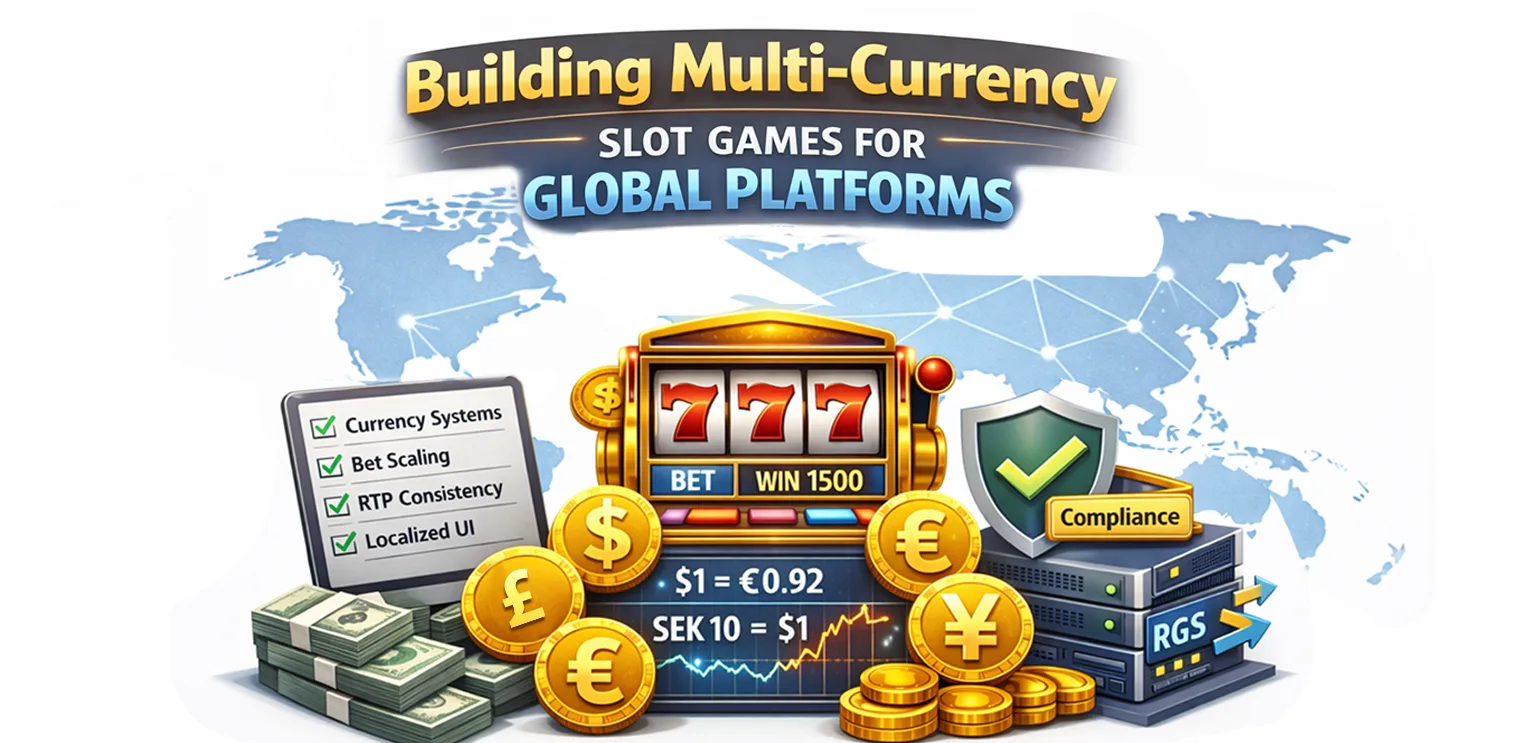
For game studios and platform providers, this means the slot engine must handle:
- Multiple currency systems
- Localized bet values
- Accurate payouts
- Regulatory requirements across jurisdictions
Without proper architecture, multi-currency support can create issues such as:
- Inconsistent RTP behavior
- Confusing UI displays
- Compliance risks
- Incorrect payout calculations
Building a robust multi-currency system is therefore a critical part of global slot game development.
This article explores how experienced studios design slot games that support multiple currencies while maintaining consistent gameplay, accurate math models, and regulatory compliance.
The Growing Need for Multi-Currency Slot Games
The expansion of regulated markets has dramatically increased the demand for flexible currency systems. Modern slot games may operate in:
- UK Gambling Commission markets
- Malta Gaming Authority platforms
- Ontario regulated casinos
- US state-based casinos
- Asian and Latin American operators
Each region uses different currencies and betting conventions. Examples include:
| Region | Currency |
|---|---|
| United Kingdom | GBP |
| Europe | EUR |
| Sweden | SEK |
| Canada | CAD |
| United States | USD |
| Japan social casinos | Virtual coins |
A single slot title may need to support dozens of currencies simultaneously. This makes multi-currency architecture a core component of the game engine.
Core Components of a Multi-Currency Slot System
A successful multi-currency slot game relies on several interconnected systems. These systems must work together while preserving the core gameplay experience.
Key components include:
- Currency management systems
- Bet scaling frameworks
- Payout calculation systems
- Localized UI displays
- Platform integration layers
Let's explore how these components function.
Currency Configuration and Bet Scaling
The first challenge developers face is bet scaling. Players expect bets that feel natural within their currency.
For example:
| Currency | Typical Bet |
|---|---|
| USD | $0.20 to $100 |
| GBP | £0.20 to £100 |
| SEK | 2 to 1000 SEK |
Simply converting currencies directly can produce awkward values such as:
- 0.17 EUR
- 1.83 CAD
Instead, developers usually define currency-specific bet tables.
Example configuration:
| USD | EUR | SEK |
|---|---|---|
| 0.20 | 0.20 | 2 |
| 0.40 | 0.50 | 5 |
| 1.00 | 1.00 | 10 |
| 2.00 | 2.50 | 20 |
This approach ensures betting options feel natural to players.
Ensuring Consistent RTP Across Currencies
A major concern when implementing multi-currency systems is RTP consistency. RTP (Return to Player) must remain mathematically accurate regardless of currency. If conversion errors occur, the game could unintentionally offer different payout rates across markets.
To prevent this, developers base RTP calculations on internal credit units rather than real-world currency values.
🔹 Example system
1 credit = base math unit
Currency mapping:
| Currency | Credit Value |
|---|---|
| USD | $0.01 |
| EUR | €0.01 |
| SEK | 0.10 SEK |
The game engine calculates all payouts using credits, ensuring the math model remains stable. Currency values are applied only when displaying results to players.
Handling Exchange Rates in Casino Platforms
Casino platforms rarely perform real-time currency conversion inside the game itself. Instead, they rely on fixed conversion configurations or internal platform currency systems. However, developers sometimes test equivalencies when designing bet levels or payout scales.
For example, studios may check how a base bet compares across markets.
Example comparison:
| Market | Value |
|---|---|
| US Dollar | $1.00 |
| Euro | €0.87 |
Such comparisons help developers ensure bet tiers remain balanced globally. In most real-money casino platforms, the operator ultimately handles the currency wallet and conversion logic.
Integrating Multi-Currency Systems with Remote Gaming Servers
Slot games typically run on Remote Gaming Servers (RGS) provided by game studios or aggregators. The RGS handles communication between the game and the casino platform.
When a player launches a slot game, the RGS receives information such as:
- Player ID
- Selected currency
- Bet limits
- Jurisdiction rules
The game client then adjusts its configuration accordingly.
Key steps include:
- Operator sends player currency to the game
- Game loads correct bet configuration
- UI updates with localized currency symbols
- Payout calculations remain credit-based internally
This architecture allows a single game build to support many markets.
Designing Currency-Aware UI Systems
Multi-currency games must display values clearly to players. UI designers must consider several challenges.
🔹 Currency Symbols
Different currencies use different symbols:
| Dollar | Euro | Pound | Yen |
|---|---|---|---|
| $ | € | £ | ¥ |
Symbols must be displayed correctly across:
- Win messages
- Bet buttons
- Balance displays
- Paytables
🔹 Number Formatting
Different regions format numbers differently.
Examples:
- United States = 1,000.50
- Europe = 1.000,50
Localization systems must handle these variations automatically.
🔹 Responsive Layouts
Some currencies require longer values.
For example:
- €1000.00 versus ¥100000
UI layouts must accommodate these differences without breaking visual design. Studios that specialize in slot UI production, such as Gamix Labs, often design scalable UI frameworks that adapt to multiple currencies while maintaining consistent visual balance across the interface.
Compliance and Regulatory Considerations
Multi-currency support also involves regulatory compliance. Some jurisdictions impose restrictions such as:
- Maximum bet limits
- Minimum bet requirements
- Jackpot limits
For example:
| Market | Max Bet |
|---|---|
| UK | £5 (in some regulated contexts) |
| Sweden | Operator-defined |
| Ontario | Varies by operator |
The game must enforce these limits dynamically based on jurisdiction. This means currency logic must integrate with compliance configuration systems.
Supporting Virtual Currencies and Social Casinos
Multi-currency design becomes even more complex when games operate across:
- Real-money casinos
- Social casino platforms
- Promotional demo modes
In social casinos, currencies often include:
- Virtual coins
- Diamonds
- Credits
These currencies may not follow traditional financial conversions. Developers often implement separate currency systems for social casino environments.
Testing Multi-Currency Slot Games
Testing multi-currency functionality requires extensive QA coverage.
Typical test scenarios include:
- Bet switching across currencies
- Payout accuracy
- Jackpot calculations
- Localization formatting
- UI alignment issues
Automated testing tools can simulate gameplay across different currency configurations. Certification labs also review these systems to ensure they comply with regulatory standards.
Common Mistakes When Building Multi-Currency Slots
Several mistakes frequently cause issues in global slot deployments.
🔹 Hardcoded Currency Values
Games should never hardcode specific currency values.
🔹 Mixing Currency with Math Calculations
All math should use internal credit units.
🔹 Ignoring Localization Rules
Incorrect number formatting can confuse players.
🔹 UI Overflow Issues
Large currency values may break UI layouts.
Avoiding these problems requires strong system architecture from the beginning.
Future Trends in Global Slot Currency Systems
Multi-currency support will become even more important as the iGaming industry expands. Several trends are shaping the future.
🔹 Cryptocurrency Integration
Some platforms are exploring support for:
- Bitcoin
- Ethereum
- Stablecoins
These systems introduce new complexities such as volatility and blockchain wallets.
🔹 Dynamic Currency Scaling
Future slot engines may dynamically adjust bet ranges based on regional player behavior.
🔹 Cross-Platform Wallets
Unified player wallets may allow seamless gameplay across multiple casino platforms. As these systems evolve, currency architecture will become an increasingly important part of slot development.
Conclusion
Building multi-currency slot games is essential for studios targeting global casino platforms.
Successful implementations require careful design across multiple systems, including:
- Currency configuration frameworks
- Bet scaling systems
- UI localization pipelines
- Platform integrations
- Compliance rules
When designed correctly, a multi-currency architecture allows a single slot game to operate seamlessly across dozens of markets. For game studios expanding into regulated international markets, mastering multi-currency systems is not just a technical challenge; it is a key step toward global scalability.
FAQ: Multi-Currency Slot Games
What is a multi-currency slot game?
A multi-currency slot game supports multiple real-world or virtual currencies, allowing players from different regions to play using their local currency.
How do slot games maintain RTP across different currencies?
Developers use internal credit systems to calculate payouts. Currency values are applied only when displaying bets and winnings.
Do slot games convert currencies in real time?
Usually not. Casino platforms manage player wallets and currency conversions, while the game simply receives the selected currency configuration.
Why are currency-specific bet tables necessary?
Different currencies require different betting increments to ensure values feel natural to players and comply with local regulations.
Do multi-currency slot games require additional certification?
Yes. Certification labs verify that payout calculations remain accurate across all supported currencies.
Can slot games support both real and virtual currencies?
Yes. Many games operate across real-money casinos and social casino platforms using separate currency systems.