Slot Game Certification Workflow for Regulated Markets
Introduction: Why Certification Is the Hidden Gatekeeper of the iGaming Industry
For slot game developers, creativity is often the most visible part of the job: designing themes, building engaging mechanics, and crafting visually compelling slot experiences. But in regulated markets, creativity alone does not get a game to market. Certification does.
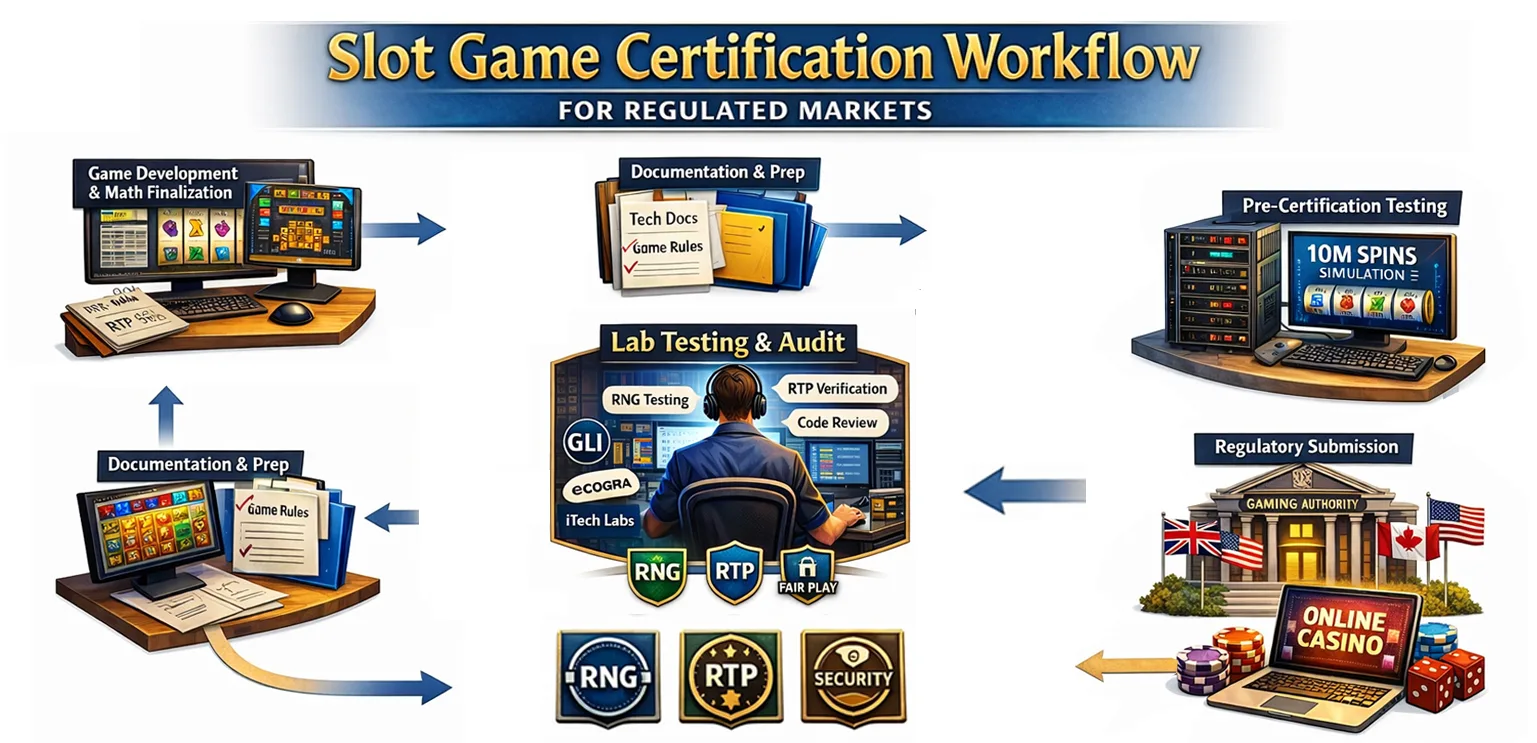
A beautifully designed slot game with polished animations and a sophisticated math model still cannot launch in jurisdictions like the UK, Ontario, Malta, or New Jersey unless it passes strict certification audits performed by independent testing laboratories.
These audits verify everything from:
- RNG randomness
- RTP accuracy
- Volatility curves
- Security integrity
- Regulatory compliance
- Responsible gaming mechanics
Independent testing labs such as Gaming Laboratories International, iTech Labs, and eCOGRA run statistical simulations and technical reviews to ensure games operate fairly and transparently. For game studios, certification is more than a compliance requirement; it directly impacts time-to-market, development cost, and scalability across jurisdictions.
This article explores the complete slot game certification workflow, including the real processes studios go through when launching games in regulated markets.
The Growing Importance of Certification in Modern iGaming
The global iGaming landscape has changed dramatically over the last decade. Instead of operating in loosely regulated offshore environments, most successful slot studios now target regulated jurisdictions such as:
- UK
- Ontario
- New Jersey
- Spain
- Sweden
- Denmark
- Malta
- Australia
These markets enforce strict requirements to protect:
- Player fairness
- Tax reporting accuracy
- Game integrity
- Responsible gambling controls
Certification verifies that slot games meet these standards.
Regulators require independent testing labs to verify key technical elements, such as:
- Random Number Generator integrity
- Return-to-Player calculations
- Security protections
- Accounting accuracy
- Responsible gaming features
Without certification, a slot game cannot legally operate in licensed markets.
What Exactly Gets Certified in a Slot Game?
Many developers assume certification only involves RNG testing. In reality, modern slot certification evaluates the entire game system.
Typical certification coverage includes:
🔹 Random Number Generator (RNG)
The RNG ensures each spin is unpredictable and statistically fair. Labs test RNG systems using millions of simulated spins to confirm:
- Unpredictability
- Statistical randomness
- Independence between spins
🔹 Return to Player (RTP)
Certification verifies that the actual payout percentage matches the advertised RTP.
Example: if a slot advertises 96% RTP, simulations must demonstrate long-term returns consistent with this value.
🔹 Game Mathematics
Labs analyze:
- Paytable distribution
- Volatility curves
- Feature triggers
- Bonus round probabilities
🔹 Game Logic
The source code is reviewed to confirm:
- Rules are implemented correctly
- Features cannot be exploited
- No hidden manipulations exist
🔹 Security Architecture
Testing ensures:
- Encryption protocols work
- Backend systems cannot be manipulated
- Administrative tools are protected
🔹 Responsible Gaming Mechanics
Modern regulations require features such as:
- Session limits
- Autoplay restrictions
- Loss limits
Some jurisdictions even require player activity tracking systems integrated into the game platform.
The Real Slot Game Certification Workflow
While every testing lab has its own processes, most slot games follow a similar certification pipeline. Below is the typical workflow used by studios launching regulated games.
Step 1: Game Development and Math Model Finalization
Certification cannot begin until the core math model is finalized.
🔹 This includes documentation such as:
- PAR sheet (Probability Accounting Report)
- RTP configuration
- Volatility settings
- Reel strip definitions
- Feature probability tables
Studios typically run large-scale simulations (10M to 100M spins) to validate math stability before submitting the game for certification.
🔹 Running simulations internally helps detect:
- Unintended payout spikes
- Incorrect feature triggers
- RTP drift
Skipping this stage often leads to failed certification tests later.
Step 2: Preparing Technical Documentation
Testing labs require extensive documentation before reviewing the game.
🔹 Typical submission packages include:
Game documentation:
- Game rules
- Paytables
- Feature explanations
- Player interface behavior
Mathematical documentation:
- RTP calculations
- Probability models
- Feature frequency
Software documentation:
- Architecture diagrams
- RNG design
- Security specifications
Platform integration details:
- RGS communication
- API documentation
- Server-side controls
Incomplete documentation is one of the most common reasons certification projects are delayed.
Step 3: Pre-Certification Testing
Experienced studios rarely send games directly to certification labs. Instead, they run pre-certification validation internally.
🔹 This includes:
- RNG test simulations
- Math model stress tests
- Payout distribution verification
- Feature trigger testing
Many studios build internal compliance pipelines to ensure games meet lab expectations before submission. This stage significantly reduces certification failures.
Step 4: Independent Lab Testing
Once the game is submitted, a third-party testing lab performs detailed audits.
🔹 Major testing labs include:
- Gaming Laboratories International
- iTech Labs
- BMM Testlabs
- eCOGRA
🔹 These labs verify compliance against technical standards such as:
- GLI-11 (gaming devices)
- GLI-19 (interactive gaming)
- Jurisdiction-specific regulations
🔹 Typical testing activities include:
- RNG statistical analysis: labs run millions of spins to test randomness distribution.
- Code review: developers may need to provide access to compiled binaries, source code, and configuration files.
- Game logic verification: auditors confirm paytable logic works correctly and feature triggers behave as expected.
- RTP verification: labs simulate long-term gameplay to confirm RTP accuracy.
Testing typically takes 4 to 12 weeks depending on complexity.
Step 5: Certification Report Issuance
If the game passes testing, the lab issues a certification report.
This report includes:
- RNG certification confirmation
- RTP verification
- Volatility analysis
- Compliance approval
Operators and regulators rely on this report to approve game deployment.
Step 6: Regulatory Submission
The next step is submitting certification results to regulators.
🔹 Examples of regulators include:
- UK Gambling Commission
- Malta Gaming Authority
- Ontario iGaming Authority
- Nevada Gaming Control Board
🔹 Regulators review:
- Certification reports
- Game documentation
- Platform compliance
Approval times vary by jurisdiction. Some markets require separate approvals for each game version.
Step 7: Deployment to Regulated Operators
After regulatory approval, the game can be deployed via:
- Remote Gaming Servers (RGS)
- Aggregator platforms
- Direct operator integrations
Some RGS platforms are themselves certified to simplify game approvals.
Real Studio Example: Multi-Market Certification Strategy
Consider a mid-sized slot studio launching a new title in:
- UK
- Sweden
- Ontario
- New Jersey
Instead of certifying separate builds for each region, the studio might use a modular certification strategy.
Approach:
- Core game logic certified once
- Jurisdiction-specific configurations added later
Examples of configuration changes:
| Market | Max Bet | Autoplay | Bonus Buy |
|---|---|---|---|
| UK | £5 | Disabled | Restricted |
| Sweden | Unlimited | Limited | Allowed |
| Ontario | Unlimited | Allowed | Allowed |
This modular strategy reduces retesting costs and speeds up deployment.
Common Certification Challenges for Game Developers
Certification is rarely smooth for first-time studios. Typical problems include:
- Poor math documentation: labs need detailed probability models.
- RNG architecture issues: improper seeding or predictable patterns will fail testing.
- Feature logic bugs: incorrect feature triggers are common.
- Platform incompatibility: RGS integration errors often cause delays.
- Inconsistent RTP configuration: multiple RTP profiles must remain mathematically stable.
A single issue can push certification timelines back several weeks or months.
Design Best Practices for Certification-Friendly Slot Development
Experienced studios design games with certification in mind from the start. Best practices include:
🔹 Build Modular Game Engines
Modular architectures allow:
- RTP switching
- Volatility configuration
- Jurisdiction-specific restrictions
🔹 Document Math Early
Maintain updated:
- PAR sheets
- Probability tables
- Feature distributions
🔹 Automate Simulation Testing
Automated testing pipelines can simulate:
- Millions of spins
- Edge case scenarios
- Feature combinations
🔹 Separate Art and Logic Layers
Studios specializing in slot production, such as Gamix Labs, often maintain separate pipelines for art production and game logic, ensuring that visual assets like symbols, UI animations, and bonus effects can evolve without disrupting certified math engines. This separation reduces the need for recertification when visual updates occur.
🔹 Maintain Version Control for Certification
Certification applies to specific software versions. Every change requires careful tracking to avoid compliance issues.
The Future of Slot Certification
Certification is evolving rapidly as iGaming expands globally. Key trends shaping the future include:
🔹 Continuous Compliance Monitoring
New regulatory standards require ongoing RNG monitoring rather than one-time certification. Labs may request automated reporting systems that monitor RNG output in real time.
🔹 Multi-Jurisdiction Certification Portability
Studios increasingly seek certification reuse across markets to reduce time to market. Some regulators accept lab reports from other jurisdictions.
🔹 AI-Driven Game Audits
Future certification processes may use AI models to detect anomalies in:
- RNG distributions
- Payout volatility
- Gameplay patterns
🔹 Faster Certification Pipelines
Studios are building internal compliance frameworks to reduce testing cycles and launch games faster.
Conclusion
Slot game certification is one of the most critical and least visible parts of launching games in regulated markets. Behind every successful slot launch lies a complex workflow involving:
- Math validation
- RNG testing
- Independent lab audits
- Regulatory approvals
For studios aiming to scale globally, understanding this certification pipeline is essential.
The most successful developers treat certification not as a final hurdle, but as a core part of the development process.
By designing games with compliance in mind from the beginning, studios can reduce delays, lower certification costs, and launch games faster across multiple regulated markets.
FAQ: Slot Game Certification
What is slot game certification?
Slot game certification is the process of verifying that a casino game meets regulatory standards for fairness, randomness, and security. Independent testing labs audit the game's RNG, RTP, and game logic before it can launch in regulated markets.
Which organizations certify slot games?
Major certification bodies include Gaming Laboratories International (GLI), iTech Labs, eCOGRA, and BMM Testlabs. These independent labs test game software and issue compliance reports required by regulators.
How long does slot game certification take?
Certification typically takes 4 to 12 weeks, depending on game complexity and documentation quality. Modifications to existing certified games may take 4 to 6 weeks.
What is RNG certification in slot games?
RNG certification verifies that the random number generator used in a slot game produces unpredictable and statistically random outcomes. Testing labs run millions of simulations to confirm randomness distribution.
Can one certification work in multiple markets?
Sometimes. Some jurisdictions accept certifications from recognized labs, allowing studios to reuse test results across markets. However, additional market-specific approval may still be required.
What happens if a slot game fails certification?
The developer must fix the issues identified during testing, resubmit the game, and undergo another round of testing. This can delay launch timelines significantly.