Concept Art vs Production Design in Game Studios
Most game studios do not struggle because of a lack of talent. They struggle because of pipeline misalignment. One of the most overlooked causes is the confusion between concept art and production design.
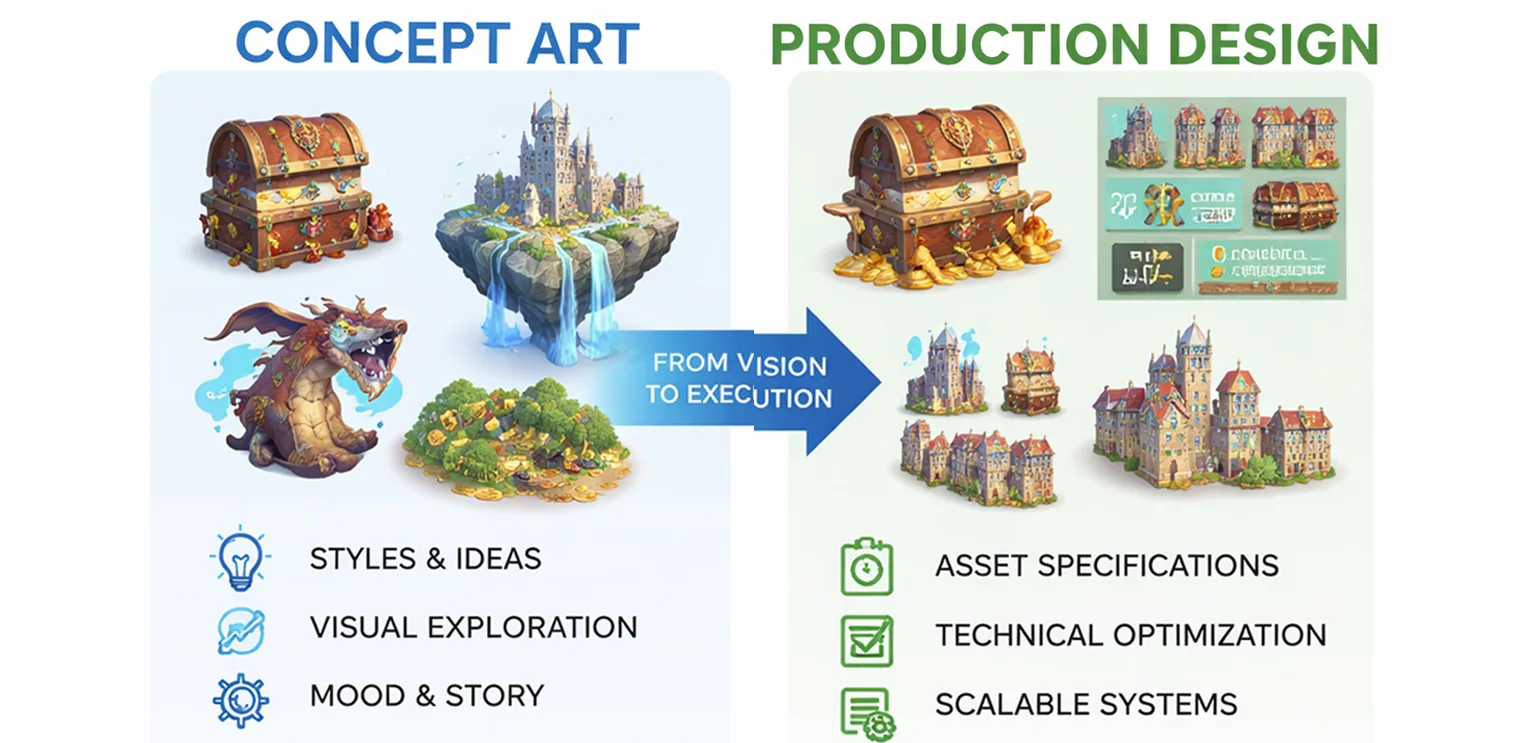
On the surface, both seem part of the same art process. But in reality, they serve completely different purposes. When this distinction is not clear, teams end up with stunning visuals that are impossible to scale or efficient assets that feel generic and forgettable.
In today’s market, where games are constantly updated, localized, and expanded, this gap becomes a serious production risk. Understanding how concept art and production design interact is no longer optional. It is a strategic requirement for building scalable, high-performing games.
Industry Context: Why This Matters More in Live Ops and Slot Games
Modern game development has shifted from one-time releases to continuous delivery. This is especially true in:
- Mobile games
- Social casino platforms
- Slot games with frequent content drops
In these environments, art is not created once. It is produced repeatedly, often under tight deadlines. A single slot game theme might require:
- 10 to 15 symbols
- Multiple animation states
- UI variations
- Promotional assets
Now multiply that across multiple themes, markets, and seasonal updates. Concept art alone cannot support this scale. What studios need is a repeatable production system, and that is where production design becomes critical.
Concept Art: Defining Vision Without Constraints
Concept art is the starting point of visual development. It exists to explore ideas, push creative boundaries, and define the emotional tone of a game. At this stage, the goal is not efficiency. It is clarity of vision.
Concept artists focus on:
- Mood, lighting, and atmosphere
- Style exploration and variations
- Visual storytelling
- Thematic consistency
They answer questions like:
- What makes this game visually unique?
- What emotional response should players feel?
- How do we differentiate from competitors?
Importantly, concept art operates without production constraints. It is intentionally ambitious.
A symbol in a slot game, for example, might be designed with layered lighting effects, intricate textures, and fine detail that looks perfect in a static image but may not yet be suitable for real-time rendering. That is not a flaw. That is the purpose.
Production Design: Turning Vision Into Scalable Systems
Production design begins where concept art ends. Its job is to translate creative ideas into assets that can be built, optimized, reused, and scaled. This is where constraints are introduced, not to limit creativity, but to make it viable.
Production design defines:
- Asset dimensions and formats
- Texture budgets and memory limits
- Animation systems and states
- UI consistency rules
- Modular design frameworks
If concept art answers what should this look like, production design answers:
- How will this be built?
- How will it perform on target devices?
- How quickly can we produce variations?
- Can this system support future updates?
In a production environment, especially in Unity-based games, this often includes decisions like:
- Using sprite atlases instead of individual textures
- Limiting animation frames for performance
- Standardizing symbol layouts across themes
These decisions directly impact cost, speed, and scalability.
The Real Difference: A Production Perspective
The difference between concept art and production design becomes clear when viewed through actual development workflows.
Concept art is about possibility. Production design is about repeatability.
Concept art is exploratory and often one-off. Production design is systematic and built for scale.
Concept art inspires the team. Production design aligns the team.
This distinction is not theoretical. It affects how teams allocate time, budget, and resources.
A Real Production Scenario: From Concept to Game Asset
Let us walk through a simplified but realistic pipeline example from a slot game project. A concept artist designs a premium symbol for a fantasy-themed slot. The design includes:
- High-detail gold textures
- Soft glow effects
- Layered shadows and highlights
The image looks visually rich and defines the aesthetic direction.
When this moves into production, several transformations happen.
First, the asset is resized to fit a fixed grid system, often something like 512x512 or 1024x1024 depending on the game’s resolution strategy.
Next, lighting effects are simplified or baked into textures to reduce runtime cost. Instead of dynamic lighting, artists simulate depth using gradients and highlights.
Then the symbol is prepared for animation. Instead of continuous effects, it is broken into defined animation states such as idle, win, and highlight, each with controlled frame counts.
Finally, the asset is packed into a sprite atlas for efficient rendering in the engine.
What started as a visually rich concept becomes a performance-optimized, reusable asset.
Studios with mature pipelines, such as teams like Gamix Labs, approach this transformation systematically. They ensure that the essence of the concept is preserved while aligning with production realities like memory budgets and animation constraints. This is where production design proves its value.
Where Studios Go Wrong
Even experienced teams make mistakes when these roles are not clearly separated.
One common issue is over-investing in concept art without validating production feasibility. This leads to rework when assets cannot be implemented efficiently. Another problem is skipping proper production design altogether. Teams jump directly from concept to asset creation without defining systems. The result is inconsistency across assets and slower production over time.
There is also the risk of introducing constraints too early. If production limitations dominate during the concept phase, the final visuals often feel generic and fail to stand out in a competitive market. These issues are not minor. They directly affect timelines, costs, and player perception.
Pipeline Thinking: How Work Should Flow
High-performing studios treat concept art and production design as connected stages within a structured pipeline. The flow typically looks like this:
- Concept exploration defines the visual direction.
- This is followed by style guides that lock key visual rules.
- Production design then translates these into technical specifications.
- Assets are created based on these specifications.
- Finally, assets are integrated, tested, and optimized in the engine.
This pipeline ensures that creativity is preserved while maintaining production efficiency. The key is not to isolate these stages, but to create feedback loops between them. If production constraints require changes, those insights should inform future concepts.
Decision Framework: When to Prioritize Each
Studios often ask where they should invest more, concept art or production design.
The answer depends on the project stage and goals.
During early development or when creating a new IP, concept art should take priority. This is where differentiation happens.
During scaling phases, such as Live Ops or multi-theme slot production- production design becomes more critical. Efficiency and consistency matter more than exploration.
For most successful studios, the balance shifts over time. Early stages are concept-heavy. Later stages become production-driven. Recognizing this shift is essential for resource planning.
Technical Depth: Why Production Design Impacts Performance
Production design is not just about workflow. It directly affects technical performance.
Poorly optimized assets can increase memory usage, slow down rendering, and cause frame drops, especially on mobile devices.
For example, using multiple high-resolution textures instead of a single atlas increases draw calls. Overly complex animations can impact CPU and GPU performance.
Production design ensures that assets are built within defined budgets. It aligns art decisions with engine capabilities, particularly in environments like Unity where optimization is critical. This is why production design often involves technical artists who understand both art and engineering constraints.
Best Practices for Studios
Studios that consistently deliver high-quality games at scale follow a few core principles.
They involve production designers early in the concept phase, not to limit creativity, but to guide feasibility. They document everything clearly, from style guides to asset specifications, reducing ambiguity across teams.
They also design assets with reuse in mind. Instead of creating everything from scratch, they build systems that support variations and extensions. Most importantly, they treat concept art and production design as equal contributors to the final product.
Future Trends: More Integration, Not Replacement
As tools evolve, the relationship between concept art and production design is becoming more integrated.
Real-time engines allow artists to test ideas directly in-game. AI tools are accelerating concept exploration. Procedural systems are enabling scalable asset generation.
However, these advancements do not eliminate the need for structure. If anything, they increase the importance of having a clear pipeline. Faster tools can amplify inefficiencies just as easily as they improve productivity. Studios that succeed will be those that combine creativity with strong production systems.
Conclusion
Concept art and production design are not interchangeable. They are interdependent. Concept art defines the vision. Production design makes that vision possible at scale.
For studios working in fast-paced, content-heavy environments like slot games and mobile platforms, this distinction is critical. Because the real challenge is not just creating great visuals.
It is creating them consistently, efficiently, and in a way that supports long-term growth.
Frequently Asked Questions
What is the main difference between concept art and production design?
Concept art focuses on visual exploration and defining style, while production design focuses on creating scalable, production-ready assets.
Can concept art be directly used in games?
No. Concept art usually needs to be adapted to meet technical constraints like performance, resolution, and animation systems.
Why is production design important in slot games?
Slot games require repeated asset creation across themes, making scalability and consistency essential for efficient production.
Who is responsible for production design in a studio?
Production design is typically handled by technical artists, art leads, or dedicated production designers.
How do studios balance creativity and technical constraints?
By involving production designers early and maintaining collaboration between concept artists and development teams.
When should studios focus more on concept art?
During early stages or when developing a new visual identity or IP.
When does production design become more important?
During scaling phases, Live Ops updates, and when producing large volumes of content efficiently.