Pay-to-Play vs Play-to-Earn Games: Key Differences Explained
From premium titles to free-to-play systems, each model defines not just how revenue is generated—but how players engage, progress, and stay invested. Today, the industry is seeing a sharp contrast between two models that operate on fundamentally different philosophies: pay-to-play (P2P) and play-to-earn (P2E).
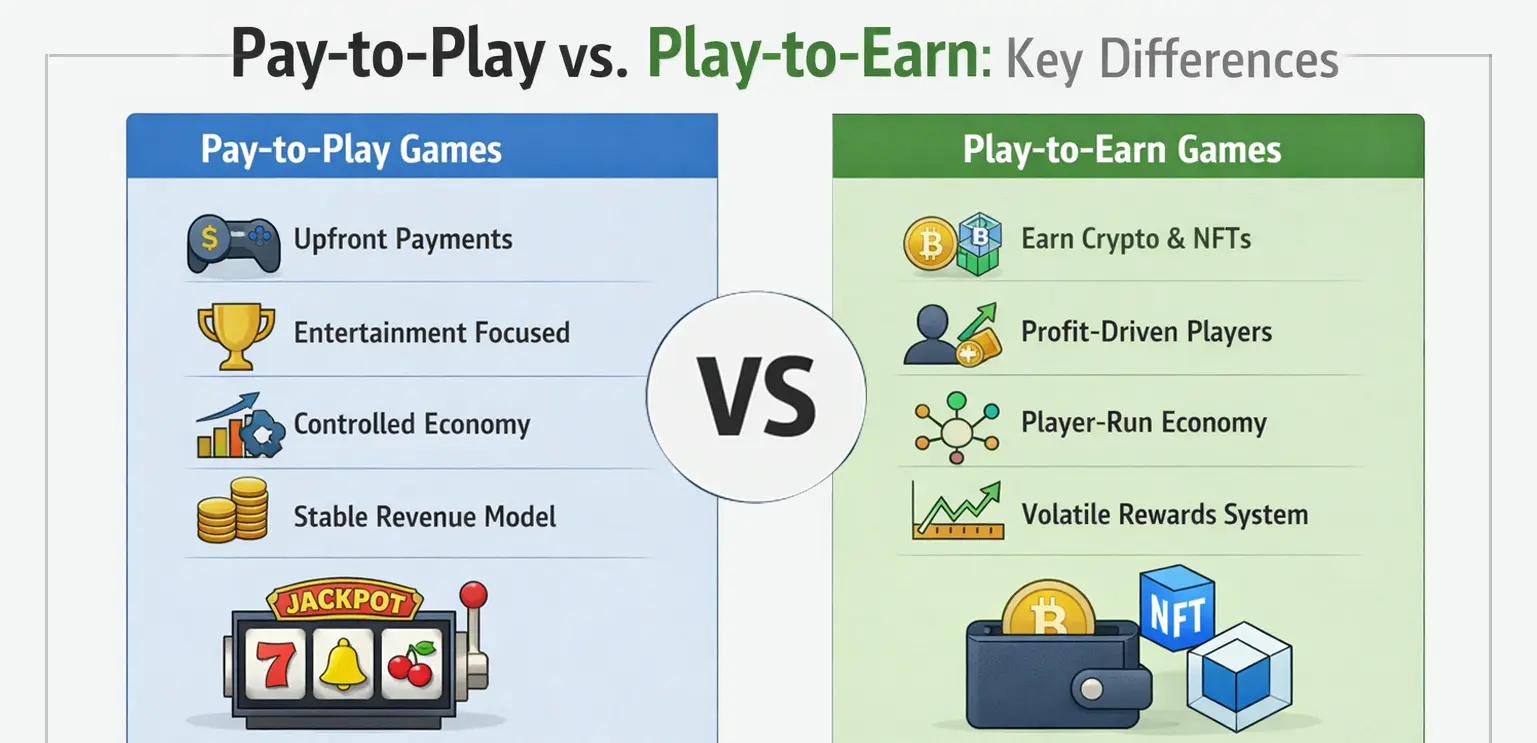
At a surface level, the difference seems simple. Players either pay to play—or they play to earn.
But in reality, the distinction runs much deeper. These models influence everything from game economy design and player psychology to long-term sustainability and production strategy. For developers, especially those in casino, mobile, and emerging blockchain spaces, understanding this difference is critical.
Industry Context: Why This Debate Matters Now
The rise of blockchain-based gaming introduced the idea that players could earn real-world value through gameplay. This challenged traditional monetization models, particularly in segments like online casinos and mobile games, where revenue typically flows from players to operators. However, while P2E gained rapid attention, many implementations struggled with sustainability. Simultaneously, traditional pay-to-play and related models (including real-money gaming in casinos) continued to dominate in terms of revenue and scalability.
This creates an important question for studios: Should we stick with proven monetization models, or experiment with player-driven economies? The answer depends on understanding how these systems actually work.
What Are Pay-to-Play Games?
Pay-to-play games require players to spend money to access gameplay or features. In traditional gaming, this might mean purchasing the game upfront. In casino environments, it often means wagering real money to participate. The defining characteristic is simple:
Players pay for access, entertainment, or the chance to win.
Revenue is directly tied to player spending, making the model predictable and scalable. In slot games, for example, players pay per spin, and the game’s design—RTP, volatility, and features—determines the overall experience.
What Are Play-to-Earn Games?
Play-to-earn games are built around the idea that players can earn rewards with real-world value through gameplay. These rewards are often tied to:
- Cryptocurrencies
- Tokens
- NFTs or digital assets
Instead of players paying purely for entertainment, they are participating in an economic system where time and skill can generate value. This shifts the player mindset from consumer to participant.
Core Differences Between Pay-to-Play and Play-to-Earn
The most important differences are not just financial—they are structural.
🔹 Revenue Flow
In pay-to-play systems, money flows from players to the operator. In play-to-earn systems, value flows both ways. Players can extract value, which means the system must sustain continuous economic balance. This creates a major design challenge in P2E: ensuring that rewards do not exceed the system’s ability to generate value.
🔹 Player Motivation
Player intent is fundamentally different. In pay-to-play games, players are primarily motivated by entertainment, excitement, and experience. In play-to-earn games, financial incentives play a significant role. Players may engage not because the game is fun—but because it is profitable. This can impact gameplay behavior, often leading to optimization rather than exploration.
🔹 Game Economy Design
Pay-to-play economies are relatively controlled. Developers define:
- Pricing
- Rewards
- Progression
In play-to-earn systems, economies are more complex and often influenced by external factors such as token markets. This introduces volatility and unpredictability.
🔹 Retention Mechanics
Retention in pay-to-play games is driven by:
- Engaging gameplay loops
- Reward systems
- Live Ops updates
In play-to-earn games, retention is often tied to earning potential. If rewards decrease, player engagement can drop rapidly.
🔹 Regulatory and Compliance Factors
Casino and pay-to-play games operate within well-defined regulatory frameworks. Play-to-earn games, especially those involving blockchain, often exist in a more uncertain regulatory environment. This creates additional risks for developers and operators.
Real-World Application: Slot Games vs Blockchain-Based Games
Slot games represent one of the most refined examples of pay-to-play systems. They are built around carefully balanced mechanics, including:
- RTP (Return to Player)
- Volatility
- Feature frequency
These systems are designed to deliver consistent engagement while maintaining profitability.
In contrast, many P2E games rely on token-based economies. If the token loses value, the entire system can collapse, regardless of gameplay quality. This highlights a key difference:
Pay-to-play games are experience-driven, while play-to-earn games are often economy-driven.
Production Impact: How These Models Affect Game Development
The monetization model directly influences how games are built.
🔹 In pay-to-play systems, development focuses on:
- Gameplay quality
- Visual and audio polish
- Retention systems
🔹 In play-to-earn systems, additional layers are required, including:
- Tokenomics design
- Blockchain integration
- Marketplace systems
This increases development complexity significantly. Studios working on slot pipelines often prioritize efficiency and scalability. For example, teams like Gamix Labs focus on creating reusable art and animation systems that support rapid content updates—an approach that aligns well with pay-to-play and Live Ops-driven models.
Challenges and Risks
Both models come with challenges. Pay-to-play games must continuously justify player spending. Poor design or lack of innovation can lead to churn. Play-to-earn games face sustainability issues. If the economic model is not balanced, the system can become unsustainable. There is also the risk of misaligned incentives. When players focus purely on earning, gameplay quality can suffer.
Best Practices for Choosing the Right Model
Studios should not choose a model based on trends alone. Instead, they should consider:
- Target audience
- Game type
- Long-term sustainability
- Regulatory environment
Often, hybrid models are emerging, combining elements of both systems. However, these require careful design to avoid conflicts between entertainment and earning incentives.
Future Trends: Convergence and Hybrid Models
The future is unlikely to be purely pay-to-play or purely play-to-earn. We are already seeing the rise of hybrid systems that blend:
- Entertainment-driven gameplay
- Optional earning mechanisms
These models aim to capture the strengths of both approaches while minimizing weaknesses. However, achieving this balance is complex and requires deep expertise in both game design and economic systems.
Conclusion
Pay-to-play and play-to-earn games represent two fundamentally different approaches to game design and monetization. One prioritizes controlled systems and entertainment-driven engagement. The other introduces player-driven economies and financial incentives.
For game studios, the choice is not just about revenue—it’s about defining the entire structure of the game. Understanding these differences is essential for building sustainable, engaging, and scalable products in today’s evolving gaming landscape.
Frequently Asked Questions
What is the main difference between pay-to-play and play-to-earn games?
Pay-to-play games require players to spend money to access gameplay, while play-to-earn games allow players to earn real-world value through gameplay.
Are play-to-earn games sustainable?
Sustainability depends on economic design. Many P2E systems struggle if rewards exceed incoming value.
Which model is better for game studios?
It depends on the game type and target audience. Pay-to-play is more stable, while P2E offers experimental opportunities.
Can casino games use play-to-earn mechanics?
Some elements can be adapted, but regulatory constraints often limit full P2E implementation.
Do players prefer earning over entertainment?
Not always. While earning is attractive, long-term engagement still depends on gameplay quality.
What are hybrid game models?
Hybrid models combine traditional gameplay with earning opportunities, aiming to balance engagement and monetization.