Creating Famous Slots: The Dog House
Creating Famous Slots · Part 4
A winning line passes through a 2× wild and a 3× wild. What should it pay: five times the ordinary win, or six?
In our Dog House-style slot, the answer is five. The two values add together. But that is only the first decision: which wilds count, how long they stay, and whether their values change on the next spin all affect the result.
After exploring the position multipliers in Sugar Rush, we are moving to fixed paylines. This time, a wild remembers both where it landed and how much it contributes.
The Dog House is a Pragmatic Play game. The reel sets, weights and examples here come from Gamix Labs' independently developed version, rather than the original manufacturer's undisclosed math. The diagrams illustrate our model.
Start with the line, then ask what the wild adds
Our board has five reels, three rows and 20 fixed paylines. A payline is a predefined route across the reels. Symbols must form a matching run from the left, with wilds standing in for paying symbols.
We calculate the ordinary value of each winning line first. Then we add the multiplier values of the wilds inside its winning run and apply that total to the line's value. A line with no contributing wild keeps its ordinary value.
The distinction between the whole line and its winning run matters. Suppose the first three reels match, the fourth breaks the match, and the fifth contains a wild. That last wild contributes nothing to the three-symbol win. It is visible on the same route, but it lies beyond the point where the winning combination ended.
This is also why we cannot total every wild on the screen and apply that number to every win. Each payline earns its own multiplier from the positions it actually uses.
A 1-unit bet, worked through one line
At a total bet of 1 unit, our 20-line model assigns 0.05 units to each line. In our paytable, three of the highest-paying ordinary symbol award 50 times that line stake.
Now take this left-to-right combination:
Top symbol → 2× wild → 3× wild → different symbol → different symbol
The first three positions make the win. Its calculation is:
| Step | Calculation | Result |
|---|---|---|
| Stake on this line | 1 ÷ 20 | 0.05 units |
| Ordinary three-symbol award | 0.05 × 50 | 2.50 units |
| Contributing wild multiplier | 2 + 3 | 5× |
| Final award for this line | 2.50 × 5 | 12.50 units |
The 12.50 units are the award for this one line; other winning lines are evaluated separately. We checked this calculation in our game.
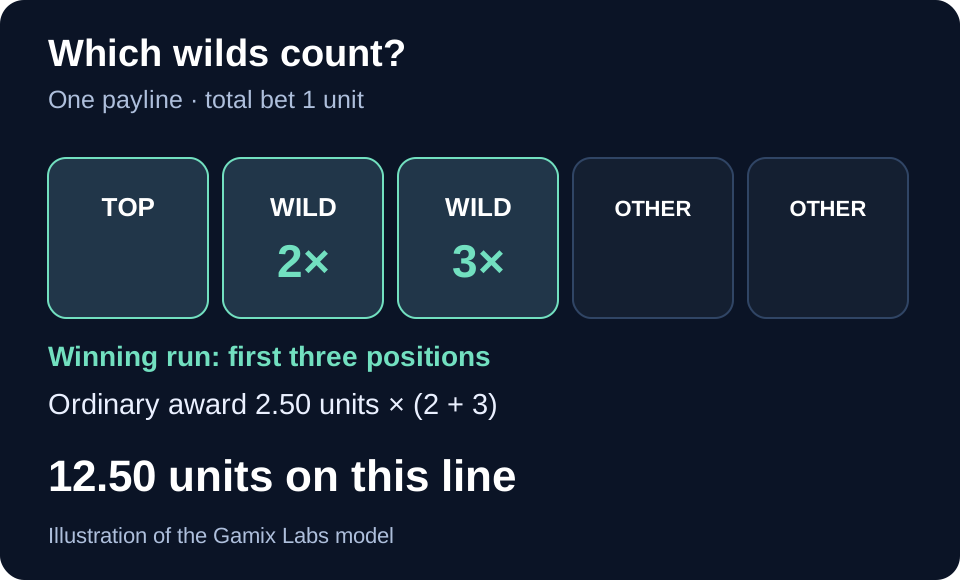
Multiplying the wild values together would give 6× and a 15-unit award instead. Both rules are possible game designs. They are different math models, so the rule needs to be settled before anyone tunes the reels.
A sticky wild remembers more than its position
During free spins, wilds remain in their positions for the rest of the feature. The next spin draws a fresh board, but the stored wilds are placed back before wins are evaluated.
We keep the multiplier with each position. If a 2× wild is already fixed in the middle row of reel two, it remains a 2× wild on later spins. Drawing another wild underneath that occupied position does not create a second wild or reroll its value.
A new position is different: it receives a multiplier when it becomes wild, then retains that value while it stays sticky.
Imagine a feature that has collected a 2× wild on reel two and a 3× wild on reel three. A later spin can use both for a 5× line multiplier, use only one of them, or fail to make a winning line at all. The board has gained opportunities, rather than a guaranteed payout on every spin.
This is a different kind of memory from Sticky Bees. There, persistent wild positions interact with clusters and cascades. Here, a fixed position and a fixed value interact with 20 predefined paths.
Four reel sets give us four separate jobs
A reel strip is a circular list of symbols. A stop on that list determines the visible symbols on a reel. Five strips together make one complete reel set for our board.
Our implementation contains four sets, or 20 individual strips:
| Reel set | Its job |
|---|---|
| Base game | Produce ordinary paid-spin boards |
| Feature entry | Produce the opening board for a purchased feature |
| Standard free spins | Supply boards while ordinary sticky wilds accumulate |
| Enhanced free spins | Supply boards for the higher-multiplier feature |
Separating entry from the continuing feature is useful. An entry board has to introduce the bonus; a free-spin board has to remain interesting as wilds occupy more positions. Those are different jobs.
The enhanced feature also has its own strips. Raising multiplier values while leaving every other part of the game unchanged would alter the payout distribution. A separate set gives us another place to adjust that distribution, although it still needs simulation to establish the final result.
The value on a new wild is a weighted choice
In our base game and standard feature, a new wild has an 80% chance of receiving 2× and a 20% chance of receiving 3×. Those percentages come from the relative weights we give each value when it is assigned.
Our enhanced free spins use 10× with an 87% chance, or 20× with a 13% chance at that same assignment step.
These percentages answer a narrow question: given that a new wild needs a value, which value will it receive? They do not say how often a wild lands, how often it participates in a win, or what percentage of bets the game returns.
Those other questions depend on the reel strips, the position of the wild, the paylines passing through it and the remaining free spins. A rare multiplier can still make a substantial contribution if it arrives early and is reused in several later wins.
For that reason, we would examine both the value of a new wild and how many future spins get to use it. Looking at multiplier weights alone misses the persistence that makes the feature distinctive.
What we would check before tuning the payouts
Small, deliberately chosen boards make the rules easier to verify than a long run of random spins. Useful checks include a line with one wild, a line with two wilds, and a wild placed just beyond the matching run. Then carry one sticky wild into a second spin and confirm that both its position and value survive.
Only after those rules are reliable does a large simulation answer the right question. It can then measure how the complete game behaves across many rounds, including the effect of when sticky wilds arrive. Our slot math simulation work follows that distinction between checking a rule and measuring a model.
For an enthusiast, the useful thing to watch is the path of the win. Two impressive wilds on screen do not automatically combine: the winning line has to connect them.
Continue with Part 5, Big Bass, where the lasting value sits in a collection meter, or Part 6, Wanted Dead or a Wild, where different bonuses remember different things.
If you are planning a game with persistent wilds, our slot development team can help turn the feature rules into a testable model. Tell us about your project.