Creating Famous Slots: Sugar Rush
Creating Famous Slots · Part 3
Five matching sweets form a winning cluster. They disappear, new symbols fall into place, and the board moves on. But something from that win stays behind: the positions where it happened.
Later, another cluster lands across some of those positions. It contains the same number of symbols, yet pays much more. The difference is the history of the cells underneath it.
That is the idea we will explore through our Sugar Rush-style implementation: the symbols keep changing, while the grid builds up value. We will follow a small payout example, explain when multipliers grow, and look at the three reel setups we use to shape play.
This follows Part 1, Sticky Bees, about persistent wild positions, and Part 2, Book of Tut, about expanding symbols. Here, the lasting feature is a multiplier attached to a place on the board.
Sugar Rush is a Pragmatic Play game. This article explains lessons from Gamix Labs' independently developed version. The reel setups, timing rules and payout examples describe our model, not the original manufacturer's undisclosed math. The diagrams are simplified illustrations.
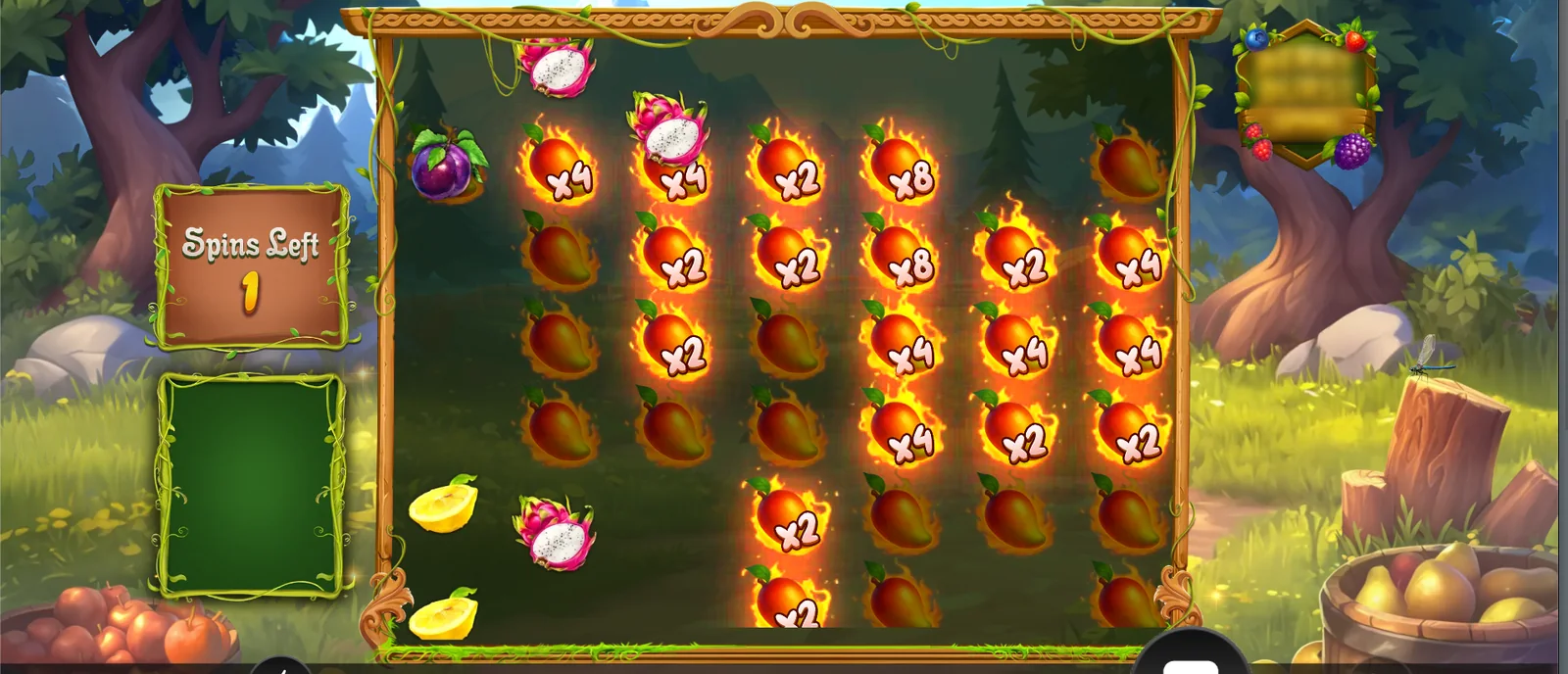
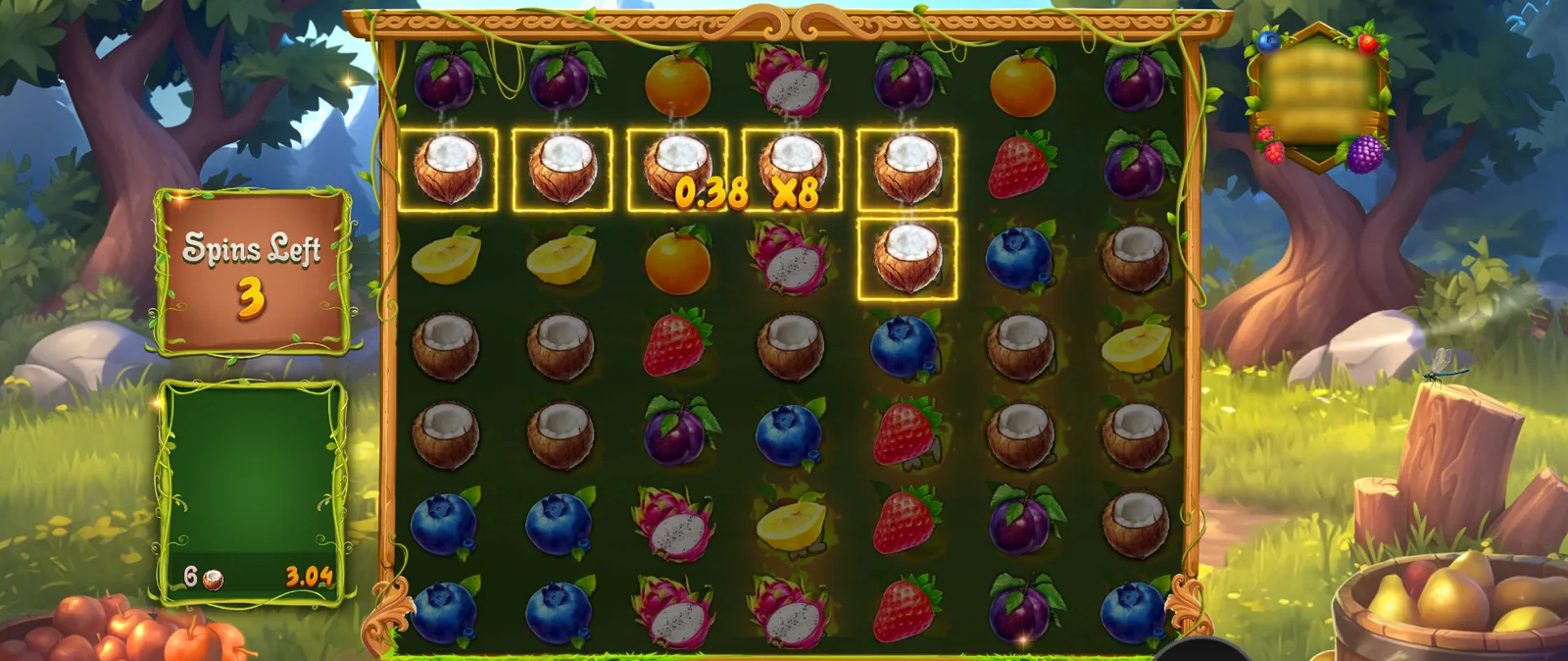
The gameplay screenshots show our fruit-themed build. The diagrams use simplified symbols to explain the calculations.
A winning cluster leaves a memory on the grid
Our version uses a 7 × 7 board and seven paying symbols. A group of five or more matching symbols pays when its members connect horizontally or vertically. Diagonal contact alone does not connect them.
After a win, the winning symbols are removed. The surviving symbols fall down within their columns, and fresh symbols fill the gaps above. This can produce another winning cluster, continuing the same paid spin. These repeated drops are called cascades, or tumbles.
Each participating position also gains a record of that win. Repeated wins at the same position eventually create a multiplier there, which can increase the value of later clusters.
It helps to picture two layers:
- The symbol layer contains the sweets that land, win, disappear and fall.
- The position layer remembers which cells have been used in wins and which multipliers they have reached.
A sweet can fall from the top row to a lower row. The multiplier underneath its old position stays where it was. Another symbol can land on that position and use it in a later win.
This is a consequential design choice. Moving the multipliers down with the falling symbols would produce a different game, even if the animation looked convincing.
A marked position is not yet an active multiplier
One detail in our implementation deserves particular attention: a cell that has participated in one win is marked, but does not yet increase the next payout.
When it participates again, its stored value becomes 2×. Further winning visits double that value through 4×, 8×, 16×, 32×, 64× and 128×.
The order matters. We calculate a cluster's win using the multipliers already present, then update its positions for later wins. A newly created or doubled multiplier does not go back and increase the win that just created it.
Here is the history of one cell, assuming it keeps joining paying clusters:
| Winning visit to that cell | State before the win | State after the win |
|---|---|---|
| First | Unmarked | Marked only |
| Second | Marked only | 2× |
| Third | 2× | 4× |
| Fourth | 4× | 8× |
On the third visit, that cell contributes its existing 2× to the current cluster's calculation. The 4× becomes available afterward. This table describes one position; the whole cluster may include other multiplier positions too.
We checked this ordering with a five-symbol cluster placed repeatedly on the same five cells. At a bet of 1 unit, its ordinary cluster value was 1 unit. The first two evaluations each paid 1 unit. On the third, all five cells already carried 2×, so their combined multiplier was 10× and the cluster paid 10 units.
That is a controlled example of the rule, not a claim that the same cluster will appear three times in actual play.
How several multipliers produce one cluster payout
The next question is how to combine the multipliers beneath a winning cluster.
In our model, active multipliers within that cluster are added together. A marked-only cell contributes nothing to that sum. If the cluster has no active multipliers, it pays its ordinary value.
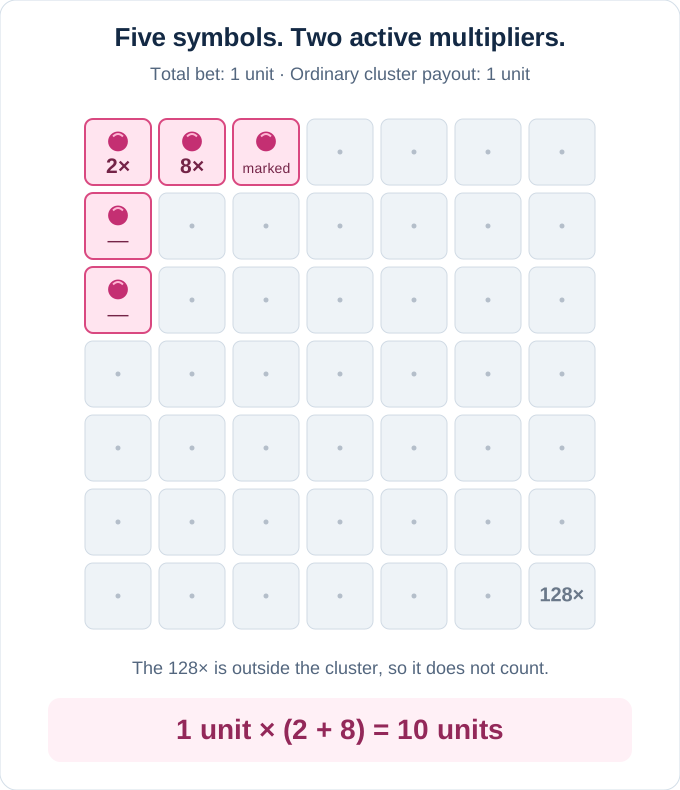
For a worked example, take a five-symbol cluster whose ordinary payout is 1 unit at a total bet of 1 unit. Within the cluster:
- One position already has 2×.
- Another already has 8×.
- A third is marked only.
- The other two are unmarked.
| Calculation | Result |
|---|---|
| Active multipliers within the cluster: 2 + 8 | 10× |
| Ordinary cluster payout: 1 unit × 10 | 10 units |
Multiplying 2 by 8 would give the wrong result. Adding an extra point for every unmarked or marked-only cell would also give the wrong result. Those cells help form the winning group, but they do not supply an active multiplier.
The 128× cell shown elsewhere on the board contributes nothing to this particular win. A multiplier has to sit underneath a member of the winning cluster to count.
After the payout, the cluster's positions advance: 2× becomes 4×, 8× becomes 16×, the marked cell becomes 2×, and the two new positions become marked. Those changes prepare the grid for future wins.
There is also a useful distinction between a cell limit and a cluster total. Our 128× limit applies to each individual position. Several active positions can add up to more than 128× across a cluster. That limit alone does not describe the game's overall maximum payout.
Cascades change symbols without moving their history
Once a cluster has paid, the next board must keep two things consistent: the surviving symbols and the position history.
Suppose a column contains seven symbols and the two in the middle are removed. The five survivors retain their order, move down, and two new symbols enter at the top. We refill only those gaps; we do not replace the entire board after every win.
Meanwhile, each multiplier remains attached to its original cell. A position can gain value even though several different symbols have occupied it over the course of the cascade.
This makes location part of the math. Two boards with identical visible symbols can pay differently if their position histories differ. Conversely, two boards with the same collection of multipliers can behave differently if those multipliers sit in different places.
For example, high-value positions close together can all sit under one connected cluster. The same values spread across the board need a different arrangement of symbols to contribute together. Total multiplier value alone cannot tell us what a particular win will pay.
We also keep separate clusters separate. If two disconnected groups of the same sweet both win, each uses only the multipliers underneath its own positions. Adding the whole board's multipliers to both groups would overpay them.
Why we use three reel setups
Position multipliers explain what happens to a win. Reel strips help shape which symbol arrangements appear in the first place.
A reel strip is an ordered list of symbols. Our game takes a visible window from each of seven strips to form the board. We use three sets of seven strips:
| Situation | Reel setup | Strip lengths in our version |
|---|---|---|
| Ordinary paid spin | Base-game set | 141 or 144 positions |
| Free spins triggered during play | Natural-entry free-spin set | 148 positions |
| Free spins entered through a feature purchase | Bought-feature free-spin set | 149 or 150 positions |
The two free-spin sets are distinct. A bonus reached during ordinary play and a bought bonus therefore do not automatically use identical symbol distributions just because their visible mechanics match.
Within each of these situations, the active reel family supplies both the opening board and fresh symbols for cascades. For a refill, our implementation draws a new window and uses the symbols needed to fill the gaps, while retaining the survivors.
These choices matter because an early cluster does more than pay once. It marks positions, opens gaps and creates another chance to land a cluster across positions that are becoming more valuable. The arrangement and order of symbols can affect that sequence.
Strip length on its own does not establish return or volatility. Nor does having a separate bought-feature set prove that it pays more or less. Those are questions for a simulation of the complete rules, including the multiplier grid and its reset behaviour.
Free spins change how long the grid remembers
In an ordinary paid spin, the grid remembers winning positions throughout that spin's cascade sequence. Once the sequence is finished, those marks and multipliers are cleared for the next paid spin.
Our standard bonus begins with ten free spins and a fresh multiplier grid. During the feature, the marks and multipliers remain between free spins. They clear when the feature finishes.
That longer memory is the central change. A free spin can produce no win and still leave valuable positions available for the next one. A new winning cluster can then benefit from work done several spins earlier.
It also means ten free spins cannot be understood simply as ten independent copies of a fresh-board spin. The state entering a later spin depends on what happened before it. Its potential payout opportunities have changed, although a win is still not guaranteed.
For balancing, we would therefore examine complete bonus sessions as well as individual spins: how often clusters revisit marked cells, how many positions reach higher values, and how widely session payouts vary. An average cluster payout alone misses the progression that gives this feature its character.
Build the payout and the display around the same sequence
The player sees a short story: a cluster wins, its positions develop, the symbols disappear, and another drop arrives. The calculation should tell the same story in the same order.
For our version, that sequence is:
- Find each qualifying cluster on the current board.
- Calculate its payout using the active multipliers already beneath it.
- Advance the participating positions' marks or multipliers.
- Remove the winning symbols, keep the survivors and refill the gaps.
- Evaluate the next board, continuing until no new win appears.
Keeping the earlier multiplier values available while showing the payout avoids a confusing result: a displayed 4× that was still 2× when the win was calculated. The frontend needs to distinguish the value used for the award from the upgraded value ready for the next drop.
Small, deliberate examples are especially helpful here. A diagonal-only group should not become a cluster. A large multiplier outside the winning group should not affect it. A cell at 128× should stay at that limit. A new paid spin should clear the grid, while the next free spin should retain it.
Once those rules are clear, longer simulations can explore how the reel setups and accumulated positions work together. That is where the design moves beyond a paytable: the location and history of a win become part of what the next win is worth.
Continue with Part 4: The Dog House, where fixed wild positions retain their multiplier values. Part 5: Big Bass explores a different memory: a collector count that advances the bonus.
For more background, see our guide to free-spin design. If you are building a slot with cascades or persistent multipliers, see our slot math and simulation services, or talk to Gamix Labs about your game.