What Is a Slot Game Math Model? A Complete Guide for Casino Operators
When players open a slot game, the first things they notice are usually the artwork, animations, sound effects, and bonus features. These elements create the visual identity of the game, but they are not what determine its long-term success. Behind every successful slot game is a carefully designed math model that controls how the game behaves from the first spin to the millionth.
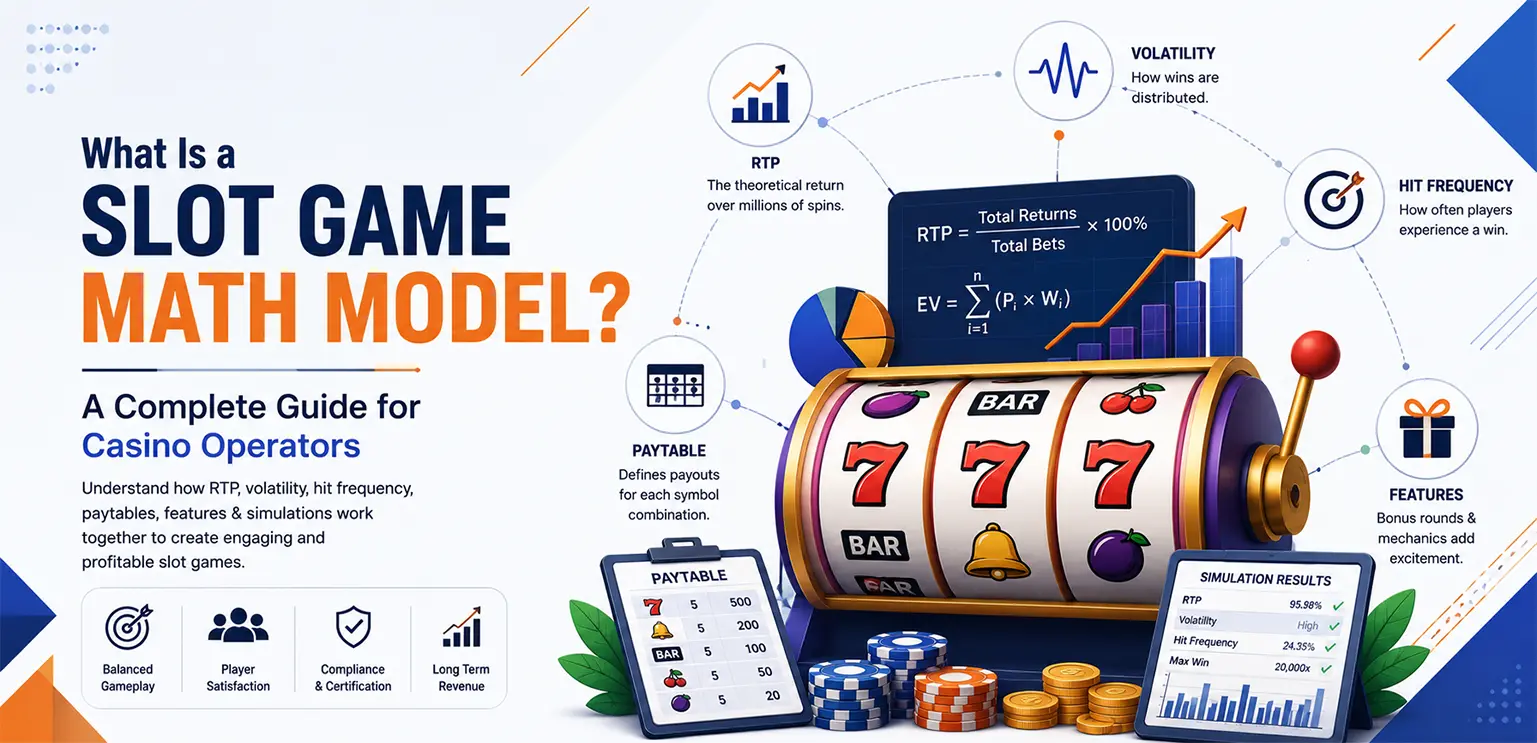
A slot game math model is the statistical foundation of the game. It defines how often winning combinations appear, how bonus features are triggered, how large payouts can become, and how the game's Return to Player (RTP), volatility, and hit frequency work together. In simple terms, it is the blueprint that transforms a collection of reels, symbols, and features into a balanced gaming experience.
For casino operators, understanding slot mathematics is no longer optional. With hundreds of new games entering the market every month, selecting titles based only on visual quality or popular themes can lead to inconsistent player engagement. A well-balanced math model helps operators build a portfolio that appeals to different player preferences while supporting long-term business goals.
For game studios, the math model guides almost every production decision. Designers, developers, artists, QA engineers, and mathematicians all work around this foundation to ensure the finished product delivers the intended player experience while meeting certification requirements.
In this guide, we'll explain what a slot game math model is, how it is created, why it matters to casino operators, and how it influences everything from gameplay balance to certification readiness.
What Is a Slot Game Math Model?
A slot game math model is the mathematical framework that defines how a slot game performs over time. Rather than controlling the outcome of an individual player session, it determines the probability of every possible outcome and ensures the game behaves consistently over millions of spins.
Think of it as the game's invisible engine. Players see reels, symbols, and animations, but every spin follows a set of predefined mathematical probabilities that govern the game's long-term behavior. A complete math model determines factors such as:
- How often players win: It defines the probability of winning combinations appearing during gameplay.
- How much players can win: Every prize, from small payouts to maximum wins, is calculated within the overall mathematical balance.
- How bonus features behave: Free spins, multipliers, respins, wilds, and other mechanics are assigned probabilities and expected values.
- How the game feels: The combination of RTP, volatility, and hit frequency shapes the overall player experience, making the game feel steady, balanced, or high-risk.
Without a well-designed math model, even visually impressive slot games may struggle to retain players because the gameplay lacks consistency or balance.
Why Casino Operators Should Understand Slot Math Models
Many operators evaluate new slot games by reviewing themes, artwork, feature lists, and supplier reputation. While these are important considerations, they only tell part of the story. The mathematical design behind a game often has a much greater impact on player satisfaction and long-term performance. Understanding math models helps operators make better commercial decisions instead of relying solely on visual appeal. Some of the biggest advantages include:
- Build a balanced game portfolio: Different players enjoy different experiences. Offering a mix of low, medium, and high-volatility games allows operators to appeal to casual players as well as those seeking higher-risk gameplay.
- Improve player retention: Games with well-balanced mathematics often provide a more satisfying experience because wins, bonus features, and gameplay pacing feel consistent over time.
- Support smarter content selection: Two games with similar themes may perform very differently due to their mathematical design. Reviewing gameplay characteristics alongside visuals leads to more informed decisions.
- Reduce commercial risk: Understanding RTP, volatility, and feature balance helps operators avoid games that may not align with their target audience or business strategy.
- Strengthen player trust: Games that perform consistently and transparently contribute to a more reliable entertainment experience, especially in regulated markets.
For operators managing hundreds of games, mathematics is just as important as branding or presentation. A visually stunning slot may attract players initially, but balanced gameplay is often what encourages them to return.
Why Every Slot Game Starts with Mathematics
A common misconception is that slot development begins with concept art or animations. In reality, experienced studios usually establish the mathematical direction of the game early in production. Before artists create symbols or developers implement gameplay, the production team typically defines questions such as:
- What player experience should the game deliver?
- Should it be low, medium, or high volatility?
- How frequently should bonus features appear?
- What maximum win should the game support?
- Which markets and player preferences is the game targeting?
These decisions influence nearly every department involved in development.
For example, if the mathematical design calls for a high-volatility game with rare but rewarding bonus rounds, the art team may create more dramatic feature animations, while designers focus on building anticipation before major events. Likewise, QA teams prepare testing strategies based on the game's expected behavior.
Starting with mathematics helps every department work toward the same gameplay vision, reducing revisions later in production.
The Slot Game Math Model Core Components
A math model isn't a single number or formula. It's a combination of interconnected systems that work together to create the overall gameplay experience. Let's explore the most important components.
🔹 Return to Player (RTP)
Return to Player, or RTP, is the theoretical percentage of total wagers that a slot game is designed to return to players over a very large number of spins.
For example, a game with a theoretical RTP of 96% is designed to return approximately $96 for every $100 wagered across millions of spins. This does not mean every player receives that return during a single session. RTP reflects long-term mathematical behavior instead of short-term results.
For casino operators, RTP helps define the overall economic profile of a game.
For developers, it serves as one of the primary targets during mathematical design and simulation testing. RTP is only one part of the math model, but it provides the foundation upon which other gameplay characteristics are balanced.
🔹 Volatility
Volatility describes how winnings are distributed, not how much the game returns overall. Two slot games can have exactly the same RTP while delivering completely different player experiences. For example:
- Low-volatility games: Smaller wins occur more frequently, creating a steadier gameplay experience that many casual players enjoy.
- Medium-volatility games: Provide a balanced mix of regular smaller wins and occasional larger payouts, creating an experience that appeals to both casual and experienced players.
- High-volatility games: Players may experience longer periods without major rewards, but larger payouts and bonus wins create higher excitement when they occur.
During game design choosing the right volatility is one of the most important decisions because it directly influences player expectations and session behavior.
🔹 Hit Frequency
Hit frequency measures how often players receive any winning outcome during gameplay. It is often confused with RTP, but the two metrics serve different purposes. A game may have:
- A high hit frequency, where players experience wins regularly, although many of those wins may be relatively small.
- A lower hit frequency, where wins occur less often but may be larger or connected to high-value bonus features.
When combined with RTP & volatility, hit frequency helps determine the overall rhythm of a slot game. For operators, understanding hit frequency makes it easier to compare games beyond their advertised RTP values.
🔹 Paytable Structure
The paytable defines how much each winning symbol combination awards and how rewards are distributed across the game. Rather than simply listing prizes, the paytable contributes directly to the mathematical balance. A well-designed paytable should:
- Support the intended volatility: Higher-value symbols and payout structures influence how rewards are distributed throughout gameplay.
- Maintain progression: Smaller wins should feel meaningful while larger combinations remain exciting and memorable.
- Complement bonus mechanics: Base game payouts and feature rewards should work together instead of competing with each other.
Even small adjustments to the paytable can significantly change the overall behavior of a slot game.
🔹 Symbol Distribution and Weighting
Not every symbol has the same probability of appearing on the reels. Developers carefully decide how frequently each symbol should appear to support the intended gameplay experience. This process helps:
- Control winning opportunities: More common symbols contribute to regular gameplay, while premium symbols remain less frequent.
- Balance feature activation: Wilds, bonuses, and scatter symbols are distributed to achieve the desired trigger frequency.
- Maintain long-term consistency: Symbol probabilities work alongside the rest of the math model to produce predictable statistical behavior over millions of spins.
Players rarely notice these calculations directly, but they have a major influence on how the game feels over time.
Why These Components Must Work Together
One of the biggest misconceptions about slot games is that each mathematical metric can be adjusted independently. In reality, the core components of a math model are closely connected.
For example, increasing the frequency of bonus features may require adjustments to payout values or volatility to maintain the intended RTP. Similarly, changes in the paytable can influence hit frequency, average wins, and the overall pacing of the slot game.
This interconnected relationship is why professional slot development relies on continuous balancing rather than isolated changes. Every adjustment is evaluated within the complete mathematical framework to ensure the final game delivers a consistent experience for players and meets the studio's design goals.
How Is a Slot Game Math Model Created?
Designing a slot game math model is a structured process that combines mathematics, game design, player psychology, and quality assurance. It's not simply about deciding an RTP percentage or creating attractive bonus features. Every decision is made with the goal of delivering a balanced player experience while meeting commercial and regulatory requirements.
Although every studio has its own workflow, most professional game development teams follow a similar process.
🔹 Define The Game Vision
Every math model starts with a clear understanding of what kind of game the studio wants to build. Before any calculations begin, the production team defines objectives such as:
- Target audience: Casual players, experienced slot enthusiasts, or high-risk players all have different gameplay preferences.
- Gameplay style: The team decides whether the experience should feel relaxed, balanced, or highly rewarding with greater risk.
- Market requirements: Different jurisdictions and casino operators may have different expectations regarding RTP ranges, compliance, and gameplay mechanics.
- Commercial goals: The mathematical profile should support the operator's portfolio strategy while remaining engaging for players.
These decisions establish the direction for every stage of production.
🔹 Design The Mathematical Framework
Once the gameplay goals are clear, mathematicians begin creating the statistical framework that governs the game's behavior. This stage involves balancing several interconnected elements:
- RTP allocation: The total theoretical return is distributed across the base game, bonus features, and special mechanics.
- Volatility profile: Developers determine how frequently wins should occur and how large those wins can become.
- Hit frequency: The expected rate of winning spins is planned to match the intended player experience.
- Reward distribution: Small, medium, and large payouts are balanced to create satisfying gameplay over both short and long sessions.
Instead of treating these components separately, developers evaluate how each adjustment influences the complete mathematical model.
🔹 Balance Bonus Features
Bonus features are often the most exciting part of a slot game, but they are also among the most carefully balanced. Every feature must contribute to the overall gameplay experience without disrupting the mathematical foundation. Developers typically evaluate:
- Trigger frequency: Bonus rounds should appear often enough to remain engaging but not so frequently that they lose their excitement.
- Average feature value: Each feature should provide meaningful rewards while remaining consistent with the intended RTP.
- Interaction with the base game: Bonus mechanics should enhance normal gameplay rather than replace it entirely.
- Overall player experience: Features should create memorable moments while maintaining a balanced progression throughout the session.
Successful bonus systems are exciting because they are mathematically planned—not because they simply offer larger prizes.
🔹 Validate Through Simulation Testing
Once the initial math model has been designed, it needs to be validated. Rather than relying only on theoretical calculations, developers run large-scale simulation testing to compare expected results with actual statistical behavior. Simulation testing helps answer questions such as:
- Is the observed RTP close to the theoretical target?
- Does the volatility profile match the intended gameplay?
- Are bonus features triggering as expected?
- Is the hit frequency consistent with the mathematical design?
- Are there any unexpected statistical patterns?
Testing at this stage allows teams to refine the model before moving further into production.
🔹 Refine and Optimize
It is uncommon for a math model to be perfect on its first iteration. Simulation reports often reveal opportunities for improvement. Developers may adjust payout values, feature behavior, symbol probabilities, or gameplay pacing before running another round of validation.
This iterative approach continues until the game delivers the intended balance between entertainment, fairness, and commercial objectives. Only after the team is confident in the results does the game move closer to certification and release.
Why Two Slot Games with the Same RTP Feel Completely Different
One of the biggest misconceptions among new casino operators is that RTP alone determines how a slot game performs.
In reality, RTP is only one part of a much larger mathematical framework. Imagine two slot games, both offering a theoretical RTP of 96%.
The first game awards frequent small wins and triggers bonus features regularly. Players often feel they are making steady progress, even if individual payouts are modest.
The second game may go many spins without significant rewards before delivering occasional large wins through premium combinations or bonus features. Although the long-term RTP is identical, the emotional experience is completely different.
The difference comes from how volatility, hit frequency, feature design, and reward distribution work together. This is why experienced operators rarely evaluate games using RTP alone.
How Bonus Features Influence the Math Model
Bonus features are among the strongest tools developers have for shaping player experience. However, they do not simply add excitement—they also influence how rewards are distributed throughout the game. Every feature contributes to the overall mathematical balance. For example:
- Free Spins: These often provide a meaningful share of the game's total theoretical return while creating moments of anticipation and extended gameplay.
- Wild Multipliers: Multipliers increase payout potential and can significantly influence volatility depending on how frequently they appear.
- Respins: Additional spin opportunities help create excitement without fundamentally changing the base game mechanics.
- Expanding or Sticky Wilds: These mechanics increase winning opportunities during qualifying events while supporting larger feature payouts.
- Bonus Games: Interactive rounds introduce variety and allow developers to distribute part of the RTP through special gameplay rather than standard reel wins.
Professional studios evaluate each feature individually and then measure its impact on the complete mathematical model.
Why Simulation Testing Is Essential
A theoretical math model is only the beginning. Developers still need evidence that the implemented game behaves as expected. This is where simulation testing becomes one of the most valuable stages of slot production. During simulations, automated systems execute millions—or even hundreds of millions—of game rounds and record every outcome. The collected data allows developers to verify:
- RTP accuracy: Comparing observed results with theoretical expectations over large sample sizes.
- Volatility behavior: Confirming whether wins are distributed according to the intended risk profile.
- Hit frequency: Measuring how often players experience winning spins.
- Bonus feature performance: Evaluating trigger rates, average payouts, and overall contribution to the game.
- Maximum win scenarios: Checking that the game behaves correctly during extremely rare high-payout events.
Without simulation testing, mathematical issues may remain hidden until after launch, making them far more expensive to resolve.
How Math Models Shape the Player Experience
Players may never see the calculations behind a slot game, but they experience their effects every time they play. The math model determines how the game feels from one session to the next. It influences:
- Gameplay rhythm: The balance between regular wins, feature triggers, and larger rewards creates the overall pace of the game.
- Session length: Well-balanced mathematics can encourage longer, more enjoyable play sessions without relying solely on visual effects.
- Excitement levels: Carefully timed bonus features and varied payout distribution help maintain player interest.
- Perceived fairness: Consistent gameplay builds trust because outcomes feel balanced rather than unpredictable in an unfair way.
- Replay value: Different volatility profiles encourage players with different preferences to return and explore more games.
Great slot games are remembered not just because of their graphics, but because the mathematics create an engaging experience from beginning to end.
Common Myths About Slot Game Math Models
There are many misconceptions surrounding slot mathematics, especially among people new to casino game development.
Myth 1: RTP Guarantees What Every Player Will Receive
RTP represents a theoretical long-term average calculated over millions of spins. Individual player sessions can produce results that are higher or lower than the theoretical percentage.
Myth 2: Developers Can Change Outcomes for Individual Players
Modern regulated slot games use certified mathematical models and approved random number generation systems. Developers design the probabilities before release—they do not control the outcome of individual spins.
Myth 3: High Volatility Means Better RTP
Volatility and RTP measure different aspects of gameplay.
A high-volatility game can have exactly the same RTP as a low-volatility game. The difference lies in how rewards are distributed, not in the total theoretical return.
Myth 4: More Bonus Features Always Make a Better Game
Adding more mechanics does not automatically improve gameplay.
Poorly balanced bonus systems can make a game confusing or reduce the impact of individual features. Well-designed games focus on meaningful, mathematically balanced mechanics rather than simply increasing feature count.
Myth 5: Visual Quality Determines Game Success
Artwork and animations attract players, but long-term engagement depends heavily on balanced mathematics. A visually impressive game with weak gameplay often struggles to retain players.
Why Math Models Matter During Certification
A well-designed math model is only valuable if it performs consistently in a production environment. Before a slot game enters regulated markets, it typically undergoes an independent review to verify that its mathematical behavior matches the developer's documented design and complies with the applicable regulatory requirements.
Certification is not simply about checking whether a game functions correctly. It also helps confirm that the game's theoretical calculations, random outcomes, and gameplay behavior remain consistent over long-term play.
During the review process, independent testing laboratories evaluate various aspects of the game, including its mathematical documentation, gameplay logic, payout behavior, and technical implementation. Developers are expected to demonstrate that the game performs as intended and that its advertised characteristics accurately reflect its long-term statistical behavior.
From a studio's perspective, certification readiness begins long before the game is submitted for review. Teams that integrate mathematical validation, quality assurance, and documentation throughout development are generally better prepared for the certification process.
How Math Models Influence Casino Operator Revenue
For many casino operators, selecting a slot game is often associated with its theme, artwork, or brand recognition. While these factors help attract players, long-term performance is largely influenced by the game's mathematical design. A well-balanced math model contributes to commercial performance in several ways.
- Supports player retention: Games that maintain a satisfying balance between regular wins, bonus excitement, and long-term progression are more likely to encourage repeat play.
- Creates a diversified portfolio: Offering a combination of low, medium, and high-volatility games allows operators to appeal to different player preferences rather than relying on a single gameplay style.
- Improves player satisfaction: Consistent mathematical behavior helps players understand what to expect from a game, creating a more enjoyable entertainment experience.
- Encourages portfolio stability: A diverse mathematical profile reduces dependence on one type of game and supports broader audience engagement.
- Supports long-term business strategy: Choosing games based on gameplay characteristics rather than visuals alone often results in a stronger and more sustainable content portfolio.
Successful operators rarely evaluate games using RTP alone. They consider the complete mathematical profile alongside the player audience they want to serve.
Choosing the Right Math Model for Different Player Segments
Not every player enjoys the same type of slot experience. Some players prefer regular wins that extend gameplay, while others are comfortable waiting longer for larger payout opportunities. Understanding these preferences helps operators build a more balanced content strategy.
🔹 Players Who Prefer Frequent Rewards
These players often enjoy games that provide regular feedback and steady gameplay progression. Suitable characteristics include:
- Lower volatility: Smaller but more frequent wins help maintain continuous engagement.
- Higher hit frequency: Winning combinations appear more regularly, even if individual payouts are modest.
- Simple bonus mechanics: Easy-to-understand features improve accessibility for casual audiences.
These games are often suitable for players who value consistent entertainment over large but infrequent rewards.
🔹 Players Who Enjoy Higher Risk
Other players actively seek games that deliver greater excitement through larger payout opportunities. These games typically include:
- Higher volatility: Longer periods between significant wins create greater anticipation.
- Feature-driven gameplay: Bonus rounds and special mechanics often play a larger role in the overall experience.
- Larger potential rewards: High-value combinations and bonus events provide memorable gameplay moments.
Although these games involve greater variation in outcomes, they remain mathematically balanced over long-term play.
🔹 Why Portfolio Balance Matters
Since players have different preferences, relying on a single mathematical profile rarely delivers the best results. Operators usually build stronger long-term portfolios by offering games with a variety of gameplay styles instead of concentrating on just one category. A balanced portfolio helps:
- Serve different player preferences.
- Increase content variety.
- Improve overall player engagement.
- Reduce reliance on a single game style.
- Support long-term retention strategies.
This is one reason why experienced operators evaluate mathematical diversity alongside game themes and visual quality.
Common Mistakes Operators Make When Evaluating Slot Games
Choosing slot content based only on appearance or marketing material can lead to missed opportunities. Understanding a game's mathematical profile provides a more complete picture of its long-term performance. Some common mistakes include:
🔹 Focusing Only On RTP
RTP is important, but it does not explain how the game feels to play.
Two games with the same RTP can deliver completely different player experiences because of differences in volatility, hit frequency, and bonus design.
🔹 Ignoring Volatility
A high-volatility game may perform well for a selected audience while being unsuitable for another.
Matching volatility to player preferences is often more valuable than chasing a specific RTP percentage.
🔹 Choosing Games Based Only on Visual Quality
Strong artwork attracts attention, but balanced gameplay encourages players to return.
Successful games combine attractive presentation with thoughtful mathematical design.
🔹 Overlooking Long-Term Performance
Early player interest is valuable, but operators should also consider how games perform over weeks and months.
Mathematical balance plays a significant role in sustaining engagement over time.
🔹 Not Reviewing Supporting Documentation
Understanding a game's mathematical profile, gameplay characteristics, and certification status helps operators make more informed purchasing decisions.
Best Practices for Building a Strong Slot Portfolio
Whether operators purchase games from multiple suppliers or work directly with development studios, following a structured evaluation process can improve long-term results. Some recommended practices include:
- Evaluate the complete mathematical profile. RTP, volatility, hit frequency, feature frequency, and maximum win potential should all be reviewed together rather than individually.
- Offer gameplay variety. A balanced mix of mathematical profiles helps attract players with different preferences and playing styles.
- Prioritise player experience over marketing claims. Sustainable engagement is usually driven by balanced gameplay rather than promotional messaging alone.
- Review certification readiness. Games developed with testing, documentation, and compliance in mind are generally easier to introduce into regulated markets.
- Monitor portfolio performance regularly. Reviewing player behavior and game performance helps operators refine future content strategies.
A data-informed approach to content selection often delivers better long-term value than relying solely on trends.
How Gamix Labs Approaches Slot Game Math Development
At Gamix Labs, slot mathematics is treated as the foundation of the entire game development process rather than a final production task. The team combines mathematical planning, game design, HTML5 development, art production, quality assurance, and large-scale simulation testing to build balanced slot games for modern casino platforms. The development workflow focuses on:
- Defining gameplay objectives early: Mathematical planning begins during pre-production so every department works toward the same gameplay vision.
- Balancing every gameplay component: RTP, volatility, hit frequency, pay-tables, and bonus features are refined together rather than independently.
- Validating through simulation testing: Large-scale automated simulations help verify long-term mathematical behavior before certification preparation.
- Supporting certification-focused production: Documentation, QA, and production workflows are designed to help clients prepare games for regulated markets.
- Optimizing for multiple platforms: Games are developed with cross-platform compatibility and scalability in mind while maintaining consistent gameplay quality.
This integrated approach allows development teams to reduce production risk, improve collaboration, and deliver engaging player experiences backed by well-balanced mathematics.
Conclusion
A slot game's artwork, animations, and bonus features may create the first impression, but the math model determines how the game performs throughout its lifetime. It defines the balance between RTP, volatility, hit frequency, feature rewards, and payout distribution, shaping every player's experience over millions of spins.
Choosing slot games based solely on their appearance can overlook one of the most important factors behind long-term performance. By understanding the mathematics that drive gameplay, casino operators can create a portfolio that serves different player preferences while supporting sustainable business objectives.
For game developers, the math model acts as the foundation of production. Every department—from game design and development to quality assurance and certification preparation—relies on it to create a consistent, engaging, and reliable gameplay experience.
As the online casino industry continues to grow, operators who evaluate games based on both creative quality and mathematical design will be better positioned to build stronger portfolios and deliver lasting entertainment. Likewise, studios that invest in structured math modelling, simulation testing, and certification-focused workflows will continue to produce games that meet the expectations of players, operators, and regulated markets alike.
Frequently Asked Questions
What is a slot game math model?
A slot game math model is the statistical framework that determines how a slot game behaves over the long term, including RTP, volatility, hit frequency, payout distribution, and bonus feature probabilities.
Is RTP the same as a slot game math model?
No. RTP is only one component of a slot game math model. A complete math model also includes volatility, hit frequency, paytable design, symbol weighting, feature probabilities, and other gameplay characteristics.
Why should casino operators understand slot mathematics?
Understanding slot mathematics helps operators compare games more effectively, build balanced portfolios, and select content that aligns with their target audience and long-term business strategy.
Can two slot games have the same RTP but feel different?
Yes. Two games may share the same theoretical RTP while offering very different player experiences because of differences in volatility, hit frequency, bonus features, and payout distribution.
Why is simulation testing important?
Simulation testing allows developers to validate RTP, volatility, hit frequency, and feature behavior across millions of automated spins, providing confidence before certification and commercial launch.
Does certification verify the game's mathematics?
Independent certification reviews the game's documented mathematical behavior alongside other technical and regulatory requirements to help ensure the game performs consistently and meets the standards of the target market.