Creating Famous Slots: Wanted Dead or a Wild
Creating Famous Slots · Part 6
In one bonus, a wild stays exactly where it landed. In another, the next spin begins without the previous spin's wild effects. In a third, the game collects a number of wilds now and places them on future boards later.
All three can look like variations on “more wilds.” Building our Wanted-style game showed us why they need different rules: a bonus must know exactly what it remembers between spins.
This instalment follows The Dog House and Big Bass. We will use their lessons about sticky positions and accumulated progress to explain a bonus with two distinct phases.
Wanted Dead or a Wild is a Hacksaw Gaming title. The examples here explain Gamix Labs' independently developed version, rather than the manufacturer's private probabilities. The diagrams illustrate our model.
Three bonuses, three kinds of memory
Our version uses a five-by-five board with 15 fixed paylines: predefined paths across the reels where matching symbols can form a win. Around that line game sit three bonus routes. The most useful way to compare them is to ask what remains after one spin ends.
| Bonus route | What carries forward | Why that matters |
|---|---|---|
| Train Robbery | The positions of collected sticky wilds | Future boards reuse those particular cells |
| Duel | The remaining bonus spins; wild effects and the multiplier reset between spins | Each new spin starts its own set of effects |
| Dead Man's Hand | A collected wild count and a combined multiplier | Later payout spins use those resources on fresh boards |
The difference between a position and a count is especially easy to overlook. “Keep four wilds” could mean keep four occupied cells, or remember that four wilds must be placed later. Those instructions can produce very different winning lines.
Train Robbery: the board changes around fixed wilds
In our Train Robbery feature, a newly collected wild adds its position to the bonus's memory. Future spins restore the remembered positions before calculating wins. A position already occupied by a stored wild is not added a second time.
Suppose two wilds have been collected on the second and fourth reels. Every later board in that feature gets those positions back, but the remaining cells are drawn again. One spin might connect through both; another might make no paying combination.
The geometric arrangement matters. Four wilds spread across different reels do not offer the same line opportunities as four wilds concentrated in fewer reels. Counting wilds alone cannot describe the value of this bonus state.
This is related to The Dog House's sticky wilds. It is also a reason to check sticky restoration using a deliberately chosen board: the important fact is that the same cells remain wild, not merely that the total wild count looks right.
Duel: clearing a feature effect is part of its rule
Our Duel route gives each spin a fresh set of wild effects. A strong spin does not leave its wilds or multiplier behind for the next one: the effects clear and the combined multiplier returns to its starting value, while the remaining bonus spins continue.
That reset has mathematical consequences. If a large multiplier accidentally carried into the next spin, it would change the game even if the reels and paytable remained untouched. If wild positions also carried forward, a feature designed around individual spin outcomes would start behaving like a sticky-wild bonus.
For a designer, “what resets?” deserves a place beside “what triggers?” in the feature description. Both decide which wins are possible next.
Dead Man's Hand: collect first, pay afterward
The third route separates the bonus into a collection phase and three payout spins.
During collection, the feature builds two resources: a wild count and a combined multiplier. These collection attempts do not consume the three payout spins, and ordinary line matches do not pay during this phase.
The collection phase starts with three chances. An attempt with neither a wild event nor a multiplier event uses one chance. A successful wild collection or a multiplier collection event restores the counter to three. Once it reaches zero, collection ends and the next step is the first payout spin.
Here is a simplified sequence with a successful wild collection in the middle:
| Collection attempt | Event | Attempts left afterward | Payout spins used |
|---|---|---|---|
| Start | Collection begins | 3 | 0 |
| 1 | Neither collection event | 2 | 0 |
| 2 | Neither collection event | 1 | 0 |
| 3 | New wild collected | 3 | 0 |
| 4 | Neither collection event | 2 | 0 |
| 5 | Neither collection event | 1 | 0 |
| 6 | Neither collection event | 0: collection ends | 0 |
Only after this sequence do the three payout spins begin. Calling all of these steps “free spins” without distinguishing their roles would make the feature difficult to understand: six collection attempts have occurred, yet all three payout spins are still available.
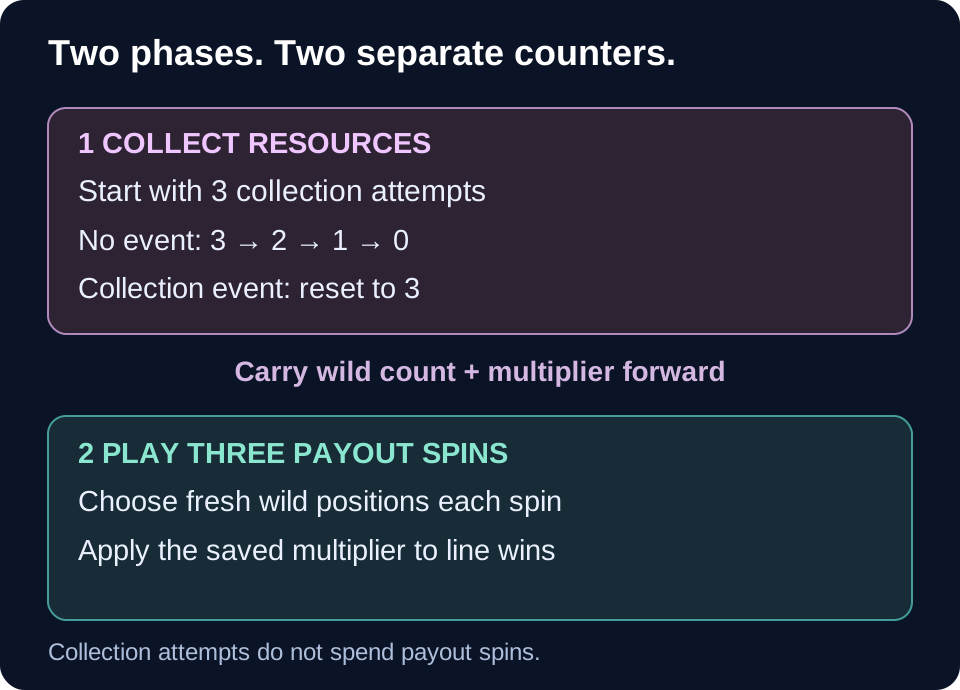
The wild count stays; the positions are chosen again
When the payout phase begins, the stored count determines how many wilds the game attempts to place on each fresh board. Positions are selected again for every payout spin, with duplicate positions skipped within that spin.
If the feature has collected four wilds, it carries a target of four wilds into the next payout board. It does not preserve the four collection-phase positions. The target and the positions are separate: the amount saved belongs to the whole feature, while its arrangement is chosen for each payout spin.
This is the opposite of Train Robbery's positional memory. With the same four-wild target, the next payout board may distribute its wilds across different reels and open different lines.
The combined multiplier then applies to the ordinary total of the payout spin's winning lines. For example, if the lines total 8 units and the accumulated multiplier is 4×, the award before any overall cap is 32 units. That does not mean each wild contributes another 4×. The saved count controls placement; the saved multiplier scales the resulting win.
Those two resources interact. More wilds can change which lines win, while a larger multiplier changes the value of those wins. A bonus with more of one resource is not automatically equivalent to a bonus with more of the other.
Why collection and payout use different reel sets
In our implementation, the collection phase and the payout phase each have a dedicated five-strip reel set: one symbol list per reel. Train Robbery and Duel also have their own bonus sets.
A collection board's main job is to support resource-building events. A payout board's job is to form line combinations after the stored wild resource is applied. Sharing one set would tie those two jobs together unnecessarily.
There is a useful contrast with Book of Tut, where our reel choices depend on the selected expanding symbol. Here, the change is driven by the phase of the bonus. In both cases, the reason to use more than one set comes from a rule the player can understand.
Describe the transitions before balancing the bonus
For a two-phase feature, we would write out a short example like the collection table before attempting large-scale tuning. It exposes questions that a final win total cannot answer: did the counter reset, did a payout spin get consumed too early, did the multiplier survive the transition, and were new wild positions selected?
Focused checks can settle those rules. Broader slot math simulations can then measure the length of collection sessions, the resources they accumulate and the resulting payout distribution. A sample transition or worked win is evidence of a rule, not a measured RTP result.
Across these three bonuses, the reusable lesson is precise: decide whether the feature remembers positions, temporary effects or resources. Once that is clear, the reel choices, counters and win calculations have a defined job.
For another form of memory between spins, read Sugar Rush, where a position keeps its multiplier after the symbol above it has disappeared.
If your next game combines several bonus types, our slot development team can help define and build their rules. Discuss your project with Gamix Labs.