Creating Famous Slots: Big Bass
Creating Famous Slots · Part 5
Three fish land with prizes of 2, 5 and 10 units. The screen looks valuable, but one more ingredient decides whether that catch is collected: a fisherman.
Building our Big Bass-style game meant separating three questions. What are the fish worth? Does this spin collect them? What does the fisherman add to the bonus's progress? Treating those as one calculation makes it surprisingly easy to describe the wrong game.
In The Dog House, wilds stay in specific positions. Here, the bonus remembers a running count even after the symbols that increased it have left the board.
Big Bass Bonanza is a Pragmatic Play title. The rules and examples here come from Gamix Labs' independently developed Big Bass-style game, rather than the manufacturer's private math. The diagrams illustrate our model.
Two ways to earn a win on the same board
Our version has five reels, three rows and ten fixed paylines. Ordinary matching combinations pay along those lines. Alongside them, fish can carry money values that are collected during the bonus.
Those are separate calculations. A fish's printed money value is not its payline award. We first need to know whether the board makes an ordinary line win, then whether the collection rule awards the money values. The final spin can contain either kind of award, both, or neither.
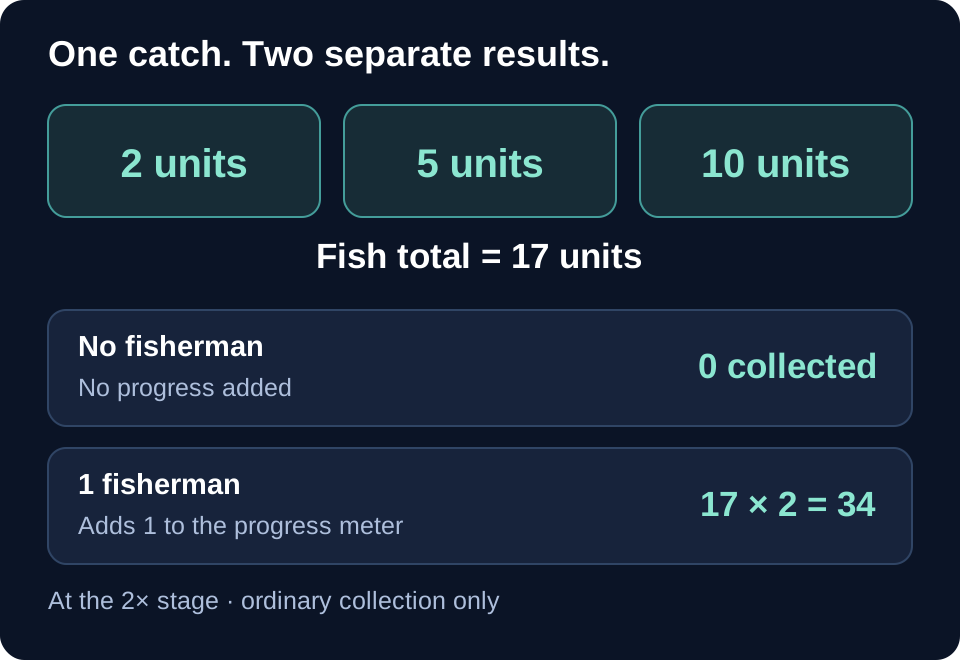
Consider fish worth 2, 5 and 10 units in a free spin. They offer a 17-unit collection total. Without a fisherman, that collection pays zero. This does not mean the whole spin necessarily pays zero: there could still be a qualifying payline elsewhere.
That distinction keeps the explanation on screen honest. The displayed catch, the collection award and the total spin win are three different amounts.
The catch and the progress meter measure different things
In our ordinary free-spin calculation, a fisherman unlocks the sum of the fish values, multiplied by the current bonus stage. It also adds one fisherman to the progress meter.
The size of the catch does not decide how far that meter advances. A fisherman collecting 17 units moves it one step; a fisherman landing without any fish still moves it one step, even though there is no catch to pay.
Our initial board-generation rules allow at most one fisherman on the board. The examples below follow that limit.
At a 2× bonus stage, the example works like this:
| Initial board | Fish total | Collection award | Progress added |
|---|---|---|---|
| Fish, no fisherman | 17 units | 0 | None |
| Fish and one fisherman | 17 units | 17 × 2 = 34 units | 1 fisherman |
| One fisherman, no fish | 0 | 0 | 1 fisherman |
These are examples of the initial collection, before any extra feature actions or separate line wins. We checked both the cash award and the progress added for each case.
For the player, that last row explains why a spin can move the bonus forward without paying a collection prize. For the designer, it means the money collected and the progress earned need to be measured separately.
A fish value is another weighted draw
Landing a money symbol and assigning its value are separate decisions in our model. The reel supplies the symbol; a weighted value table supplies its prize. Think of the weights as tickets in a draw: an entry with twice the weight has twice the chance of being selected.
Our regular value table contains 14 entries but only ten distinct prize values. Some values appear more than once. To understand the actual probability of a value, we have to add together every entry that awards it.
For example, the 1×-bet value occurs in two entries, each with a weight of 700,000. Their combined weight is 1,400,000 out of a total of 3,139,000. So roughly 44.6% of assignments from this table produce a 1× value.
That is not a 44.6% chance of winning on a spin. A fish must first be present, the collection condition must be met, and the stage multiplier determines the collected amount. The percentage describes only the value assignment.
Our purchased-feature value table is separate. That lets us adjust the prizes offered inside that route without assuming that its distribution should be identical to a naturally entered feature. It also means those two routes need separate measurement during math simulation.
The bonus multiplier belongs to a stage
The ordinary progression in our version moves through 1×, 2×, 3× and 10×. The thresholds are cumulative counts of 4, 8 and 12 fishermen.
The same 17-unit catch would therefore be worth 17, 34, 51 or 170 units, depending on the active stage. None of those values tells us how likely the catch or the stage is; they show why the stage is part of the payout calculation.
There is a timing detail that matters just as much as the thresholds. In our version, collecting enough fishermen qualifies the feature for an extension. The extension and higher stage are applied at the end of the current block of free spins, rather than immediately on whichever earlier spin crosses the threshold.
For a standard ten-spin block, consider reaching the fourth fisherman on spin six. The current block continues at its existing multiplier. At its end, the qualifying count allows another ten spins and the move to 2×. The catch that qualified the feature is not retrospectively increased.
We checked that distinction at the boundary: progress can meet the threshold before the last spin without changing the current stage; the block-ending check then grants the extension and updates the multiplier.
This is a useful question for any progression feature: does a milestone change the current win, the next spin, or the next stage? The same artwork can conceal three different payout rules.
Six bonus reel sets give fish and fishermen different controls
Our continuing bonus has six dedicated reel sets, each containing five reel strips. They are organised into standard, fish-focused and fisherman-focused choices, with versions for naturally entered and purchased features. Base play and feature-entry boards have additional setups. A reel strip is the circular symbol list from which one reel's visible symbols are drawn.
| Bonus reel choice | What it lets us tune |
|---|---|
| Standard | The starting mix of ordinary symbols, fish and fishermen |
| Fish-focused | The mix of fish symbols available for a catch |
| Fisherman-focused | The mix of collector symbols before board limits are applied |
The reel set is only one part of that decision. The board-generation rules also limit fishermen after the draw, so a set's name or raw symbol count cannot tell us the final collector frequency. We have to measure the completed board after all those rules have run.
When both fish and fisherman modifiers are active, our implementation chooses between the two specialised reel sets for a spin instead of merging their symbols into one new strip. The selected board still goes through those limits. Combining the strips would be a separate model requiring its own tuning.
Measure the feature as a journey
A final average can hide why a bonus feels the way it does. For a collection game, useful measurements include how often fish land without a collector, how frequently collectors advance the meter without a valuable catch, and how many sessions reach each multiplier stage.
It also helps to separate the money collected before a stage change from the money collected afterward. Otherwise, a feature may appear generous in aggregate while most of its value sits in a stage that few sessions reach.
These are measurements to make in a full simulation, not results established by the small examples in this article. The examples establish the rules; a simulation establishes how often those rules produce each kind of outcome.
That is the design lesson we take from this build: the fish values, the collection condition and the progress meter need their own definitions before they can be tuned together.
Next, Wanted Dead or a Wild takes progression further with a bonus that collects resources first and uses them in a later payout phase. For another form of persistent value, revisit Sugar Rush's position multipliers.
Working on your own collection feature? Our slot game development service covers the rules, math and presentation together. Share your concept with us.