Creating Famous Slots: Book of Tut
Creating Famous Slots · Part 2
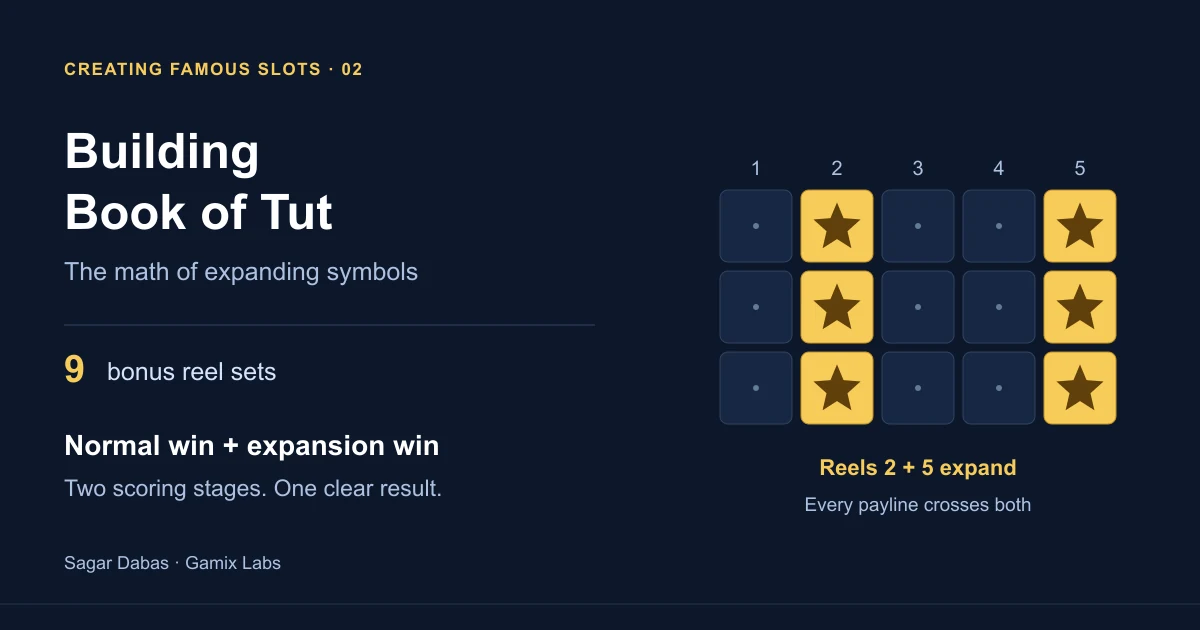
Two matching symbols land on the second and fifth reels. They are on different rows, with gaps between them. Nothing about that arrangement looks like a normal line win.
Then both symbols expand to fill their reels. Suddenly, every payline crosses them. A board that had no ordinary win can now pay through the bonus feature.
That change is the interesting part of building a Book of Tut-style slot. It raises a practical question: how can the same board have two different ways of being paid?
In Part 1, Sticky Bees, we explored wild positions that carry over between free spins. This time, we will look at a different kind of bonus: choosing one special symbol, giving it its own reel setup, and evaluating what happens when it expands. The examples come from our own implementation, and you do not need to read code to follow them.
John Hunter and the Book of Tut is a Pragmatic Play game. This article explains lessons from Gamix Labs' independently developed version. The reel choices, probabilities and payout examples below describe our model; they do not reveal the original game's proprietary math. The diagrams are simplified illustrations.
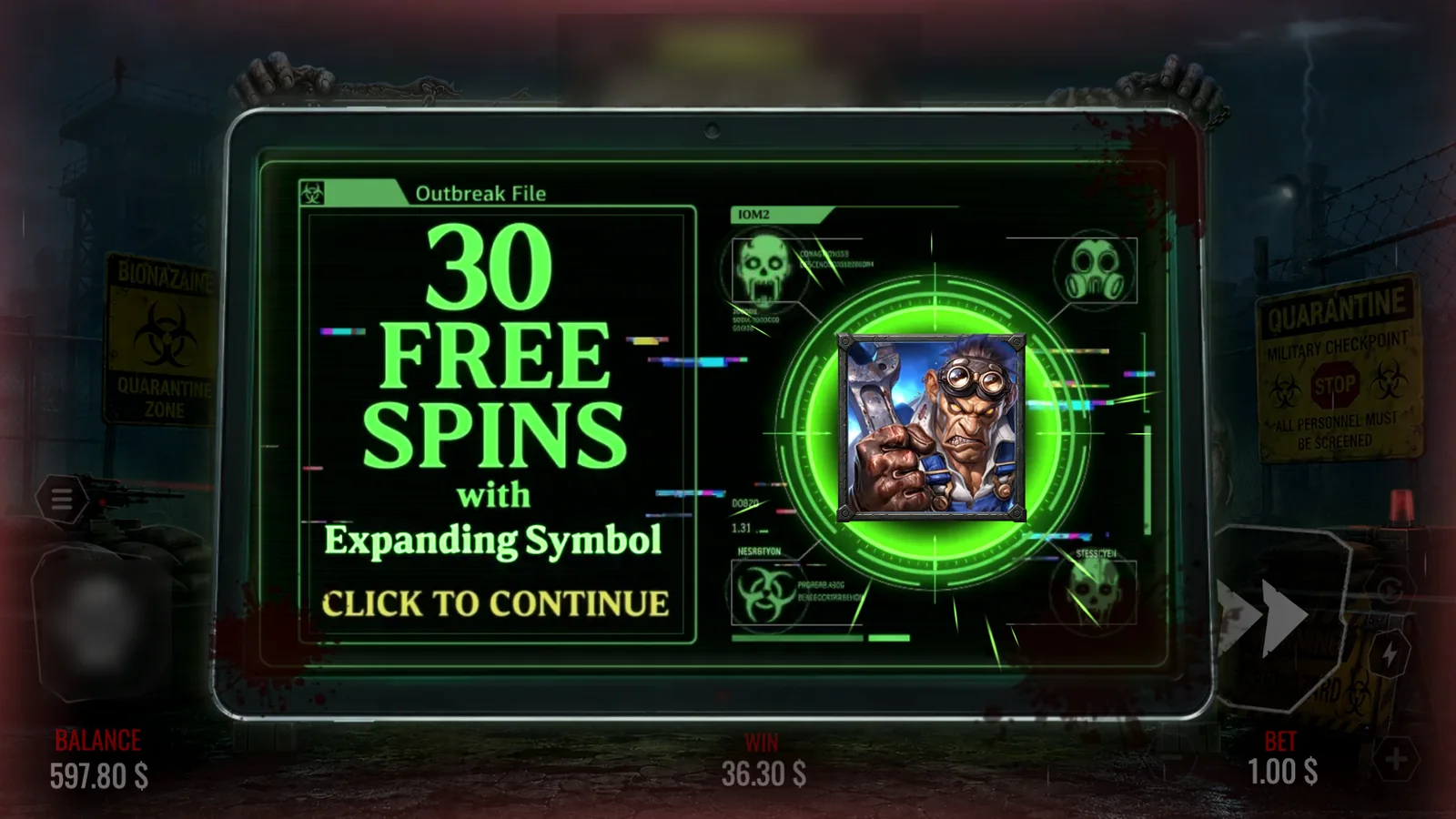
The gameplay screenshots show these mechanics in our themed build, with a 30-spin bonus and a ×4 modifier. The worked examples use the ten-spin configuration described here.
Start with the two jobs of a book symbol
Our version has five reels, three visible rows and ten paylines. A payline is a fixed path through the board, taking one position from each reel. Some run straight across; others change rows.
Ordinary wins are evaluated from the leftmost reel. Matching symbols must continue along the payline until the required number is reached. A matching pair on reels two and five does not satisfy that rule.
The book has two jobs. It substitutes for paying symbols in ordinary line wins, and it acts as a scatter: three or more books anywhere on the board trigger ten free spins.
At the start of the bonus, the game selects one of nine paying symbols as the expanding symbol. That choice remains in place for the free-spin session. On each new spin, the game looks for fresh appearances of that symbol and checks what their expansion pays.
The selected symbol is what persists. The expanded columns are formed from the current spin's board. That distinction tells us what the game needs to remember between spins, and what it needs to work out again.
Why we gave each bonus symbol its own reel set
The most useful design choice in our implementation is easy to miss while playing: selecting the expanding symbol also selects its free-spin reels.
We use nine dedicated free-spin reel sets, one for each possible expanding symbol. Each set contains five strips, one per reel. A strip is an ordered list of symbols from which the game takes its visible window.
This gives the bonus more flexibility than changing the selected symbol alone. A premium symbol may pay from fewer reels, while a lower-paying symbol needs a wider spread. Their appearance patterns can therefore need different treatment.
| Part of the game | Reel setup | Design purpose |
|---|---|---|
| Ordinary paid spin | A base-game set | Shape the board before book placement |
| Bought-feature entry | A separate entry set | Build the board that introduces the bonus |
| Free spins | One of nine symbol-specific sets | Shape the opportunities around the selected expanding symbol |
Our symbol-specific free-spin strips are 24 or 26 positions long. The base-game strips are 29 or 32 positions long. Those lengths describe the lists we used; length alone does not tell us how generous a reel will be. The symbols, their order and the rules applied after the window is drawn all matter.
For example, repeating a symbol vertically within one reel creates a different opportunity from spreading it across three reels. In this feature, the number of different reels containing the selected symbol is particularly important.
The practical lesson is to evaluate each symbol together with the reels used for its bonus. A large payout in the paytable does not, by itself, tell us the average value of that symbol's free-spin session.
Expansion changes how the board is evaluated
We score a free spin in two stages.
First, score the ordinary paylines on the original board. At this point, the symbols are still exactly where they landed.
Then, evaluate the selected symbol's expansion. Every reel containing that symbol is filled with it. The expansion award counts the selected symbols along each payline, including appearances separated by other reels.
This second rule makes the opening example possible. A selected symbol on reel two and another on reel five occupy two different reels. Once those reels expand, every one of the ten paylines crosses two copies of the selected symbol.
The reels do not have to be adjacent for this expansion award. The selected symbols also do not have to land on the same row.
There is an important limit to that idea: two selected symbols on the same reel still produce only one expanded reel. Filling a column does not make it count twice. Simply counting the number of matching pictures anywhere on the board would produce the wrong answer.
A worked example: two separated reels, ten paying lines
Let us use the highest-paying symbol in our model and a total bet of 1 unit. The star in the diagram represents that selected symbol. Other cells are left neutral so the two affected reels are easy to follow.
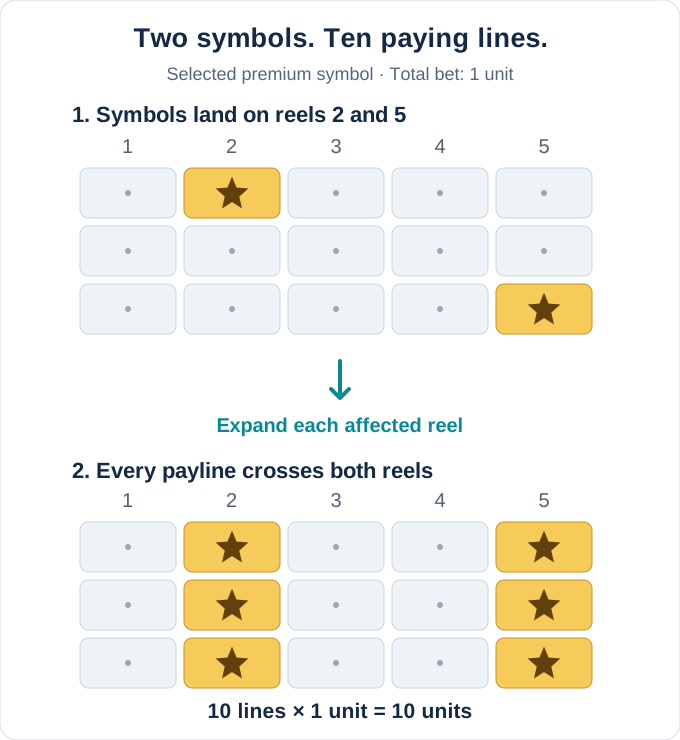
The total bet is divided across ten lines, so each line carries 0.1 unit. In our paytable, two copies of this premium symbol pay 10 times the line bet.
| Calculation | Result |
|---|---|
| Bet per line: 1 ÷ 10 | 0.1 unit |
| Expansion payout on each line: 10 × 0.1 | 1 unit |
| Ten paying lines: 10 × 1 | 10 units |
On the board we used to check this example, the ordinary line payout was zero. The expansion added 10 units, giving a total of 10 times the total bet.
This is why it helps to label the units in a slot-math example. “Pays 10” could mean ten times the line bet or ten times the total bet. Here, each line pays the former, and the ten lines together produce the latter.
Now consider a separate board with the same premium symbol on the first two positions of the middle horizontal payline. In our checked example, that produces an ordinary win of 1 unit. Expanding those two reels then adds another 10 units. The result is 1 + 10 = 11 units.
Both stages contribute. Scoring only the expanded board would lose the distinction between the original line win and the feature award.
Why some symbols need two reels and others need three
The selected symbol does not qualify for an expansion payout merely because it appears.
Our paytable divides the nine possible selections into two groups:
| Selected symbol group | Number of symbols in the group | Minimum different reels for an expansion payout |
|---|---|---|
| Premium symbols | Four | Two |
| Lower-paying symbols | Five | Three |
These thresholds follow the paying combinations in our paytable. They are not separate promises that every pair or trio of symbols on screen wins.
We checked the same two-reel arrangement with a lower-paying symbol: it produced no expansion award. Adding that symbol to a third reel made the arrangement eligible. For the lower-paying symbol used in that example, the three-reel expansion paid 1 unit in total at a bet of 1.
That difference affects how a bonus feels. Two appearances can already be enough for a premium selection, while another selection needs the player to see it spread further across the board.
It also explains why testing only one selected symbol is insufficient. The game has nine possible bonus setups, with different minimum combinations and different payouts. Each needs to be checked with its own reels.
Bonus frequency is a separate design decision
Reel strips are only part of our starting-board logic. Ordinary paid spins use a separate draw to decide how many books to place, with at most one placed on each reel.
In this configuration, the draw has 1,200 equally likely outcomes. Five request enough books to start free spins:
| Books requested | Qualifying outcomes out of 1,200 |
|---|---|
| Three | 2 |
| Four | 2 |
| Five | 1 |
| Total that trigger the bonus | 5 |
The configured entry chance for an ordinary paid spin is therefore 5 ÷ 1,200 = 1 in 240, or about 0.42%. This is a probability derived from the placement rule, rather than a result measured from a simulation. It does not mean a bonus arrives on every 240th spin.
Bought-feature entry follows a different path: it requests three books directly. That is another reason to keep the entry rules explicit when comparing normal play with buying the feature.
The useful distinction for a developer is between how often the bonus starts and what happens once it starts. Book placement controls the first part. The selected symbol, its reels and the expansion payouts shape the second.
Changing the entry chance leaves the bonus rules untouched, but changes how often those rewards contribute to the paid game. Changing a symbol's bonus reels can alter feature value while leaving the entry chance alone. Both decisions need to be considered together when balancing the complete game.
Let the player follow both scoring stages
The two-stage calculation also shapes the presentation.
Our game result keeps the original board and its ordinary wins separately from the expanded board and its expansion award. That gives the frontend the information needed to show a clear sequence:
- Reveal where the symbols landed.
- Show any ordinary line wins.
- Highlight and expand the selected symbol's reels.
- Show the expansion award and update the total.
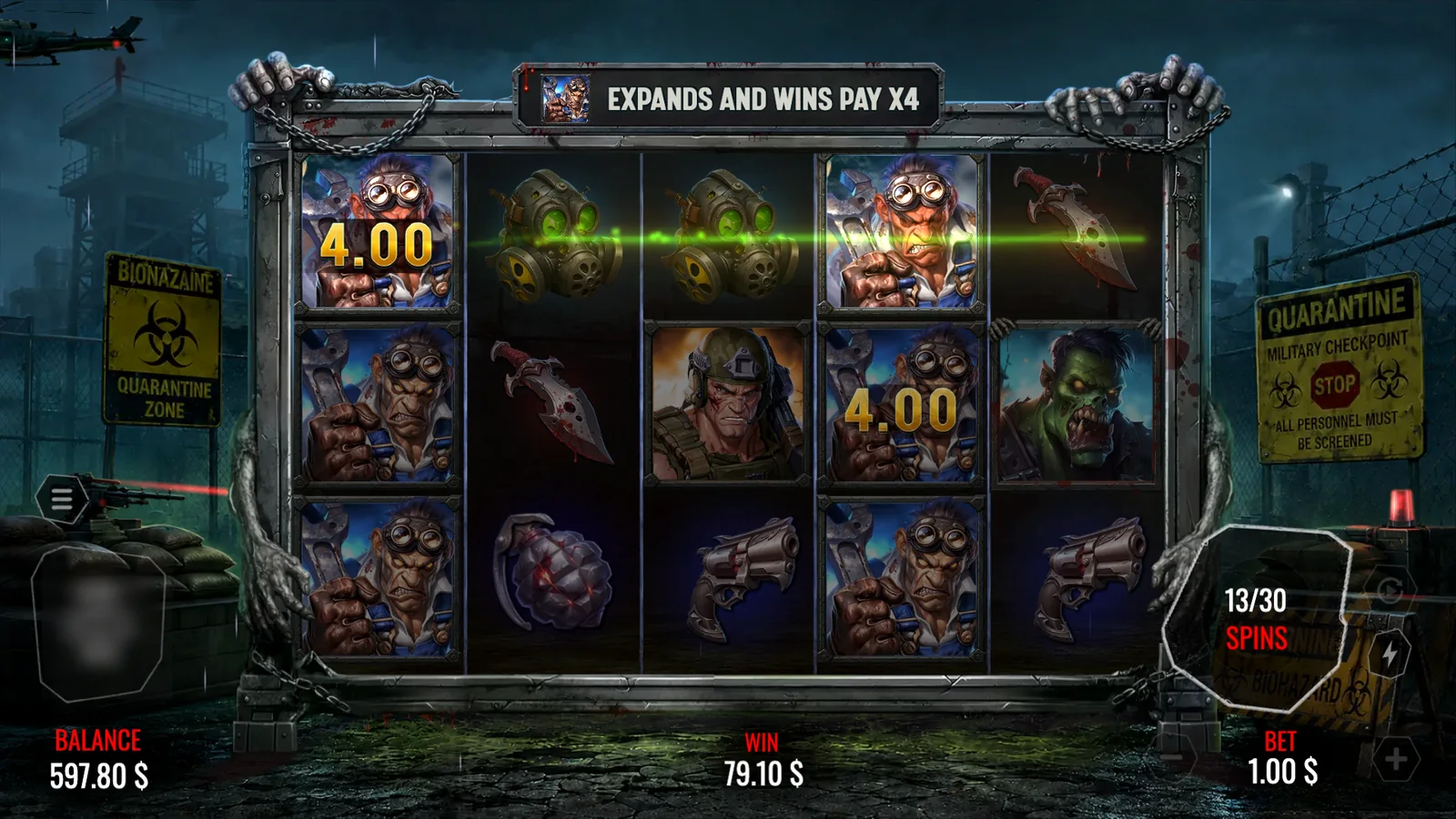
For the 11-unit example above, the player should be able to follow the ordinary 1-unit win and the additional 10-unit feature win. Showing only the last board would make that total harder to understand.
The same principle applies when a session is resumed. The selected bonus symbol and the remaining free spins belong to the game state. Remembering only the last payout would not be enough to continue the same feature.
Build and test the nine bonus setups together
If you are creating this kind of slot, a useful build order is:
- Make ordinary line wins work. Start with the five-by-three board, ten payline paths, book substitution and clearly labelled bet units.
- Define bonus entry. Decide how books appear, how many trigger the feature and how bought entry differs.
- Choose the bonus symbol and its reels together. Keep that selection for the session.
- Add the expansion award as a second stage. Check separated reels, repeated symbols within one reel and each symbol's minimum paying combination.
- Evaluate every bonus selection. Compare how frequently each expands, its average session payout and its payout spread before combining the results into an overall picture.
Small examples establish whether the rules work. Longer simulations are then useful for understanding how those rules behave across many rounds. A single average across all bonuses can hide substantial differences between the nine selections.
The main lesson from our implementation is that an expanding symbol is connected to several parts of the design: the reel set chosen for the session, the combinations that qualify, the order of scoring and the way the result is shown. Building those parts together makes the feature easier to explain and easier to test.
Continue with Part 3: Sugar Rush, where we explore multiplier positions that retain their history while the symbols tumble away.
For a different reason to separate bonus reel sets, read Part 6: Wanted Dead or a Wild, where collection and payout happen in different phases.
For more background, read our guide to how free spins are designed. If you are planning your own slot, explore our slot math and simulation services, or talk to Gamix Labs about your game.