Creating Famous Slots: Sticky Bees
Creating Famous Slots · Part 1
A wild lands, helps complete a winning group, and stays on the board for the next spin. Add a few more wilds and the bonus starts to feel different: places that were ordinary a moment ago now help connect new wins.
That is the appeal of a sticky-wild feature. Building it means answering some less obvious questions. What replaces a winning symbol? Can one wild help two groups win at once? And how much does one extra free spin matter when the board has already collected several wilds?
Welcome to our Creating Famous Slots series. In each article, we will explore a familiar slot and share practical lessons from building our own version. We are starting with Sticky Bees: the reel choices, cascading wins and persistent wilds that make this kind of game interesting. You do not need to read code to follow along.
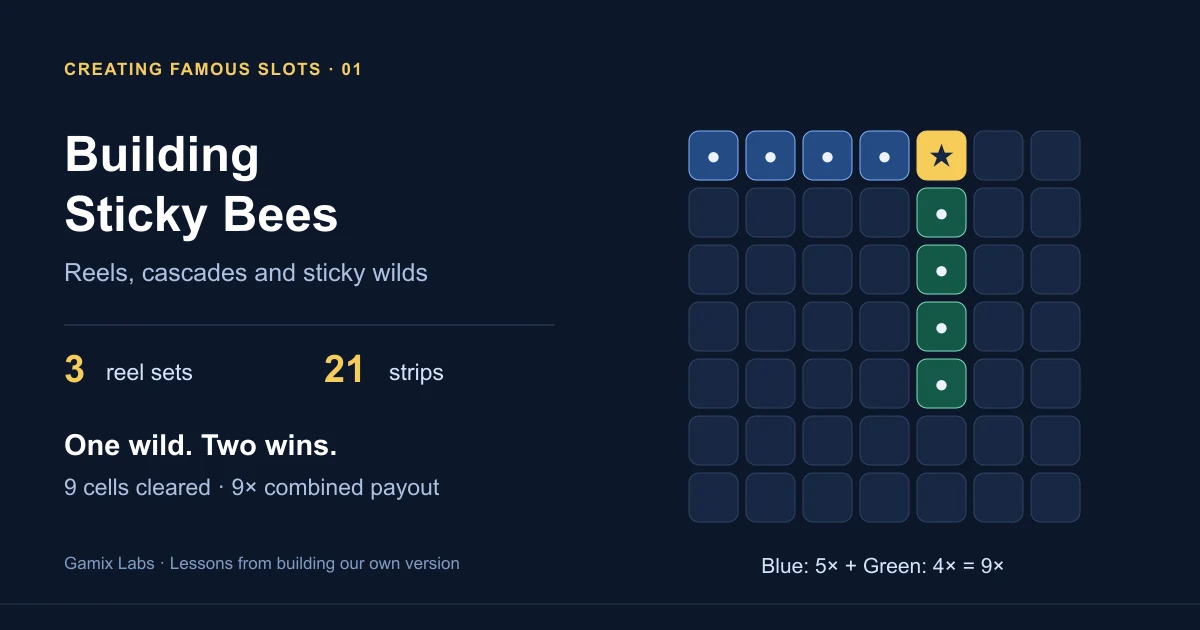
Sticky Bees is a Pragmatic Play game. This article draws on Gamix Labs' independently developed version of its mechanics. The design numbers and payout examples below describe our version; the original game's underlying math is proprietary.
The gameplay screenshots show our own themed implementation. The fruit symbols in the diagrams are simplified illustrations of the math examples.
Start with the experience you want to build
Our version uses a 7 × 7 board. Five or more matching symbols touching horizontally or vertically form a winning group, called a cluster. Diagonal neighbours do not connect.
After a win, the winning symbols disappear. The remaining symbols drop into the gaps, and new ones arrive from above. If that creates another win, the process repeats. These repeated drops are called cascades.
The bees add another layer. They activate wild positions, which can stand in for ordinary symbols. During free spins, those positions are meant to remain active as the feature continues.
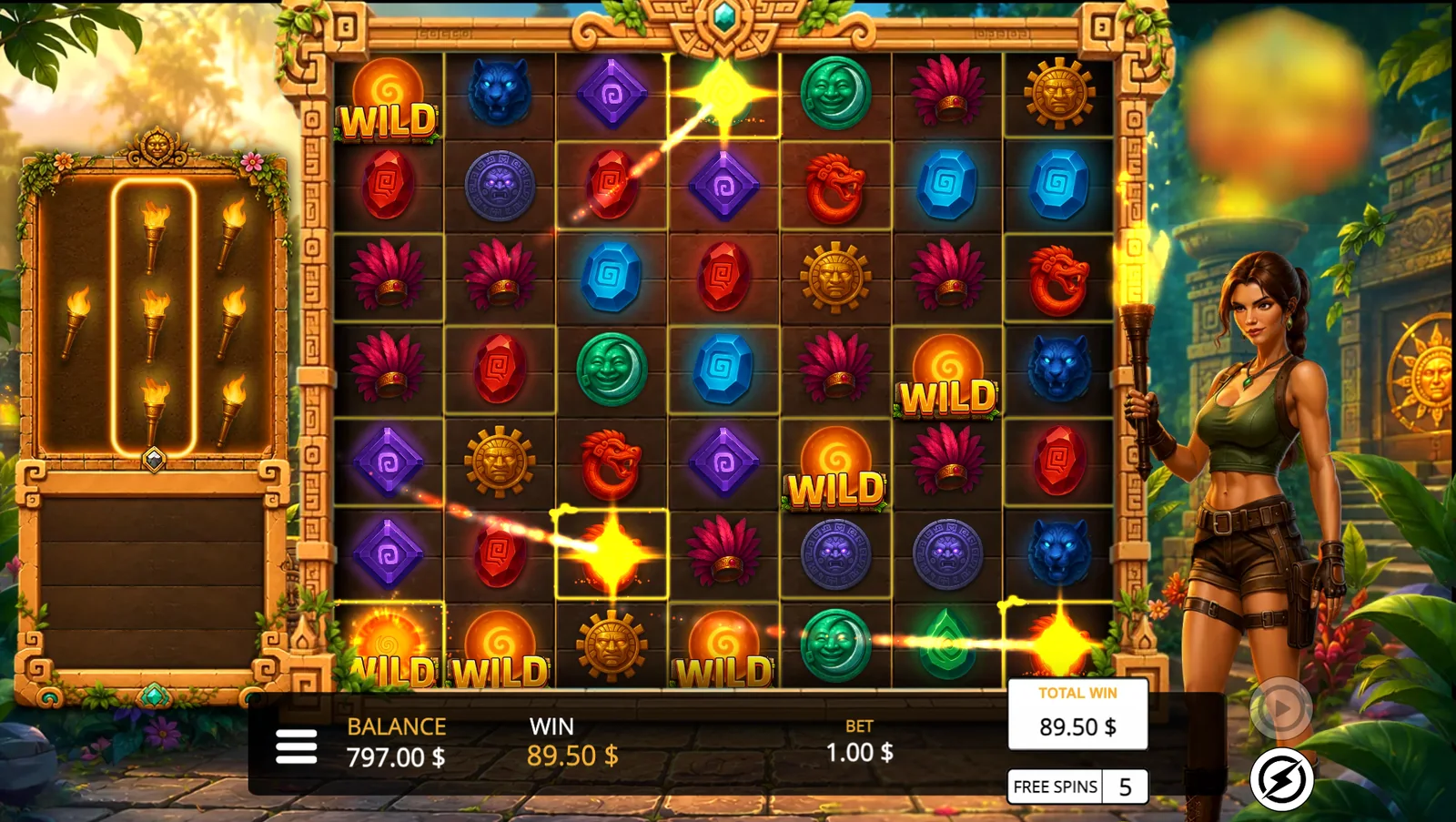
The design challenge comes from combining those rules. A cascade clears winning cells, but a sticky wild needs its position remembered. More wilds can connect more groups, which can create more cascades. Those cascades then give the board more opportunities to win again.
Before choosing payouts, we need to understand that chain of events. Changing one part can affect several others.
Why we used three reel sets
A digital reel strip is an ordered list of symbols. The game chooses a starting position and takes a visible section from that list. Changing the list changes which combinations can appear together.
We used three sets of seven strips: 21 distinct strips in total. Each set has a different job.
| Reel set | When it is used | What it lets us shape |
|---|---|---|
| Opening reels | The first board of a paid spin | The starting mix of symbols, bees and scatters |
| Refill reels | New symbols arriving after a base-game win | How a cascade can continue after the opening result |
| Free-spin reels | Opening boards and refills during free spins | The ordinary symbol mix around accumulated sticky wilds |
That separation is useful because the opening board and a refill are different situations. The opening board starts fresh. A refill must fit around symbols that survived the previous win, including positions influenced by the feature.
For example, our opening strips include bee symbols, while our base-game refill strips do not. A cascade therefore does not keep introducing fresh bees from the reels. This gives us a way to shape cascade behaviour separately from the opening bee event.
Our free-spin strips contain ordinary wilds, but bees are introduced through a separate feature rule. That lets us adjust the background symbol mix and bee activity independently.
Reel design is about deciding what each stage needs. Using one set everywhere would tie those stages together: a change intended to improve the first drop could also alter every cascade and every free spin.
Give small wins room to grow
There is another part of our opening-board design that cannot be explained by the reels alone.
On average, 17 out of every 100 starting boards take an additional step that attempts to place a small connected group. On that path, the requested group has five symbols about 82% of the time and six symbols about 18% of the time.
Those numbers describe a design choice, not a promise that 17% of spins will win. The other starting boards can form wins naturally. A placed group may join matching neighbours, and bees can change the result again.
Why begin with a small group? It gives the cascade a starting point while leaving room for the rest of the board to matter. Imagine five matching symbols disappearing near the bottom of a column. The symbols above fall, fresh symbols arrive, and a different group may connect.
The lesson from this approach is to separate starting a cascade from deciding how far it can go. The opening-board rules influence the first opportunity; refill symbols and the surviving board influence what follows. Both must be tested together to understand the complete payout pattern.
One wild can help two different groups win
Wilds sound simple: they substitute for other symbols. In a cluster game, that leaves an important question unanswered. Can the same wild belong to two winning groups?
In our version, it can.
Imagine four blue fruit symbols in a row, with a wild beside them. Below that same wild are four green fruit symbols. The wild completes both groups.
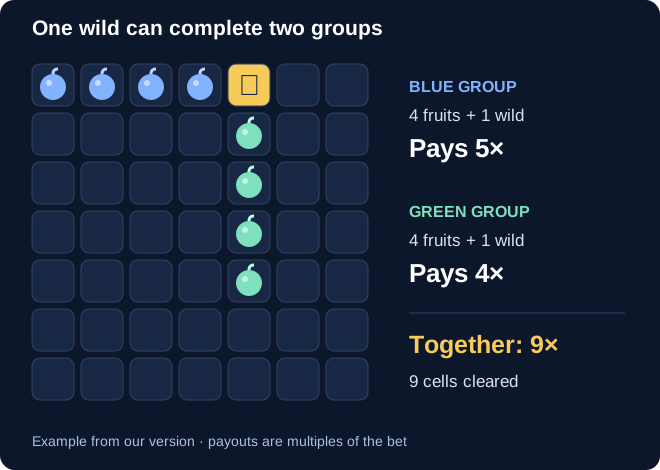
For a total bet of 1, the corresponding five-symbol groups in our payout table award:
| Group | Payout |
|---|---|
| Four blue fruits plus the wild | 5 |
| Four green fruits plus the same wild | 4 |
| Total for the two groups | 9 |
Both wins count. But when the symbols disappear, there are only nine different cells to clear. The wild has helped twice and disappears once.
We also require each winning group to contain at least one actual symbol of the fruit being paid. A group made entirely of wilds cannot claim the payout for every fruit at once. In our model, an all-wild board produces no cluster payout under this rule.
This is a small rule with a large effect on the game's behaviour. “Wilds substitute for everything” needs a clear explanation of how shared wilds and all-wild groups are treated.
Remember the position, not just the picture
A sticky wild needs to survive two kinds of change: a cascade within the current spin, and the arrival of the next free spin.
Consider a sticky wild in the centre of the board. It helps complete a winning group. The win is paid, the group disappears and symbols fall into the empty spaces. The game still needs to know that the centre position is sticky, even if the visible symbols have changed.
Our approach keeps a separate record of the positions activated by bees. The ordinary board answers “what is visible now?” The remembered positions answer “what must remain active?”
That distinction also prevents ordinary wilds from accidentally becoming permanent. A wild that arrives from a free-spin reel may look similar during a win, but it has not necessarily earned the sticky behaviour of a bee-activated position.
The timing matters just as much as the record. If a newly activated position is remembered only after the first refill, it can disappear during the very win it helped create. The design needs to account for new sticky positions before that refill takes place.
The practical lesson is to test the first winning cascade after a bee activates. A feature can look correct on a quiet spin and still lose its intended behaviour when symbols start moving.
Decide what happens when special symbols meet
Now imagine a scatter arriving at a position reserved for a sticky wild. Scatters are the special symbols used to trigger free spins. If the sticky wild takes over that position, does the scatter still count towards the bonus?
That decision belongs in the game rules. It should be settled before the animations are built.
One possible design gives a scatter credit when it lands. Another counts only the scatters visible at a particular point in the spin. Those choices can produce different bonus frequencies, even with the same reels.
There is a second trap: a scatter can stay on the board through several cascades. Counting it again on every drop would turn one arrival into several. Counting only the last board, on the other hand, could discard an earlier arrival if the rules were meant to recognise it.
Working through these situations taught us to define when a symbol earns its effect, as well as where it appears. The player should be able to follow the same rule on screen.
Why one extra free spin can change more than you expect
During the base game, a bee can spread activity to additional marked positions. During free spins, our version converts the landed bee in place. The bonus builds through the positions carried forward from one spin to the next.
This creates a different kind of progression. Early in the feature, relatively few positions may be sticky. Later, the same symbol drop could connect differently because more helpful positions have accumulated.
Suppose you change a bonus from seven free spins to eight. It is tempting to estimate the extra cost as “one more average spin.” But the eighth spin begins with the board history created by the first seven. Its value depends on how many sticky positions have accumulated and where they are.
Position matters too. Two nearby wilds may help connect one large group. Two separated wilds may support different groups. Counting wilds alone does not fully describe the opportunity.
This does not mean every later spin will pay more. It means bonus length and sticky accumulation must be evaluated together. The same applies to retriggers that add spins after the feature has already developed.
In our natural-entry rules, four scatters award seven free spins and five award eight. That change needs to be assessed as a different bonus experience, rather than assumed to add a fixed amount of value.
For the wider choices around bonus length, triggers and feature types, see our guide to how free spins are designed.
Test the journey, not only the final win
A final payout can hide a great deal. Two rounds paying the same amount might reach it through one large cluster, several small cascades or a bonus that builds gradually.
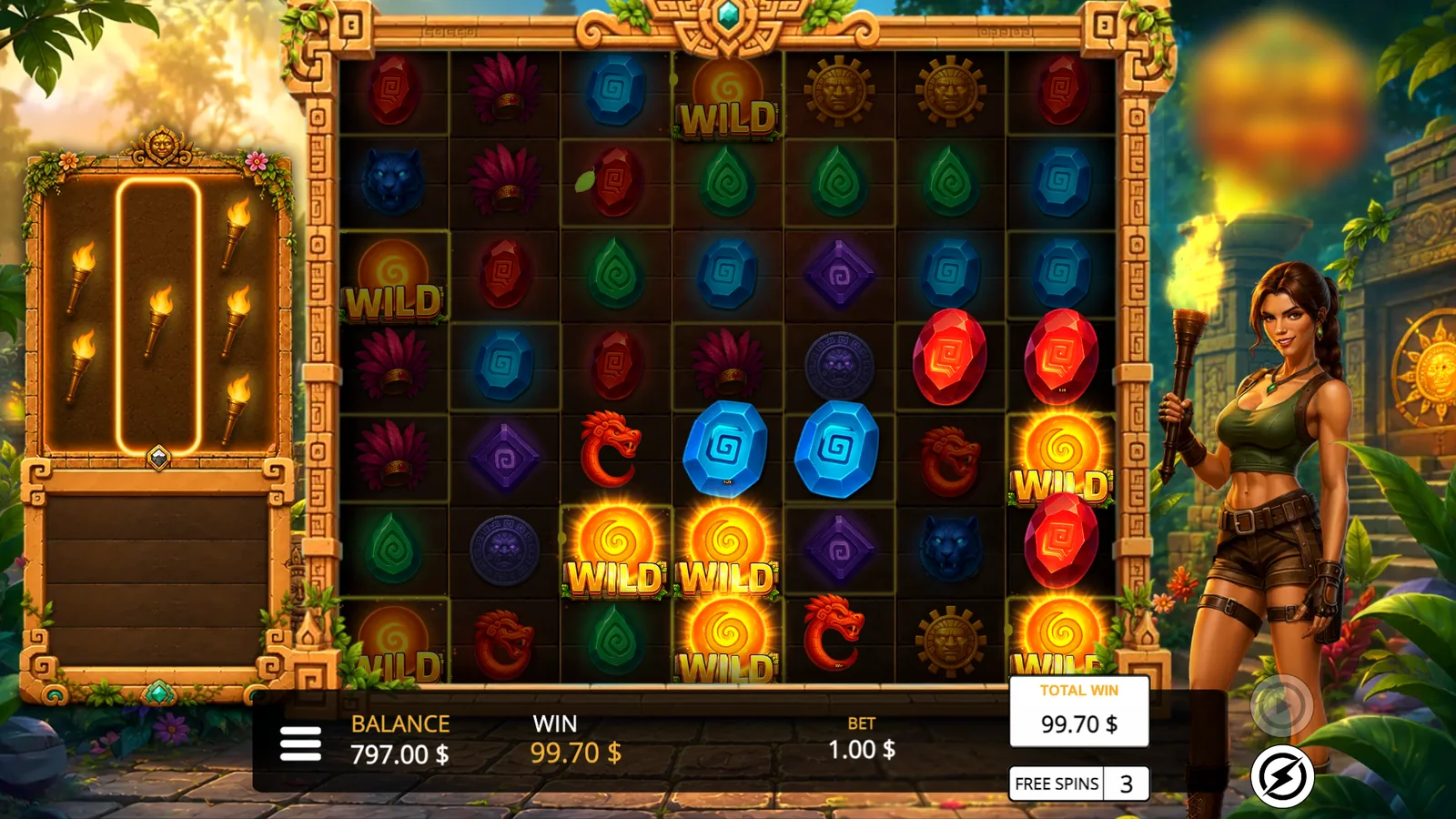
When evaluating a game like this, useful questions include:
- How often does the opening board win, and how often do refills extend that win?
- Do bees add new sticky positions, or land on positions already activated?
- How do payouts change with the number and arrangement of sticky wilds?
- What happens when a scatter and sticky position compete for the same cell?
- Does the animation explain each win and show the correct board afterwards?
Long simulations help estimate the payout pattern. Small, deliberately constructed examples help establish whether an individual rule works. We used the shared-wild example above to check that both groups pay while their common cell is cleared only once.
There is a practical server lesson here as well: a player returning to an unfinished bonus needs the same sticky positions and remaining spins. Saving only the balance would lose part of the feature they had already built.
These details shape the experience just as surely as the payout table does.
A practical order for building your own version
For someone starting out, the work becomes easier to reason about when each layer is added in order:
- Build ordinary cluster wins. Start with the board, matching symbols, a five-symbol minimum and a clear payout table.
- Add cascades. Clear winning cells, preserve the survivors and refill the gaps. Check that one cell shared by two wins is removed once.
- Introduce bee activity. Define the marked positions and how bees turn them into wilds.
- Add persistence across free spins. Keep ordinary wilds distinct from sticky positions, and decide how scatters interact with them.
- Balance the complete game. Measure the opening drop, cascades and bonus together, including longer bonuses and the maximum-win rule.
The most useful lesson from building our version was that these features cannot be balanced in isolation. Reel choices affect cascades. Cascades interact with sticky positions. Sticky positions change what an extra free spin can be worth.
That is what this series will explore: the decisions behind recognisable slot mechanics, using lessons from games we have actually built. Each instalment will turn those decisions into examples readers can understand and apply to their own designs.
Continue with Part 2: Book of Tut, where we explore nine bonus reel sets and how expanding symbols create a second scoring stage.
For a comparison of sticky wilds on fixed paylines, see Part 4: The Dog House, where each remembered position also retains a multiplier value.
If you are planning a slot with cascading wins or persistent features, explore our slot math and simulation services, or talk to Gamix Labs about your game.