What Is Hit Frequency in Slot Games and Why Does It Matter?
When casino operators evaluate a new slot game, the first specification they usually check is the Return to Player (RTP). Some also consider volatility, maximum win, or bonus features. However, one equally important metric is often overlooked—hit frequency.
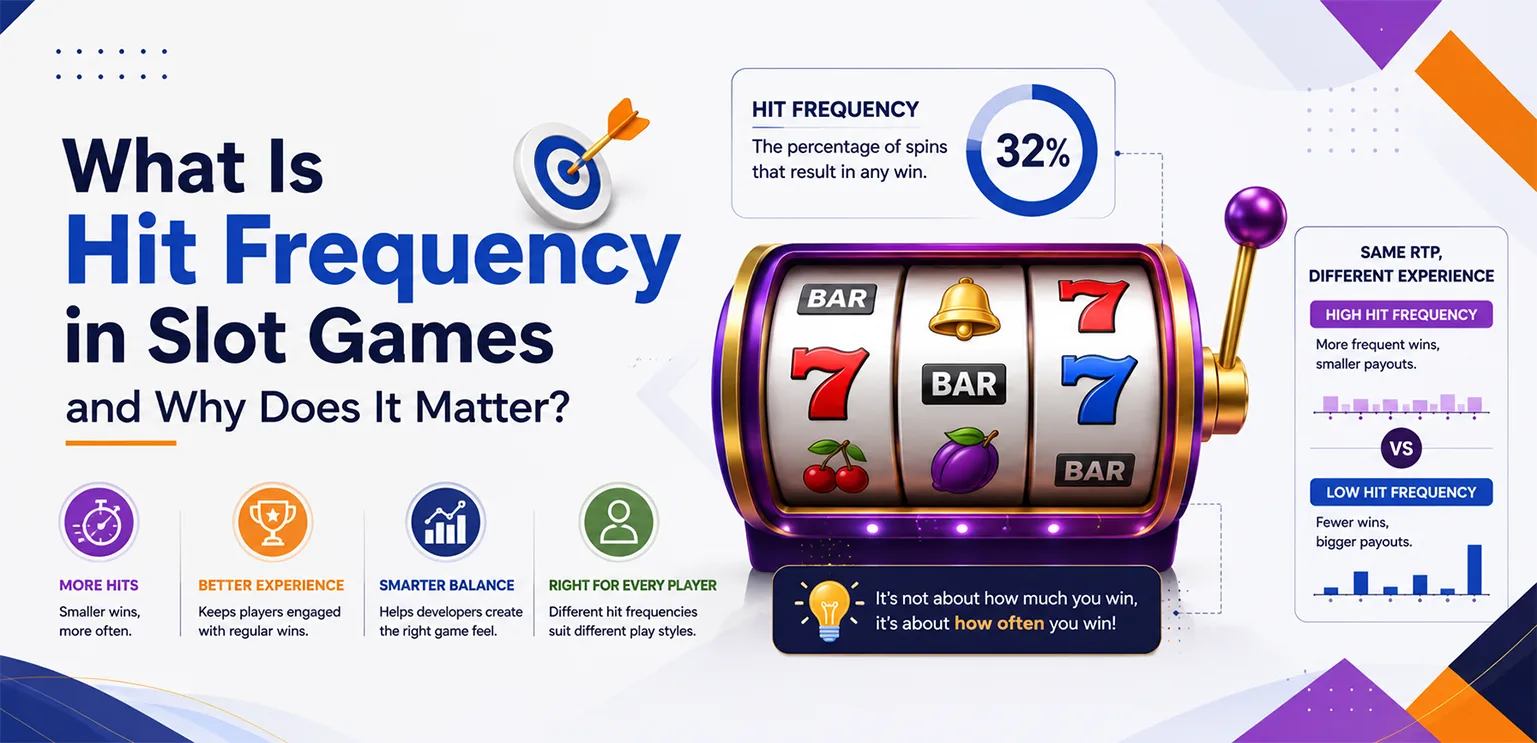
Hit frequency plays a major role in shaping how a slot game feels during play. It influences how often players experience winning spins, affects the rhythm of the gameplay, and helps define whether a game feels rewarding or challenging. While it doesn't determine the total amount a game returns over time, it significantly impacts the player's perception of the experience.
For developers, hit frequency is one of the core components of a slot game's mathematical model. It is carefully balanced alongside RTP, volatility, pay-tables, and bonus mechanics to create the intended gameplay experience. For casino operators, understanding hit frequency makes it easier to compare games, build a balanced portfolio, and select titles that match different player preferences.
In this guide, we'll explain what hit frequency means, how it differs from RTP and volatility, why it matters, and how it influences the overall design and performance of modern slot games.
What Is Hit Frequency?
Hit frequency refers to how often a slot game produces any winning outcome over a many spins. A "hit" simply means that a spin results in a payout, regardless of whether the prize is large or small. In simple terms, hit frequency answers the question:
"How often can players expect to see a winning spin?"
For example, if a slot game has a hit frequency of 30%, it means that, statistically, around 30 out of every 100 spins result in some type of winning combination over long-term play.
It's important to understand that hit frequency does not indicate how much players will win. It only measures the frequency of winning events, not their value. A game with frequent small wins can have the same overall RTP as a game that offers fewer but much larger payouts. This is why hit frequency should always be evaluated together with other mathematical metrics rather than on its own.
How Hit Frequency Works
Every slot game is built on a mathematical model that assigns probabilities to symbol combinations and gameplay events. These probabilities determine how often different outcomes occur during play. Hit frequency is calculated by analyzing a very large number of simulated spins rather than short gameplay sessions. Individual player experiences may vary significantly, but long-term statistical testing reveals how frequently winning outcomes occur overall.
Several factors influence hit frequency, including:
- Symbol distribution: The probability of symbols appearing on the reels directly affects how often winning combinations are formed.
- Pay-line or ways-to-win structure: Games with more winning opportunities may produce more frequent hits, although individual payouts may be smaller.
- Bonus mechanics: Features such as expanding wilds or cascading reels can increase the number of winning events during gameplay.
- Game mathematics: RTP, volatility, and hit frequency are balanced together to achieve the intended player experience.
Because these elements work together, changing one part of the game often requires adjustments elsewhere in the mathematical model.
Why Hit Frequency Is Important
Many people assume that players judge a slot game only by its biggest wins. In reality, the overall playing experience is often influenced by how regularly the game provides positive feedback. Frequent winning spins can make a game feel more active and engaging, even when individual payouts remain relatively modest.
For casino operators, understanding hit frequency offers several advantages:
- Better game comparisons: Two games with identical RTP values may perform very differently because one provides more frequent winning moments than the other.
- Improved portfolio planning: A balanced mix of different hit frequencies allows operators to serve players with varying gameplay preferences.
- Stronger player engagement: Games that deliver consistent feedback often encourage players to continue exploring the experience.
- More informed purchasing decisions: Looking beyond RTP helps operators evaluate games from a broader mathematical perspective.
Hit frequency should not be viewed as a measure of game quality. Instead, it is one of several characteristics that define how a game behaves over time.
Hit Frequency vs RTP
One of the most common misconceptions is that hit frequency and RTP represent the same thing. Although they are closely related, they measure completely different aspects of a slot game.
| Hit Frequency | RTP |
|---|---|
| Measures how often players receive a winning spin. | Measures the theoretical percentage of wagers returned over the long term. |
| Focuses on the frequency of wins. | Focuses on the total value returned over millions of spins. |
| Does not indicate payout size. | Does not indicate how often wins occur. |
| Helps shape gameplay rhythm. | Helps define the game's long-term mathematical return. |
To better understand the difference, consider two hypothetical games.
Game A produces winning spins regularly, but most rewards are relatively small. Game B produces fewer winning spins, but when players do win, the payouts tend to be significantly larger.
Both games could have an identical RTP of 96%, yet they would feel completely different because their hit frequencies and payout distributions are different. This example highlights why experienced operators evaluate multiple mathematical metrics rather than relying solely on RTP.
Hit Frequency vs Volatility
Hit frequency and volatility are also frequently confused, but they describe different aspects of gameplay.
Volatility refers to how rewards are distributed, while hit frequency describes how often winning spins occur. For example:
- High hit frequency with low volatility: Players experience regular wins that are generally smaller, creating a smoother and more consistent gameplay experience.
- Lower hit frequency with high volatility: Winning spins occur less often, but they may produce larger payouts or more valuable bonus events.
- Balanced hit frequency with medium volatility: Many modern slot games aim for a mix of regular wins and occasional larger rewards to appeal to a broad audience.
Although these metrics influence one another, they are not interchangeable. A game's volatility cannot be determined simply by looking at its hit frequency, and vice versa.
How Hit Frequency Shapes the Player Experience
Players rarely think about mathematical models while enjoying a slot game, but they quickly notice how the game feels. Hit frequency contributes to that feeling in several important ways.
- Creates gameplay rhythm: Regular winning spins help establish a steady pace that keeps players engaged between bonus features.
- Builds anticipation: Longer gaps between wins can increase excitement for players who enjoy higher-risk experiences.
- Supports emotional engagement: A balanced mix of small wins, bonus triggers, and larger rewards creates a more memorable gameplay journey.
- Complements visual design: Great artwork and animations become even more effective when paired with satisfying gameplay progression.
Developers carefully balance hit frequency because it directly influences how players perceive the overall entertainment value of the game.
Why Hit Frequency Is Not About Winning More
A common misunderstanding is that a higher hit frequency automatically means players will receive more money. This is not necessarily true. Imagine two slot games:
Game One awards frequent small prizes that help maintain a steady playing experience. Game Two awards fewer wins, but those wins may be considerably larger.
Over millions of spins, both games could return the same theoretical RTP even though one produces many more winning events than the other. For this reason, hit frequency should always be considered alongside RTP, volatility, payout distribution, and bonus mechanics rather than in isolation.
What Determines Hit Frequency in a Slot Game?
Hit frequency isn't chosen randomly during development. It's the result of numerous mathematical decisions made throughout the design process. Every adjustment to the game's mechanics can influence how often players experience winning spins. Rather than focusing on a single setting, developers balance multiple mathematical variables until the game delivers the intended player experience.
Some of the biggest factors include:
- Symbol probability: The likelihood of each symbol appearing on the reels directly affects how often winning combinations occur. Frequently appearing symbols generally increase the number of winning spins, while premium symbols remain less common to preserve game balance.
- Reel strips and symbol placement: Every reel contains symbols arranged in a specific order. The number of times a symbol appears on each reel significantly influences its probability of forming winning combinations.
- Winning mechanics: Traditional pay-lines, Cluster Pays, Megaways®, or All-Ways systems each create different mathematical opportunities for forming wins. The game mechanic itself can influence how often players experience successful spins.
- Feature integration: Wilds, Scatters, Cascading Reels, Expanding Symbols, and Respins all affect the frequency of winning events. These mechanics are carefully balanced to support the intended gameplay experience.
- Pay table design: Developers decide how much each winning combination should pay. Sometimes increasing hit frequency requires lowering average payouts to maintain the desired RTP.
These elements are interconnected. Adjusting one component usually requires changes elsewhere to keep the mathematical model balanced.
How Developers Balance Hit Frequency with RTP
One of the biggest challenges in slot mathematics is balancing hit frequency without affecting the game's target RTP.
Imagine a developer decides to increase the number of winning spins by making low-value symbols appear more often. At first glance, this seems like a simple improvement. However, increasing the number of wins also increases the amount returned to players unless other parts of the math model are adjusted.
To maintain the same RTP, developers may need to:
- Reduce the value of smaller payouts: More frequent wins can be balanced by slightly lowering their average value.
- Adjust premium symbol probabilities: High-paying combinations may become less common to offset the increase in smaller wins.
- Refine bonus feature rewards: If base-game wins occur more often, bonus payouts may need slight adjustments to preserve the overall mathematical balance.
- Review the entire payout distribution: Every change is analyzed within the complete model rather than as an isolated adjustment.
Where every decision influences multiple gameplay characteristics, professional slot mathematics is a balancing exercise.
The Relationship Between Hit Frequency and Volatility
Although hit frequency and volatility are different metrics, they work closely together to shape the player's overall experience. A game with frequent wins does not automatically have low volatility, and a game with infrequent wins is not always highly volatile. The relationship depends on how rewards are distributed throughout gameplay. Consider these examples:
🔹 Example 1: High Hit Frequency + Low Volatility
This type of game rewards players regularly with relatively modest payouts. Typical characteristics include:
- Frequent winning combinations.
- Consistent gameplay progression.
- Smaller average prizes.
- Lower risk over short sessions.
- Suitable for players who enjoy steady entertainment.
🔹 Example 2: Low Hit Frequency + High Volatility
Here, players may experience longer periods without significant wins, but the rewards can be much larger when they occur. Typical characteristics include:
- Less frequent winning spins.
- Larger payout potential.
- Higher reliance on bonus features.
- Greater excitement during major wins.
- Appealing to players who enjoy higher-risk gameplay.
🔹 Example 3: Balanced Hit Frequency + Medium Volatility
Many modern online slots aim for a middle ground that appeals to a broad audience. These games often combine:
- Regular smaller wins.
- Periodic bonus features.
- Moderate payout variation.
- Balanced gameplay sessions.
This approach helps developers create games that feel rewarding without becoming predictable.
How Bonus Features Influence Hit Frequency
Bonus features are often associated with large payouts, but they also influence how frequently players experience winning moments. Each feature contributes differently to the game's mathematical behavior. For example:
- Free Spins: Extend gameplay while creating additional opportunities for winning combinations. Their contribution depends on trigger frequency and average payout.
- Wild Symbols: Increase the probability of completing winning combinations by substituting for other symbols.
- Sticky or Expanding Wilds: Can significantly increase consecutive winning spins once activated, making feature rounds feel more rewarding.
- Cascading Reels: A single paid spin may produce multiple winning events, increasing the perceived frequency of rewards during gameplay.
- Respins: Offer extra chances to create winning combinations without requiring a completely new wager, helping maintain player engagement.
Developers evaluate not only how exciting these mechanics feel but also how they affect the overall mathematical balance.
How Simulation Testing Validates Hit Frequency
Mathematical planning alone is not enough. Once a slot game has been implemented, developers need to confirm that its real-world behavior matches the intended design. This is achieved through simulation testing.
Instead of relying on manual gameplay, automated systems run millions—or even hundreds of millions—of virtual spins. Every outcome is analyzed and recorded to verify that the game behaves according to its mathematical model.
Simulation testing helps developers measure:
- Observed hit frequency: Comparing actual winning spin frequency with the theoretical design.
- RTP consistency: Ensuring that changes to hit frequency have not unintentionally affected the overall return.
- Volatility behavior: Confirming that payout distribution still matches the intended player experience.
- Feature performance: Measuring how often bonus rounds trigger and how they contribute to gameplay.
- Statistical confidence: Large sample sizes reduce random variation and provide more reliable results.
Simulation testing is one of the most effective ways to validate whether a slot game's mathematics are functioning as expected before certification and launch.
Can Hit Frequency Be Too High?
At first glance, increasing hit frequency might seem like an easy way to improve player satisfaction. However, this approach can introduce new design challenges. If players receive winning spins too often, several issues may arise:
- Reduced excitement: Continuos small wins can make gameplay feel repetitive rather than rewarding.
- Lower impact of bonus features: Frequent rewards may reduce the anticipation that makes bonus rounds memorable.
- Less distinction between ordinary and special events: Players may become accustomed to winning, making larger moments feel less significant.
- More difficult mathematical balancing: Higher hit frequency often requires lower average payouts, which may affect overall player perception.
The goal isn't simply to maximize winning events. It's to create a rhythm that feels enjoyable, balanced, and engaging over time.
Common Mistakes When Evaluating Hit Frequency
Hit frequency is sometimes misunderstood because it is viewed in isolation rather than as part of the complete mathematical model. Some common misconceptions include:
🔹 Assuming Higher Hit Frequency Means Better Gameplay
Frequent wins may suit some audiences, while others prefer games that build anticipation through less frequent but larger rewards.
🔹 Comparing Games Using Hit Frequency Alone
Two games with similar hit frequencies can still provide very different experiences because of differences in volatility, feature design, and payout distribution.
🔹 Ignoring the Role of Bonus Mechanics
Special features often contribute significantly to the overall gameplay experience. Evaluating only base-game hit frequency may not provide a complete picture.
🔹 Expecting Every Session to Match the Statistics
Hit frequency is a long-term statistical measurement. Individual sessions can differ considerably from the theoretical average.
🔹 Treating Hit Frequency as a Marketing Number
For developers and operators, hit frequency is a mathematical design tool—not simply a promotional specification. It should always be interpreted alongside the game's complete mathematical profile.
Why Hit Frequency Matters for Casino Operators
For casino operators, choosing a slot game involves much more than selecting an attractive theme or a well-known brand. Every game added to a platform influences player engagement, session behavior, and the overall balance of the game portfolio.
Hit frequency provides valuable insight into how a game is likely to feel over time. While it doesn't predict commercial success on its own, it helps operators understand the type of player experience the game is designed to deliver.
When reviewing new slot content, operators should consider hit frequency as part of the game's overall mathematical profile rather than treating it as an isolated statistic.
Some practical benefits include:
- Build a balanced game portfolio: Including games with different hit frequencies helps cater to a wider range of player preferences. Some players enjoy regular winning moments, while others prefer the excitement of waiting for larger rewards.
- Match games to your audience: Understanding player behavior allows operators to select mathematical profiles that align with their target market instead of relying solely on popular themes or branded titles.
- Evaluate gameplay beyond RTP: Two games with identical RTP values may produce very different player experiences. Reviewing hit frequency alongside volatility and feature design provides a clearer picture of how the game is likely to perform.
- Support long-term engagement: A diverse portfolio with varied gameplay styles encourages players to explore different games, helping keep the casino experience fresh and engaging.
For experienced operators, hit frequency is not a replacement for RTP or volatility—it is another important piece of the decision-making process.
Into the Complete Math Model: How Hit Frequency Fits
Hit frequency should never be evaluated on its own. It works alongside several other mathematical components that collectively define the gameplay experience. Think of a slot game's math model as a complete system where each element influences the others.
| Mathematical Component | Primary Purpose |
|---|---|
| RTP | Defines the theoretical long-term return to players. |
| Hit Frequency | Measures how often winning spins occur. |
| Volatility | Determines how winnings are distributed over time. |
| Paytable | Defines the value of each winning combination. |
| Symbol Weighting | Controls how frequently symbols appear. |
| Bonus Features | Introduce additional rewards and gameplay variation. |
| Maximum Win | Sets the highest potential payout available in the game. |
Looking at only one of these metrics provides an incomplete understanding of how the game behaves. The strongest slot games achieve balance across all of these components rather than excelling in just one area.
Best Practices for Evaluating Hit Frequency
Whether you're developing a new slot game or selecting games for an online casino, understanding hit frequency can lead to better decisions.
Some recommended practices include:
- Review the complete mathematical profile. Hit frequency should always be assessed alongside RTP, volatility, bonus mechanics, and payout distribution to understand how the game is designed to perform.
- Compare games with similar mechanics. Games that use different reel systems or winning mechanics may naturally produce different hit frequencies, making direct comparisons less meaningful.
- Understand the intended audience. Casual players, experienced slot enthusiasts, and high-risk players often prefer different gameplay rhythms. Matching mathematical profiles to player expectations is more valuable than chasing a single statistic.
- Use simulation data whenever possible. Large-scale simulation reports provide a more reliable view of hit frequency than short gameplay sessions or promotional materials.
- Think long-term rather than session-by-session. Hit frequency is a statistical measure based on millions of spins. Individual player experiences will naturally vary.
These practices help operators evaluate games from a broader perspective instead of focusing on a single specification.
The Future of Hit Frequency Analysis
As slot games become more sophisticated, developers are gaining access to better analytical tools for evaluating mathematical performance. Modern development workflows increasingly combine simulation testing, gameplay analytics, and statistical modelling to refine the player experience before release.
Many trends are shaping the future of hit frequency analysis:
- Larger simulation datasets: Studios are running hundreds of millions—or even billions—of automated spins to improve statistical confidence and validate mathematical behavior.
- Data-driven game balancing: Simulation reports help teams fine-tune gameplay before launch by identifying areas where hit frequency, volatility, or bonus performance can be improved.
- AI-assisted mathematical analysis: Artificial intelligence is beginning to support the review of large simulation datasets, making it easier to identify unusual patterns and optimize game balance.
- Continuous refinement after development: Internal analytics allow studios to compare design expectations with real-world player behavior, helping guide future game development.
These advancements make hit frequency analysis more precise and enable developers to create increasingly balanced and engaging slot games.
How Gamix Labs Approaches Hit Frequency Balancing
At Gamix Labs, hit frequency is considered one of the core building blocks of a slot game's mathematical design—not simply a number added during the final stages of production. The development process focuses on ensuring that hit frequency works in harmony with RTP, volatility, pay-tables, symbol weighting, and bonus mechanics to deliver a consistent player experience.
The team's approach includes:
- Planning gameplay objectives early: Mathematical decisions are made during pre-production so every department works toward the same gameplay vision.
- Balancing interconnected metrics: Hit frequency is refined alongside RTP, volatility, and feature probabilities rather than being adjusted independently.
- Validating through simulation testing: Large-scale automated simulations help confirm that the implemented game behaves according to the intended mathematical model.
- Supporting certification-focused workflows: Mathematical validation and documentation are integrated into production to help prepare games for regulated markets.
By combining mathematical planning with structured testing, developers can reduce production risk while delivering balanced and engaging gameplay experiences.
Conclusion
Hit frequency is one of the most important—but often misunderstood—components of a slot game's mathematical model. Rather than measuring how much a game pays, it measures how often players experience winning spins, helping define the overall rhythm and feel of the gameplay.
When combined with RTP, volatility, pay-tables, and bonus features, hit frequency helps create balanced slot games that appeal to different types of players. A game with frequent small wins can be just as mathematically sound as one that delivers larger rewards less often. The difference lies in the experience each game is designed to provide.
For casino operators, understanding hit frequency leads to better content selection, stronger portfolio planning, and a more informed evaluation of new games. Looking beyond RTP alone provides a clearer understanding of how a game is likely to perform from the player's perspective.
For game developers, hit frequency is an essential design tool that influences gameplay pacing, feature balance, and long-term player engagement. Careful planning, simulation testing, and mathematical validation ensure that the final game delivers a consistent and enjoyable experience while meeting certification expectations.
As online casino games continue to evolve, operators and studios that understand the relationship between hit frequency and the broader math model will be better positioned to create and deliver games that keep players engaged over the long term.
Frequently Asked Questions
What is hit frequency in slot games?
Hit frequency is the percentage of spins that result in any winning outcome over many spins. It measures how often players receive wins, not how much those wins are worth.
Is hit frequency the same as RTP?
No. RTP measures the theoretical long-term return to players, while hit frequency measures how often winning spins occur. Both are important but describe different aspects of a slot game's mathematics.
Can two slot games have the same RTP but different hit frequencies?
Yes. Two games may both have a 96% RTP, yet one can produce frequent small wins while the other offers fewer but larger payouts. Their player experiences will feel very different even though their theoretical return is the same.
Does a higher hit frequency mean players win more money?
Not necessarily. A higher hit frequency usually means players experience winning spins more often, but those wins are often smaller. The total long-term return depends on the complete mathematical model.
How is hit frequency tested?
Developers validate hit frequency through large-scale simulation testing, where millions or even hundreds of millions of automated spins are analyzed to compare observed results with the intended mathematical design.
Why should casino operators consider hit frequency?
Understanding hit frequency helps operators compare games more effectively, diversify their game portfolio, and select content that matches the preferences of different player segments.