What Is a Slot Game Backend and Why Is It Important?
When players launch an online slot game, they immediately notice the graphics, animations, sound effects, and bonus features. These visual elements create the entertainment experience, but they represent only one side of the game. Behind every successful online slot is a powerful backend system that keeps the game secure, reliable, and connected to the casino platform.
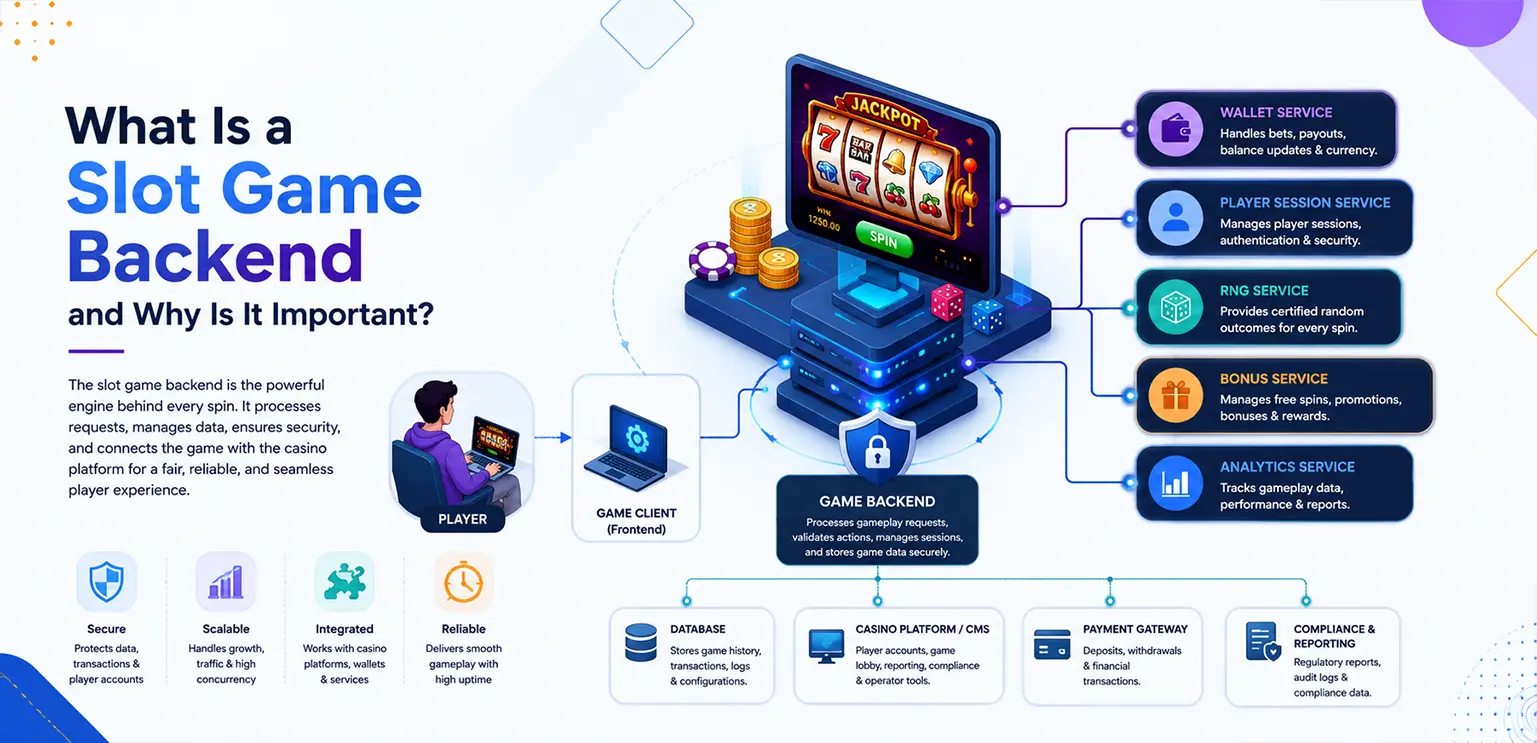
The backend is the operational engine of an online slot game. It manages communication between the game and the casino platform, validates gameplay requests, processes transactions, stores important game data, and helps ensure that every spin is handled correctly. Without a backend, an online slot would be little more than a visual animation with no secure way to process bets, calculate outcomes, or record player activity.
For casino operators, the backend is just as important as the game itself. It affects platform stability, scalability, security, regulatory compliance, and the overall player experience. A poorly designed backend can lead to interrupted gameplay, failed transactions, integration challenges, and increased operational risks.
For game developers, the backend forms the foundation that supports the frontend experience. While players interact with reels and symbols, the backend works continuously in the background to keep every session running smoothly.
In this guide, we'll explain what a slot game backend is, how it works, why it matters, and which components make it an essential part of modern online casino game development.
What Is a Slot Game Backend?
A slot game backend is the server-side system responsible for managing the technical operations that players do not see during gameplay. Unlike the frontend, which focuses on visuals and player interaction, the backend processes requests, communicates with external systems, manages game sessions, and ensures that gameplay remains secure and reliable.
Whenever a player performs an action—such as opening the game, placing a bet, spinning the reels, or collecting winnings—the frontend sends a request to the backend. The backend processes that request, communicates with the necessary services, and returns the appropriate response to the game.
Depending on the game architecture, the backend may also communicate with:
- Casino management systems
- Player account services
- Wallet and payment systems
- Random Number Generator (RNG) services
- Game history databases
- Bonus and promotion engines
- Analytics platforms
- Regulatory reporting systems
Although players rarely notice these processes, they occur within seconds and are essential for delivering a smooth gaming experience.
Frontend vs Backend: What's the Difference?
Many people new to game development confuse the frontend with the backend because both work together to deliver the final product. However, they serve very different purposes.
| Frontend | Backend |
|---|---|
| Displays graphics, UI, reels, animations, and sound. | Processes game logic, communication, transactions, and server operations. |
| Runs inside the player's browser or application. | Runs on secure servers or cloud infrastructure. |
| Handles user interaction. | Handles business logic and data processing. |
| Focuses on visual experience. | Focuses on reliability, security, and platform integration. |
A simple way to think about it is this: the frontend is what players experience, while the backend is what makes that experience possible. Both are equally important, and neither can deliver a complete online slot game on its own.
Why Every Online Slot Game Needs a Backend
Unlike land-based slot machines that operate as standalone systems, online slot games constantly communicate with external platforms and services. Every player action generates information that needs to be processed securely and accurately.
The backend is responsible for managing these interactions. Some of its key responsibilities include:
- Managing player sessions: The backend verifies when players enter or leave a game and helps maintain a secure gameplay session throughout their activity.
- Processing gameplay requests: Every bet, spin, feature activation, or game action is validated before the appropriate response is returned.
- Communicating with casino platforms: Online slots exchange information with operator systems to ensure wagers, balances, and gameplay remain synchronized.
- Recording gameplay data: Important events such as bets, wins, game rounds, and session activity are stored for reporting, auditing, and customer support.
- Supporting regulatory compliance: Backend systems help maintain records and operational processes required in regulated gaming markets.
Without these capabilities, online casino games could not operate reliably in a real-money environment.
How Does a Slot Game Backend Work?
Although backend architecture varies between development studios, the overall workflow follows a similar pattern. Imagine a player opening an online slot game and pressing the Spin button. Behind the scenes, several operations happen almost instantly:
- The player submits a gameplay action through the frontend.
- The frontend securely sends the request to the backend.
- The backend validates the request and confirms that the session is active.
- The backend communicates with the required services, such as wallet systems, RNG services, or platform APIs.
- The game outcome is processed according to the game's certified logic.
- The backend records the game round and updates relevant systems.
- The result is returned to the frontend.
- The frontend displays the reel animation, winning combinations, and updated balance.
Although players see only the spinning reels, multiple backend processes are working together to complete each game round securely.
Core Components of a Slot Game Backend
Modern backend systems consist of several interconnected services rather than a single application. Each component has a specific responsibility within the overall architecture.
🔹 Game Server
The game server acts as the central controller of the backend. Its responsibilities typically include:
- Receiving gameplay requests: Every player action is received, validated, and processed before the game continues.
- Managing game sessions: The server keeps track of active sessions and ensures that gameplay remains consistent.
- Coordinating backend services: Different backend components work together through the game server to complete each game round.
The game server is often considered the heart of the backend architecture.
🔹 Player Session Management
Every player who launches a slot game creates an active session. Session management helps ensure that gameplay remains secure, stable, and uninterrupted throughout that session.
Typical responsibilities include:
- Authenticating player access.
- Tracking active gameplay sessions.
- Handling reconnects if a player loses connection.
- Managing session expiration securely.
- Preventing duplicate or conflicting sessions.
Reliable session management contributes directly to a smoother player experience.
🔹 Wallet Integration
Real-money casino games constantly exchange information with wallet systems. Whenever players place bets or receive winnings, the backend communicates with the operator's wallet service to update balances accurately.
Wallet integration generally handles:
- Bet deductions.
- Win payouts.
- Balance synchronization.
- Currency management.
- Transaction verification.
Because financial data is involved, wallet communication must be fast, reliable, and secure.
🔹 Database Management
Online slot games generate large amounts of operational data. Backend databases help organize and store this information for future use.
Common examples include:
- Player session records.
- Gameplay history.
- Bet and win transactions.
- Configuration settings.
- Game statistics.
- Error logs.
- Audit records.
Proper database management improves reporting, troubleshooting, customer support, and regulatory compliance.
🔹 API Layer
Modern online casino platforms rely heavily on APIs (Application Programming Interfaces). The API layer allows the backend to communicate efficiently with external systems.
These integrations may include:
- Casino operator platforms.
- Wallet providers.
- Tournament systems.
- Bonus management services.
- Analytics platforms.
- Authentication services.
- Responsible gaming tools.
A well-designed API layer makes backend systems more flexible and easier to integrate across multiple casino platforms.
Why Backend Architecture Matters
As online casino platforms grow, backend systems must support increasing numbers of players, transactions, and game sessions without sacrificing performance.
A strong backend architecture helps development teams:
- Maintain high availability: Reliable infrastructure reduces downtime and keeps games accessible during peak traffic.
- Improve scalability: Backend services can support growing player numbers without major architectural changes.
- Strengthen security: Secure communication helps protect player accounts, gameplay data, and financial transactions.
- Simplify maintenance: Well-structured backend services are easier to update, monitor, and troubleshoot.
- Support future growth: Modular architecture allows new features and integrations to be added with minimal disruption.
For modern online slot games, backend quality directly influences both technical performance and business success.
RNG and the Slot Game Backend
One of the most common misconceptions is that the backend itself decides whether a player wins or loses. In reality, the backend's role is to manage and validate the game flow, while the game outcome is generated according to the certified game logic and Random Number Generator (RNG).
When a player starts a spin, the backend coordinates the process by securely handling the request and communicating with the required game services. Once the outcome is generated according to the game's certified logic, the backend verifies the response, records the transaction, updates the player's balance, and returns the result to the frontend.
Rather than determining outcomes, the backend ensures that every game round is processed securely, consistently, and according to the game's approved implementation.
Security: One of the Backend's Biggest Responsibilities
Online slot games process sensitive information every second. Player accounts, wagers, balances, promotional rewards, and gameplay history all pass through the backend. A secure backend helps protect this information from unauthorized access and operational risks.
Some important security responsibilities include:
- Secure communication: Data exchanged between the game, casino platform, and backend should be protected during transmission to reduce the risk of interception.
- Player authentication: Backend systems verify that only authorized players can access active game sessions.
- Transaction validation: Every wager and payout is checked before being recorded, helping maintain accurate financial records.
- Session protection: Secure session management reduces the likelihood of interrupted gameplay or unauthorized access.
- Audit logging: Recording important backend events makes troubleshooting, compliance reviews, and investigations much easier.
Security isn't a single feature—it's an ongoing process built into every layer of the backend architecture.
Backend Scalability: Preparing for Growth
A slot game may initially launch with a small player base, but after being released on multiple casino platforms, successful titles mostly experience rapid growth. If the backend cannot handle increased traffic, players may experience slow loading times, failed game rounds, or unexpected disconnections.
Scalable backend architecture allows developers to support growth without redesigning the entire system. Some key advantages include:
- Handling higher player volumes: Infrastructure can support increasing numbers of simultaneous users while maintaining stable performance.
- Managing traffic spikes: Promotional campaigns, new releases, or jackpot events often generate temporary surges in player activity.
- Supporting multiple operators: Many game providers distribute the same title across several casino platforms, increasing backend demand.
- Reducing downtime: Scalable systems help maintain service availability even during periods of heavy usage.
Planning for scalability early in development is often more efficient than trying to solve performance problems after launch.
Cloud Infrastructure in Modern Slot Games
Most modern online casino games rely on cloud-based infrastructure rather than traditional physical servers. Cloud platforms provide greater flexibility, allowing developers to adjust computing resources as player demand changes.
Cloud infrastructure offers several practical benefits:
- Flexible resource allocation: Computing capacity can be increased or reduced depending on player activity.
- Improved availability: Services can continue operating even if individual servers experience issues.
- Faster deployment: New backend updates can often be released more efficiently using cloud-based workflows.
- Global accessibility: Cloud infrastructure helps support players across multiple regions with improved reliability.
For studios serving international operators, cloud technology has become an important part of delivering consistent game performance.
Platform Integration: Connecting Games to Casino Systems
A slot game rarely operates in isolation. It usually communicates with numerous external systems that help manage the overall casino experience. The backend acts as the communication bridge between the game and these services.
Typical integrations include:
- Casino management platforms: Exchange gameplay information, player sessions, and operational data.
- Wallet systems: Process bets, payouts, and balance updates securely.
- Bonus engines: Apply free spins, promotional rewards, and loyalty incentives where applicable.
- Tournament platforms: Track eligible gameplay for leaderboard competitions and promotional events.
- Responsible gaming tools: Support features such as betting limits, session controls, or self-exclusion requirements.
Well-designed integrations improve operational efficiency while helping operators deliver a seamless player experience.
Supporting Progressive and Multiplayer Jackpots
Progressive jackpots introduce additional backend complexity because prize pools are often shared across many players or even multiple casino platforms.
The backend helps coordinate these systems by:
- Tracking jackpot contributions: A small portion of qualifying wagers is added to the shared jackpot pool.
- Monitoring jackpot values: Current prize amounts are updated and synchronized across participating games.
- Validating jackpot triggers: Special winning events are verified before jackpot payouts are processed.
- Recording jackpot transactions: Complete records support reporting, auditing, and financial reconciliation.
Accurate backend coordination is essential because progressive jackpot systems involve significant financial transactions and high player expectations.
Live Operations and Backend Management
Launching a slot game is only the beginning of its lifecycle. Once the game is live, the backend continues supporting daily operations. Development teams regularly monitor system performance, investigate issues, and deploy improvements without disrupting gameplay.
Common live operations include:
- Performance monitoring: Identifying slow responses, server issues, or unusual behavior before players are affected.
- Error management: Detecting technical problems quickly so they can be investigated and resolved.
- Software updates: Deploying backend improvements while minimizing service interruptions.
- Operational reporting: Reviewing system performance, gameplay statistics, and technical health.
Strong live operations contribute to a stable gaming experience long after release.
Monitoring and Analytics
Backend systems generate valuable operational data that helps developers and operators understand how games are performing. Unlike marketing analytics, backend monitoring focuses on the technical health of the game and its supporting services.
Useful metrics include:
- Server response times: Measuring how quickly gameplay requests are processed.
- Session activity: Monitoring concurrent players and session stability.
- Transaction success rates: Ensuring wagers and payouts are processed reliably.
- System availability: Tracking uptime and identifying potential infrastructure issues.
- Error frequency: Detecting recurring technical problems before they affect larger numbers of players.
These insights support continuous improvement throughout the game's lifecycle.
Common Backend Challenges
Even experienced development teams encounter backend challenges during production and live operations. Understanding these risks helps studios build more reliable systems.
🔹 Managing High Traffic
Sudden increases in player activity can overload backend services if capacity planning is inadequate. Scalable infrastructure helps reduce this risk.
🔹 Complex Platform Integrations
Different casino operators often use different APIs and technical requirements. Flexible backend architecture makes supporting multiple integrations much easier.
🔹 Maintaining Data Consistency
Financial transactions, gameplay records, and player balances must remain synchronized across multiple systems. Careful validation helps prevent inconsistencies.
🔹 Reducing Latency
Players expect game rounds to complete quickly. Optimizing backend communication improves responsiveness without sacrificing reliability.
🔹 Supporting Regulatory Requirements
Different jurisdictions require different reporting, operational, and technical standards. Backend architecture should be designed with compliance in mind rather than treating it as an afterthought.
Best Practices for Building a Reliable Slot Game Backend
Successful backend systems are built around long-term reliability rather than short-term functionality.
Some recommended practices include:
- Design modular services. Separating backend responsibilities makes systems easier to maintain, update, and scale.
- Plan for future growth. Building scalable infrastructure from the beginning reduces future redevelopment costs.
- Prioritize security throughout development. Security should be integrated into every backend component rather than added later.
- Validate integrations thoroughly. Reliable communication between the game and external platforms improves operational stability.
- Monitor continuously after launch. Ongoing monitoring helps identify issues before they affect players.
A well-designed backend supports not only today's requirements but also future expansion as games grow across new markets and platforms.
Why Backend Quality Directly Impacts Business Success
For many casino operators, backend infrastructure remains invisible until something goes wrong. A game may have exceptional graphics, engaging gameplay, and exciting bonus features, but if the backend struggles to process requests or integrate with the casino platform, the overall player experience quickly suffers.
A reliable backend is more than a technical requirement—it is a business asset. It helps operators deliver stable gameplay, reduce operational risks, and support long-term platform growth.
Some of the key business benefits include:
- Improved player satisfaction: Stable gameplay, fast response times, and uninterrupted sessions contribute to a smoother gaming experience, encouraging players to return.
- Reduced operational issues: A well-designed backend minimizes failed transactions, synchronization errors, and unexpected downtime, reducing support requests and maintenance costs.
- Faster operator integrations: Standardized APIs and modular architecture simplify the process of connecting games to multiple casino platforms, accelerating market expansion.
- Better scalability: As player numbers grow, scalable backend systems allow operators to expand without major infrastructure changes.
- Greater confidence in regulated markets: Well-structured backend systems support the technical processes required for auditing, compliance, and certification.
For operators, backend quality directly influences platform reliability, player trust, and long-term business performance.
Slot Game Backend vs Game Server vs Casino Management System (CMS)
These three terms are often used interchangeably, but they represent different parts of the overall iGaming ecosystem. Understanding the distinction helps operators communicate more effectively with game providers and development teams.
| Component | Primary Responsibility |
|---|---|
| Slot Game Backend | Manages server-side game operations, integrations, transactions, and communication between the game and external services. |
| Game Server | Executes gameplay requests, manages active sessions, and coordinates communication between backend services. It is one component of the backend. |
| Casino Management System (CMS) | Allows operators to manage players, games, promotions, reporting, payments, responsible gaming tools, and business operations across the entire casino platform. |
A simple way to understand the relationship is:
- The player interacts with the frontend.
- The frontend communicates with the backend.
- The backend uses the game server to process gameplay.
- The backend exchanges information with the casino management system to keep player accounts, balances, and platform services synchronized.
Each component has a different responsibility, but they work together to deliver a seamless gaming experience.
Future Trends in Slot Game Backend Development
As online casino technology continues to evolve, backend architecture is becoming more flexible, scalable, and intelligent. Several trends are shaping the future of backend development.
🔹 Cloud-Native Architecture
More studios are building backend systems specifically for cloud environments rather than adapting traditional server applications. Cloud-native architecture improves scalability, deployment speed, and service reliability.
🔹 Microservices
Instead of developing one large backend application, many studios now divide functionality into smaller independent services. For example:
- Wallet Service
- Player Session Service
- Bonus Service
- Reporting Service
- Tournament Service
- Analytics Service
This approach makes updates easier and reduces the impact of individual service failures.
🔹 API-First Development
Modern game providers increasingly design backend services around standardized APIs. This simplifies:
- Operator integrations.
- Third-party service connections.
- Future platform expansion.
- Multi-market deployment.
API-first architecture also improves long-term maintainability.
🔹 AI-Assisted Monitoring
Artificial intelligence is beginning to support backend operations by analyzing system logs and performance metrics. AI can help development teams:
- Detect unusual traffic patterns.
- Identify recurring technical issues.
- Predict potential infrastructure bottlenecks.
- Improve operational monitoring.
While AI does not replace engineers, it can help teams respond more quickly to operational challenges.
🔹 Stronger Security Practices
As online gaming platforms continue to grow, backend security is becoming increasingly important. Studios are investing more heavily in:
- Secure authentication.
- Advanced monitoring.
- Data protection.
- Automated threat detection.
- Continuous security testing.
Security is expected to remain a major focus for future backend development.
How Gamix Labs Builds Reliable Slot Game Backends
At Gamix Labs, backend development is approached with the same level of attention as game design and frontend production. The goal is to build backend systems that are secure, scalable, and ready to support modern online casino platforms.
The development process focuses on creating infrastructure that allows games to perform reliably from launch through long-term live operations.
Key areas of focus include:
- Scalable architecture: Backend services are designed to support growing player numbers and multi-operator deployments without compromising performance.
- API-driven integrations: Standardized APIs simplify communication with casino platforms, wallet providers, promotional systems, and other third-party services.
- Reliable transaction handling: Backend workflows are designed to process financial transactions accurately and consistently alongside gameplay requests.
- Simulation and quality assurance: Backend functionality is thoroughly tested alongside gameplay systems to identify issues before release.
- Production-ready deployment: Development emphasizes stability, maintainability, and operational readiness to support long-term success in regulated gaming environments.
By combining structured backend engineering with game development expertise, Gamix Labs helps clients deliver slot games that perform reliably across a wide range of casino platforms.
Conclusion
The backend is one of the most important yet least visible components of an online slot game. While players interact with reels, symbols, and bonus features, the backend quietly manages sessions, validates gameplay, processes transactions, stores data, and communicates with the wider casino ecosystem.
Without a reliable backend, even the most visually impressive slot game can experience operational issues that negatively affect both players and operators. Stable infrastructure supports smooth gameplay, secure transactions, efficient integrations, and scalable growth as player demand increases.
For casino operators, understanding backend architecture leads to better conversations with game providers and more informed technology decisions. Looking beyond graphics and gameplay helps operators evaluate whether a game is built to perform reliably in real-world environments.
For developers, backend quality is just as important as frontend polish. Careful planning, modular architecture, secure integrations, and continuous monitoring help create games that remain stable throughout their entire lifecycle.
As the online casino industry continues to evolve, backend systems will play an even greater role in supporting innovation, scalability, and long-term platform success. Studios that invest in modern backend architecture today will be better prepared to meet the demands of tomorrow's gaming ecosystem.
Frequently Asked Questions
What is a slot game backend?
A slot game backend is the server-side infrastructure that manages game sessions, processes gameplay requests, communicates with casino platforms, records transactions, and supports the technical operations behind an online slot game.
Is the backend the same as the game server?
No. The game server is one component of the backend. The backend also includes APIs, databases, wallet integrations, session management, analytics, and other supporting services.
Why is a backend necessary for online slot games?
Online slot games must communicate with casino platforms, process wagers, update player balances, maintain session data, and support secure gameplay. These responsibilities are handled by the backend.
Does the backend generate random game outcomes?
No. The backend manages communication and processing, while game outcomes are generated according to the game's certified logic and Random Number Generator (RNG) implementation.
Can a slot game work without a backend?
Simple offline demonstration games may not require a backend. However, real-money online casino games rely on backend systems to process gameplay, manage transactions, and communicate with operator platforms.
Why is backend scalability important?
Scalable backend systems help games support increasing numbers of players, reduce downtime during peak traffic, and simplify expansion across multiple casino operators and markets.